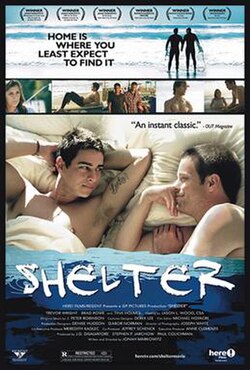
Shelter-2007
Director Jonah Markowitz
Starring Trevor Wright, Brad Rowe
Scott’s Review #758
Reviewed May 16, 2018
Grade: B+
By the mid-2000s, independent LGBT films were coming fast and furious as the genre was still relatively new and ripe for the picking with good ideas.
With Shelter (2007), we have a sweet film that focuses on the new romance between two young men, one of whom is coming to terms with his sexuality.
The lead characters are not gay stereotypes and could easily pass for straight men, a characteristic impressive in LGBT films- and other mainstream films for that matter.
Rather than focusing on the discrimination the characters may face or on obstacles from other characters (family and friends), the film wisely makes the story a character study of the demons one man wrestles with while “coming out”.
The small film is written intelligently, save for one supporting character’s plot-driven decision.
Also, in the modern age, we are beginning to see a bevy of similarly themed films emerge from the LGBT community, and Shelter offers nothing we have not seen before.
Set in sunny southern California, our main protagonist is Zach (Trevor Wright), an aspiring artist in his early twenties.
The ultimate “good guy,” he is popular with friends and girls and frequently babysits his five-year-old nephew Cody while his sister parties and has one-night stands.
When Zach meets his best friend’s older brother, Shaun (Brad Rowe), the pair fall in love as Zach wrestles with his sexuality and conflicts with his plans.
Zach’s sexual and family struggles are the main themes of the film.
Shelter (not sure I get the title’s meaning) is a solid slice-of-life story.
Zach initially dates a pretty girl, Tori, who is blonde, wholesome, and a girl-next-door type. This is done intentionally to show that Tori is a girl any young straight man would be interested in.
We never see Zach show interest in any men other than Shaun, so the film leans towards a solid romantic drama once the fellas get together.
Still, we see Zach’s internal struggles and his acceptance of himself for who he is play out.
Actor Wright and director Jonah Markowitz capture this successfully.
Shaun, arguably second fiddle to Zach, is a character that I feel is very well written. Avoiding negative stereotypes, Shaun is handsome, masculine, and charismatic.
Completely confident and exuding great poise, he is a character that any gay male should look up to. He is openly gay yet “one of the guys” as he should be.
He immediately connects with Cody, becoming a father or a cool surrogate-uncle figure for the lad. A quick concern of Zach’s sister, Jeanne, about having the boy around a gay man is trivialized in a quick form.
Another positive aspect of the film is the multiple scenes that show Zach, Shaun, and Cody as a happy family, and how normal that is. Examples of this are frolicking around the beach, playing football, or engaging in horseplay.
A quiet dinner of barbecue steaks and red wine for the men and macaroni and cheese for Cody elicits images of a connected family unit, despite some in society still poo-pooing this idea.
The film presents the connectivity as normal.
A tiny flaw in the character of Jeanne shows her willingness (almost eagerness) to leave Cody (and her ailing father) behind when she decides to take off to Oregon with her brand new boyfriend. This point seems rushed and out of character.
While a party girl with a crappy job at a grocery store, Jeanne exhibited heart and was portrayed as sympathetic and caring throughout the film. Surprisingly and unrealistically to me is that she would give up her life.
A paltry excuse of “Oregon not allowing kids” was left unclear and unexplained.
A part coming-of-age story, part coming-out story, Shelter (2007) is an example of a little film that could with an appreciation of independent cinema.
The film tells a nice story about one man’s journey of self-discovery and the people he surrounds himself with. With impressive California oceanfront and working-class principles as a backdrop, the film has a calming texture and weaves a solid viewing experience.