Legally Blonde-2001
Director Robert Luketic
Starring Reese Witherspoon, Luke Wilson
Scott’s Review #807
Reviewed August 30, 2018
Grade: B+
Legally Blonde (2001) is a film that, by all accounts, should have been a hot mess, but for some reason is a great ball of fun.
High art it ain’t by any means, and the plot is implausible beyond belief, and suspension of disbelief must be securely tucked away.
Despite portraying more serious roles before and after this film, Reese Witherspoon is largely responsible for the film’s success and is closely associated with it.
Quite simply, all the elements align perfectly in this film.
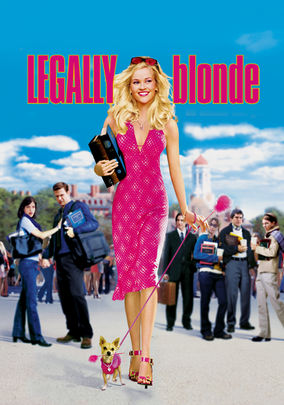
Elle Woods (Witherspoon) is the president of her sorority at a Los Angeles college. Clad in fluffy pink attire and carrying her cute dog everywhere she goes, she epitomizes the stereotypical “dumb blonde”.
However, she does carry a 4.0 grade point average in fashion.
Expecting a marriage proposal from her upper-class, snooty boyfriend, Warner, Elle instead finds herself dumped due to not being serious enough.
Determined to prove herself worthy, she manages acceptance into Harvard Law School, along with Warner, and embarks on hijinks and adventures.
Warner’s fiancée and a potential new love interest cause turmoil for the boisterous Elle.
Legally Blonde never takes itself too seriously and is simply a fun, silly-minded, comic adventure.
Audiences will likely chuckle and smile along with Elle on her adventures as she gets into one pickle after another, always determined to prove her intelligence.
To be clear, the film itself is very formulaic and could easily have been trivial and uninspired, resulting in a bomb. But Witherspoon shines in the lead role, adding a likable, charming quality to the character.
The actress possesses great wit and comic timing, so that her character becomes more of a champion, and we root for her to overcome obstacles and succeed.
By miles, she is the standout in the film.
Suspension of disbelief is at an all-time high. In “real life,” there is no way Elle would ever get into the elitist Ivy League school, brandishing a pink resume or other silly tricks to be cute and appealing.
Nor would she ever likely be so instrumental in winning a murder case so quickly. To nobody’s surprise, Elle eventually graduates with flying colors and is honored to give a graduation speech, inspiring those around her.
But as implausible as these situations are, they are also Legally Blonde’s appeal.
The supporting characters are pure caricatures, especially the main foils (Warner and Vivian- who take Elle’s place as fiancée). Both are villains, Vivian going so far as to embarrass Elle by inviting her to a stuffy party under the guise that it was a costume party.
In the end, one of the characters “turns good”, another common element of predictable films of this nature. But again, the film is just pure and simple fun, so these stereotypes are okay.
In more modern times (not that 2001 was so long ago), the film would not have been directed by a man, but rather by a woman.
Screenwriters Kirsten Smith and Karen McCullah Lutz prepared a female-driven film that was based on a novel by Amanda Brown.
Why a man was chosen to direct is beyond me, but, alas, this is the way things were at the time.
Interestingly, another recent film I reviewed, My Big Fat Greek Wedding (2002), would work perfectly as a retro romantic-comedy double feature with Legally Blonde (2001).
Both are fun and light, but also celebrate strong female characters.
Legally Blonde borrows heavily from the 1995 brilliant, similar-genre film Clueless, but is not as great as that film. Still, the film is an inspired effort, largely due to the charms of its lead star.