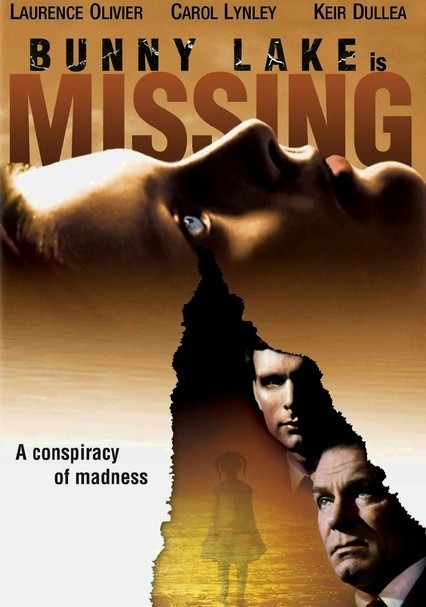
Bunny Lake Is Missing-1965
Director Otto Preminger
Starring Keir Dullea, Carol Lynley
Scott’s Review #877
Reviewed March 13, 2019
Grade: A-
Bunny Lake Is Missing (1965) is a taut psychological thriller that feels fresh and unpredictable, with a mysterious, almost haunting quality throughout.
The film focuses on one big question: Is the main character’s interpretation of events real or imagined? The uncertainty makes the film intriguing to watch.
Glimpses of London locales also make for fun viewing, as the chaotic, creepy children’s school is the film’s primary setting.
Though not well remembered, the film is still worth a watch.
Ann (Carol Lynley) is a single mother recently transplanted to London with her well-kept brother Stephen (Keir Dullea).
When she hurriedly drops off her unseen daughter, Bunny, at her new preschool and instructs the school cook to watch her, the girl soon disappears.
When the police investigate, they find no one on staff saw the young girl.
The plot thickens when it is revealed that all of Bunny’s belongings have been removed from Ann’s residence and that Ann had an imaginary childhood friend also named Bunny.
Has Ann concocted the entire scheme herself for attention, or could she be harmful or psychotic?
The film offers several subtle nuances that either work or don’t. The opening credits are a lesson in cinematic creativity, with the words appearing as slivers of paper torn down the middle.
Though the musical score during this sequence is not necessarily eerie, its complexity and ferocity create an ominous and intriguing element.
This point is a wise move because it sets the tone for such a thriller as the film presents itself.
Otto Preminger’s black-and-white style is upbeat, enhancing the picture’s overall look. The muted tones evoke an effective ghost-story style with an ambivalent, chilling technique.
As the mystery is ultimately resolved, the introduction of new and peculiar characters offsets the tangled plot, while the film’s look remains constant.
Wilson (Noël Coward), Ann’s landlord, and Ada Ford, played by Martita Hunt, the retired schoolmistress who lives in the attic, do wonders for adding creepiness.
But are they meant to be red herrings or keys to the big reveal?
A few gripes: incorporating the English rock band The Zombies serves little purpose, and the addition is perplexing. I’m not opposed to the band’s music, but the songs have nothing to do with the plot.
Seen on television during a pub scene and later heard on a janitor’s radio during an escape scene, the odd placement seems little more than a marketing tool: product placement.
Another miss is with the casting of Sir Laurence Olivier as Superintendent Newhouse. His talents are wasted mainly with little more than a throwaway role despite arguably being considered the lead.
As the straight man handling the investigation, his performance is adequate but limited, especially given his Shakespearean stage actor talents. His performance feels phoned in and beneath the actor’s stature.
The other roles are well-cast, especially Lynley and Dullea in key parts.
For the film’s first portion, I assumed the pair were husband and wife until it was revealed otherwise, which is a lovely, unexpected nuance.
Their chemistry is sweet and easy, and both perform their respective roles with poise and charisma.
1965, both were relatively novice young actors on the brink of stardom, though sadly short-lived. Their acting chops are firmly in place with this film, which is fun to witness.
For fans of psychological thrillers with an implied ghost story in its clutches, Bunny Lake Is Missing (1965) is worthy, mysterious entertainment with a surprise ending.
The film is stellar; it has few weaknesses, is a true classic, and feels like a brilliant Twilight Zone-inspired episode.