Tag Archives: Ingrid Bisu

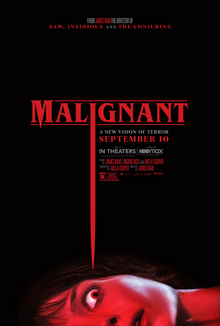
Malignant-2021

Malignant-2021

Director James Wan

Starring Annabelle Wallis, George Young

Scott’s Review #1,294
Reviewed August 30, 2022

Grade: B

James Wan is a fantastic director responsible for co-creating the Saw (2003-2017) and Insidious (2010-2018) franchises.

Anyone familiar with those films will likely enjoy Malignant (2021), as it borrows from them and incorporates elements reminiscent of those films.

In particular, it taps into supernatural elements of Insidious and the mood and score from Saw. Malignant even copies the gruff and robotic phone caller’s voice that was Jigsaw’s trademark and used in Saw.

It’s not as threatening, but it brings back those memories.

The result of Malignant is mixed, with a mostly positive outcome. It’s not one bit scary like Insidious was, but not gratuitously gory like the Saw films, though it has its moments of butchery.

Though utterly ridiculous, the conclusion of Malignant contains a terrific twist and a weird supernatural CGI contortionist choreography extravaganza that somehow reminded me of The Matrix (1999).

The storyline twist must have been influenced by Sisters (1973), an early effort by director Brian DePalma. It may seem silly, but somehow it’s my favorite part of the film.

Wan reaches into his magical bag of tricks and pulls out some wins. He also demands suspension of disbelief, which is okay in supernatural horror films, but many points of the story do not add up.

Malignant begins in 1993 when Dr. Florence Weaver (Jacqueline MacKenzie) and her colleagues treat a violent, disturbed patient named Gabriel at Simion Research Hospital. Gabriel can control electricity and broadcast his thoughts via speakers. He kills several staff members, but Weaver survives and deems him untreatable.

Years later, Madison Lake (Annabelle Wallis) becomes paralyzed by fear from shocking visions. She slowly realizes that when a murder victim dies, she is in the room with them, witnessing their gruesome death.

Gabriel is on the loose and intent on killing Dr. Weaver and her colleagues for calling him cancer, and Madison is somehow involved.  She and her sister, Sydney (Maddie Hasson), must work alongside the police to get to the bottom of the mystery.

Malignant does well with the mood and tone of the filming. It has a dark grey quality plentiful in modern horror films, and fans of Insidious and Saw will enjoy this familiar style of filmmaking. It’s set in Seattle, which is a wise choice, though all we get are some aerial views of the city, specifically the Space Needle.

Because Wan directs it, it’s professional and contains the horror elements to be expected. There’s even a giant window fan that I swear I’ve seen in a Saw film. Wan knows what he is doing, and the name recognition alone was enough to get me to see the movie.

It’s not an ‘A’, but it does what a modern horror film is supposed to do, and that’s to entertain. Malignant is not groundbreaking, but it sounds good.

The plot holes are not worth dissecting beyond asking why there are no other patients in a large city hospital —a device that has existed since at least Halloween II in 1981 —but that’s just the beginning.

Malignant annoyed me when it decided to add some humor.

A sidekick character, Detective Regina Moss (Michole Briana White), bears an uncanny resemblance to the funny lady Wanda Sykes. Unfortunately, her one-liners feel thrown in for kicks, and a blossoming romance between Sydney and Detective Kokoa (George Young) goes nowhere.

During these scenes, I felt like I was watching Chicago Med or Chicago Fire or any one of those other generic network television shows.

Fortunately, the scenes were brief, and Wan returned to the point of the film- blood, killing, and chaos.

Lead actress Wallis is a fine casting choice. Pretty but relatable, she carries the film as the victim, especially as more of her backstory is revealed.

Films like Malignant (2021) require putting the brakes on any deep analysis and merely going along for the ride. It’s entertaining and that’s good enough for me. With Wan at the helm, I anticipated a particular type of horror film and was ultimately satisfied with what I was served.
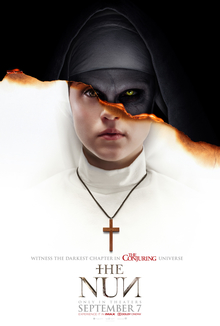

The Nun-2018

The Nun-2018

Director Corin Hardy

Starring Taissa Farmiga

Scott’s Review #812

Reviewed September 19, 2018

Grade: B-

A film such as The Nun (2018) is best described as a genre horror film strong on atmosphere, scares, and effects but weak on story, dialogue, or satisfyingly integrating much of the other films.

To stress, the set pieces and foreboding convent where most events occur are tremendously thought out, adding to the stylistic filming; however, the story stinks, making the overall result barely above mediocre.

This story point, which is said to be connected to The Conjuring (2013) and Annabelle (2014), is all but laughable.

Theoretically, The Nun is a prequel, but since the film is set in 1952, the only connection is a super-quick scene in later years. Ed and Lorraine Warren use a character in The Nun as a case study for their audiences.

Admittedly, I have not seen The Conjuring 2 (2016), but from what I can surmise, what remains of The Nun is a stand-alone film. Was the demonic nun in The Conjuring 2? This may make more sense.

The creepy setting in Romania is a superb choice, given its association with Transylvania and Dracula. The film begins with the suicide of a Roman Catholic nun in a gloomy and largely abandoned Monastery.

Having been visited by an unseen force who kills another nun, a vicious demon appearing in the form of a nun looks on menacingly. Father Burke (Demian Bichir) from the Vatican arrives with Sister Irene (Taissa Farmiga) to investigate, where they meet flirtatious local, Frenchie (Jonas Bloquet).

The atmosphere used throughout almost the entirety of the film is spot on and highly effective.

Most of the scenes are set at nighttime (naturally!) and in or around the vicinity of the spooky, gothic monastery. To double, a gorgeous castle in Romania was used. From the dark and narrow hallways to the crucifixes and obvious religious decor, the props and set design shine through.

The best scenes occur within the grounds of the statuesque building, where dozens of graves can be seen. When bells from the graves begin to ring on their own and spirits can be seen lurking, the audience is in for a good scare.

Even the scenes in daylight hours are fraught with creepy tension. When Frenchy comes upon the nun, dead for days, she dangles from the monastery, eyes gouged and covered with feasting crows, as her blood drips onto the front porch.

The camera close-up of the shot is highly effective, as are others involving the typical jolts and creaky floors that have become a cliche in horror films, but somehow feel fresh and invigorating in The Nun.

And the demonic nun, a grimacing Marilyn Manson-type ghoulish figure, is downright scary.

Unfortunately, along with praise must come some criticisms. The story and the logic do not make much sense, and I stopped trying to figure out the plot points halfway through.

Why the Father and Sister are chosen to go alone to investigate is implausible. A silly, brief mention of a Duke in the old days, evoking a curse in the monastery that was “conjured” up during World War II and must be contained again, is hardly a compelling story.

The plot-driven device (and frankly done to death at this point) attempt to forge a romantic connection between Irene and Frenchy never works. How many times in film have we seen a handsome, young man trying to woo a pretty nun away from her calling?

Filmmakers may have added this for humor, and (hopefully) the characters’ intentional or unintentional religious exclamations of “Oh My God!” or “Mother of God!” are laugh-out-loud silly. With a film like The Nun (2018), riveting writing is not on the wish list- great atmosphere and effects are.

The film delivers excellent content and makes for an enjoyable experience with good thrills and scares. Thankfully, for the horror genre, the film is rated a solid “R” and not watered down for PG-13 audiences.

Just be prepared for some hokey writing.

Toni Erdmann-2016

Toni Erdmann-2016

Director Maren Ade

Starring Peter Simonischek, Sandra Hüller

Scott’s Review #686

Reviewed October 1, 2017

Grade: A-

Reaping a slew of award nominations in 2017, mainly in the Foreign Language film categories, Toni Erdmann is a unique film I must champion for its imagination and humanistic perspective alone.

It can be watched in segments—almost a miniseries—at two hours and forty-two minutes.

Set in Bucharest, Romania, the film offers several exterior scenes of the bustling city and fascinating European culture.

However, the film is produced by Germany and Austria.

Winfried Conradi (Peter Simonischek) is a hippie-type man in his sixties. Divorced and working as a music teacher, his dog suddenly dies, resulting in his decision to reconnect with his corporate, power-hungry daughter, Ines (Sandra Hüller).

She is forging her career in business consulting and is currently on assignment in Bucharest.

Winfried insinuates himself into Ines’s busy life, even though she wants little to do with him or the petty practical jokes he keeps playing on her.

Gradually, involving a few hysterical antics and embarrassing situations, father and daughter reunite and forge the loving relationship they once shared.

Toni Erdmann is unusual because you never know what to expect or which direction it will take as you get to know and love the characters.

We know that Ines is a driven career woman, busy beyond belief, with no time for her father.

Yet, in all the scenes Ines and Winfried share, the fantastic, believable acting by the two leads (Simonischek/Hüller) shows an underlying love and appreciation for each other.

This chemistry made me root for the father-daughter reunion and reconnection.

When Winfried dons his garish wig and horrid false teeth and names himself “Toni Erdmann,” a series of hilarious scenes ensue. Winfried is noticed at essential corporate functions and dinners, and he follows Ines, too.

He also attends a ladies’ dinner with Ines and her friends and tells them he is in Bucharest for a funeral that a friend is having for his pet turtle.

Simonischek brings earnestness and dry wit to his character, making these scenes hilarious.

My favorite scene that will indeed be talked about for years to come is the “naked party” scene.

Not only is the scene comical, but it is also fraught with meaning, as it is a turning point for the character of Ines.

She hosts a team-building party for her birthday, but when it’s time to start, Ines cannot get her dress on, and her shoes don’t match.

Frustrated, with a guest already at the door, Ines strips naked and decides to turn the party into a naked team-building experience.

Some guests are disgusted and leave. Others reluctantly agree to strip nude. It is when Ines sheds her clothes and her stodgy, rigid persona and begins to appreciate and enjoy life again, thanks to her father.

Toni Erdmann is a unique and unpredictable film by a female director (Maren Ade) with an interesting and strong perspective on the female psyche.

She tells a thoughtful story about a damaged father and daughter, with characters you root for and a grounded sense of realism.

The film is a fun, laugh-out-loud romp that dips into drama, careful to stay playful and not get too overwrought.

I enjoyed it tremendously.

Oscar Nominations: Best Foreign Language Film

Independent Spirit Award Nominations: 1 win-Best International Film (won)