The Best Years of Our Lives-1946
Director William Wyler
Starring Frederic March, Dana Andrews
Top 250 Films #102
Scott’s Review #858
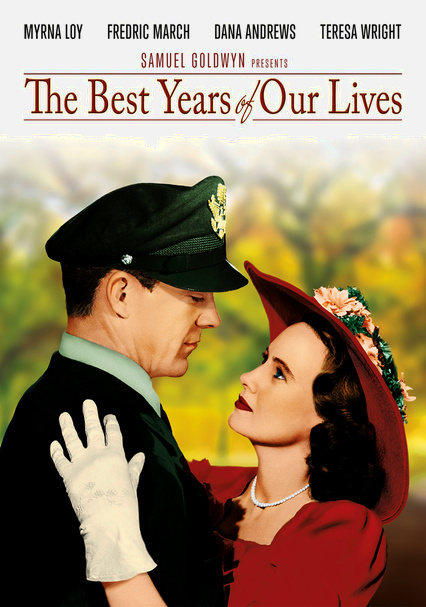
Reviewed January 20, 2019
Grade: A
Many films emerged during the 1940s that depicted the horrific events of World War II. The Best Years of Our Lives (1946) is the first film to focus on the war’s aftermath and the lasting psychological effects on soldiers and their loved ones.
The film may teeter on the edge of soap opera territory.
Still, it is powerful, dramatic, tender, and heartfelt, allowing its audience to experience the challenges faced by those who serve their country after leaving the military.
Director William Wyler, who also created the similarly themed Mrs. Miniver (1942), again explores the family drama genre. Still, the drama occurs this time in small-town America rather than outside London.
While Mrs. Miniver focuses on the ravages of the current war, he chooses to delve into its after-effects, which offer a broader range of situations and greater complexity.
The result is a more substantial and cerebral experience.
The story centers on three U.S. service members as they attempt to readjust to civilian life upon returning home from the battlefields of World War II. Homer (Harold Russell), Al (Frederic March), and Fred (Dana Andrews) all live in the same small town, Boone City, USA.
The men were acquaintances but did not serve together in the war, as each held a different rank and had other duties.
Al has the most going for him with a loving wife, Milly (Myrna Loy), two children, and a stable household. He is promoted to Vice President of a local bank, but despite this achievement, he is a heavy drinker and prone to anger.
He is enraged at the poor treatment of veterans trying to obtain bank loans and at the United States for hindering veterans’ attempts at rebuilding their lives.
His adult daughter, Peggy (Teresa Wright), is a prominent character as she begins a flirt with Fred.
Fred is unskilled and must return to his menial job as a drugstore soda jerk, much to the chagrin of his selfish wife, Marie (Virginia Mayo).
Homer lost both hands in the war and wore mechanical prosthetic hands, which made him insecure and troubled.
His days as a respected high school football quarterback have sadly come to an end, though he has unwavering support from his fiancée, Wilma (Cathy O’Donnell).
The trials and tribulations of many characters begin to mount as one character fights another over a dispute about the meaning of the war. Another character plots to ruin a marriage and embarks on a plan to rescue a character from another.
The plots risk being too daytime-drama-like, except that the underlying point about troubled veterans is always at the forefront, and their challenges are to be taken seriously.
A poignant moment is a crucial scene when one character admits that they have “given up the best years of my life,” a frustrated testimonial and proof that war can ravage not only the lives of the veterans but also of their loved ones.
Wyler does not hold back in conveying a clear message through the film. The viewer will undoubtedly ponder the title, “The Best Years of Our Lives,” and realize that it is open to different interpretations and does not have only a positive connotation.
The most powerful aspect of The Best Years of Our Lives is that the actor who played a military veteran, Harold Russell, was a disabled veteran.
This realism of a man portraying himself and the terrible effects the war had on him makes his character my favorite and highly empathetic.
His Academy Award wins for Best Supporting Actor are emotional and deserving, as he a won Best Picture and seven other awards.
Featuring a topic that gained prominence after World War II, The Best Years of Our Lives (1946) is a grand Hollywood film that embodies all the hallmarks of a classic drama.
Under the surface, the film is dripping with relevance, social commentary, and the psychological trauma that veterans face upon returning home, and how some are damaged beyond repair.
The rich American-style film remains a worthy watch, nearly a century after production wrapped.
Oscar Nominations: 7 wins-Best Motion Picture (won), Best Director-William Wyler (won), Best Actor-Fredric March (won), Best Supporting Actor- Harold Russell (won), Best Screenplay (won), Best Scoring of a Dramatic or Comedy Picture (won), Best Sound Recording, Best Film Editing (won)
Golden Globe Nominations: 2 wins-Best Picture (won), Special Achievement Award-Harold Russell (won)