Tag Archives: Linda Hayden

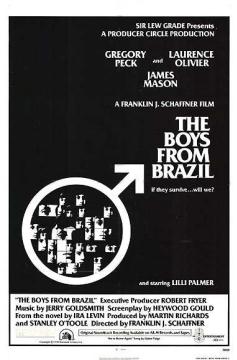
The Boys from Brazil-1978

The Boys from Brazil-1978

Director Franklin J. Schaffner

Starring Gregory Peck, Laurence Olivier, James Mason

Scott’s Review #1,391

Reviewed August 20, 2023

Grade: B+

The Boys from Brazil (1978) is a taut political thriller with a neo-Nazi focus and a weird cloning subject matter. It’s a bit of a tough follow, but quite compelling all the way through, and doesn’t lag at all.

Sometimes political thrillers get overly complicated or drag, but this one doesn’t. The story is slightly hokey and impractical, even bordering on ludicrous, but since it’s so intriguing and action-packed, these adjectives can be overlooked.

Surprisingly, I wasn’t blown away by either Laurence Olivier’s or Gregory Peck’s performance, despite being a fan of both actors. Both actors overact and create stereotypes, but especially Peck’s character is a bit too cartoonish.

It took me half the film even to recognize either man, since both are heavily made up, making them hard to tell apart. It also took until the dramatic conclusion for either character to grow on me truly.

A brilliant one-scene cameo performance by Uta Hagen, a German-American actress, as a former Nazi guard now imprisoned, nearly steals the show and should have earned an Oscar nomination.

The story surrounds Doctor Josef Mengele, played by Peck, who clones Adolf Hitler ninety-five times and raises the boys in Brazil, giving them childhoods identical to Hitler’s in various parts of the world.

His goal is to create a band of Nazi leaders that can continue where Hitler left off, forming the Fourth Reich. Their fathers will be murdered, and the boys will be mothered as Hitler was.

Ezra Lieberman (Laurence Olivier), a Nazi hunter, learns of the plan from a young journalist (Steve Guttenberg) and is determined to thwart it.

The plot is a tough pill to swallow and takes some time to absorb fully, but it’s fresh and unique. I’m not sure if, in 1978, people had had enough of Nazi and World War II films, but both subjects are always worth dissecting again.

I’m not sure why it was so tough to get used to Peck as the evil doctor, but it was. It’s probably because Peck usually plays characters with a strong moral compass, and he was playing way against type.

His character looks weird, and Peck seems to be overacting sometimes, almost like he was playing a James Bond villain. It’s not exactly a role that measures up to Atticus Finch in To Kill a Mockingbird (1962).

Olivier is better and the main protagonist of The Boys from Brazil, but I’m not sure he entirely wins me over. It’s not easy immersing oneself in the prim-and-proper British aristocratic actor playing a Jewish man who kvetches so often.

Still, by the finale, when Mengele meets Lieberman in a deadly showdown involving vicious Dobermans, a gun, and a Hitler clone, I was cheering for Olivier all the way.

Supporting characters played by Guttenberg, Anne Meara (Jerry Stiller’s wife) as Mrs. Curry, one of the Hitler clones’ mothers, and the aforementioned Hagen are excellent. I wish that each character were explored better and given more screen time.

The same can be said for Rosemary Harris in a one-scene performance. While quality, I wanted more from her character of Frau Doring, the wife of one of the murdered fathers of the Hitler clones.

Finally, James Mason has little to do as Colonel Seibert other than serve as second fiddle to Peck.

But The Boys from Brazil is the Olivier and Peck show.

The locales are a big win since they add an international vibe and relevance. Geographies such as Germany, Paraguay, Austria, and rural Pennsylvania, United States, are featured, which greatly elevate the film.

The taught nature of the film provides suspense, an ode to history, and an eerie measure of Trumpism in comparison to Nazi-ism. The Boys from Brazil (1978) isn’t prime steak, but it’s not a bad watch either.

Oscar Nominations: Best Actor-Laurence Olivier, Best Film Editing, Best Original Music Score

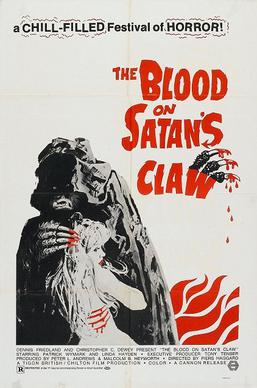
The Blood on Satan’s Claw-1971

The Blood on Satan’s Claw-1971

Director Piers Haggard

Starring Patrick Wymark, Linda Hayden

Scott’s Review #1,050

Reviewed August 7, 2020

Grade: B

I am always up for a good British horror film, with a creepy musical score, satanic elements, and eclectic, good actors. Especially embraceable are offerings from the late 1960s and early 1970s.

The Blood on Satan’s Claw (1971), also released as Satan’s Skin, is very reminiscent of both Witchfinder General (1968) and The Wicker Man (1973), the three often lumped together in a small, brief sub-genre termed folk horror.

The film is not high art, nor is it intended to be. Taking itself too seriously would ruin the experience.

Instead, a gruesome, low-budget offering is just what the doctor ordered for late-night sipping, cocktails, or your preferred enlightenment or sedative.

The elements are all there- thunder and lightning, a perfect score, and the English countryside.

The Blood on Satan’s Claw would have been dynamite if the choice to cast horror legend Peter Cushing or Christopher Lee had come to fruition, but Cushing’s wife was dying of cancer, and Lee wanted too high a salary, or so the story goes.

Anyway, Patrick Wymark was awarded the lead role of a village judge. The actor had a penchant for booze and had to be watched closely.

Sadly, he died soon after filming wrapped.

Those expecting a concise plot will be disappointed. Reportedly, the script was changed repeatedly in a dizzying fashion before filming commenced. Some plot points and characters are introduced only to be unceremoniously dropped or forgotten.

Little wonder why the story confused me to no end.

Many characters have strange reaction shots as if they are reacting to different scenes. No matter, though, the film is a good time despite the inconsistencies.

In a nutshell, a cute plowman Ralph (Barry Andrews) uncovers a hideously deformed skull with one gouging eye and strange fur. When he reports his findings to the local judge (Wymark), the judge is skeptical, especially when the skull disappears before he lays eyes on it.

The village and its inhabitants quickly succumb to a group of teenage devil-worshipers led by beautiful but fiendish Angel Blake (Linda Hayden), who begins to perform blood sacrifices to bring the skull back to life.

Director Piers Haggard, who also wrote some of the script with Robert Wynne-Simmons, does a great job of adding the right elements to create a satisfactory mood.

The ancient setting of early-eighteenth-century England is always a juicy horror add-on, since the unfamiliar time lends it mystique.

The cinematography is gorgeous with lavish fields and stone buildings. I could have done without the laughably bad wigs the male actors were forced to wear, though.

Hayden is the standout for me.

A dead ringer for The Brady Bunch’s Maureen McCormick, only British, mixes deadly with beautiful in an underappreciated role. The actress was at the time a sex symbol, appearing in other horror films such as Taste the Blood of Dracula (1970) and Vampira (1974).

As the teenage ringleader, her best scene is when she serves as a temptress to the local Reverend (Anthony Ainley). She seductively disrobes and confidently walks over to the intimidated man, offering full-frontal nudity and the obvious daydreams of schoolboys everywhere.

Those not turned off by witch hunts, devil fur shavings, or characters sawing off their limbs will find The Blood on Satan’s Claw (1971) a real treat.

The film will please those classic horror fans expecting what the expected is in British horror which is a good thing. The demonic and religious trimmings mix well with a cast that is classically trained with most appearing in similarly themed horror films.

The story is weak and haphazard but the film is recommended to just enjoy the moment with.

Madhouse-1974

Madhouse-1974

Director Jim Clark

Starring Vincent Price, Peter Cushing, Adrienne Corri

Scott’s Review #233

220px-Madhouseposter[1]

Reviewed April 3, 2015

Grade: B-

Madhouse, a 1974 British horror film, stars horror icon Vincent Price, who portrays a sympathetic Hollywood actor who is unsure of his sanity after the grisly murder of his trophy fiancée, whom he may or may not have been responsible for murdering.

Mainly set in London, Madhouse also stars famed British actors in the latter stages of their careers, such as Peter Cushing, and is a treat for classic British horror fans.

The look of the film is stylistic and effective in the mood- the story, while silly, is also fun.

Paul Toombes (Price) is a renowned actor best known for his portrayal of Dr. Death in a successful film franchise. He seemingly has it all and is the envy of his contemporaries- wealth, notoriety, and a glamorous blonde fiancée named Ellen.

After Ellen is murdered by someone dressed as Dr. Death, Paul is unable to remember the circumstances or his whereabouts during the murder.

After spending years in a mental institution in a confused state, he is summoned to London to mount an acting comeback of sorts, reprising his Dr. Death alter-ego.

As the bodies begin to pile up, a whodunit commences- is Paul Toombes the killer, or is someone impersonating him?

The film itself is quite pleasing to a horror fan like me. The deaths, while silly, are fun and campy.

Mostly all female victims, a comical aspect is how the victims, when cornered by the killer, simply scream and stand there waiting to be sliced.

Wouldn’t they fight back in real life?

This film is certainly not realism at its finest, but it is a fun horror film. It is a bit exaggerated and over-the-top in a campy way, but it is also true to the 1970s style, with point-of-view scenes from the killer’s perspective.

A wonderful aspect of this film is the inclusion of real clips from old Vincent Price films (The Raven, The Pit and the Pendulum, and House of Usher), to name a few, featuring the deceased horror god Boris Karloff and Basil Rathbone.

Since the plot features Price as a former horror actor, this is a wonderful opportunity to showcase classic horror films from long ago, and it works perfectly.

I enjoyed the television scenes within the film plot as Paul revives his career and shoots a series for the BBC. The film chooses interesting, haunting sets, and Cushing’s character, Herbert Flay, and his zany wife reside in a spooky, vast mansion with eerie spiders that the wife is obsessed with.

The set pieces are great and very Halloween-like. And the spider-eating-flesh scene is excellent!

The tag team of Price and Cushing is fun to watch- both horror stalwarts connect well, and both actors play off of each other successfully.

They had a ball while making this film.

Towards the end of the film, the plot becomes confusing, and the big reveal of the killer’s identity and the surrounding motivations is a disappointment.

The conclusion to the film is silly and makes little sense, although that is secondary to a film of this genre that borders on camp.

Madhouse (1974) is an enjoyable midnight flick starring two of the classic horror genre’s top icons.