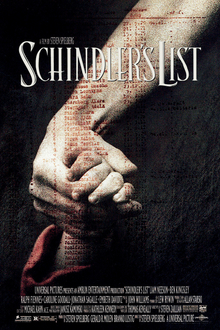
Schindler’s List-1993
Director Steven Spielberg
Starring Liam Neeson
Top 250 Films #179
Scott’s Review #775
Reviewed June 19, 2018
Grade: A
Schindler’s List (1993) is a film that is arguably Steven Spielberg’s finest directorial work and Liam Neeson’s finest acting performance.
The film is as disturbing as it is awe-inspiring, as many emotions will undoubtedly envelop any viewer, most of them dark and dire.
Spielberg’s most personal story centers on the devastating Holocaust of World War II, which will grip and tear audiences to pieces.
The work deservedly secured the Oscars for Best Picture and Best Director, as well as numerous other accolades.
Oskar Schindler (Neeson) is a powerful German businessman who arrives in Krakow, Poland, during the atrocities of World War II, presumably to make his fortune.
Handsome and respected, he is charismatic and feared by the German army, who have forced most of the Polish Jews into the overcrowded ghettos where they await their fates.
Schindler himself is a Nazi, but becomes more humanistic than most and ultimately against the Holocaust killings. He establishes a factory and hires a Jewish accountant (Ben Kingsley) to assist.
As he is tremendously affected by the inhumanity he sees throughout the city, he makes arrangements to hire and thus save the lives of over a thousand Polish refugees.
He does so by allowing them to work safely and productively in his factory. The story is reportedly true and was a rare instance of humanity in a cold and ugly chapter in world history.
To be clear, Schindler does not start as a hero and is admittedly rather an unlikely one. The man is a businessman, greedy, and undoubtedly flawed. He plans to use the Jews because they are cheap labor and can be used to his advantage.
Because of the very long running time of the film (over three hours), Spielberg slowly depicts Schindler’s complex character growth and eventual determination to save these poor people from the Auschwitz gas chambers.
Spielberg shoots Schindler’s List entirely in black and white with tremendous results. The camera work adds such ambiance and style to the 1990s film that, throughout, I felt as if I were watching a documentary from the 1940s.
The film is epic and choreographed with precision and timeliness- some of the best camera work in cinema history as far as successfully creating the perfect solemn and dreary mood.
Supporting turns by Ben Kingsley and Ralph Fiennes are notable. In vastly different types of roles, both shine.
As the understandably nervous Jewish accountant for Schindler’s factory, Itzhak Stern is best known for creating the famous “list”. This contains the names of those who would be transferred to the factory and thus have their lives spared.
Kingsley, a brilliant actor, fills the character with empathy and heart.
Conversely, Fiennes plays a dastardly character as Amon Göth, a commander at the concentration camp. Evil and known for taking glee from killings, he is the man instrumental in deciding to exterminate all of the people in the ghetto.
A pivotal character, Göth, is important because he is the man who makes Schindler realize how sickening and inhumane the treatment is.
Fiennes carves the character with such hate that he is believable in the role.
One of the most beautiful scenes is aptly named “the girl in red” and is highly symbolic and worthy of analysis. Oskar watches as prisoners are escorted, presumably to their executions. He notices a three-year-old girl walking by herself- she is clad in a bright red coat.
The coat is Spielberg’s only use of color throughout the entire film.
The scene is incredibly important as the girl stands out, proving that all the Nazi commanders are accepting of her death. In tragic form, Oskar later sees her dead body draped in her red coat.
The scene is sad and powerfully distressing.
Schindler’s List (1993) is an outstanding film that elicits raw emotion in anyone who watches it.
By no means an easy watch and most assuredly “a heavy”, the film depicts the true struggles and catastrophic events occurring not all too long ago.
A film for the ages that all must see to appreciate the terror and inhumanity that occurs throughout the world.
Oscar Nominations: 7 wins-Best Picture (won), Best Director-Steven Spielberg (won), Best Actor-Liam Neeson, Best Supporting Actor-Ralph Fiennes, Best Adapted Screenplay (won), Best Original Score (won), Best Sound, Best Art Direction (won), Best Makeup, Best Costume Design, Best Cinematography (won), Best Film Editing (won)
