The Great Escape-1963
Director John Sturges
Starring Steve McQueen, James Garner
Scott’s Review #1,053
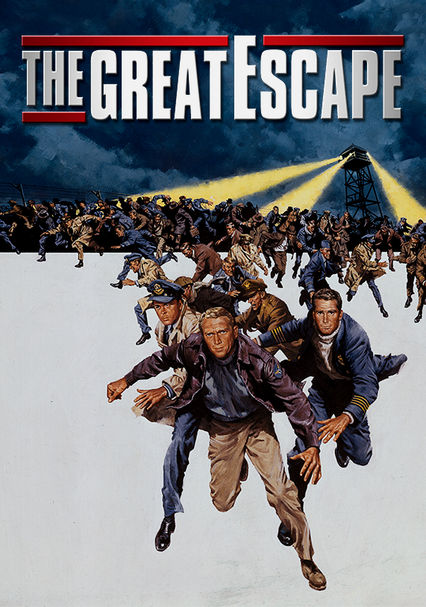
Reviewed August 17, 2020
Grade: B
Often heralded as one of the great World War II action films of all time, there is little great about the first half of the interminable two-hour and fifty-three-minute running time.
With enough military silliness to make television’s Hogan’s Heroes seem like high drama, the first half of The Great Escape (1963) would be graded a mediocre C or a C- and that’s being generous.
The final hour is entirely different. The film kicks into high gear when the actual “great escape” is launched. Not only does the action begin, but the characters become more layered, emotional, and compelling.
Killer location shots of Germany and Switzerland occur at a zooming pace, and the comedy soon turns to tragedy.
I don’t understand why the decision was made to save all the goodies for the final act instead of dispersing them throughout the film, but I am glad it took off.
Directed by John Sturges, known for creating a similarly masculine and muscular offering from 1960, The Magnificent Seven, he once again is lucky to cast several of Hollywood’s then hot, young stars like Steve McQueen and James Garner.
And more relatable character actors like Donald Pleasence and Richard Attenborough, who provide the acting grit.
While not on my list of great World War II films (Schindler’s List (1993) gets top honors), the film is recommended for the enthralling finale alone.
The film is based on Paul Brickhill’s 1950 nonfiction book of the same name, a firsthand account of the mass escape by British Commonwealth prisoners of war from German POW camp Stalag Luft III in Nazi Germany.
Unsurprisingly and shockingly, the actual events are significantly modified from the historical record, depicting a starkly fictionalized version of the escape, including Americans among the escapees.
Let’s discuss both portions, warts and all.
The changes are most irritating and done to make it more “Americanized” and, therefore, more appealing to mainstream audiences.
This manipulation gnawed at me during most of the film since it’s factually incorrect.
There is a brief disclaimer at the beginning with a note saying the story is a work of fiction save for the escape portion, but this will inevitably be unnoticed or forgotten by the casual viewer.
Most of the first arc action is spent within the confinement of a massive, high-security, prisoner-of-war camp where the group of men is huddled, having escaped other camps or prisons.
You would think the camp would be the equivalent of Alcatraz, but besides some barbed wire and not-so-threatening German soldiers with guns they rarely use, it’s not so intimidating.
Nonetheless, the group plots their elaborate, mostly underground escape upon arriving.
Whoever composed the musical score for the first section wanted to create a campy, situational comedy-style tone with brassy, patriotic tunes worthy of Gilligan’s Island.
This does nothing to create tension or danger, nor do the Nazi soldiers.
The men would be terrifying and rely on torture, but there is none of that to be found. Safe, but trying to be stern, this does not work as the German soldiers are played more like foils than those to be feared.
When the “great escape” is upon us, The Great Escape gets an A-plus for its thrills, action, and emotion.
A harrowing plane ride by Robert Hendley (Garner) and Colin Blythe (Pleasence) is juicy with tension and atmosphere. The plane runs into trouble as the duo flies low across German terrain, heading over the Swiss Alps for safety.
Meanwhile, Hilts (McQueen) steals a motorcycle and traverses the Germany/Switzerland border in a frantic chase scene while the Germans are in hot pursuit.
In a third sequence, other men flee via train in a cat-and-mouse pursuit.
Seventy-six POWs flee the camp, and a startling fifty are killed. Twenty-three are returned to the camp, and only three successfully escape.
If Sturges had built around the final hour and reduced the silly comedy style, probably attempting a contrasting theme to make the drama more imbalanced, he might have had a masterpiece.
Instead, The Great Escape (1963) is a twofold experience.
The comedy develops into a nail-biting, edge-of-your-seat thriller but suffers from too much historical inaccuracy to reach the depths of cinematic greatness.
Oscar Nominations: Best Film Editing
Golden Globe Nominations: Best Motion Picture-Drama
