Absence of Malice-1981
Director Sydney Pollack
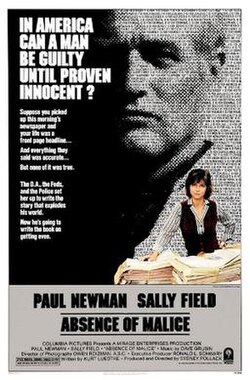
Starring Paul Newman, Sally Field
Scott’s Review #1,055
Reviewed August 20, 2020
Grade: A-
Absence of Malice (1981) is a terrific, slick crime thriller that, while compelling and well above average, feels like a studio creation and a vehicle for its two A-list stars.
There is little wrong with that, since Paul Newman and Sally Field are top-notch talents, and the result has tension, thrills, and a relevant concept.
I loved the Miami locales, as the hot, steamy atmosphere set the right tone for sizzling romance and intrigue. Despite feeling manipulated by the casting, the film nonetheless feels fresh and authentic.
The film compares with 1976’s magnificent All the President’s Men in terms of story and look, though Absence of Malice is much more mainstream.
The former has more grit and dirt, while the latter adds some romance that may or may not have been a wise decision. The chemistry between Newman and Field is mediocre, but it’s the story that works.
In rock n roll terms, Absence of Malice is the opening act to All the President’s Men’s headliner. They make a perfect double-bill.
Field plays Megan Carter, an ambitious young journalist who writes a scathing article implicating Michael Gallagher (Newman), a successful liquor wholesaler with ties to a criminal family, in the disappearance of a labor leader.
When he confronts Megan, she sees his side, and the duo team up to find the truth. Their mutual attraction complicates matters and leads to romantic interludes.
The initial setup seems like a ploy to put Megan and Michael at odds, only for them to fall madly in love. Fortunately, the story has more depth than that.
Any trite 1980s or 1990s romantic comedy uses the same trick. No, not only do sparks fly, but the characters realize that Megan was duped into writing the article.
This sets off a series of events to figure out who wants to frame Michael and why. And why Megan has been “chosen” to help see this through.
Plenty of political espionage and other elements keep the audience engaged. Similar genre films would flood movie theaters throughout the decade, becoming watered down.
If Absence of Malice were released in 1988 or 1989, it would not have had the same effect as it did upon release in 1981.
The soggy 1980s style of filmmaking had not yet appeared, so I like to think of Absence as more of a 1970s film.
Sally Field is a Nancy Drew type, a sleuth determined to solve a mystery. She is assertive, yet feminine, with a trendy hairstyle.
Newman is, well, Newman. Aging handsomely with his dazzling blue eyes, he can charm the pants off any woman. I didn’t quite buy the romantic element, not because he is at least twenty years older than she.
He is suave and charming, and she is so strait-laced that the romance doesn’t work.
The film would have been better as a buddy film with a male and a female buddy.
The supporting cast fleshes out the film nicely, especially Melinda Dillon, who is fabulous as Teresa Perrone, Michael’s conflicted friend who serves as his alibi.
In a nicely crafted side story, she suffers because her abortion is revealed to the public. Teresa, a devout Catholic, must decide between life and death. It is admirable to give a supporting character a good, juicy story.
Pollack is the right director for the job, and he successfully crafts a thriller laden with liberal beliefs that serves up a message film without losing tension.
Absence of Malice (1981) has snippets of style and tone reminiscent of his other films, such as They Shoot Horses, Don’t They (1969), The Way We Were (1973), and The Electric Horseman (1979).
My mind wanders, thinking about a potential Robert Redford/Jane Fonda pairing instead of Field and Newman, or some combination of a Barbra Streisand/Newman/Redford/Fonda mix.
I am not sure if Absence of Malice (1981) is still on anyone’s radar, but some forty years later, the message couldn’t be timelier.
When government officials regularly attack journalists for providing “fake news” or “alternate facts,” this film is a refreshing reminder that, more often than not, they seek to uncover corruption and get to the truth.
Oscar Nominations: Best Actor-Paul Newman, Best Supporting Actress-Melinda Dillon, Best Original Screenplay
Golden Globe Nominations: Best Actress-Drama-Sally Field, Best Screenplay