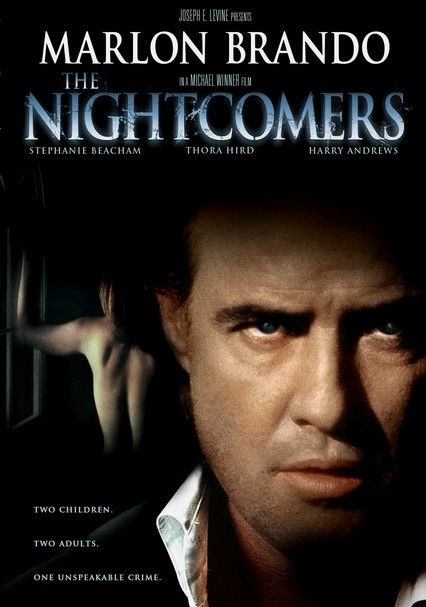
The Nightcomers-1972

The Nightcomers-1972

Director Michael Winner

Starring Marlon Brando, Stephanie Beacham

Scott’s Review #1,080

Reviewed November 11, 2020

Grade: B-

The Nightcomers (1972) is a disappointing prequel to Henry James’ 1898 novella The Turn of the Screw, which had already been adapted into the 1961 film The Innocents.

The dreadful title is neither catchy nor specific to the film. The lackluster and unmemorable result is jarring, given the masterpiece that is The Innocents.

It’s unclear whether the intention was to build on the film or to base it directly on the novella, forgetting The Innocents.

It’s not worth the effort to ruminate over the answer.

The most interesting comparison is that the film was released the same year as The Godfather (1972), in which the iconic role of Vito Corleone, the mafia head of household, and arguably the best role of Marlon Brando’s career, was created.

Mirrored against his role as a bizarre gardener named Peter Quint, with a broken Irish accent, one can guess why one role is memorable and why the other isn’t.

Flora (Verna Harvey) and Miles (Christopher Ellis) are recently orphaned children living in a vast English estate. Their absent guardian pays for the housekeeper, Mrs. Grose (Thora Hird), and governess, Miss Jessel (Stephanie Beacham), to keep things running smoothly.

Jessel and Peter embark on a torrid and sometimes abusive relationship that the children witness and emulate through play-acting. Flora and Miles suffer from isolation and must use their imaginations to make the best of their idle days.

Watching in sequence with The Innocents is not encouraged.

The Nightcomers is best served as a stand-alone product. The events and continuity are muddy and will confuse the most astute viewer.

Flora is much older than she is in The Innocents, even though the action takes place before those events. The characters being played by different actors doesn’t help.

Finally, The Nightcomers contains none of the ghostly mystique and spookiness that The Innocents does. So, it is advisable to put The Innocents out of mind.

Admittedly, events do come together in the final act, which is the best part of the film.

When two deaths occur simultaneously, they are both quite shocking and powerfully filmed. I felt more emotionally invested in the final ten-minute sequence than in the rest of the film.

Brando has one emotional scene worthy of his talents. Given the actor’s powerful chops, he can make any scene believable, but this is the cream of the crop material.

Stephanie Beacham is an okay casting choice, but I never felt the chemistry or connection between Jessel and Quint. Their relationship didn’t work for me.

Suspension of disbelief is required to get through a scene where a character drowns in what looks like two feet of water, making the scene lose some power.

Harvey and Ellis, as the children, are okay, but nothing spectacular. I am jaded, but I compare them again to The Innocents, and those actors are just better and more haunting, especially Miles.

The subject of mental illness and the distinction between reality and imagination is not explored in The Nightcomers.

The production is not a total dud, containing enough exterior elements of the plush and English landscape to please and make viewers feel they are in the country manor themselves.

The interior scenes are just as good. The children gallop through the enormous house to their heart’s delight, making the viewer feel like a kid along with them.

The sadomasochistic scenes between Peter and Miss Jessel are quite titillating and border on the X-rated. During the bedroom scenes, I nearly blushed from embarrassment. But, as erotic as they are, they also don’t do much to further the plot or add to the story.

They have a kinky sex life- so what?

There is also a weird suggestion of incest since Flora and Miles imitate what Quint and Jessel do; how far would they take it? The plot has good potential, but the film and direction aren’t executed well, and things don’t come together.

If you’ve never heard of The Innocents (1961), then The Nightcomers (1972) is recommended.

If viewing a cinematic masterpiece is desired, however, stick with the former and never look back.

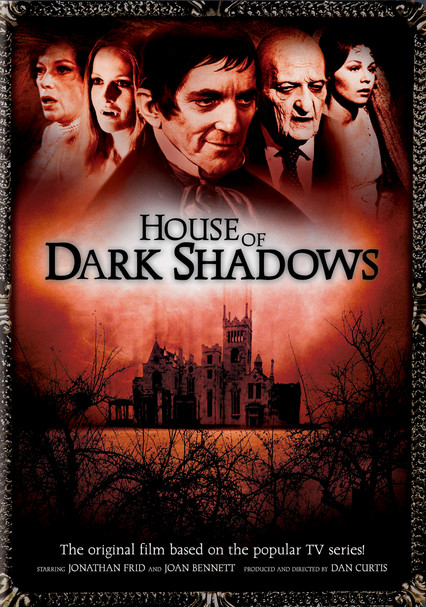
House of Dark Shadows-1970

House of Dark Shadows-1970

Director Dan Curtis

Starring Jonathan Frid, Grayson Hall

Scott’s Review #1,079

Reviewed November 9, 2020

Grade: B

House of Dark Shadows (1970) is undoubtedly intended primarily as a treat for fans of the popular gothic soap opera Dark Shadows, which aired on ABC from 1966 to 1971.

The soap was groundbreaking for its gloominess and its focus on the world of vampires, eliminating the tried-and-true apple-pie wholesomeness of serials like As the World Turns and The Guiding Light.

The film was an enormous hit with fans at the time of release, and while all can enjoy it, it screams of a specific target audience.

Released during the height of the television show’s popularity in 1970, it must have been enthralling to be the first feature film based on a daytime soap opera.

And how exciting for fans to see their favorites on the silver screen. I tried to keep this in mind as I was watching, and it helped me enjoy it more.

In later years, I watched bits of season one, so I have some knowledge.

If memory serves, some of the action happens in both the series and the film (like Barnabas rising from his coffin), but that doesn’t seem necessary and felt more like a recap to me.

The film is entertaining enough on its own merits, in a spooky, atmospheric way, though beyond more blood and chills, it follows the same formula as the series.

Our star, Barnabas Collins (Jonathan Frid), emerges from his coffin in the family mausoleum, much to the chagrin of the family handyman. He introduces himself to the Collins family as a distant cousin from England.

He has an uncanny resemblance to a figure in a portrait displayed at the estate, which is over a hundred years old.

A fancy ball is thrown to celebrate the family, where Barnabas bites Carolyn (Nancy Barrett), turning her into a vampire. He quickly becomes obsessed with governess Maggie (Kathryn Leigh Scott) while awakening the suspicions of psychologist Julia Hoffman (Grayson Hall).

The whole package is stylish and haunting, with plenty of essential goth attire, like coffins, capes, fangs, and blood-red lips. The production style is appealing and not the least bit cheesy or amateurish.

The famous Lyndhurst estate in Tarrytown, New York, was used during the shoot, and with good results. The interior is lavish, and the exterior is just as grand with lush grounds and a hidden driveway, which is helpful in the plot. The eerie attic, with its macabre and stifling trimmings, is vital in one scene.

This works much better than a studio set, and the overall production is superior to the series.

The final thirty minutes or so are the best part, with an astonishing Hammer horror likeness. When Julia gives Barnabas a powerful injection meant to cause him to age rapidly, all hell breaks loose.

You see, while Barnabas is obsessed with Maggie, Julia is secretly in love with Barnabas, so the dramatic soap opera necessities are intact.

The makeup during this sequence is highly effective and downright creepy.

Other characters are likable and respectable in the film, but the acting isn’t great, which reduces believability just a bit. Stalwarts like Joan Bennett as Elizabeth Collins Stoddard, Roger Davis as Jeff Clark, and David Henesy as little David Collins have prominent roles.

It’s an ensemble effort, as each character has a role to play in supporting the main story. This is a nice add-on and gives everyone time to shine.

Regardless of knowledge of the daytime drama series, one can enjoy the film on its own merits, though how exciting it must have been for fans to see their favorites on the silver screen in 1970.

I am not sure how many viewers will need to invest in the film, because it feels like a reward for series viewers and, in the present day, a retro, nostalgic experience.

The series was again celebrated in a film, the mediocre 2012 effort Dark Shadows, starring Johnny Depp.

House of Dark Shadows (1970) is a compelling watch around Halloween time, with nice autumnal, gothic elements that fit the season of the witch.

The ghastly (in a good way) makeup and bloody bites and pretty people turned vampires, suffering from stakes through the heart, is worth the watch.

The Concorde…Airport ’79-1979

The Concorde…Airport ’79-1979

Director David Lowell Rich

Starring Alain Delon, Susan Blakely, Robert Wagner

Scott’s Review #1,078

Reviewed November 7, 2020

Grade: B

The fourth and final installment of the popular Airport film franchise, The Concorde…Airport ’79 (1979) has an appealing, sophisticated international flavor, mainly French, that may turn off some viewers seeking a more traditional, domestic offering.

The three previous installments contained a wholesome Americana quality that is lacking in this one. The rich culture is the high point for me in a film that by all accounts is not very good.

By the late 1970s, the disaster genre had all but crashed and burned, so the film was commercially unsuccessful, and the franchise was thus abandoned.

The plot is utterly ridiculous, even by disaster standards, and my hunch is that ideas for what could go wrong on an airplane were hard to come by. After all, it’s not easy to top an airliner crashing and sinking into the ocean, leaving most passengers unscathed.

This time, we experience an airplane flying upside down (more than once!), nose-diving (more than once!), and nearly doing backflips and somersaults (more than once!).

Disappointing is the limited amount of deaths that occur despite these treacheries, unless you count a shooting inside an apartment and a suicide that have little to do with the plane ride.

Back to my original point, the cultured and vibrant foreign presence, specifically Paris and its lustrous and historic offerings, is the high point of The Concorde…Airport ’79.

The City of Lights is prominently featured as a team of American Olympic athletes travels from Washington, D.C., to Moscow, with a layover at Charles de Gaulle Airport.

The heavenly site of the Eiffel Tower is an immediate identifier as French pilot, Captain Paul Metrand (Alain Delon), flies the state-of-the-art Concorde to the United States to transport its passengers to the games.

There is a strong French flavor to this film. During the Paris layover, George Kennedy’s Joe Patroni, now a pilot, befriends a gorgeous woman named Francine, with whom he bonds over dinner.

They and others embark on a fabulous French bistro experience and have the time of their lives. Who cares that she is later revealed to be a prostitute? The setting oozes with French goodness, food, and sexy accents.

One peculiarity is why the trip goes from Paris to Washington, D.C., back to Paris, and then on to Moscow. It’s a bit confusing and unnecessary.

Unintentionally funny is how the Concorde is attacked by a drone en route to Paris, and then a bomb is planted on the plane before takeoff to Moscow.

Trouble occurs in the same plane with the same passengers.

You would think anyone with half a brain would sit the second leg out, perhaps hopping on the nearest boat or train out of town.

The main story is secondary and quite superfluous. Robert Wagner plays Kevin Harrison, a corrupt arms dealer who plots the destruction of the Concorde because news reporter and girlfriend, Maggie Whelan (Susan Blakely) has evidence of his weapons sales to communists.

He plans to blow up the plane, killing all the passengers, instead of hiring an assassin to kill only Maggie when she lands and before she can tell authorities.

The plot is completely story-driven.

Several celebrity cameos are added mostly for comic relief and largely go nowhere.

Jimmie Walker as the pot-smoking, saxophone-playing Boise, and Martha Raye’s bathroom-crazed Loretta are ridiculous by any standards. Charo’s one scene as Margarita, a woman who sneaks her dog onto the plane and is subsequently kicked off the flight, is a waste of time.

I would have rather witnessed another scene of Loretta needing to use the restroom or Boise getting high.

And Susan Blakely overacts throughout the film.

Despite all these hard knocks, The Concorde…Airport ’79 (1979) is good entertaining fun, not to be taken seriously, and encouraged for fans of the genre.

There is much fun to be had with the guest stars, once A-list, now B or C-list, and the crash-landing finale over the snowy Alps is pretty cool.

Just know what you are getting yourself into.

Land of the Dead-2005

Land of the Dead-2005

Director George A. Romero

Starring Simon Baker, John Leguizamo

Scott’s Review #1,077

Reviewed November 6, 2020

Grade: C+

Land of the Dead (2005) is a post-apocalyptic horror film written and directed by George A. Romero, the fourth of Romero’s six Living Dead movies, preceded by Night of the Living Dead (1968), Dawn of the Dead (1978), and Day of the Dead (1985).

The result is a mediocre effort, plagued by poor acting and too much silliness. The goofy nature of the film negates any sense of foreboding or dread despite there being plenty of zombies.

The result is camp over horror instead of a blended mix of both which would have worked better.  To compare Land of the Dead to Night or Dawn is a tough ask since the formers are so much better and have political points to make.

There is nothing like that in Land of the Dead besides a weak side story about the class distinction that goes nowhere, and some jokes about the Bush regime.

That’s a shame because it would have made the film more relevant.

What we are served is a healthy dose of shoot ’em up or slice ’em up scenes where zombie heads or some other appendage are blown or sliced off. This was fun for a while, but I wanted something more.

Wisely, and staying true to the other films, the events are set around Pittsburgh, Pennsylvania which helps with continuity. The geographical reference to the famous “three rivers” immediately identifies the city used.

As events kick off, we learn that the zombie population has outnumbered the human population forcing the humans to barricade themselves within a structured community for safety. There exist the haves who live in a luxury high-rise and the have-nots who survive in squalor.

Dennis Hopper plays the rigid government figure, Paul Kaufman, and our good guy is the handsome Riley Denbo (Simon Baker) who provides aid to those in need.

Conflict erupts when it’s discovered that the zombies exhibit superior intelligence. They storm the gates of the city in droves and wreak havoc on the people of the community.

Other characters along for the ride are Cholo (John Leguizamo), Slack (Asia Argento- yes, daughter of famous horror director Dario Argento), and Charlie (Robert Joy). The rest of the film is a battle between good and evil (the zombies and greedy Paul) and not much else.

Why do zombies exhibit advanced intelligence? Are they cloning or are more humans becoming zombies? These questions are not answered.

Creatively, Land of the Dead looks good. It is stylistic, dark, and mysterious. Scenes, where zombies parade around in misty and gloomy conditions, are cool. The slicker and more commercial style gives a modern and fresh look and feel.

Reminiscent of 28 Days Later, the 2002 offering by Danny Boyle, that’s not a bad thing though it’s tepid for Romero. 28 Days Later rejuvenated the zombie genre so patterning after it doesn’t hurt Land of the Dead.

Another positive is the homoerotic nature of the relationship between Cholo and Mike (Shawn Roberts), a rookie. Both masculine and aggressive, there exists a hint of tenderness and closeness that feels romantic. When Mike is bitten and commits suicide to avoid turning, Cholo is devastated, implying that they might have shared a close background.

Unfortunately, this is never explored after Mike’s death.

On that note, the characters are not particularly interesting or crafted well. Paul is merely bad, while Riley is heroic. Cholo is angry and rebellious, while Slack is a prostitute. Charlie is the sidekick.

Everyone has their place, but little substance is given about their past lives, their hopes for the future, or anything more than escaping the zombies. I get that’s the goal, but more personal stuff would have been better.

The rest is what you would expect from a zombie film and nothing more, which feels lazy of Romero especially since he wrote the screenplay. He tends to deliver better products with some meaning or interpretation.

In Dawn of the Dead, for example, the zombies sought the mall because it was familiar to them. One could argue that a city and its lights offer more of the same, but this feels weak and has already been explored.

I guess I was expecting more of something that would grab me into the world of the film and nothing ever did.

A forgettable affair, Land of the Dead (2005) does not require repeated viewings as its predecessors do. This film was one-and-done for me.

Some trimmings and entertainment exist, but I yearned for more substance than a standard, Saturday late-night zombie-fest. There are enough of those already.

Valerie and Her Week of Wonders-1970

Valerie and Her Week of Wonders-1970

Director Jaromil Jireš

Starring Jaroslava Schallerová

Scott’s Review #1,076

Reviewed October 30, 2020

Grade: B+

One of the oddest films I’ve ever laid eyes on. The best way to view a film like Valerie and Her Week of Wonder (1970) is to absorb it and let it either pull you in or turn you off.

The cadence is to feel the film and then, later, search for any semblance of meaning or interpretation, or perhaps never.

The genre best to categorize the film is art cinema meets fantasy meets horror meets fairy tale. Is it ever a bizarre experience? If one is to take hallucinogens first, this film is a recommended watch.

The production is Czech and is translated to Valerie a týden divů in its native language. 

The story involves a week in the life of Valerie (Jaroslava Schallerová), a girl on the cusp of womanhood, and the weird sexual thoughts and desires she encounters while blossoming. She encounters witchcraft, vampires, and a bizarre Constable, who wears a mask.

Valerie is raised by the strangest grandmother imaginable (Helena Anýžová), who morphs into other characters named Mother and Redhead. Valerie does not live a boring life.

One poster for the film is of a blooming flower with splotches of blood that can be interpreted as a girl losing her virginity.

To delve much further into the plot than a quick summary would is wasteful, because it doesn’t make much sense.

Such activities as Valerie’s grandmother making a pact with vampires to keep her young forever, Valerie lying in a coffin surrounded by rotten apples, being burned at the stake, and finally being followed and menaced by her priest are a few of the shenanigans the film presents.

This is shrouded by some of the loveliest photography and scenery you’ve ever seen.

The creativity and experimental nature of Valerie and Her Week of Wonders will allure an open-eyed viewer seeking something left-of-center… very left-of-center.

The story is secondary.

The medieval landscape is gothic and haunting, perfect for evil-doings and strangeness. Not to harp on this point, but the look of Valerie and Her Week of Wonders is the money shot. All else can be left by the sidelines.

The perspective is all Valerie’s, which is nice in an early 1970s feminist way. It feels like Valerie is changing from a girl to a woman and a strong one at that. She is coming into her own after facing and challenging demons. In the mix is a handsome man who titillates Valerie.

I felt like I was emerging into the girl’s subconscious and experiencing her fears and desires alongside her.

Critically speaking, I would have preferred a little more logic and wrap-up, but that’s just me.

Surely, not a realistic interpretation. Was the girl dreaming while asleep or merely delving into fantasy one day? The more I tried to follow the story and put the pieces together like a puzzle, the less it did me any favors.

I then decided to space out and indulge in the other lovelies included. I should have done this from the beginning.

I am unsure how many Czech films I have seen, if any, but Valerie and Her Week of Wonders (1970) is a clear example of what Czech filmmakers can do, and it’s wild what they can come up with.

The mystique is likely multiplied on American audiences, and a viewer used to more formulaic approaches to film. With a desire for more put-together stories and logic, I nonetheless admired this film for the magic and style it offered.

Alice Doesn’t Live Here Anymore-1974

Alice Doesn’t Live Here Anymore-1974

Director Martin Scorsese

Starring Ellen Burstyn, Kris Kristofferson, Diane Ladd

Scott’s Review #1,075

Reviewed October 27, 2020

Grade: A-

Deserving of the Best Actress statuette she won for her role, Ellen Burstyn carries the film Alice Doesn’t Live Here Anymore (1974) from start to finish with drama and comedy.

I can’t watch any performance of Burstyn’s without smarting at how she lost the same award years later, after her frighteningly good performance in Requiem for a Dream, released in 2000.

She was defeated by Julia Roberts, who delivered an adequate, though unexceptional, performance in Erin Brockovich (2000).

But, I digress.

A character study, Alice Doesn’t Live Here Anymore, tells the powerful story of a woman (Burstyn) forced to begin a new life and forge her path after her husband is killed in a car accident.

She is thirty-five years old and wary of the approaching middle age as she pursues a singing career. She is joined by her young son, Tommy (Alfred Lutter), and faces fear and loneliness as the pair embarks on a journey throughout the southwestern United States.

She dates, fights, and does a soul search, finally landing a job as a waitress at a roadside diner.

On paper, this film could have been reduced to television movie status, as the premise sounds kind of corny and sentimental.

Shocking to me is that Martin Scorsese directed it. Best known for male-driven mobster pictures like Goodfellas (1993), Gangs of New York (2002), and The Irishman (2019), Martin Scorsese’s introspective female-journey film doesn’t seem like his thing.

A fun fact is that he agreed to direct at Burstyn’s urging, since she wouldn’t have starred otherwise. The actress surmised that the script needed more darkness and grit, which it contains without losing its heart.

A strange yet lovely photographed scene kicks off the picture and seems to be an homage to The Wizard of Oz (1939). With a dusty, golden backdrop, a young Alice looks like Dorothy with an idyllic life.

Suddenly, Alice’s mother bellows her to come home for dinner. She responds with salty language. The scene feels out of place based on the rest of the film, but it looks good.

Burstyn made me care about Alice from the first scene containing adult Alice. Alice is a good person. She is hard-working and strives to please her husband, hoping he will enjoy the delicious dinner she has prepared for him. He barely grunts at the meal and has a tumultuous relationship with Tommy, whom Alice spoils.

This plot point returns later in the film.

Alice is not a doormat; however, she provides humor and comic relief during tense moments. She also shares a warm friendship with her neighbor. We do not know what the husband’s demons are (depression?).

He and Alice share an emotional moment in bed one night before he dies the next day.

With her marriage behind her and limited financial means, Alice and Tommy take to the road. I adore the relationship between the two. Tommy is not always easy to parent, exhausting his mother with typical young adult nonsense.

It’s easy to forget that he has lost his father and has no direction. Their relationship is complicated, but there is much love.

The juiciness comes when Alice finally lands a singing gig at a seedy lounge bar and meets the maniacal Ben, played flawlessly by Harvey Keitel.

At first, he is charming and attentive, wooing her like she’s never been wooed before. When she learns he is married, he turns psycho, and she is forced to leave town.

The meat of the film comes when Alice begins working at the diner and meets her new friend, Flo (Diane Ladd), and her new love, David (Kris Kristofferson). After some trials and tribulations, Alice realizes her life is not so bad.

As much as there are dramatic elements, Alice Doesn’t Live Here Anymore is not a soap opera or overwrought. The scenes and situations bristle with energy and authenticity, thanks to the great acting and fluid direction.

My favorite scenes occur at the diner. With greasy blue-plate specials and dishes piled with ham, eggs, and hash browns, the working-class extras are perfectly positioned around the diner.

In the background, they lend a feeling of rush, chaos, and family traditions. The diner scenes are where Alice bonds the most with Flo and David, and they are delicious.

Alice Doesn’t Live Here Anymore (1974), a lighter, wholesome production, was turned into a popular television sitcom in the late 1970s, titled Alice. It’s a progressive story about a woman on her own, getting it done, and mustering the courage to face whatever life throws at her.

It’s an inspiring story for both women and men.

Oscar Nominations: 1 win-Best Actress-Ellen Burstyn (won), Best Supporting Actress-Diane Ladd, Best Original Screenplay

Friday the 13th Part VI: Jason Lives-1986

Friday the 13th Part VI: Jason Lives-1986

Director Tom McLoughlin

Starring Thom Mathews, Jennifer Cooke

Scott’s Review #1,074

Reviewed October 26, 2020

Grade: B-

Due to the fan outrage that surrounded Friday the 13th: A New Beginning (1985), a film I thought was decent, the powers that be decided that a return to form was in order, quickly resurrecting Jason in the corniest of ways.

Re-discovering the “real Jason” is not the worst idea in the world but the execution is not there and I’m not crazy about the introduction of “superhuman” Jason.

How is anyone supposed to ever kill him?

Adding comedy and children is okay with me but both ideas largely fall flat when paired with inadequate acting and gimmicky sitcom situations with no character development. There is no time invested in getting to know any of the characters.

The heavy metal soundtrack, featuring the music of Alice Cooper, is the best part.

The film isn’t helped by a slicker 1980s visual look though this does come with better production values.

Not the greatest of all the Fridays.

The chapter gets off to a compelling start when Tommy (Thom Mathews) and his friend Allen Hawes (Ron Palillo- yes, Horshack from the Welcome Back Kotter television series) trudge through the rain and mud back to Camp Crystal Lake to finally bury Tommy’s demons.

Fans of the series will recall that Tommy did a stint in Pinehurst Halfway House and a pretend Jason went on a killing spree to avenge his son’s death.

The friends dig up the grave of Jason. The murderer is struck by lightning and magically comes back to life, killing Allen. Tommy spends the rest of the film trying to warn the town that Jason is alive and well and back on a deadly rampage.

The camp has been renamed to the more pleasant-sounding Forest Green to make people forget that numerous killings have ever taken place. This seems to have worked as a busload of kids flock to the camp for a summer of fun along with the usual batch of camp counselors in tow.

To the film’s credit, like with its predecessor, there is a black character, this time a counselor named Sissy Baker (Renee Jones), and some of the child characters offer different ethnicities.

The diversity and inclusiveness are to be admired, but unfortunately for Sissy, she is dragged through a window and savagely beheaded.

Jason kindly spares the kids.

I like how there is consistency in keeping the main character Tommy Jarvis, albeit with a different actor. We’ll probably never know why it was decided to recast John Shepherd with Thom Mathews, but the actors look enough alike to avoid too much confusion.

Like Shepherd, Mathews possesses a wounded look which makes the casting adequate.

There is a rooting quality to Tommy especially as he faces adversity with the police department. Sheriff Garris and Deputy Rick are played purely as foils and are a roadblock to capturing Jason.

Any attempt at romantic chemistry between Tommy and Megan (Jennifer Cooke) falls flat because there simply isn’t any between the actors, try as they might. Neither are the best actors in the world (not a requirement for the horror genre) but do have the right, fresh-faced look warranted to be cast.

Megan is the only person who believes Tommy as they race to the camp to stop and kill Jason.

The rest of the film is more of the same and offers no surprises except for more humor. A coked-up pair having sex in a motorhome and a group of corporate types on a paintball outing are examples of this. The four “suits” beheaded by a machete are the best part of the otherwise campy and obnoxious sequence.

The rest of the characters are killed off systematically with nothing especially interesting to add to the film.

Writer and director Tom McLoughlin attempts to revitalize the aging series and genre with more special effects and techniques and does little else to freshen his characters. It would have been nice to get to know some of them better.

By 1986 the slasher film needed rest and Friday the 13th Part VI: Jason Lives is a dull entry in the series catalog.

There is nothing terrible about the film, nor is there anything memorable either.

The Boys in the Band-2020

The Boys in the Band-2020

Director Joe Mantello

Starring Jim Parsons, Zachary Quinto, Matt Bomer

Scott’s Review #1,073

Reviewed October 21, 2020

Grade: A-

One may ask oneself why bother checking out the 2020 version of the legendary (and dark!) 1970 stage turned cinematic rendition of the sniping and vicious gay drama The Boys in the Band?

Primarily because of the terrific cast, a cast featuring the troupe who starred in the recent 2018 stage revival. But more than that, the film feels surprisingly modern and relevant, providing a message of hope that the original did not contain.

Crucial and historical to point out is that every principal actor is openly gay, and their characters are gay or bisexual. My, how much progress has been made for actors when not too long ago an “out” actor risked both reputation and career for the price of his truth.

This is monumental.

The remake wisely keeps to the crucial period of 1968, and really, how could a modern setting work at all? Being gay in 1968 is nothing like being gay in 2020; I don’t care if it is the Upper East Side of Manhattan.

To bring this film to any other time would diminish its power and importance. If anything, it makes one proud of how far the LGBTQ+ community has come, though there are further advancements left to make.

Alas, the Vietnam era is safely intact, during a time when a strip of gay bars and a group of gay friends were the only things to keep a gay man from going crazy, regardless of how abusive they were.

This will hopefully teach young gay viewers, or anyone else, what being a gay male was like over 50 years ago. When the rest of the world was deemed “normal” and you were cast aside as either a sexual deviant or a head case, this is powerful.

Self-hatred, denial, or the closet were commonalities.

The Boys in the Band has no females save for a blink and you’ll miss it moment featuring a snooty neighbor.

Important to realize is that the film is a pre-A.I.D.S epidemic in a time of carefree love and endless hookups, where booze and drugs were a necessary escape and usual was to feel out of sorts regularly.

A few characters are effeminate. One is presumably bisexual and closeted, and one is masculine and recently divorced from a woman, now cohabiting with a male lover; one is black, and one is an escort. Each character comes from a different walk of life, yet they are bonded.

The running of the gamut of unique types and personalities is part of why I love this story.

The events commence one evening when Michael (Jim Parsons) throws a birthday party for friend Harold (Zachary Quinto) at his apartment. They are joined by other friends, Donald (Matt Bomer), Hank (Tuc Watkins), Larry (Andrew Rannells), Bernard (Michael Benjamin Washington), and Emory (Robin de Jesús).

Guests include Cowboy (Charlie Carver), a “birthday present” for Harold, and Alan (Brian Hutchison), a college friend of Michael’s.

As the booze flows, the talk gets vicious and the claws come out.

The men, prompted by a drunken Michael, play a daring game of “telephone”. Each guest is dared to call the one person he truly believes he has loved. With each call, past scars and present anxieties are revealed in a torturous fashion.

This is when the film gets interesting.

Bernard and Emory bear the brunt as their phone calls take a tremendous toll on each other.

Parsons and Quinto are the standouts. As the lead, the character of Michael seems stable at first. He is stylish, well-dressed, and lives in a reputable apartment. Though unemployed, he once traveled the world.

Parsons slowly unleashes the vicious fury contained within Michael, the more he drinks. He enjoys hurting others just as he has been injured.

The catalyst for his character is Alan. Are they in love? Is Michael in love with Alan? Alan takes a fancy to masculine Hank.

Quinto, as Harold the self-professed “ugly, pockmarked Jew fairy”, is becoming increasingly morose about losing his youthful looks and his ability to attract cute young men.

The catalyst to his character is Cowboy, who has those qualities that Harold lacks.

Strangely, Harold and Michael are best friends, both loving and hating each other. After brutalizing each other with words, Harold exits the apartment, announcing he will call Michael tomorrow. They’ve been through this before and probably will again.

No, The Boys in the Band circa 2020 is not quite on par with The Boys in the Band circa 1970, but this is merely because brilliance is a tough act to replicate.

The modern telling is an absolute joy and will hopefully recruit fresh audiences to the perils and brutality of being gay in another time.

Thanks to Ryan Murphy for adapting this project to Netflix as part of his United States $300 million deal with the streaming platform.

Airport ’77-1977

Airport ’77-1977

Director Jerry Jameson

Starring Jack Lemmon, Lee Grant, Brenda Vaccaro

Scott’s Review #1,072

Reviewed October 20, 2020

Grade: B+

The word that springs to mind after a viewing of the disaster flick Airport ’77 (1977) is “entertaining”. Whether this is positive or negative depends on the viewer and what they want out of a film.

As a huge fan of the disaster genre, I was one satisfied customer, though there is little to distinguish the film from other efforts. It is a more cohesive and professional-feeling effort than its predecessor, Airport ’75.

The fun is watching the cast, the grandiose list of who’s who of Hollywood heavyweights gracing the opening credits.

We wonder who will survive and who will not.

The star is the airplane. Shown in both interior and exterior shots, the luxurious, privately owned Boeing 747-100 is a standout in the picture.

Owned by wealthy philanthropist Philip Stevens (James Stewart), the plane is packed with VIPs and priceless art traveling to his Florida estate for a party.

The wealthy travelers are drugged, and the aircraft is subsequently hijacked before crashing into the ocean in the Bermuda Triangle and sinking 100 feet, prompting the survivors to undertake a desperate struggle to live.

The airplane set is a feast for the eyes. A double-deck plane (naturally!), the plush green carpets, and the spiral staircase, complete with a robust bar stocked with every type of liquor imaginable, are wonderful trimmings.

It allows the viewer to forget all about the typical in-flight treats like their seat being kicked, a screaming baby, or a fat man snoring, and escape to the pleasures of champagne, caviar, and slippers.

Seriously, the sets are tremendous and worthy of their accolades.

Jerry Jameson, primarily a television director, sticks to a formulaic approach that makes the film look like a long television series. Think Murder, She Wrote, Dallas, or Dynasty at 30,000 feet.

I say this because the melodrama is sky-high (no pun intended), and situations arise between flight crew and passengers to create more tension than the crash itself.

The juiciest drama exists between husband and wife, Martin (Christopher Lee) and Karen Wallace (Lee Grant). He flirts with women at the bar, drinks too much, and gets jealous. They squabble. You get the idea.

What a joy it is to see some of the stars on-screen together, specifically Stewart, Olivia de Havilland, and Joseph Cotten. Nicholas Cotten is a romantic match for de Havilland’s Emily Livingston, and they appear to be old friends.

Fans of classic cinema will undoubtedly associate him with Shadow of a Doubt (1943) and her with Gone with the Wind (1939), and to see the legendary stars side by side is darling, nearly worth the price of admission.

Stewart is perfectly cast as the rich and distinguished man eager to see the impending arrival of his estranged daughter and her son, hopeful of a happy reunion.

These delights are why I love this genre.

The actors teeter back and forth between phoning in their lines and enthusiastically having a ball with their respective roles. Sometimes it’s hard to tell which is which. I’ll bet the set was tension-free as everyone was earning a bundle of cash.

And why not? The budget is plentiful and overabundant.

The plot is generally ludicrous, as is to be expected. The thought that anyone, let alone nearly everyone, could survive a crash into the ocean and remain unscathed as it sinks to the depths of the water is beyond silly.

Suddenly, when all passengers conveniently emerge from their drug-induced stupor simultaneously, hysterics erupt, which is quite humorous. As the water slowly seeps into the plane, a frenzied effort to find a way out begins.

The last portion of the film, involving a rescue crew arriving to save the passengers, is a disappointment, lacking much in the way of captivation.

Airport ’77 (1977) has all the elements its target audience expects. If the well-known cast were instead unknowns, the crash peril and its following adventure would not be danger personified, and the dramatic and romantic tensions left out, the film would be a disappointment.

The film is like sinking your teeth into a fattening, highly caloric Whopper from your favorite Burger King. It’s a guilty pleasure you wouldn’t necessarily tell your health-conscious friends about, one you get so much enjoyment from.

But it’s fun, so why not indulge from time to time?

Oscar Nominations: Best Art Direction, Best Costume Design

After Hours-1985

After Hours-1985

Director Martin Scorsese

Starring Griffin Dunne, Rosanna Arquette

Scott’s Review #1,069

Reviewed October 9, 2020

Grade: A-

After Hours (1985) is a gem of a film.

When thoughts of director Martin Scorsese are conjured, Taxi Driver (1976), Raging Bull (1980), or Goodfellas (1993) are films that immediately spring to mind.

Scorsese’s decision to create a pared-down independent film was met with enormous success and accolades for the very first Best Feature indie film victory and Best Director honors.

The experience is a black comedy set within the gritty and unpredictable underbelly of Soho-New York City in the 1980s.

Mixing comedy with satire, Scorsese leapfrogs from similar content in The King of Comedy (1983) to this film made only two years later.

Any fan of New York City will cheer with joy at the authenticity achieved since the film was shot on location there. The Big Apple in the 1980s was a notoriously violent cesspool so the genuine setting and the use of dark streets and alleys is an immeasurable treat and adds much zest to this unusual film.

A nice guy, Paul Hackett (Griffin Dunne), works hard as a computer data entry worker by day and shares an encounter with a quirky young woman named Marcy Franklin (Rosanna Arquette) in a Manhattan coffee shop.

After she gives him her number and leaves, he is unable to stop thinking about her and embarks on a late-night adventure to go and see her at her apartment.

The night does not end how he thinks it will. Not by a long shot, as he spends the rest of the long night meeting various women and other strange characters as he traverses around the city attempting to get back home. He has lost his money and is broke.

The great aspects of After Hours are its bizarre characters and the cinematography that offers a tantalizing view of downtown Manhattan. The film is atmospheric and zany in its gloomy and steamy side streets and odd locales sprinkled with color.

A dingy bar, a sophisticated artist’s apartment, and a man sculpture that follows Paul everywhere are usurped by the film’s strangest and most interesting set, Club Berlin, an “after-hours” club inhabited by punks who want to shave Paul’s head into a mohawk.

I enjoyed this film as a sort of “A Day in the Life of Paul” adventure story, albeit a gothic one. The film concludes wonderfully as the sun begins to rise just as the film ends and thus Paul’s wild night finally ends.

I was chomping at the bit with the thought of what a new morning would bring and the possibilities of reuniting with any of the women he encountered the night before, either dead or alive.

Particularly charming to me while watching After Hours, the decade of decadence well into the past, are the relics once commonplace in everyday life. A phone booth, the traditional yellow cabs, and desktop personal computers are heavily featured.

These items, relevant when the film was made, now seem like throwback niceties that make the film endearing and like a glimpse into someone’s time capsule.

I did not pick up on much authentic romance between Paul or any of the female characters- Marcy, June, Gail (Catherine O’Hara), or Julie (Teri Garr), but maybe that’s the point. While one winds up dead, not one, but two of them pursue him, and not in a good way.

The film is mystical, weird, and energetic. The inclusion of Cheech & Chong only adds to the revelry.

Sadly, underappreciated and too often forgotten, After Hours (1985) is a Scorsese treat worth dusting off now and then. The birth of the Independent Spirit Awards has a lot to owe to this film for grabbing top honors and the admiration works both ways.

For a glimpse at the creative genius that is Martin Scorsese, this film gets an enormous recommendation.

Independent Spirit Award Nominations: 2 wins-Best Feature (won), Best Director-Martin Scorsese (won), Best Female Lead-Rosanna Arquette, Best Screenplay, Best Cinematography

Clemency-2019

Clemency-2019

Director Chinonye Chukwu

Starring Alfre Woodard, Richard Schiff

Scott’s Review #1,068

Reviewed October 7, 2020

Grade: A-

I will be candid. Clemency (2019) is not a film that will appeal to everybody’s taste.

The topics of prison, execution, and psychological conflict among its characters are pretty heavy.

After a long day of work and the desire to snuggle on a comfy couch with a tall glass of wine, this film may not be recommended. But, for those seeking a thought-provoking experience about timely and serious social issues, with racial overtones, Clemency is a riveting and powerful story.

This film is written well, and it matters.

Haggard, prison warden Bernadine Williams (Alfre Woodard) trudges along day after day, managing the multitude of tasks that her job requires of her. She is committed to overseeing the prison executions and experiences her twelfth at the start of the film.

The procedure is botched, causing the prisoner excess pain, and an investigation is launched. Bernadine is conflicted and consumed by her job, causing her marriage to Jonathan (Wendell Pierce) to deteriorate and her visits to a local watering hole to increase.

When Bernadine takes interest in Anthony Woods (Aldis Hodge) a prisoner slated for execution in a case receiving national media attention and prison protests, her conflict escalates.

Anthony’s ex-girlfriend (Danielle Brooks) and attorney (Richard Schiff) play vital roles, especially when the convicted cop killer’s innocence is called into question.

Will he or won’t he receive a last-minute pardon from the governor sparing his life?

Chinonye Chukwu, a rookie director, is a black, Nigerian female with lots of interesting things to say and a bright future ahead of her. She also penned the screenplay and tackles a weighty issue of great controversy in the United States.

The age-old debate of whether capital punishment is inhumane or even deters crime is not the focus of the film’s narrative, but neither is it about that per se.

The fact that Chukwu and her characters, Bernadine and Anthony, are both black introduces an additional racial element.

In the time of “Black Lives Matter”, this is a powerful statement.

To say that Clemency is a downer is an understatement, though it leaves the viewer with some sense of hope amid an ambiguous ending. I won’t spoil the film, but we wonder what will become of Bernadine.

Has she had enough of the prison lifestyle and decided to fly off in a new direction, or does her work so consume her that she is trapped for life, too far gone for any growth?

The final sequence is brilliant.

An impending execution, emotional goodbyes are said, and a full minute or so of a close-up scene focused on Woodard’s face taps a range of emotions that include compassion, disgust, and unbridled sadness.

The gloomy and stark atmosphere that Chukwu presents fills the film with a bleakness that is eclipsed ever so slightly by the possibility of change.

A common theme, and not only with Bernadine, is the need to be heard and the frightening perception of being invisible. Jonathan, in a strong supporting role by Pierce, is the perfect husband. A teacher, he is responsible, loyal, and even prepares a surprise dinner on their anniversary.

He feels diminished by Bernadine and resides in a motel after he has had too much. Anthony’s attorney and a priest, both of whom plan to retire soon, feel their jobs are pointless, as they are not heard and their work is neither appreciated nor noticed.

Interesting that Chukwu does not reveal which state within the United States the twelve or thirteen executions take place in, though we can only guess it’s somewhere in the south.

Clemency (2019) is a bold offering fraught with debate, questions, and character conflict. A slow build, there is much to savor and mull over, and the story feels personal.

Woodard delivers a soaring performance, backed by exceptional work from all the supporting players.

I cannot wait to see what Chukwu comes up with next.

Independent Spirit Award Nominations: Best Feature, Best Female Lead- Alfre Woodard, Best Screenplay

Adventures in Babysitting-1987

Adventures in Babysitting-1987

Director Chris Columbus

Starring Elisabeth Shue

Scott’s Review #1,067

Reviewed October 5, 2020

Grade: B

Swimming in the myriad of teen comedies that were all the rage in the 1980s, a few good, most bad, Adventures in Babysitting (1987) is one of the “okay” ones.

It’s lightweight, yet fun.

I like the female-centered character who drives the story, likable, and personable, but also strong and bold, capable of handling tough situations without the saving hands of a man.

The antics throughout the city of Chicago are also a major draw as I loved seeing the landscape and sites. The film is formulaic but works better than most.

The premise is quite far-fetched, bordering on absurd, masking no sort of reality whatsoever. The plot points are gimmicky, silly, predictable, and filled with urban, inner-city stereotypes, playing on the timely feeling of terror at the thought of being lost and in danger amid a major city.

The reality of this decade was of crime-ridden United States cities and the idea is brilliant for a mostly suburban audience safely nestled in their homes away from any real trouble.

They can securely escape to the cinema where pretend danger awaits.

Elisabeth Shue, a near novice fresh off her debut film role in The Karate Kid (1984), takes center stage like the cool, pretty girl who is everyone’s best friend, not the least bit snobby.

She plays Chris Parker, the fresh-faced, perky, seventeen-year-old high school senior, who is ditched by her boyfriend on their anniversary and is convinced by her mother to spend the evening babysitting the two Anderson kids, Brad (Keith Coogan) and Sara (Maia Brewton).

Naturally, trouble ensues, and a planned dull evening of popcorn and a movie goes awry.

The gags must not be taken seriously.

Beginning in the friendliness of Oak Park, Illinois, the action quickly spells out danger as a dirty, downtown bus station becomes the next set. Teenagers and youngsters being left alone in a metropolis is most parent’s worst nightmare and the film uses this angle to create one perilous situation after another.

The gang even dangles from a skyscraper!

Adventures in Babysitting is director Chris Columbus’s first film and a worthy debut. Soon to hit the big time with the Home Alone film and its sequel (1990-1992) it’s easy to see how those films are patterned after Adventures. The tone is similar, and the antics of a young adult are explored.

Columbus then moved to success with Mrs. Doubtfire (1993) before taking on the Harry Potter films. So, he adopts stories with a youthful or a young person’s point of view.

While watching Adventures in Babysitting the viewer needs to suspend all disbelief and just go into the experience for the enjoyment value. I vividly recall seeing this film in a theater on a hot summer night with popcorn and soda in tow, eager for a nice, light-hearted experience. This film delivered then and still does.

The best part is witnessing Chris and the gang driving a station wagon throughout downtown Chicago. Could this particular car be any more obvious a symbol of the ‘burbs? Does anyone in a city drive a station wagon ever? The image conjures up a boatload of kids, the shopping mall, and McDonald’s.

Chris is so out of place in the city and the situations so preposterous that we should be annoyed by the hijinks. But, somehow the film works!

Of course, the film is riddled with banalities like car thieves, gangs, a dirty blues club, and as many criminals as one can imagine.

For viewers aching for a carefree trip down memory lane 1980s style, the typical bunch of offerings from John Hughes- the trio of Sixteen Candles (1984), The Breakfast Club (1985), and Pretty in Pink (1986) usually come to mind first.

But lest not forget a fine and fun film, Adventures in Babysitting (1987) with a subtle message of a young woman taking charge and taking control, albeit with every other stereotype in the book contained glaringly.

Enjoy the ride.

Adventureland-2009

Adventureland-2009

Director Greg Mottola

Starring Jesse Eisenberg, Kristen Stewart

Scott’s Review #1,066

Reviewed October 1, 2020

Grade: B-

Adventureland (2009) is a cute film. That may seem like a compliment, but it’s not. There is nothing wrong with this film, but it’s a rather safe experience.

In a word, it is fine, nothing more, nothing less.

It plays like a romantic comedy and is mixed with a coming-of-age theme about two young adults merging from kid to adulthood. It’s a story that most of us can appreciate though it’s been done too many times in cinema for this film to do much more with.

The selling point is the excellent acting.

The theme park (aka Adventureland) and the nostalgic 1980s time is a nice touch though it feels like a 2009 film with the actors fitted into retro costumes and hairstyles.

Greg Mottola directed Superbad in 2007 so you can see the influence. He has a knack for directing films with a light comedic touch that will appeal to young adults going through some angst or young, blossoming feelings of love.

The stars of the film, Jesse Eisenberg and Kristen Stewart, terrific actors in their regard, have little chemistry together and that weakens the picture. They are helped immensely by a talented supporting cast, who pick up the slack and improve the film.

Bill Hader, Kristen Wiig, Wendie Malick, and Ryan Reynolds give a comic boost to the events. Unfortunately, despite positive trimmings, the film feels like your standard, every day, independent comedy with little left to separate it from other contemporaries.

It just has big stars.

Likable James Brennan (Eisenberg) anticipates a fabulous trip to Europe after graduating from Oberlin College, having earned it for his achievements.

Unfortunately, his parents Mr. and Mrs. Brennan (Jack Gilpin and Malick) break the bad news to him. They are in dire financial straits and can no longer support him. He must get a part-time job immediately.

The disappointing news disappointed me as well. I was savoring a nice adventure in London, Paris, and Rome.

Sadly, the rest of the film takes place in an amusement park in Pennsylvania.

Predictably, Mottola, who wrote the screenplay as well, offers banal and stereotypical characters such as Mike Connell (Reynolds), the resident mechanic, who is a rival for the affections of Em (Stewart), the love interest of James.

Thrown into the mix are various characters who are a bitch, a sarcastic college student, and a nerd. And, for good measure, James is a virgin. Naturally.

The film nosedives with some slapstick humor and misunderstandings worthy of American Pie (1999).

When Adventureland was made Eisenberg was on the brink of breaking out into a fantastic role in The Social Network (2010) that garnered him an Oscar nomination and credibility.

Stewart, meanwhile, was in the middle of her Twilight (2008-2012) years which made her a household name but was undoubtedly creatively very unfulfilling.

This film is a reminder that actors need to work and make the best of the material they are given.

Truth be told, the main attraction of watching Adventureland is to sit back and admire what was to become of Stewart and Eisenberg. Since the film’s release in 2009, they have traversed meatier and better projects.

Eisenberg has a Tom Hanks or James Stewart likeability. He is someone to whom the average young male can relate and the problems that James must face could easily be challenges the viewer might also have.

In the case of Stewart, what a star this girl is with the right roles. Since 2012 she has declined roles in big-budget films in favor of independent productions for the next few years. She took on a terrific supporting role in the drama Still Alice (2014) as a troubled daughter.

Still young, the future looks very bright for the talented actress.

But, back to Adventureland (2009). This film is only suggested for a glimpse at the early work of Eisenberg and Stewart. Two young stars who went on to enormous critical cinematic success.

Agatha Christie’s Evil Under the Sun-1982

Agatha Christie’s Evil Under the Sun-1982

Director Guy Hamilton

Starring Peter Ustinov, Diana Rigg, Maggie Smith

Scott’s Review #1,065

Reviewed September 29, 2020

Grade: B+

Following the success of Murder on the Orient Express (1974) and Death on the Nile (1978), Agatha Christie’s Evil Under the Sun (1982) is of a similar formula and is an entertaining yarn.

The experience is like savoring a favorite meal- we know what we will get, and we dive in with pleasure.

Director Guy Hamilton, famous for directing four James Bond films, takes the director’s chair and keeps the action moving quickly crafting an enjoyable effort with a bit more humor than Christie’s novel in which it is based. Nearly on par with the two films save more predictability, this one nonetheless is a fine and joyous offering.

The setup remains the same, only the setting changed, as the affluent characters flock to a swanky resort area for fun and frolicking amid the Adriatic island with a saucer full of secrets and enough intrigue to last a lifetime.

Peter Ustinov returns as Detective Poirot in a very good effort. The man sleuths his way to a final revelation common in these films as the whodunit culminates in unmasking the murderer or murderers and bringing them to justice.

Spoiler alert- there are two killers. The juicy reveal takes place as all suspects are gathered and nervously fret possible accusations.

I found it easy to figure out the culprits since they are written as the most secretive, but it’s fun watching the unraveling and the explanation of their motivations. Also enjoyable is how each character has a specific ax to grind with the victim.

Agatha Christie’s Evil Under the Sun is a solid, classic, whodunit done very well, and the characters are rather well-written and the acting stellar.

The action starts mysteriously in the North York Moors when a hiker finds a strangled, female victim. Quickly, Hercule Poirot is asked to examine a diamond belonging to rich industrialist, Sir Horace Blatt (Colin Blakely).

The diamond is deemed a fake, and Blatt’s mistress, famous actress Arlena Stuart Marshall (Diana Rigg) has suspicion cast upon her. Events then switch to the resort island as we are left to ponder what the dead woman at the beginning has to do with anything. In good time the audience finds out and this is ultimately satisfying.

As usual, a large principal cast is introduced along with well-known stars.

Daphne Castle (Maggie Smith) owns the lavish hotel and caters to Arlena’s put-upon husband, Kenneth (Denis Quilley), and stepdaughter, Linda (Emily Hone), while Arlena openly flirts with the yummy Patrick (Nicholas Clay), who has fun prancing and preening wearing next to nothing.

Other characters are the husband and wife producers Odell and Myra Gardener (James Mason and Sylvia Miles), gay writer Rex Brewster (Roddy McDowell), and Patrick’s ailing wife, Christine (Jane Birkin).

Each has an issue with Arlena, who is the intended murder victim.

Like Murder on the Orient Express and Death on the Nile, the setting is the character itself. Though not a train or a boat, the sunny and sandy island is the perfect locale. The water, a noon cannon, suntan lotion, and a watch are the items most important in the whodunit but wait there’s more!

A tennis match, the cliffs, and a by-the-minute timeline are of utmost importance to figure out the mystery. The point of a film like this, as with the treasured Agatha Christie books, is deducing the why’s and how’s of the murder.

Delicious are the scenes featuring Daphne and Arlena going toe-to-toe and there are just not enough of them. Bitch versus bitch, as they trade barbs and snickering insults with glee, Smith and Rigg enjoy their roles, and the audience is treated as such.

Rigg is great as the bad girl, relishing in offending nearly everyone she encounters, and Smith speaks volumes with her eyes.

As for the male characters, Nicholas Clay gets my vote for the sexiest man of the year. With his lean, toned, bronzed chest and white shorts which he confidently pulls up to reveal his bare butt cheeks as he struts near the pool, he can have any girl he wants (and possibly guys) and adds layers to the film.

The biggest riddle is what he has in common with his wife, Christine, who is saddled with health issues, and simply not fun.

Staying largely true to the novel, Agatha Christie’s Evil Under the Sun (1982) will satisfy its intended audience.

A herculean author penning characters like Hercule Poirot and Miss Marple, everyman, and everywoman sleuths, this film was the last to be a big-screen affair. Made for television movies would soon follow.

A lavish landscape, bitchy characters, scheming characters, murder, and mayhem, are the recipe of the day for a good time.

Adaptation-2002

Adaptation-2002

Director Spike Jonze

Starring Nicolas Cage, Meryl Streep, Chris Cooper

Scott’s Review #1,064

Reviewed September 24, 2020

Grade: B+

Adaptation (2002) is a kooky film that is recommended for all writers or lovers of the written word, especially for those ever having suffered from writer’s block.

The film is wonderful for people who are either curious or obsessed (me!) with how a novel is turned into a screenplay.

With an A-list cast featuring Nicolas Cage and Meryl Streep, the offering is credible and not just a bumbling indie experiment with no budget. Stars must get paid, which allows the film a mainstream audience, and awards.

The film will be too weird for some. There is a measure of conceit and self-indulgence (it’s set in Los Angeles after all!) that is sometimes off-putting, but I adored the premise too much and chomped at the bit at what I was offered.

It’s quite non-linear and the characters sometimes do things that are weird or out of turn.

Adaptation is different (in a good way) and is recommended for its oddness as I cannot think of another film like it, though Being John Malkovich (1999) would be close. Director, Spike Jonze would later create Her (2013) and, of course, directed Malkovich too.

Charlie Kaufman wrote the screenplay and the central character is Charlie Kaufman, played by Cage, who also plays Kaufman’s brother Donald, a mooch. Charlie is self-loathing and disheveled but somehow likable. He struggles mightily to bring words into his head as he nervously sits at his typewriter day after day when he is tasked to adapt the novel, The Orchid Thief, into a film.

The novel’s author, Susan Orlean, played by Meryl Streep, intimidates Charlie, who decides to pay her a visit to New York City.

This film features the best work of Cage’s career. An actor who is “not for everybody”, the performance rivals that of Leaving Las Vegas (1995), in which he won an Academy Award.

A dual role is tough to play, but the actor does so with bombast and confidence, making the characters very different from each other and making me forget they were Cage.

Too often sinking to inferior action films like Face/Off (1997) or Con Air (1997), the actor wisely had an epiphany or something and made a wise decision. Cage does best when he goes for wacky- Raising Arizona (1987) is proof of that.

The supporting players, specifically Streep and Cooper are fantastic. Streep could fart through a film and still give a great performance and you can tell she enjoys the part of Susan, allowed to let loose. Her character loves sex and drugs and is not above devious shenanigans to get her way.

Cooper, who won the Oscar, is delicious as John Laroche, a theatrical character with missing front teeth, who is the secret lover of Susan.

Both provide great entertainment.

Adaptation simply feels good for a thought-provoking writer providing oodles of “writer things” to ponder and discuss with friends after the credits roll. Many scenes are rich with layered dialogue and rife with originality making the words sparkle with pizzazz.

And there are enough twists and turns to keep viewers guessing.

One of the most original and kooky films you will ever see, Adaptation (2002) pairs well with Being John Malkovich (1999) for an evening of the odd and absurd, but also films not altogether hard to follow.

The satirical Hollywood theme will both please and annoy but it’s all good fun and a lesson in creative art cinema.

Oscar Nominations: 1 win-Best Actor-Nicholas Cage, Best Supporting Actor-Chris Cooper (won), Best Supporting Actress-Meryl Streep, Best Adapted Screenplay

A Hidden Life-2019

A Hidden Life-2019

Director Terrence Malick

Starring August Diehl, Valerie Pachner

Scott’s Review #1,063

Reviewed September 22, 2020

Grade: A

Terrence Malick returns to the big screen with A Hidden Life (2019), a lavish, sprawling beauty with a more structured plot than many of his other films.

His recent offering, The Tree of Life (2011), though marvelous, lost some viewers with its spiritual themes and lack of pacing.

With A Hidden Life, the director presents more substantial writing and a more straightforward story. It seems we can never get enough of World War II Nazi stories and conflict in cinema, as the topic remains relevant and robust.

This one stands out to me in a powerful way because it is based on a real-life figure. Although set in 1940s Germany and Austria, it resonates with great relevance in current United States history, as Malick offers clear parallels to the Donald Trump era—frightening stuff.

He weaves the past with the present, so Trump and Hitler’s personalities are compared, and the supporters of each are portrayed as similar. Again, frightening stuff.

A peaceful peasant farmer, Franz Jägerstätter (August Diehl), lives a quiet life with his wife, Fani (Valerie Pachner), in rural Austria. Over the years, they welcomed three daughters and lived in the idyllic village, popular and well-liked by the townspeople.

Their beautiful life soon turns ugly when the German army recruits Franz for basic training.

Events escalate when he refuses to take a loyalty oath to Hitler, wanting nothing to do with a war he does not support, nor with those who align themselves with the dictator.

This leads to many conflicts for Franz and his family as they face the wrath of once kindly neighbors, and the vicious Nazis.

The artistic details are gorgeous, as frequent scenes of lush landscape erupt in a frenzy. The statuesque mountains in the background, a shot of a running stream, the characters digging, planting, and growing produce —all are exquisite, adding a grandness and spirituality.

It is advisable to watch the film on the big screen, although I did not, and I still marvel at these sequences.

Despite the camerawork, A Hidden Life is not an easy watch, but it is an important one. The film is rich with meaning, texture, and substance. You get the feeling you are watching something of worth, and that means something.

The film is not a work of fiction, and the realism is quite powerful.

To imagine a man like Franz sticking to his values and beliefs in the face of death and peril in real life is astonishing and sobering. Malick does not do glossy or downplay the ordeals that Franz endures in the hideous German prisons.

Treated barely better than Jews were in concentration camps, he was nonetheless mocked, humiliated, and eventually executed.

When Franz is repeatedly advised by a local priest and others to merely take the oath and not mean a word of it, Franz cannot do it. I was left wondering how many other German and Austrian people pretended to support Hitler to save him from death, but did not.

I couldn’t find any studies.

The comparisons to the horrific conditions in the United States present day with a wannabe dictator in the White House are sobering.

Thankfully, the United States remains the land of the brave and the free, and certainly the outspoken. But we have a voice, and Franz did not, nor do the Austrian people whom he presumably represents. He did his best and refused to succumb to the pressures, but the question can be asked if it was worth it.

Oh, how I wish A Hidden Life had a different title, though. Not exactly one that rolls off the tongue, it took me days to remember what the title was.

I kept confusing it with A Better Life (2011), a completely different type of film with a similar name. Something a bit more dynamic would have been preferred, though I get why the word “life” was included. It’s such a profound word. The correlation of titles with The Tree of Life (2011) does make sense.

Malick does it again, offering another left-of-center production that goes against the grain compared to most modern cinema. World War II films are a dime a dozen, but this film stands out for its beauty and characterization.

One needs to see Terrence Malick’s films to truly understand and appreciate what the man is going for here, and props for adding a more concise story to draw viewers.

A Hidden Life (2019) is grand and fraught with meaning, adding relevance to the current state of the United States’ political system.

Independent Spirit Award Nominations: Best Director- Terrence Malick

They Call Her One Eye-1973

They Call Her One Eye-1973

Director Bo Arne Vibenius

Starring Christina Lindberg, Heinz Hopf

Scott’s Review #1,061

Reviewed September 14, 2020

Grade: A-

They Call Her One Eye (1973) is a marvelously wicked revenge film that is a must-see for any Quentin Tarantino fan, as it’s a blueprint for his work to come.

The famous director worked as a clerk at a video store (back when they had video stores) and stumbled upon many odd and wonderful, obscure, independent films.

With his stepfather’s guidance, he was encouraged to pursue his love of film by visiting art theaters and similar venues.

Undoubtedly, They Call Her One Eye was one of his findings.

A young woman (Christina Lindberg) struggles to overcome her tortured past but runs into more trouble when she gets mixed up with a seemingly wonderful man (Heinz Hopf), who turns out to be the exact opposite.

After she misses her bus to her job at a farm, the man picks her up and soon has her working as a prostitute and addicted to drugs. Her only chance to escape will be to learn martial arts and exact revenge on her pimp. She spends her time learning to fight and plotting a day of reckoning.

Impossible not to conjure images of Kill Bill: Volume 1 (2003) and Kill Bill: Volume 2 (2004), the film is told from a female perspective, and revenge is the recipe of the day.

The main character also wears an eye patch, following a horrific scene when her eyeball is removed as punishment for being defiant.

Any fan of Tarantino knows that the character of villainous Elle Driver (Daryl Hannah) in Kill Bill also wears an eye patch and is a force to be reckoned with.

The film is focused on the 1970s female revenge genre, so the fun is in witnessing how badly Madeleine is treated by her pimp and her myriad of clients, because we know they will soon be dead.

Director Bo Arne Vibenius makes no bones about what type of film this is and, as a good measure of gender equality, throws in a female client who abuses Madeleine.

They Call Her One Eye is also reminiscent of I Spit on Your Grave, a disturbing 1978 American film with a similar story and more fanfare.

Those with even the slightest hint of prudishness must be forewarned. There is not only extreme nudity (the film is Swedish after all!), but contained within are several pornographic sequences of both vaginal and anal sex.

The scenes are tough to watch, and the unknown is whether the actors appeared in these moments themselves since their faces cannot be seen.

My hunch is that these scenes were spliced in from real pornographic films of the day, but are not necessary or relevant to the rest of the film.

The Swedish locales are lovely, especially those of the countryside or farmland, and the subtitles are nice to have. The film loses a point because my copy of the DVD is dubbed in English rather than authentically Swedish-speaking.

I found this a slight detraction, but other viewers may find this just fine.

The fight scenes are mostly done in slow-motion, which is another Tarantino stamp. This adds some flavor, as the slowed-down scenes become more effective, with blood and saliva spattering at a maximum.

Madeleine is the clear heroine (no pun intended) of the story, so the film doesn’t contain any other good characters except for Madeleine’s parents, who quickly commit suicide after receiving hateful letters they think are from their daughter.

Her plight is lofty since she was raped at a young age by a filthy derelict, which left her mute.

The girl has little luck.

Her pimp, Tony, is dastardly, and when he picks her up on the roadside, we know there is terror in her future, even though he benevolently takes her for dinner.

They Call Her One Eye is so low-budget that it almost feels like someone walked around with a camcorder and videotaped the sequences. Of course, this only lends credence to the grit the film produces and works exceptionally well for offering a seedy, dirty delight.

Rumor has it that during the eye-slicing scene, recommended for only those with steel-lined stomachs, a real corpse was used. Whether or not this is an urban legend is anyone’s guess.

Fans of Tarantino or those of experimental, artsy, horror-meets-thriller productions will adore They Call Her One Eye (1973), as it is rich in disturbing storylines and abundant in blood.

However, the result will leave feminists or anyone championing women with a small smile on their face after the dramatic conclusion.

Airport 1975-1974

Airport 1975-1974

Director Jack Smight

Starring Charlton Heston, Karen Black, George Kennedy

Scott’s Review #1,060

Reviewed September 8, 2020

Grade: B+

Possessing all the disaster film genre schmaltz, proper trimmings, and then some, Airport 1975 (1974) is good, hammy entertainment that gleefully satisfies. However, artistic types will be embarrassed to admit how much they like it.

The Towering Inferno (1974) and Earthquake (1974) were among the highest-grossing films of the year, and it is little wonder why. The offering has enough adventure and peril to satisfy the entire family.

I watched this film practically in tandem with Airport (1970) and it feels a letdown by comparison, but that hardly matters. Both are very good.

With great anticipation, the filmmakers paid a ton of cash to secure a bevy of Hollywood stars of yesteryear, ensuring they could rake in the box office.

Most are past their prime but still marketable. What a treat to see legendary silent film star Gloria Swanson playing herself as a passenger.

The unequivocal star and hero of the film is Charlton Heston, as he also was in Earthquake. Karen Black, Myrna Loy, Linda Blair, Susan Clark, Nancy Olson, and George Kennedy (reprising his role from the first Airport) round out the stellar cast.

Worth its price of admission is watching the opening credits to see who is in the cast.

Unlike Airport, which wisely spent much of its time inside the actual airport setting up the events and stories, Airport 1975 takes flight right away and crafts its trials and tribulations within the aisles and cockpit of the plane.

We learn right off the bat that the main romantic couple is Heston and Black. Captain Alan Murdock (Heston) apparently cannot commit to Chief Stewardess Nancy Pryor (Black), and they plan to meet up in Los Angeles to discuss the drama further.

We know they will have more to do with each other as her flight to La La Land takes off.

Quickly, a small plane flown by businessman Scott Freeman (Dana Andrews) is diverted to Salt Lake City airport, and he suffers a massive heart attack while descending.

His plane naturally crashes into the cockpit of the enormous Boeing 747, killing two pilots and blinding the other.

With no one able to fly the plane, Nancy must figure out how to avert disaster as it cascades over mountains and contemplates a fuel leak. Murdock and crew try to land the plane remotely or get somebody up there to save the day.

Predictably, Murdock is that man.

If Airport 1975 weren’t so damned fun, it would be offensive since it’s riddled with gender stereotypes. Screenwriter Don Ingalls composes a project so fraught with machismo and masculinity that the female characters have little chance to do much of anything without being saved by a man.

Let’s cite a couple of examples. Nancy is left alone in the open cockpit to navigate the plane.

Worth mentioning is that her hair remains perfect throughout.

Anyway, Murdock must explain to her how to check various controls, which he does as if she were a five-year-old learning the alphabet, referring to a picture of the “little airplane” and calling her “dear”.

She rattles off a puzzled “what?” before figuring out where or what the “little airplane” is.

Secondary Stewardess Bette (Christopher Norris) is boy-crazy, asking Nancy if the flight crew is “sexy” before making googly eyes at the Latin pilot, Julio (Erik Estrada). He is married, but that doesn’t seem to bother either of them.

They flirt while he orders her to bring him a cup of coffee. The male characters telling the female characters to get them drinks is a common theme in Airport 1975.

Naturally, Murdock eventually makes it on board to take over the controls and land the plane.

We imagine Nancy’s character thinking, “Good Heavens, thank goodness a man arrived just in the nick of time to save all of us!” She is promptly sent to get Murdock a drink and fluff pillows.

But these are gripes I can look past, given that if this film were made in 2020, Nancy would either land the plane or Murdock would be a female character and Nancy a male character.

Imagine that!

The real threats are the peril and drama associated with the events on the flight.

A sick kid (Linda Blair) must reach land quickly so that she can be provided medical assistance, while a crack in the airplane’s ceiling could burst at any moment, killing everyone on board.

For popcorn-fueled entertainment sure to please any viewer, Airport 1975 (1974) is a perfect late-afternoon, rainy-day suggestion.

It is advisable not to look too deeply into the stereotypes and contrived setups, or this will ruin the fun. Instead, hop aboard and enjoy the bumpy flight from the comfy cushions of your living room with the assurance that you will land safe and sound.

Airport-1970

Airport-1970

Director George Seaton

Starring Burt Lancaster, Dean Martin, Helen Hayes

Scott’s Review #1,059

Reviewed September 2, 2020

Grade: A

The film that triggered the popular disaster genre that captivated much of 1970s cinema, Airport (1970), led the pack in innovation and entertained the masses with a large cast of A-list Hollywood stars suffering peril.

What fun!

The blueprint continued with The Poseidon Adventure (1972), Earthquake (1974), and The Towering Inferno (1974). Interestingly, the Airport contains little death, unlike the others who systematically killed off cast members in a reverse whodunit, more like “who gets it”.

It holds up quite well.

Airport is pure bliss for me. An enormous fan of the disaster epic, to begin with, this one satisfies my obsessions with airports and airplanes, adding late 1960s sophistication and style, and a healthy dose of subplots.

From a romantic triangle to mental illness to an elderly stowaway named Ada (Helen Hayes), the storylines mesh so that there’s never a dull moment. Events unfold over a twenty-four-hour period, with a busy, snowy Chicago airport as the backdrop.

The cinematic spectacle was based on a little-known novel of the same name by Arthur Hailey, adapted into a screenplay by George Seaton, who also directed the flick. I love it when a director also writes the dialogue because a better experience often prevails.

Seaton directed Miracle on 34th Street (1947) and a slew of other films, so he knows a thing or two about pulling the heartstrings while offering adventure.

The film was rated “G,” so it’s a family-friendly affair.

A cold and snowy winter night in Chicago results in flight delays and a 707 plane getting stuck on the runway in snow and mud. As crews dig to free the plane, Airport manager Mel Bakersfield (Burt Lancaster) is forced to work overtime.

His furious wife Cindy (Dana Wynter) demands a divorce. He’s in love with Tanya anyway, a pretty customer relations agent for the airline, Trans Global Airlines, a clever play on Trans World Airlines.

Other characters emerge, such as a high-spirited chief mechanic (George Kennedy) and married man Vernon, a TGA captain having an affair with stewardess Gwen (Jacqueline Bisset), who is pregnant with his child.

The heavy is a mentally disturbed man named D.O. Guerrero (Van Heflin) who is so down on his luck that he desperately crafts a handmade bomb and takes out an insurance policy that his struggling wife Inez (Maureen Stapleton) will receive upon his death.

He boards a plane to Rome with most of the other characters, intent on detonating the bomb, killing himself, and leaving Inez with some financial relief. When she catches on, she hurries to the airport, desperate to stop the flight from departing. Of course, things don’t go so well.

The Guerreros are my favorite characters. D.O. could have easily been written as a villain, one-note, and dastardly, but he isn’t. He is a sympathetic character, pained and wounded; his troubles are the result of war, and he oozes compassion.

Stapleton is tremendous as Inez, the suffering wife who loves her husband and desperately wants them to have a nice life. The actress gives a gut-wrenching performance that should have won her the Oscar.

Instead, it went to Hayes’s comic talents.

The main appeal of these stories is that the audience slowly gets to know and falls in love with the characters. They become like good friends.

The pacing is so good that the real action takes place only in the last forty-five minutes of the film.

Strong characters and rich stories are offered as the buildup, and we know that peril is eventually coming, and indeed it does.

The special effects and the airplane set are fantastic for 1970. The luxury airline, with its plush seats and catered meals, is on display, and the entire length of the plane, including the cockpit, is used extensively.

Characters walk up and down the aisles frequently, so the illusion is a vast and stylish airliner, even though a small set was probably used.

The stewardesses and pilots offer a glimpse of what a luxury it used to be to fly in style without the annoyances of long security lines, check-ins, and constant hassles.

Hell, D.O. casually walks on the plane with a bomb, and Ada gets on without a second glance when she claims to be giving a passenger their dropped wallet!

Airport (1970) set the tone for other similar films to follow and successfully mixes sudsy dramatic stories of its characters’ lives with the thrills and plights of those same characters in danger.

I don’t consider it the fluff that many others do, but a satisfying, well-constructed film that still holds up well.

Three sequels followed the film and were hilariously spoofed by the comedy Airplane! (1980).

It bears repeated viewings.

Oscar Nominations: 1 win-Best Picture, Best Supporting Actress-Helen Hayes (won), Maureen Stapleton, Best Screenplay Based on Material from Another Medium, Best Original Score, Best Sound, Best Costume Design, Best Art Direction, Best Cinematography, Best Film Editing

The Mackintosh Man-1973

The Mackintosh Man-1973

Director John Huston

Starring Paul Newman, James Mason, Dominique Sanda

Scott’s Review #1,058

Reviewed August 31, 2020

Grade: B

The Mackintosh Man (1973) is not one of legendary director John Huston’s best films.

Known for well-remembered titles like The African Queen (1951), The Maltese Falcon (1941), and The Misfits (1961) that all movie historians and fan buffs are familiar with (or should be), this project is rather lackluster, only picking up at the very end to offer a riveting ending.

The rest is mediocre, weighed down by a plot that lacks depth, a romance that falls short, and little in the way of answers or a good wrap-up.

If this sounds too harsh, I will say that anything starring Paul Newman is worth seeing. Huston hit the jackpot in the casting department, and the actor provides enough to raise The Mackintosh Man’s status to an adequate “B” ranking.

I hate the title as it took days for it to stay in my memory.

Huston attempts to make the film a taut thriller, which at times is achieved, especially during the climax, and mixes humor, but the humor rarely comes through, only getting in the way of what would have been better in a darker vein.

It feels like a weak attempt to turn Paul Newman into James Bond.

Back to Newman. With his handsome face and icy blue eyes, he makes any film compelling, but I never really bought him in the role. This could be because of how the character is written.

Newman is an American actor who plays a British secret agent pretending (sometimes) to be Australian. This is a busy ask even for an actor of Newman’s caliber. He was much better in Alfred Hitchcock’s critically panned but well-aged Cold War thriller, Torn Curtain (1966), in a similar role.

Dominique Sanda, brilliant in The Conformist (1969), has little screen time until the finale, when her character finally shows depth.

Newman plays Joseph Rearden, a British intelligence agent tasked with bringing down a communist spy ring. After purposely getting himself tossed in a high-security prison, he breaks out of the joint in an escape arranged by a mysterious organization.

Rearden then tries to track the group’s activities and unmask its shadowy leader, played by James Mason.

On paper, the premise sounds quite appealing, and with Newman, Mason, and Sanda in my pocket, my expectations were lofty, but not met.

I am not painting the film as bad by any means, just not as good as I anticipated. Certainly, some aspects work.

Reardon’s time in prison is appealing and might have influenced the not-yet-made Escape from Alcatraz (1979).

When a male prisoner makes a pass at Reardon on the lunch line, asking Reardon if he’d like to dance with him, he is kindly rebuffed. Does the prisoner cleverly respond with “maybe in a year or two”?

The scene is played for laughs but also contains a sweet innocence.

The Mackintosh Man is not a film in which a scene like this can be interpreted as anything more than a reaffirmation of Reardon’s (and Newman’s) masculinity, though.

From there, we get back to business.  He meets a convicted Russian spy, and the two conceive a successful prison break. How they escape so easily is hard to swallow, but they have help from an organization.

After the breakout, Reardon finds himself drugged and sent to Ireland. It turns out that Mackintosh organized the escapade in the hope that Reardon could infiltrate the Scarperers, gather information on the group’s leader, Sir George Wheeler (James Mason), and prove that he was a Russian spy.

Just writing this out feels too confusing, which is the film’s main problem.

Reardon has a flirtation with an eccentric, tall, bad girl straight out of a Kubrick film, before connecting better with Mrs. Smith (Sanda), and culminating in a harrowing climax aboard a luxury yacht, with the gorgeous backdrop of Malta.

The sequence almost makes the rest of the film forgivable, as a lot of action suddenly develops, and the landscape is gorgeous. A deadly and unexpected shooting occurs after an incident involving drugged champagne or white wine.

I advise watching The Mackintosh Man (1973) with the knowledge that the slowness and the confusion of most of the film are worth watching for the fantastic finish.

Events and plot points may not necessarily all be spelled out, but the yacht scene and Malta locales are tremendous.

Newman carries the film with good acting from Mason and Sanda supporting the star.

Across the Universe-2007

Across the Universe-2007

Director Julie Taymor

Starring Evan Rachel Wood, Jim Sturgess

Scott’s Review #1,057

Reviewed August 27, 2020

Grade: A

Across the Universe (2007) is a film that some will deem sappy or trite or classify as a cliched love story, and admittedly some of those elements exist. But the film offers so much more.

Truthfully, the romance genre is not usually for me, for those very reasons. Somehow the inclusion of The Beatles songs and the psychedelic backdrop of musical compositions makes the film beautiful, lovely, and charismatic.

The war effects and the healthy dose of chemistry by the lead actors make this a winner in my book.

I adore the pairing of lovebirds Lucy and Jude, played by Evan Rachel Wood and Jim Sturgess. The chemistry between them sizzles from the moment they appear together, though this takes a while to happen.

When it did, over a savory Thanksgiving meal and while bowling, I was hooked, and most audiences were too. The beauty is that we experience the characters separately first and get to know them well.

The love story is the meat and potatoes of Across the Universe. If the connection between Jude and Lucy were not there the film would not work.

This is far from merely a love story, though. That is only one facet. A hefty thirty-four Beatles compositions are included throughout the film, all strategically placed cleverly to match the scene.

For example, when Jude is working in a Liverpool shipyard in the 1960s, he reminisces about a girl he has loved and lost to the tune of “Girl”.

In a matching sequence, Lucy frets about her current boyfriend heading off to the Vietnam War while singing “Hold Me Tight”.

The 1960s period is brilliantly placed to add not only a clear juxtaposition to when the Beatles ruled the world but during a frightening time in world history when many young soldiers died needlessly during the ravaging war.

The mixture of the war, the songs, and the hybrid of live-action and animation provide a magical, other-worldly quality that is perfect. It provides a feeling of escapism to the deadly war. The visuals and the gorgeous colors are a complete contrast to the grey and dark war elements.

Julie Taymor takes an anti-war, activist stance created through the main characters when Jude and Lucy proclaim themselves revolutionaries. This occurs when the war hits home after Lucy’s brother is drafted. They sadly realize they may never see Daniel again, and they are right.

Taymor gives a personal touch to the characters and a political decision is made that shapes the film. I found the stance perfectly logical given the characters and their viewpoints, but some audience members could be turned off or feel slighted depending on their beliefs.

I love the point she makes that war is bad.

Twenty-five of the vocal tracks are performed by one or more of the six lead cast members. My favorite treasures are the new takes on classic songs, especially “Come Together” and “With a Little Help from My Friends” which are unusual and elegant.

When Daniel is killed in Vietnam and Detroit, a young boy is killed in the 1967 riot (combined “Let It Be”), the moment is sentimental and powerful.

A dry eye will not be left.

Locales such as Greenwich Village, and New York City show the creative artists who inhabit those streets. The riot-fueled streets of Detroit, Michigan are featured, and finally, the dirty and jungle-killing fields of Vietnam provide a diverse slate of experiences.

The love story and musical soundtrack provide exceptional emotion to an important and timeless film.

Across the Universe (2007) is artistic and inspirational.

Oscar Nominations: Best Costume Design

Westworld-1973

Westworld-1973

Director Michael Crichton

Starring Richard Benjamin, James Brolin, Yul Brynner

Scott’s Review #1,056

Reviewed August 25, 2020

Grade: A-

I have seen the film version of Westworld (1973) before and after having watched the current hit HBO television series, brilliant in its complexities.

Many are not even aware that the series is based on a film, and that is a pity because the film is good stuff with lots to digest in a short time.

Admittedly, watching it in present times, given the series’s extreme psychology, the film has so much more it could have offered, but it’s still a great watch.

One must always remember the time period a film was made in for proper context and comparison.

Yul Brynner nearly steals the film with a spectacular, creepy performance as a wide-eyed, futuristic android cowboy to Richard Benjamin and James Brolin’s regular guys out for an escapist good time.

Much of the film could be conceived as a buddy film with a bevy of homoerotic elements brimming beneath the surface if one is aware. These tidbits spice things up in an already escapist and futuristic world.

A titillating, high-tech adult-themed amusement park serves as the film’s backdrop. Participants can choose any of the three worlds: the Western World, the Medieval World, or the Roman World. All feature lavish, realistic trimmings and ooze realism.

The inhabitants are robots, not real people, so they can be shot, stabbed, or made love to depending on the personal tastes of those who wish to indulge in their wildest fantasies.

The island is very exclusive, and the experience comes at a high cost.

Peter (Benjamin) and John (Brolin) are businessmen who adore the Wild West, so they select the Western World. They enjoy frolicking with desperadoes, gunslingers, and dance-hall girls who appear as if they are human beings.

Enjoying their adventures, the technicians notice odd behavior from the androids. Small at first, events escalate quickly when a gunslinger (Brynner) goes on a rampage with Peter and John as his targets.

Since the television series is fleshed out so well and the motivations and the stories of the androids are examined at length, it makes it easy to ask why the film does not, or rather, wishes it had.

On the one hand, it is creepy not knowing what makes Brynner’s gunslinger tick; on the other hand, I want to know.

I also wanted to know more about the guests. Why were they there, and what are their lives in the real world like?

One way the film is superior to the series is in the way Peter and John are written.

Is it my imagination, or do the pair seem a little closer than merely friends? Do they wish to escape their lives to be together? Are the wives and children waiting at home for them?

A scene of Peter bathing is erotic, especially as he must abandon the tub mid-soak to battle a foe. He is the Marlboro man personified, though Benjamin’s too recent turn as the twit father from Diary of a Mad Housewife (1970) ruins any masculinity he has.

The climax is riveting.

Since we are unsure of the gunslinger’s motivations, we are unsure what he will do. A frightening scene unfolds as the gunslinger intently walks down a corridor, his expressionless eyes attentively stalking his prey. This still gives me the chills.

When the android is sprayed with acid, its face becomes freakish and psychotic-looking. This adds to the fright of an already frightening character. When Peter frantically traverses the park in search of help, his peril is heightened as he finds dead guests and damaged robots everywhere.

The severity of the situation is finally realized.

Crichton deserves much of the credit since he not only directed but wrote the screenplay, and this was his debut! The pacing is excellent, and something is going on at all times, making the film feel as entertaining as it is intelligent.

The dazzling cinematography of the world allows the viewer to see the differences.

Westworld is riddled with intriguing questions that go unanswered, which adds to the tension.

Impossible not to compare the film to the series as much as we might like not to. Westworld (1973) is a freakish, creative adventure that I wanted so much more from, having seen the complexities and story possibilities crafted for the series.

I am not a fan of remakes, but in this case, a modern retelling is not a bad idea. Some accuse the film of being cheesy, over-the-top, or “too 70s,” but I disagree.

I like the hidden trimmings and messages mixed with the good fun.

Absence of Malice-1981

Absence of Malice-1981

Director Sydney Pollack

Starring Paul Newman, Sally Field

Scott’s Review #1,055

Reviewed August 20, 2020

Grade: A-

Absence of Malice (1981) is a terrific, slick crime thriller that, while compelling and way above average in content, feels like a studio creation and a starring vehicle for its two A-list stars.

There is little wrong with this since Paul Newman and Sally Field are top-notch talents, and the resulting project has tension, thrills, and a relevant concept.

I loved the Miami locales, as the hot, steamy atmosphere set the right tone for sizzling romance and intrigue. Despite feeling manipulated by the casting, the film nonetheless feels fresh and authentic.

The film compares with 1976’s magnificent All the President’s Men in terms of story and look, though Absence of Malice is much more mainstream.

The former has more grit and dirt, while the latter adds some romance that may or may not have been a wise decision. The chemistry between Newman and Field is mediocre, but it’s the story that works.

In rock n roll terms, Absence of Malice is the opening act to All the President’s Men’s headliner. They make a perfect double-bill.

Field plays Megan Carter, an ambitious young journalist who writes a scathing article implicating Michael Gallagher (Newman), a successful liquor wholesaler with ties to a criminal family, in the disappearance of a labor leader.

When he confronts Megan, she sees his side, and the duo team up to find the truth. Complicating matters is their mutual attraction, which leads to romantic interludes.

The initial setup seems like a ploy to put Megan and Michael at odds, only for them to fall madly in love. Fortunately, the story has more depth than that.

Any trite 1980s or 1990s romantic comedy uses the same trick. No, not only do sparks fly, but the characters realize that Megan was duped into writing the article. This sets off a series of events to figure out who wants to frame Michael and why. And why Megan has been “chosen” to help see this through.

There is plenty of political espionage and other things to keep the audience engaged. Similar genre films would flood movie theaters throughout the decade, becoming watered down.

If Absence of Malice were released in 1988 or 1989, it would not have had the same effect as it did upon release in 1981.

The soggy 1980s style of filmmaking had not yet appeared, so I like to think of Absence as more of a 1970s film.

Sally Field is a Nancy Drew type, a sleuth determined to solve a mystery. She is assertive, yet feminine, with a trendy hairstyle.

Newman is, well, Newman. Aging handsomely with his dazzling blue eyes, he can charm the pants off any woman. I didn’t quite buy the romantic element, not because he is at least twenty years older than she. He is suave and charming, and she is so strait-laced that the romance doesn’t work.

The film would have been better as a buddy film with a male and a female buddy.

Supporting stars flesh out the film nicely, especially Melinda Dillon, who is fabulous as Teresa Perrone, Michael’s conflicted friend who serves as his alibi.

In a nicely crafted side story, she suffers because her abortion is revealed to the public. Teresa, a devout Catholic, must decide between life and death. It is admirable to give a supporting character a good, juicy story.

Pollack is the right director for the job, and he successfully crafts a thriller laden with liberal beliefs that serves up a message film without losing tension.

Absence of Malice (1981) has snippets of style and tone reminiscent of his other films, such as They Shoot Horses, Don’t They (1969), The Way We Were (1973), and The Electric Horseman (1979).

My mind wanders, thinking about a potential Robert Redford/Jane Fonda pairing instead of Field and Newman, or some combination of a Barbra Streisand/Newman/Redford/Fonda mix.

I am not sure if Absence of Malice (1981) is still on anyone’s radar, but some forty years later, the message couldn’t be timelier.

When government officials regularly attack journalists for providing “fake news” or “alternate facts,” this film is a refreshing reminder that, more often than not, they seek to uncover corruption and get to the truth.

Oscar Nominations: Best Actor-Paul Newman, Best Supporting Actress-Melinda Dillon, Best Original Screenplay

About Schmidt-2002

About Schmidt-2002

Director Alexander Payne

Starring Jack Nicholson, Kathy Bates

Scott’s Review #1,054

Reviewed August 18, 2020

Grade: A-

Anyone familiar with the works of director Alexander Payne knows that the man is notorious for crafting pictures with wry humor and dark sarcasm mixed with emotion.

Election-1999, Sideways-2004, and The Descendants-2011 immediately spring to mind.

Interestingly, several of his projects are set in Omaha, Nebraska, not exactly a hotbed of excitement, but there is a reason for this- he embraces every man.

Payne also has a knack for casting big stars, sometimes before they are big stars, giving them meaty and clever roles to sink their teeth into.

With About Schmidt (2002) he hits the jackpot and obtains the legendary Jack Nicholson, an actor famous for turning down many roles that simply aren’t good. This already bodes well for the film which spotlights an older character and plants the spotlight firmly on him, admirable in youth-obsessed Hollywood.

The film is very good, sometimes adding stock characters, but an admirable, worthwhile effort with surprisingly strong emotion and sentimentality. The result was both a critical and commercial success and is highly recommended.

The film kicks off showing Walter Schmidt (Nicholson) staring at the clock in his office, day after day counting the minutes until his shift concludes and he goes home for dinner. He has a dull job as an actuary at a life insurance company.

Finally, one day he retires and feeling useless, sponsors an African child, and the two become quick pen pals. Suddenly, Walter’s wife, Helen (June Squibb), dies as they are about to embark on a cross-country trip in their Winnebago.

Devastated, he finally goes it alone.

About Schmidt is a film with many emotions: happy, angry, sad.

Walter is a lonely, unhappy man, in a loveless marriage with Helen, though he doesn’t have the heart to tell her. She’s a nice lady, but the honeymoon ended years ago, and the spark has dulled.

At the same time, he has a tough time coping with her death and can barely cook, clean, or do laundry. He uncovers a secret about his wife that both turns his life into free fall and inspires him to conjure up the nerve to live a little.

Walter is a great character and exhibits the traits of many, many men. He is someone for audiences (especially males) to relate to and fall in love with. Bored with life, he is used to doing the same thing every day, no doubt eating the same meals, going to bed at the same time each night, etc.

Helen dictates what he does, reducing him to urinating and sitting down. Audiences will champion his reemergence to the land of the living! The fun is witnessing his escapades.

A hilarious sequence erupts when he meets the vivacious Roberta Hertzel (Kathy Bates). She is the mother of Walter’s daughter Jeannie’s (Hope Davis) intended, Randall (Dermot Mulroney), and has a voracious sexual appetite.

She immediately sets her sights on Walter and attempts to seduce the unwitting man in her hot tub. Bates is terrific in the role and her nude scene is something to always remember and major props to the actress for letting it all hang out!

The characters of Jeannie and Randall are not written especially well, and I was not a fan at all. They are “types” meant to complicate the plot or affect other characters in some way.

Actors Davis and Mulroney do their best with what they are provided, but they are meant to be obstacles for Walter to overcome. He loves his daughter and doesn’t want to see her marry a jerk.

Jeannie is angry because her life hasn’t turned out the way she wanted it to, so she takes it out on Walter. I did not buy or bond with Jeannie or Randall the way I did with Walter and Roberta.

Nicholson’s performance is one of the best of his career and the most multi-faceted. The final scene when he returns home to find a note from his pen pal with a sentimental crayon drawing is electric with emotion, feeling authentic, and is a pivotal breakthrough for Walter.

The character runs the course from submissive and lost to emboldened and strong. It’s a joy to watch his progression.

I love how Payne frequently celebrates and showcases older characters who are more than providers of advice, good listeners, or some other watered-down stock characters. They have their own stories and enriched meaningful lives.

About Schmidt (2002) has it all and is one of Payne’s top films deservedly showcasing this generation in cinema.

Oscar Nominations: Best Actor-Jack Nicholson, Best Supporting Actress-Kathy Bates

The Great Escape-1963

The Great Escape-1963

Director John Sturges

Starring Steve McQueen, James Garner, Richard Attenborough

Scott’s Review #1,053

Reviewed August 17, 2020

Grade: B

Often heralded as one of the great World War II action films of all time, there is little great about the first half of the interminable two-hour and fifty-three-minute running time.

With enough military silliness to make television’s Hogan’s Heroes seem like high drama, the first half of The Great Escape (1963) would be graded a mediocre C or a C- and that’s being generous.

The final hour is entirely different. The film kicks into high gear when the actual “great escape” is launched. Not only does the action begin, but the characters become more layered, emotional, and compelling.

Killer location shots of Germany and Switzerland occur at a zooming pace, and the comedy soon turns to tragedy.

I don’t understand why the decision was made to save all the goodies for the final act instead of dispersing them throughout the film, but I am glad it took off.

Directed by John Sturges, known for creating a similarly masculine and muscular offering from 1960, The Magnificent Seven,  he once again is lucky to cast several of Hollywood’s then hot, young stars like Steve McQueen and James Garner, and more relatable character actors like Donald Pleasence and Richard Attenborough who provide the acting grit.

While not on my list of great World War II films (Schindler’s List (1993) gets top honors), the film is recommended for the enthralling finale alone.

The film is based on Paul Brickhill’s 1950 nonfiction book of the same name, a firsthand account of the mass escape by British Commonwealth prisoners of war from German POW camp Stalag Luft III in Nazi Germany.

Unsurprisingly and shockingly, the actual events are significantly modified from the historical record, depicting a starkly fictionalized version of the escape, including Americans among the escapees.

Let’s discuss both portions, warts and all.

The changes are most irritating and done to make it more “Americanized” and, therefore, more appealing to mainstream audiences. This manipulation gnawed at me during most of the film since it’s factually incorrect.

There is a brief disclaimer at the beginning with a note saying the story is a work of fiction save for the escape portion, but this will inevitably be unnoticed or forgotten by the casual viewer.

Most of the first arc action is spent within the confinement of a massive, high-security, prisoner-of-war camp where the group of men is huddled, having escaped other camps or prisons. You would think the camp would be the equivalent of Alcatraz, but besides some barbed wire and not-so-threatening German soldiers with guns they rarely use, it’s not so intimidating.

Nonetheless, the group plots their elaborate, mostly underground escape upon arriving.

Whoever composed the musical score for the first section wanted to create a campy, situational comedy-style tone with brassy, patriotic tunes worthy of Gilligan’s Island.

This does nothing to create tension or danger, nor do the Nazi soldiers.

The men would be terrifying and rely on torture, but there is none of that to be found. Safe, but trying to be stern, this does not work as the German soldiers are played more like foils than those to be feared.

When the “great escape” is upon us, The Great Escape gets an A-plus for its thrills, action, and emotion.

A harrowing plane ride by Robert Hendley (Garner) and Colin Blythe (Pleasence) is juicy with tension and atmosphere. The plane exhibits trouble as the duo flies low across the German terrain, heading over the Swiss Alps for safety.

Meanwhile, Hilts (McQueen) steals a motorcycle and traverses the Germany/Switzerland border in a frantic chase scene while the Germans are in hot pursuit.

In a third sequence, other men flee via train in a cat-and-mouse pursuit.

Seventy-six POWs flee the camp, and a startling fifty are killed. Twenty-three are returned to the camp, and only three successfully escape.

If Sturges had built around the final hour and reduced the silly comedy style, probably attempting a contrasting theme to make the drama more imbalanced, he might have had a masterpiece.

Instead, The Great Escape (1963) is a twofold experience.

The comedy develops into a nail-biting, edge-of-your-seat thriller but suffers from too much historical inaccuracy to reach the depths of cinematic greatness.

Oscar Nominations: Best Film Editing

Welcome to my blog!1,531 reviews posted so far! I'm Scott Segrell and I reside in Stamford, CT. My site features hundreds of film reviews I have written since I launched the site in 2014. I hope you enjoy reading my latest reviews or searching for your own favorites to see if we agree. Please see my featured films of the month, and don't forget to utilize the tags and category links.