Category Archives: Richard Benjamin

Diary of a Mad Housewife-1970

Diary of a Mad Housewife-1970

Director Frank Perry

Starring Carrie Snodgress, Frank Langella

Top 250 Films #86

Scott’s Review #189
MPW-36461

Reviewed November 5, 2014

Grade: A

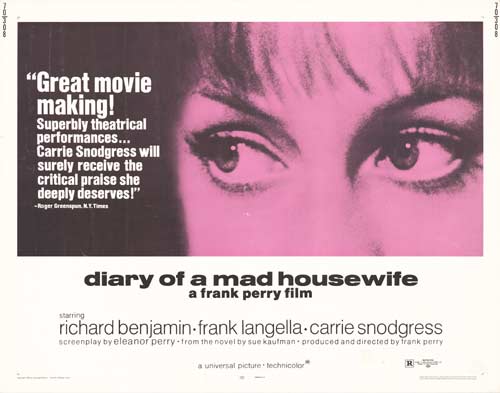
The film version of Diary of a Mad Housewife (1970), based on the best-selling novel by Sue Kaufman, is a tremendous, unique story of one woman’s frustration with her irritating life.

A superb Carrie Snodgrass stars as a haggard, insecure, yet affluent housewife named Tina Balser, living in New York City with an unpleasant family.

The family is led by Tina’s verbally abusive and neurotic husband, Jonathan- a successful attorney, played flawlessly and instead comedically by Richard Benjamin, and her two brattish daughters, Sylvie and Liz.

Bored, Tina decides to embark on an affair with crude artist George Prager, wonderfully played by Frank Langella. She teeters on the edge of an emotional breakdown throughout the film and trudges through life depressed and disappointed with all aspects of her life except for her affair with George.

George, however, is a womanizer and openly has other conquests besides Tina.

The film’s brilliant idea is to tell the story strictly from Tina’s point of view. All of the action centers on her character, which makes the film so enjoyable.

On the surface, one might argue she has everything- she is intelligent, well-educated, and affluent. A stay-at-home mother, she is treated like a servant by her husband, Jonathan, as he constantly berates her appearance and criticizes her activities- she is always doing something incorrectly.

The film, though, is not a downer. It is a dry, satirical comedy that reminds me very much of a Woody Allen film. Tina is depressed, yes, but she goes through life with a realistic, almost chin-up, outlook. Her marriage to Jonathan is loveless, yet why doesn’t she leave him?

Her affair with George is sexually satisfying, but she has no intention of pursuing anything further with him, nor does he want to. Tina dotes on her husband- planning dinner parties, sending Christmas cards, and various other wife duties.

I’m not sure that the film’s true intent is to show Tina as either a strictly sympathetic character or as completely downtrodden- the film is not a moral tale nor is it a schmaltzy, woman victimized and will rise against the world’s generic drama- it is witty and filled with black humor.

Despite her unkind husband, I found myself, in a way, envying Tina’s life, and I think the film expects that of the viewer. I never got the impression that Tina was suicidal in any way.

It’s not that type of film.

Instead, she has wealth, and she goes to fancy restaurants, but she also has a very needy husband- he does not abuse her in a physical sense, nor is she reduced to tears by his outbursts.

She gets annoyed, merely accepts that this is the way life is, and gets by with an occasional swig of alcohol while doing dishes or preparing dinner, or when the dog has “an accident” on the living room rug and Tina’s kids cannot wait to tattle on her.

She is a sophisticated woman, trapped in an unhappy yet financially secure relationship.

Diary of a Mad Housewife is an interesting character study for all women to view and perhaps even slyly wink at.  Many women would champion Tina. She is a likable, sarcastic, fabulous chick. Audiences will find themselves drawn to her and even falling in love with her before long- I know I did.

Without the talents of Carrie Snodgrass, who completely carries this film, it would not be the wonder that it is. An excellent satire, the film is not as wry or satirical as the novel, but how many films are?

The novel delves deeper into the role of the Balsers’ maid, who is barely mentioned in the film, yet she plays a larger role in the Kaufman novel.

I loved the portrayal of Jonathan by Richard Benjamin, who must receive some honor for the most annoying character ever in the film when he repeatedly screams for his wife by bellowing “teeeenaaaaa!”, or initiating sex by asking “Would you like a little roll in dee hay?”, one wants to choke him.

The way Tina’s daughters whine “mudder” instead of “mother” is comically brilliant. And her simmering hatred of all of them is dark hysteria.

Diary of a Mad Housewife is a genius and should not be forgotten.

Oscar Nominations: Best Actress-Carrie Snodgress

Westworld-1973

Westworld-1973

Director Michael Crichton

Starring Richard Benjamin, James Brolin, Yul Brynner

Scott’s Review #1,056

Reviewed August 25, 2020

Grade: A-

I have seen the film version of Westworld (1973) before and after having watched the current hit HBO television series, brilliant in its complexities.

Many are not even aware that the series is based on a film, and that is a pity because the film is good stuff with lots to digest in a short time.

Admittedly, watching it in present times, given the series’s extreme psychology, the film has so much more it could have offered, but it’s still a great watch.

One must always remember the time period a film was made in for proper context and comparison.

Yul Brynner nearly steals the film with a spectacular, creepy performance as a wide-eyed, futuristic android cowboy to Richard Benjamin and James Brolin’s regular guys out for an escapist good time.

Much of the film could be conceived as a buddy film with a bevy of homoerotic elements brimming beneath the surface if one is aware. These tidbits spice things up in an already escapist and futuristic world.

A titillating, high-tech adult-themed amusement park serves as the film’s backdrop. Participants can choose any of the three worlds: the Western World, the Medieval World, or the Roman World. All feature lavish, realistic trimmings and ooze realism.

The inhabitants are robots, not real people, so they can be shot, stabbed, or made love to depending on the personal tastes of those who wish to indulge in their wildest fantasies.

The island is very exclusive, and the experience comes at a high cost.

Peter (Benjamin) and John (Brolin) are businessmen who adore the Wild West, so they select the Western World. They enjoy frolicking with desperadoes, gunslingers, and dance-hall girls who appear as if they are human beings.

Enjoying their adventures, the technicians notice odd behavior from the androids. Small at first, events escalate quickly when a gunslinger (Brynner) goes on a rampage with Peter and John as his targets.

Since the television series is fleshed out so well and the motivations and the stories of the androids are examined at length, it makes it easy to ask why the film does not, or rather, wishes it had.

On the one hand, it is creepy not knowing what makes Brynner’s gunslinger tick; on the other hand, I want to know.

I also wanted to know more about the guests. Why were they there, and what are their lives in the real world like?

One way the film is superior to the series is in the way Peter and John are written.

Is it my imagination, or do the pair seem a little closer than merely friends? Do they wish to escape their lives to be together? Are the wives and children waiting at home for them?

A scene of Peter bathing is erotic, especially as he must abandon the tub mid-soak to battle a foe. He is the Marlboro man personified, though Benjamin’s too recent turn as the twit father from Diary of a Mad Housewife (1970) ruins any masculinity he has.

The climax is riveting.

Since we are unsure of the gunslinger’s motivations, we are unsure what he will do. A frightening scene unfolds as the gunslinger intently walks down a corridor, his expressionless eyes attentively stalking his prey. This still gives me the chills.

When the android is sprayed with acid, its face becomes freakish and psychotic-looking. This adds to the fright of an already frightening character. When Peter frantically traverses the park in search of help, his peril is heightened as he finds dead guests and damaged robots everywhere.

The severity of the situation is finally realized.

Crichton deserves much of the credit since he not only directed but wrote the screenplay, and this was his debut! The pacing is excellent, and something is going on at all times, making the film feel as entertaining as it is intelligent.

The dazzling cinematography of the world allows the viewer to see the differences.

Westworld is riddled with intriguing questions that go unanswered, which adds to the tension.

Impossible not to compare the film to the series as much as we might like not to. Westworld (1973) is a freakish, creative adventure that I wanted so much more from, having seen the complexities and story possibilities crafted for the series.

I am not a fan of remakes, but in this case, a modern retelling is not a bad idea. Some accuse the film of being cheesy, over-the-top, or “too 70s,” but I disagree.

I like the hidden trimmings and messages mixed with the good fun.

Catch-22-1970

Catch-22-1970

Director Mike Nichols

Starring Alan Arkin, Bob Balaban, Martin Balsam

Scott’s Review #41

60020883

Reviewed June 18, 2014

Grade: B

Catch-22 (1970) is a satirical film similar in subject matter to Robert Altman’s M*A*S*H, released the same year, though admittedly, I have not seen that film yet.

It does remind me of Dr. Strangelove (1964) and Slaughterhouse-Five (1972) in their anti-war theme.

This film is well-made and certainly effectively portrays the outrageousness and lunacy of war.

Most of the characters are portrayed as crazy, albeit in a darkly humorous, over-the-top way.

Alan Arkin is wonderful as the protagonist trying to find a way out of the island of Italy, where he and his fellow pilots are stationed.

At times, the film feels disjointed and hard to follow, which I understand the novel is too (I have not read the entire book), but Catch-22’s (1970) message comes across loud and clear.