Category Archives: Nigel Patrick

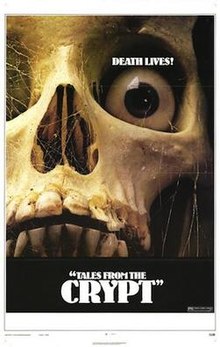
Tales from the Crypt-1972

Tales from the Crypt-1972

Director Freddie Francis

Starring Joan Collins, Ian Hendry, Robin Phillips

Scott’s Review #1,200
Reviewed November 25, 2021

Grade: A-

Tales from the Crypt (1972) is a delicious British anthology based on stories from the EC Comics series. Each of the five chapters is eerie storytelling that offers horror fans glimpses into the minds of depraved, devilish characters with sinister motives.

The sheer joy is witnessing their comeuppance.

This film is the predecessor to Vault of Horror (1973) and can be watched as a companion piece.

Below is a summary, review, and rating of each vignette.

Intro

Five strangers are suddenly compelled to join a tourist group to visit the old catacombs.

Separated from the main group, the strangers find themselves in a room with the mysterious Crypt Keeper (Ralph Richardson), who details how each of them may die.

…And All Through The House- A

Joanne Clayton (Joan Collins) brutally kills her husband Richard (Martin Boddey) on Christmas Eve to get her hands on their insurance money.

She prepares to hide his body but hears a radio announcement of a homicidal maniac (Oliver MacGreevy) on the loose.

She sees the killer (who is dressed in a Santa Claus costume) outside her house, but cannot call the police without exposing her crime.

Her daughter is upstairs in her bedroom, unaware.

This is my favorite chapter, and it’s nonstop action. Collins is terrific as the greedy Englishwoman put in peril. The audience will cheer for her to get her just desserts, especially after she callously disregards a lovely Christmas gift her husband bought for her.

Reflection of Death- B+

Carl Maitland (Ian Hendry) abandons his family to be with his secretary, Susan Blake (Angela Grant). After they drive off together, they are involved in a car accident. He wakes up, having been thrown clear of the burned car. He tries to hitchhike home, but everyone he meets screams with horror when they see him.

This vignette is slightly confusing in terms of the events’ timeline, but compelling as we wait to see what Carl’s face looks like and what has happened to Susan and his wife.

Poetic Justice- A

James Elliott (Robin Phillips) lives with his father Edward (David Markham) across from the home of elderly dustman Arthur Edward Grimsdyke (Peter Cushing), who owns several dogs and entertains children in his house.

James hates Arthur’s ramshackle lawn and embarks on a scheme to rid the neighborhood of the older man.

I love seeing Cushing play against type as a kindly grandfatherly character, and this chapter is the ultimate revenge fantasy, and quite satisfying to see what happens to James.

It’s also a perfect watch for Valentine’s Day, since the holiday is in play.

Wish You Were Here- A-

Businessman Ralph Jason (Richard Greene) is on the verge of financial collapse. His wife Enid (Barbara Murray) notices the inscription on a Chinese statue the couple owns.

They are granted three wishes. Enid decides to wish for a fortune and, surprisingly, the wish comes true, but with dire results.

This one wonderfully cascades a chain of events that leaves the characters in peril. The theme is once again about greed, specifically surrounding insurance money. The fast-paced nature is appealing, and the ancient Chinese wishes leave one character in eternal suffering.

Blind Alleys- A-

Major William Rogers (Nigel Patrick) becomes the new director of a home for blind people and exploits his position to live in luxury with his dog, Shane. At the same time, his drastic cuts to food and heating worsen the residents’ living conditions.

Led by George Carter (Patrick Magee), the residents revolt after a fellow resident dies of hypothermia. Rogers and Shane are locked in the basement, where Rogers must navigate through a maze of razor blades and a now ravenous wild dog who will hungrily eat his owner.

Though far-fetched, Blind Alleys is delicious fun and contains my most hated character. This is all the more satisfying as he ‘gets it’ in the end!

Finale

After completing the final tale, the Crypt Keeper reveals that he was not warning them of what would happen, but telling them what has already happened: they have all “died without repentance.

The conclusion does nothing more than put a satisfying cap on the viewer as each character once again pays for their shenanigans.

The Mackintosh Man-1973

The Mackintosh Man-1973

Director John Huston

Starring Paul Newman, James Mason, Dominique Sanda

Scott’s Review #1,058

Reviewed August 31, 2020

Grade: B

The Mackintosh Man (1973) is not one of legendary director John Huston’s best films.

Known for well-remembered titles like The African Queen (1951), The Maltese Falcon (1941), and The Misfits (1961) that all movie historians and fan buffs are familiar with (or should be), this project is rather lackluster, only picking up at the very end to offer a riveting ending.

The rest is mediocre, weighed down by a plot that lacks depth, a romance that falls short, and little in the way of answers or a good wrap-up.

If this sounds too harsh, I will say that anything starring Paul Newman is worth seeing. Huston hit the jackpot in the casting department, and the actor provides enough to raise The Mackintosh Man’s status to an adequate “B” ranking.

I hate the title as it took days for it to stay in my memory.

Huston attempts to make the film a taut thriller, which at times is achieved, especially during the climax, and mixes humor, but the humor rarely comes through, only getting in the way of what would have been better in a darker vein.

It feels like a weak attempt to turn Paul Newman into James Bond.

Back to Newman. With his handsome face and icy blue eyes, he makes any film compelling, but I never really bought him in the role. This could be because of how the character is written.

Newman is an American actor who plays a British secret agent pretending (sometimes) to be Australian. This is a busy ask even for an actor of Newman’s caliber. He was much better in Alfred Hitchcock’s critically panned but well-aged Cold War thriller, Torn Curtain (1966), in a similar role.

Dominique Sanda, brilliant in The Conformist (1969), has little screen time until the finale, when her character finally shows depth.

Newman plays Joseph Rearden, a British intelligence agent tasked with bringing down a communist spy ring. After purposely getting himself tossed in a high-security prison, he breaks out of the joint in an escape arranged by a mysterious organization.

Rearden then tries to track the group’s activities and unmask its shadowy leader, played by James Mason.

On paper, the premise sounds quite appealing, and with Newman, Mason, and Sanda in my pocket, my expectations were lofty, but not met.

I am not painting the film as bad by any means, just not as good as I anticipated. Certainly, some aspects work.

Reardon’s time in prison is appealing and might have influenced the not-yet-made Escape from Alcatraz (1979).

When a male prisoner makes a pass at Reardon on the lunch line, asking Reardon if he’d like to dance with him, he is kindly rebuffed. Does the prisoner cleverly respond with “maybe in a year or two”?

The scene is played for laughs but also contains a sweet innocence.

The Mackintosh Man is not a film in which a scene like this can be interpreted as anything more than a reaffirmation of Reardon’s (and Newman’s) masculinity, though.

From there, we get back to business.  He meets a convicted Russian spy, and the two conceive a successful prison break. How they escape so easily is hard to swallow, but they have help from an organization.

After the breakout, Reardon finds himself drugged and sent to Ireland. It turns out that Mackintosh organized the escapade in the hope that Reardon could infiltrate the Scarperers, gather information on the group’s leader, Sir George Wheeler (James Mason), and prove that he was a Russian spy.

Just writing this out feels too confusing, which is the film’s main problem.

Reardon has a flirtation with an eccentric, tall, bad girl straight out of a Kubrick film, before connecting better with Mrs. Smith (Sanda), and culminating in a harrowing climax aboard a luxury yacht, with the gorgeous backdrop of Malta.

The sequence almost makes the rest of the film forgivable, as a lot of action suddenly develops, and the landscape is gorgeous. A deadly and unexpected shooting occurs after an incident involving drugged champagne or white wine.

I advise watching The Mackintosh Man (1973) with the knowledge that the slowness and the confusion of most of the film are worth watching for the fantastic finish.

Events and plot points may not necessarily all be spelled out, but the yacht scene and Malta locales are tremendous.

Newman carries the film with good acting from Mason and Sanda supporting the star.