Category Archives: Lelia Goldoni

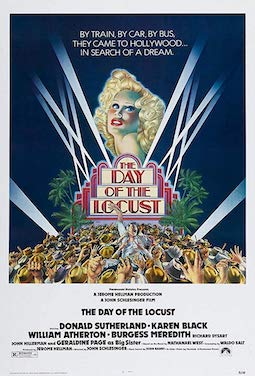
The Day of the Locust-1975

The Day of the Locust-1975

Director John Schlesinger

Starring William Atherton, Karen Black, Donald Sutherland

Top 250 Films #189

Scott’s Review #1,460
Reviewed January 16, 2025

Grade: A

I love films set in Los Angeles, especially those dealing with Hollywood and/or the dark underbelly of the City of Angels. With its lights and allure, there is a murky side laden with drama, jealousy, and loneliness.

John Schlesinger’s dark period piece The Day of the Locust (1975) examines the bleak lives of several aspiring people in 1930s Hollywood, just before World War II.

The prominent themes are alienation and desperation, with aspirations for success that do not come true, emphasizing the sad saying, ‘The road to Hollywood is paved with broken dreams.’

It’s a brilliant adaptation by screenwriter Waldo Salt, based on Nathanael West’s 1939 novel of the same title. The film horrifically depicts the Hollywood film industry in all its artificial glitz and glamour.

In the 1930s, Los Angeles ‘ sunny Hollywood shone like a beacon to helpless people across the city who were looking for fame, fortune, or a quick buck.

In one apartment block, blond bombshell Faye Greener (Black) aspires to be an actress, artist Tod Hackett (Atherton) seeks legitimacy, and a frightening child actor named Adore (Jackie Earle Haley) performs a grotesque homage to Mae West.

Introverted accountant Homer Simpson (Donald Sutherland) watches as society collapses under greed and ambition.

From a romantic standpoint, Homer and Tod vie for Faye’s affection in a tragic triangle fraught with jealousy and competition.

Schlesinger knows his way around dark, influential, intelligent films. He created stalwarts such as Midnight Cowboy (1969) and Sunday Bloody Sunday (1975), both unconventional and controversial, the former being the only film ever to win Best Picture and garner an X rating.

The Day of the Locust is no different.

There is scarcely a likable character in the cast, but I ascertain that Tod is the most stable and trustworthy in the rogues’ gallery.

He appears grounded and the voice of reason, though he mocks Homer later on at a party, so he’s not exactly Prince Charming. He arrives at work as a production illustrator in the art department at a major film studio and rents an apartment in the same community as the other characters.

Gently, he places a lovely flower in a crack in the wall.

Tod is smitten with Faye, a callous vixen who beds not one, not two, not three, but four men and makes no bones about it. Not exactly a feminist, she is more concerned with rising to stardom at any cost.

We meet Faye as she works as an extra in a lavish production. She smacks her gum and then snaps into character as a royal sophisticate, revealing a tacky, tawdry presence to the audience.

Later, during the grand finale, she tries to catch a glimpse of the big stars arriving in limos at a premiere at Grauman’s Chinese Theatre, one in a crowd of thousands.

She’s a lost soul, filled with self-delusion, desperately wanting the spotlight in whatever form she can get.

Her father is played by Burgess Meredith, who nearly steals the show as an elderly, washed-up ex-vaudevillian.

Despite the outstanding performances, the production design and cinematography are flawless, seamlessly portraying what life was like in Hollywood in the early days.

My favorite sequences are in the movie sets filled with pizazz, glamour, and intricacies.

The most significant scene, though, occurs at the star-studded event, a premiere of The Buccaneer, when all hell breaks loose, and a tragic death occurs, leading to subsequent bloodshed and further death and destruction.

It’s a spectacle, supposed to be the movie event of the year, with champagne and the ultimate celebration of film, but the stark nature of one’s rage overtakes the beautiful moment.

During this pivotal scene, we see the darkness of humanity counterbalanced against the glitz and glamour of movie stars.

Schlesinger masterfully takes us through this journey of human depravity with flawless ease.

The Day of the Locust (1975) is a brilliant film.

Oscar Nominations: Best Supporting Actor-Burgess Meredith, Best Cinematography
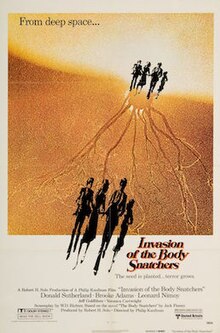
Invasion of the Body Snatchers-1978

Invasion of the Body Snatchers-1978

Director Philip Kaufman

Starring Donald Sutherland, Brooke Adams, Veronica Cartwright

Top 250 Films #217

Top 40 Horror Films #31

Scott’s Review #1,434

Reviewed July 22, 2024

Grade: A-

Even though this film is a remake and remakes are usually not as good as the original, I am partial to the 1978 version of Invasion of the Body Snatchers versus the 1956 release.

This might even be one of the best remakes ever.

The 1950s version has a campy science-fiction element popular in the decade, featuring frightening, otherworldly elements like The Day the Earth Stood Still (1951) or Invaders from Mars (1953), which were meant to promote the idea of invaders taking over Earth.

This was enough to scare the bejesus out of middle America, USA, and their white picket fence-encased neighborhoods.

The 1970s version eschews camp in favor of a straight-ahead sci-fi/horror hybrid. A glamorous, artistic approach oozes from the 1970s and from various exterior sequences in San Francisco, making it superior to the original.

It’s a more polished and mainstream-ready product that works better for this film.

By far the best scene is the final scene between a perfectly cast Donald Sutherland and Veronica Cartwright, which left chills going up and down my spine.

I won’t spoil the fun, but suffice it to say that the actor’s facial expressions make the scene exceptional, especially when paired with the creepy sound effects.

Director Philip Kaufman also toys with his audience when he teeters ambiguously between his leading ladies. Is Cartright the ‘final girl’ or is it Brooke Adams? In parallel to Hitchcock’s Psycho (1960), the lead may not be who you assume it to be.

Matthew Bennell (Donald Sutherland) is a health inspector who assumes that when his friend and colleague Elizabeth (Brooke Adams) complains of her husband’s strange mood, it’s a cheating husband or an exaggerated concern.

He begins to worry, however, as more people report similar observations about their loved one’s strange behavior.

His concern is confirmed when writer Jack Bellicec (Jeff Goldblum) and his wife (Veronica Cartwright) discover a mutated corpse that creates a citywide epidemic in which humans are replaced by alien doubles devoid of humanity or emotion.

The casting is first-rate, especially because Sutherland is front and center. The actor does wonders with his bulging blue eyes and a spacey demeanor. This works well in a film where we wonder whether his character is ‘one of them’.

He’s also a good actor and easily carries the film along with Adams and Cartright.

Kaufman peppers the film with eerie atmospheric elements like the mysterious parasitic alien race scurrying to harvest before their planet dies, and small seed pods amid hallucinogenic pink flowers.

The success is mainly due to the audience being left uncertain about whether to hate the aliens or feel sorry for them. Since they are ambiguous, this leaves confusion and, therefore, a sense of empathy.

Speaking of the exterior sequences, a great one takes place on the streets of San Francisco, where a hysterical man warns Elizabeth and Matthew of danger as a mob pursues him. He is then killed in a hit-and-run, surrounded by emotionless onlookers.

Eagle-eyed viewers will spot Kevin McCarthy, the leading man in the 1950s film, and director Don Siegel.

When this scene plays, it is eerie and underscores that the small group of friends must stick together against a mob of clones.

Wisely, Kaufman assures readers that the story does not play for laughs or appear over-the-top or silly. The gritty camera angles, superior makeup crew, and wonderfully practical sound effects confirm that he is making a film to be remembered.

Taking what the 1950s version created but only scratched the surface of the potential during a cinematically safe decade, the 1978 Invasion of the Body Snatchers has muscle and compels from start to finish.

Years later, it still holds up wonderfully well alongside similar stylistic and popular horror films such as Jaws (1975), Carrie (1976), Dawn of the Dead (1978), and Halloween (1978).

On a larger level, it also confirms the 1970s as the greatest decade for horror films.

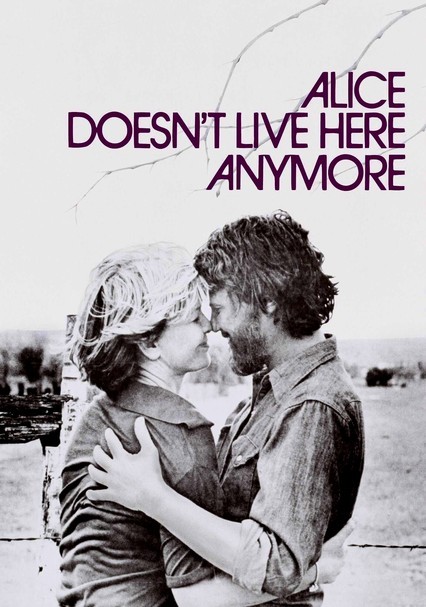
Alice Doesn’t Live Here Anymore-1974

Alice Doesn’t Live Here Anymore-1974

Director Martin Scorsese

Starring Ellen Burstyn, Kris Kristofferson, Diane Ladd

Scott’s Review #1,075

Reviewed October 27, 2020

Grade: A-

Deserving of the Best Actress statuette she won for her role, Ellen Burstyn carries the film Alice Doesn’t Live Here Anymore (1974) from start to finish with drama and comedy.

I can’t watch any performance of Burstyn’s without smarting at how she lost the same award years later, after her frighteningly good performance in Requiem for a Dream, released in 2000.

She was defeated by Julia Roberts, who delivered an adequate, though unexceptional, performance in Erin Brockovich (2000).

But, I digress.

A character study, Alice Doesn’t Live Here Anymore, tells the powerful story of a woman (Burstyn) forced to begin a new life and forge her path after her husband is killed in a car accident.

She is thirty-five years old and wary of the approaching middle age as she pursues a singing career. She is joined by her young son, Tommy (Alfred Lutter), and faces fear and loneliness as the pair embarks on a journey throughout the southwestern United States.

She dates, fights, and does a soul search, finally landing a job as a waitress at a roadside diner.

On paper, this film could have been reduced to television movie status, as the premise sounds kind of corny and sentimental.

Shocking to me is that Martin Scorsese directed it. Best known for male-driven mobster pictures like Goodfellas (1993), Gangs of New York (2002), and The Irishman (2019), Martin Scorsese’s introspective female-journey film doesn’t seem like his thing.

A fun fact is that he agreed to direct at Burstyn’s urging, since she wouldn’t have starred otherwise. The actress surmised that the script needed more darkness and grit, which it contains without losing its heart.

A strange yet lovely photographed scene kicks off the picture and seems to be an homage to The Wizard of Oz (1939). With a dusty, golden backdrop, a young Alice looks like Dorothy with an idyllic life.

Suddenly, Alice’s mother bellows her to come home for dinner. She responds with salty language. The scene feels out of place based on the rest of the film, but it looks good.

Burstyn made me care about Alice from the first scene containing adult Alice. Alice is a good person. She is hard-working and strives to please her husband, hoping he will enjoy the delicious dinner she has prepared for him. He barely grunts at the meal and has a tumultuous relationship with Tommy, whom Alice spoils.

This plot point returns later in the film.

Alice is not a doormat; however, she provides humor and comic relief during tense moments. She also shares a warm friendship with her neighbor. We do not know what the husband’s demons are (depression?).

He and Alice share an emotional moment in bed one night before he dies the next day.

With her marriage behind her and limited financial means, Alice and Tommy take to the road. I adore the relationship between the two. Tommy is not always easy to parent, exhausting his mother with typical young adult nonsense.

It’s easy to forget that he has lost his father and has no direction. Their relationship is complicated, but there is much love.

The juiciness comes when Alice finally lands a singing gig at a seedy lounge bar and meets the maniacal Ben, played flawlessly by Harvey Keitel.

At first, he is charming and attentive, wooing her like she’s never been wooed before. When she learns he is married, he turns psycho, and she is forced to leave town.

The meat of the film comes when Alice begins working at the diner and meets her new friend, Flo (Diane Ladd), and her new love, David (Kris Kristofferson). After some trials and tribulations, Alice realizes her life is not so bad.

As much as there are dramatic elements, Alice Doesn’t Live Here Anymore is not a soap opera or overwrought. The scenes and situations bristle with energy and authenticity, thanks to the great acting and fluid direction.

My favorite scenes occur at the diner. With greasy blue-plate specials and dishes piled with ham, eggs, and hash browns, the working-class extras are perfectly positioned around the diner.

In the background, they lend a feeling of rush, chaos, and family traditions. The diner scenes are where Alice bonds the most with Flo and David, and they are delicious.

Alice Doesn’t Live Here Anymore (1974), a lighter, wholesome production, was turned into a popular television sitcom in the late 1970s, titled Alice. It’s a progressive story about a woman on her own, getting it done, and mustering the courage to face whatever life throws at her.

It’s an inspiring story for both women and men.

Oscar Nominations: 1 win-Best Actress-Ellen Burstyn (won), Best Supporting Actress-Diane Ladd, Best Original Screenplay