Category Archives: Eddie Albert

Oklahoma!-1955

Oklahoma! -1955

Director Fred Zinneman

Starring Gordon MacRae, Shirley Jones, Rod Steiger

Top 250 Films #184

Scott’s Review #51
820796

Reviewed June 20, 2014

Grade: A-

Oklahoma! (1955) is one of a slew of memorable Rodgers and Hammerstein musicals to emerge from the 1950s and 1960s Hollywood and to be based on a popular stage version.

The film has an old-west, homespun, comfortable appeal. It is best enjoyed during the summer months.

While Oklahoma! seems a bit too hokey and is not my favorite musical compared to other more sophisticated stalwarts such as My Fair Lady (1964), An American in Paris (1951), or The Sound of Music (1965), it emits a flavor and tasteful appeal of the West.

The plot focuses on a love triangle between a good old boy, Curly, a good girl, Laurey Williams, and brooding Jud, though the real rooting couple is Curly and Laurey.

The trio is supported by many townspeople who gossip about them and help Curly and Laurey admit their true feelings and unite as a couple.

Of course, Jud is the villain, and conflicts come into play throughout the production.

A lesser couple, Will Parker and Ado Annie, also enter each other’s arms amid traditional small-town events such as a lively summer fair.

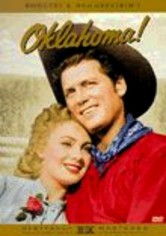
Stars Gordon MacRae (Curly) and Shirley Jones (Laurey) are very handsome and likable in the lead roles, making for a nice pairing.

Gloria Grahame is as appealing and comical as Ado Annie, especially in her rousing turn bellowing out, “I Can’t Say No,” Charlotte Greenwood is the moral voice of reason as Aunt Eller.

What works best in the film are the settings of Oklahoma, as the viewer experiences such a feel for life in the heartland long ago (though the exteriors were shot in Arizona).

It’s pure fantasy enjoyment with a magical Wizard of Oz feel, though no cyclone or munchkins are anywhere in sight. The film version closely follows the original stage version.

The musical numbers are pretty catchy (“Oh What a Beautiful Morning,” “I Can’t Say No,” and “Oklahoma” are my favorites). The controversial mid-number “Dream Ballet” is provocative, artistically enjoyable, and jarringly different from the rest of the traditional tale.

This jaw-dropping number mirrors a similar spectacle in An American in Paris.

Perhaps Oklahoma! is not entirely on par with other musicals of its day but darned close.

Oscar Nominations: 2 wins-Best Scoring of a Musical Picture (won), Best Sound Recording (won), Best Cinematography, Color, Best Film Editing

The Concorde…Airport ’79-1979

The Concorde…Airport ’79-1979

Director David Lowell Rich

Starring Alain Delon, Susan Blakely, George Kennedy

Scott’s Review #1,078

Reviewed November 7, 2020

Grade: B

The fourth and final installment of the popular Airport film franchise, The Concorde…Airport ’79 (1979) has an appealing and sophisticated international flavor, mainly French culture, that may turn off some viewers seeking a more traditional and domestic offering.

The three previous installments contained a wholesome Americana quality that is lacking in this one. The rich culture is the high point for me in a film that by all accounts is not very good.

By the late 1970s, the disaster genre had all but crashed and burned so the film was commercially unsuccessful, and the franchise thus abandoned.

The plot is utterly ridiculous even by disaster standards and my hunch is that ideas of what could go wrong on an airplane were hard to find. After all, it’s not easy to top an airliner crashing and sinking into the ocean, leaving most passengers unscathed.

This time we experience an airplane flying upside down (more than once!), nose-diving (more than once!), and nearly doing backflips and summersaults (more than once!).

Disappointing is the limited amount of deaths that occur despite these treacheries unless you count a shooting inside an apartment and a suicide that have little to do with the plane ride.

Back to my original point, the cultured and vibrant foreign presence, specifically Paris and its lustrous and historic offerings, is the high point of The Concorde…Airport ’79.

The City of Lights is heavily featured as a team of American Olympic athletes traveling from Washington D.C. to Moscow by way of a layover at Charles De Galle airport. The heavenly site of the Eifel Tower is an immediate identifier as French pilot, Captain Paul Metrand (Alain Delon), flies the state-of-the-art Concorde to the United States to transport its passengers to the games.

There is a strong French flavor to this film. During the Paris layover, George Kennedy’s Joe Patroni, now a pilot, befriends a gorgeous woman named Francine, whom he bonds with over dinner.

They, and others, embark on a fabulous French bistro and have the time of their lives. Who cares that she is later revealed to be a prostitute? The setting oozes with French goodness, food, and sexy accents.

One peculiarity is why the trip goes from Paris to Washington D.C. back to Paris and then on to Moscow. It’s a bit confusing and unnecessary.

Unintentionally funny is how the Concorde is attacked by a drone en route to Paris, and then a bomb is planted on the plane before takeoff to Moscow. Trouble occurs in the same plane with the same passengers.

You would think anyone with half a brain would sit the second leg out, perhaps hopping on the nearest boat or train out of town.

The main story is secondary and quite superfluous. Robert Wagner plays Kevin Harrison, a corrupt arms dealer who plots the destruction of the Concorde because news reporter and girlfriend, Maggie Whelan (Susan Blakely) has evidence of his weapons sales to communists.

He plans to blow up the plane, killing all the passengers, instead of hiring an assassin to kill only Maggie when she lands and before she can tell authorities.

The plot is completely story-driven.

Several celebrity cameos are added mostly for comic relief and largely go nowhere.

Jimmie Walker as the pot-smoking, saxophone-playing Boise, and Martha Raye’s bathroom-crazed Loretta are ridiculous by any standards. Charo’s one scene as Margarita, a woman who sneaks her dog on board and is subsequently kicked off the flight is a time waste.

I would have rather witnessed another scene of Loretta needing to use the restroom or Boise getting high.

And Susan Blakely overacts throughout the film.

Despite all these hard knocks, The Concorde…Airport ’79 (1979) is good entertaining fun, not to be taken seriously, and encouraged for fans of the genre.

There is much fun to be had with the guest stars, once A-list, now B or C-list, and the crash-landing finale over the snowy Alps is pretty cool.

Just know what you are getting yourself into.

Roman Holiday-1953

Roman Holiday-1953

Director William Wyler

Starring Gregory Peck, Audrey Hepburn

Scott’s Review #694

Reviewed October 26, 2017

Grade: B+

Roman Holiday, released in 1953, was a box office hit, pleasing legions of fans at the time, and a critical darling.

The film reaped Academy Award nominations, including the coveted Best Actress statuette for a young Audrey Hepburn.

A happy, uplifting story, the film is not diminished by Cinderella in the reverse storyline but rather is a charming, romantic experience immersing itself in pleasing locales of the cultural city of Rome.

Admittedly, Roman Holiday is an example of a film in which I preferred the latter half to the former, but it set the bar high in the romantic comedy genre.

Our heroine, Princess Ann (Hepburn), has it all glamorous life, gorgeous clothes, and assistants tending to her every need and want. However, she is unhappy and trapped in a rigid life that lacks freedoms or decisions, to say nothing of the fun. She catches glimpses of party-goers reveling in each night from her expansive palace window.

Simply put, she is lonely and unfulfilled.

When she sees an opportunity to escape her life for a night, she snatches it and stumbles upon an American reporter, Joe Bradley (Peck). Despite their differing backgrounds, they fall madly in love.

At first, I found something missing in the film, and the chemistry between Peck and Hepburn did not immediately embrace me. As the duo meets Ann, who is drunk from sleeping pills, and Joe is the ultimate nice guy who allows her to sleep in his apartment, the story seems lagging and lacks a good punch.

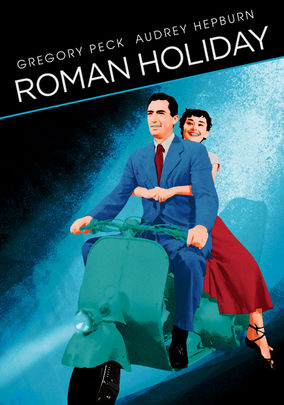
The pair drives around Rome on a scooter and acts childish and silly. Ann acts girlish because fun is an entirely new concept to her. At this point, the film is reasonable but little more than a farce.

As Roman Holiday progresses, primarily through the final act, the film sheds some of its light skin and becomes much more poignant and meaningful.

Ann and Joe, while in love, realize they will not and cannot embark on a fairy tale ending, which truthfully, would have made Roman Holiday little more than a standard romantic comedy we have all seen before- you know the type- boy meets girl, roadblocks persist, boy whisks girl away and rides off into the sunset together.

While not a dark film, it goes deeper than a transparent, predictable ending.

Related to this point is that Roman Holiday contains a realness that sets it apart from many films undoubtedly drawn from it. Still, unlike this film, it leans into contrived or predictable situations.

As Joe and Ann fall in love, the audience falls in love with them. The main plot hurdle—Joe’s temptation to profit from Ann once he realizes her true identity after a sought-after interview—is earnestly handled without pretension.

Other similar films ought to take note of this.

Indeed, the historic and culturally relevant locales of Rome are a significant selling point of the film, and if these scenes had been shot on a movie set, a lack of authenticity would undoubtedly have emerged.

Instead, we are treated to such fabulous location sequences as the Colosseum, the Tiber River, the Trevi Fountain, and Piazza Venezia. Such a delight is the long sequence of Roman escapades as Joe and Ann traverse the city in giddy bliss.

It is enjoyable to see how Roman Holiday contains no real villain.

There are no physical hurdles to the duo’s relationship—no outside forces plotting to keep Joe and Ann apart, other than their lifestyles. Ann lives in a world of royalty and pampering, but Joe is an everyman, so the chances of living happily ever after are slim.

Film lovers intent on discovering one of the early romantic comedies—one could argue that It Happened One Night (1934) was the first—should watch a feel-good Hollywood classic from 1953. It is rich in honesty, good humor, and raw emotion without being too heavy a melodrama.

After a mediocre start, the film finishes with gusto.

Oscar Nominations: 3 wins-Best Motion Picture, Best Director-William Wyler, Best Actress-Audrey Hepburn (won), Best Supporting Actor-Eddie Albert, Best Screenplay, Best Story (won), Best Art Direction, Black and White, Best Cinematography, Black and White, Best Costume Design, Black-and-White (won), Best Film Editing

Carrie-1952

Carrie-1952

Director William Wyler

Starring Jennifer Jones, Laurence Olivier

Scott’s Review #240

60011689

Reviewed May 3, 2015

Grade: B

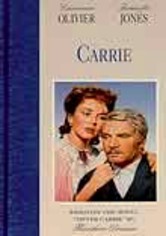
Carrie, not to be confused with the 1976 horror classic Brian DePalma, is a 1952 drama starring Laurence Olivier and Jennifer Jones—two big Hollywood stars of the time.

Shot in black and white, the film tells the story of a self-titled ingénue (Jones) from a Midwest upbringing who travels to Chicago to make her fortune.

Attempting to launch her career, Carrie becomes immersed in a love triangle with Olivier, who is unhappily married and runs a restaurant with salesman Charles Drouet, played by Eddie Albert.

Directed by William Wyler, the film has a melancholy tone as one of the characters sinks into a world of despair.

The highlight of this film is Laurence Olivier’s excellent performance as George Hurstwood, who goes from being a successful restaurant manager with an affluent existence to a poverty-stricken, lonely, and broken older man.

Olivier is so effortless and believable in his performance, as he always was.

However, I felt that Jennifer Jones was miscast. While attractive, yes, I did not think that every man would lust after her on sight alone, as was needed for the character of Carrie. Her acting, while okay, is not on the level of either Albert or especially Olivier, with whom she shares much screen time.

Perhaps Vivian Leigh, Teresa Wright, or Kim Novak might have been wiser choices.

The story itself is compelling and engaging. Here we have a woman- at the turn of the twentieth century- forging ahead to make it on her own- almost unthinkable for a woman, taking menial jobs as a sewing worker in a factory to scrape by.

Carrie resists the urge to become a rich husband-seeking gal and believes in marriage and true love. That is why she is devastated when she learns that George is married.

Will true love win out for them? This seems to be the central aspect of the film.

Behind-the-scenes issues may have contributed to the problems that appear onscreen. Wyler reportedly did not want to cast Jones, Olivier did not like Jones, Olivier was injured during much of the filming, and the film’s ending was changed to provide a “happier” ending.

Initially, George was to commit suicide, which might have successfully made the film more shocking and heartbreaking.

Containing beautiful costumes and interesting cinematography, Carrie has positives but might have been much better than the final product ended up being, but for poor casting and real-life dramas that hurt the film.

Oscar Nominations: Best Art Direction, Black-and-White, Best Costume Design, Black-and-White