Category Archives: Harry Andrews

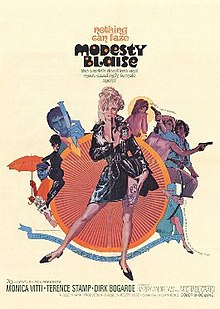
Modesty Blaise-1966

Modesty Blaise-1966

Director Joseph Losey

Starring Monica Vitti, Terence Stamp, Dirk Bogarde

Scott’s Review #1,243
Reviewed April 9, 2022

Grade: B

Modesty Blaise (1966) is a campy, over-the-top escapist film loosely based on a British comic strip. It features a relaxed style but a convoluted plot.

The story doesn’t matter much, and the film feels based on the James Bond film series with some Dick Tracy and Brenda Starr comic elements thrown in.

Throughout the action, I chuckled at the characters’ situational comedy antics. Both heroes and villains get mixed up in one hokey situation after another, and all the actors seem well aware that they are not performing Shakespearean comedy.

They forge ahead, making it as much of a zany offering as humanly possible.

Much of the film is reminiscent of television, Get Smart, a foolish but sweet-natured 1960s spy-genre offering.

I challenge the odd decision to make a film of this genre a bloated one hour and fifty-seven minutes. A spry ninety or ninety-five minutes would have been ample time to wrap up the experience and allow audiences to head for the exits.

This might prevent some from realizing how silly a film they’d just sat through

Modesty Blaise is not a traditionally good film but grooviness and pizazz are the main attractions as characters indulge in an orgy of colorful situations and preposterous setups.

Lavish locales like Amsterdam, and London, and the roaring beaches off the coast of the Mediterranean Sea bring the film back from going too far off the rails and pepper it with some cultivation.

If you’re in the right mood, Modesty Blaise is a chuckle fest, but don’t waste your time if you’re aching for high art. The psychedelic, groovy art design and Mad Men-like sets won me over.

I quickly forgot to try and piece together the complicated plot.

I didn’t care who was who or who was trying to outwit who and why. And I was okay with that.

Gorgeous Italian actress Monica Vitti leads the charge, followed by the dashing English actor Terence Stamp. Together, they make a lusty and good-looking pair, though Vitti gets no acting accolades.

Her looks are the primary reason for her casting win.

The actress plays a beautiful former criminal named Modesty who decides to go straight and work for the Secret Service. They send her to infiltrate a ring of jewel thieves, but the stuck-up older regime does not especially respect her.

She shrugs it off and offers her best services.

Soon after she joins the gang, sophisticated and dangerous head honcho Gabriel (Dirk Bogarde) grows suspicious of his new charge; Modesty realizes that British Intelligence gave her a mission they could care less if she survives.

She then enlists her former partner, Willie (Stamp), to help her out of her peril while outsmarting both sides.

Most action scenes are ludicrous, and the likelihood of any of the stories being true is slim to none. Plenty of sequences are set on a luxury yacht or some other water transportation, and Vitti and Stamp are clad in as little as possible.

I smirked at more than one James Bond nod, though some influence on the still-to-be-made Diamonds Are Forever (1971) is noticed.

If I’m making Modesty Blaise out to be a terrible film, it’s not.

The gimmicky angle of having Modesty appear with a different hairstyle in every sequence is clever and enjoyable (my preference is for her as a blonde).

When she is imprisoned in a spiraling-colored basement cell and must climb out the roof for help, the set design is one of the best I’ve ever seen. The creative team gets an A-plus for expressiveness and imagination, which is why Modesty Blaise is so fun.

Dirk Bogarde and Rossella Falk play cartoonish criminals Gabriel and Clara, who are deliciously wicked. I was amazed at Gabriel’s towering purple cocktail and craved a sip to see exactly what he was drinking.

Satisfyingly, both main villains get their comeuppance.

The film is foolish, campy, and a silly time wrapped up in fantastic artistry from a creative team that deserves more credit than they probably received.

Modesty Blaise (1966) is a messy but enjoyable film. I found it endearing more than I probably should have. It’s the guiltiest pleasure in a chest of sub-par spy comedy films.
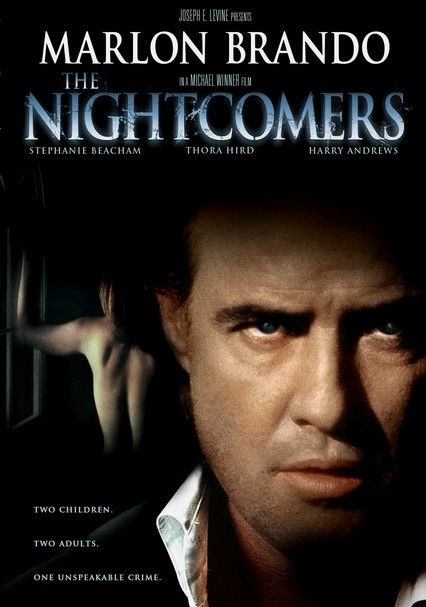
The Nightcomers-1972

The Nightcomers-1972

Director Michael Winner

Starring Marlon Brando, Stephanie Beacham

Scott’s Review #1,080

Reviewed November 11, 2020

Grade: B-

The Nightcomers (1972) is a disappointing prequel to Henry James’ 1898 novella The Turn of the Screw, which had already been adapted into the 1961 film The Innocents.

The dreadful title is neither catchy nor specific to the film. The lackluster and unmemorable result is jarring, given the masterpiece that is The Innocents.

It’s unclear whether the intention was to build on the film or to base it directly on the novella, forgetting The Innocents.

It’s not worth the effort to ruminate over the answer.

The most interesting comparison is that the film was released the same year as The Godfather (1972), in which the iconic role of Vito Corleone, the mafia head of household, and arguably the best role of Marlon Brando’s career, was created.

Mirrored against his role as a bizarre gardener named Peter Quint, with a broken Irish accent, one can guess why one role is memorable and why the other isn’t.

Flora (Verna Harvey) and Miles (Christopher Ellis) are recently orphaned children living in a vast English estate. Their absent guardian pays for the housekeeper, Mrs. Grose (Thora Hird), and governess, Miss Jessel (Stephanie Beacham), to keep things running smoothly.

Jessel and Peter embark on a torrid and sometimes abusive relationship that the children witness and emulate through play-acting. Flora and Miles suffer from isolation and must use their imaginations to make the best of their idle days.

Watching in sequence with The Innocents is not encouraged.

The Nightcomers is best served as a stand-alone product. The events and continuity are muddy and will confuse the most astute viewer.

Flora is much older than she is in The Innocents, even though the action takes place before those events. The characters being played by different actors doesn’t help.

Finally, The Nightcomers contains none of the ghostly mystique and spookiness that The Innocents does. So, it is advisable to put The Innocents out of mind.

Admittedly, events do come together in the final act, which is the best part of the film.

When two deaths occur simultaneously, they are both quite shocking and powerfully filmed. I felt more emotionally invested in the final ten-minute sequence than in the rest of the film.

Brando has one emotional scene worthy of his talents. Given the actor’s powerful chops, he can make any scene believable, but this is the cream of the crop material.

Stephanie Beacham is an okay casting choice, but I never felt the chemistry or connection between Jessel and Quint. Their relationship didn’t work for me.

Suspension of disbelief is required to get through a scene where a character drowns in what looks like two feet of water, making the scene lose some power.

Harvey and Ellis, as the children, are okay, but nothing spectacular. I am jaded, but I compare them again to The Innocents, and those actors are just better and more haunting, especially Miles.

The subject of mental illness and the distinction between reality and imagination is not explored in The Nightcomers.

The production is not a total dud, containing enough exterior elements of the plush and English landscape to please and make viewers feel they are in the country manor themselves.

The interior scenes are just as good. The children gallop through the enormous house to their heart’s delight, making the viewer feel like a kid along with them.

The sadomasochistic scenes between Peter and Miss Jessel are quite titillating and border on the X-rated. During the bedroom scenes, I nearly blushed from embarrassment. But, as erotic as they are, they also don’t do much to further the plot or add to the story.

They have a kinky sex life- so what?

There is also a weird suggestion of incest since Flora and Miles imitate what Quint and Jessel do; how far would they take it? The plot has good potential, but the film and direction aren’t executed well, and things don’t come together.

If you’ve never heard of The Innocents (1961), then The Nightcomers (1972) is recommended.

If viewing a cinematic masterpiece is desired, however, stick with the former and never look back.

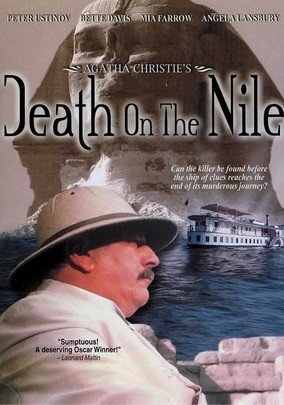
Death On The Nile-1978

Death On The Nile-1978

Director John Guillermen

Starring Peter Ustinov, Mia Farrow, Bette Davis

Scott’s Review #714

Reviewed January 14, 2018

Grade: B+

Death On The Nile is a 1978 British thriller that follows up the successful 1974 offering, Murder On The Orient Express- both films based on the fabulous Agatha Christie novels of the 1930s.

This time around, Belgian detective Hercules Poirot (Peter Ustinov) investigates a string of deaths aboard a luxurious steamer carrying the lavishly wealthy and their servants.

The film is a good, old-fashioned whodunit, perhaps not on the level of storytelling as its predecessor-the murder mystery contains not the oomph expected- but features exquisite Egyptian historical locales- worth its weight in gold.

Featuring a who’s who of famous stars and tremendous actors of the day, Death On The Nile carves a neat story right off the bat in such a way that the murder victim is fairly obvious right away- most of the characters have reason to celebrate her demise.

Rich and reviled heiress, Linnet Ridgeway (Lois Chiles), has stolen best friend Jacqueline’s (Mia Farrow) beau, Simon, sparking a bitter feud between the women. While honeymooning in Egypt, the newlyweds are continually taunted by angry Jacqueline.

Once the cruise ship departs with all on board, Jackie is the prime suspect when Linnet is murdered.

Poirot must find the killer as numerous other suspects all with grudges against Linnet, begin to emerge.

Death On The Nile serves up a stellar cast including legendary Bette Davis in the role of Marie Van Schuyler- an eccentric American socialite with an eye for Linnet’s necklace. The casting of Davis is reason enough to watch the film, though the character is not center stage but rather a supporting role.

The lead female honor is held for Farrow, who has the meatiest and most complex role in the film.

Jackie’s unstable actions make her the most likely to commit the deed, but the fun is to figure out the “whys” and the “hows” of the murder. Is there more than one killer? Are they working in cahoots or independently? As the body count increases these questions begin to resonate more and more.

The costumes and sets are gorgeous and it is no wonder the film won the Oscar for Best Costume Design. At a ball, the women are dripping with jewels and gorgeous gowns.

Along with Davis, boozy author Salome Otterbourne, hilariously played by Angela Lansbury, is granted the prize of wearing the most luxurious and interesting of all the costumes. She drips with jewels and, with a cocktail always in hand, is the film’s comic relief.

Director John Guillermin makes the film an overall light and fun experience and, despite the murderous drama, does not take matters too seriously.

Offering humorous moments, this balances nicely with the inevitable murders.

The fun for the audience is deducing whodunit- most of the characters have the motive and the cast of characters is hefty.

I had memories of the famous board game Clue- Was it Jackie in the ballroom with the revolver? You get the idea. The film makes for a good, solid game of mystery.

Comparisons to 1974’s Murder On The Orient Express cannot help but be drawn, especially in the lead casting of Hercules Poirot.

Truth be told, Albert Finney’s portrayal in “Murder” is superior to Peter Ustinov’s Poirot in “Death” and I am not sure what purpose Colonel Race (David Niven) as Poirot’s friend offers other than to be a loyal sidekick and present a character that Poirot can explain events to- think what Watson was to Sherlock Holmes.

Regardless, Finney is the superior Poirot as he musters more strength and charisma than Ustinov does.

How lovely and historic to witness the wonderful Egyptian locales- the Sphinx and the Great Pyramids are featured amid an attempt on the life of the romantic pair by way of falling rocks- this sets the tone for the perilous cruise about to be embarked upon.

Perhaps a perfect film for a Saturday stay-at-home evening with friends, complete with a serving of quality wine and cheese, Death On The Nile is a sophisticated, yet fun, British mystery film, fantastic to watch in a party setting where the audience can be kept guessing until the nice conclusion and the big reveal of who killed whom and why.

Oscar Nominations: 1 win-Best Costume Design (won)

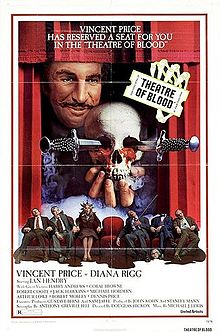
Theatre of Blood-1973

Theatre of Blood-1973

Director Douglas Hickox

Starring Vincent Price, Diana Rigg

Scott’s Review #230

220px-Theatreofbloodposter

Reviewed March 23, 2015

Grade: B

Theatre of Blood (1973) stars Vincent Price, a long-time fixture in the classic/campy horror scene, as a demented Shakespearean theatre actor who enacts revenge on the critics who fail to recognize him with a coveted award that he cherishes.

Price, as always frighteningly good, delivers a campy, but not ridiculous, turn as the crazed actor.

Price’s appearance alone- tall, wiry, with sinister facial expressions, poises him perfectly to believability in any dastardly role he portrayed in his heyday and the performance he gives as Edward Lionheart is no exception.

Not solely a campy, melodramatic horror film, Theatre of Blood rises above that categorization with humorous tributes to Shakespeare and a unique chronicle of the Shakespearean works used to systematically off the critics one by one about the Shakespearean story- quite frankly in a comical and witty way.

Price eerily dresses in many different elaborate costumes to commit the murders- a wine-tasting expert, and a television host, among other interesting characters, and oftentimes, taunts his victims before permanently dispensing them.

The film is quite British in tone and humor and done in a tongue-in-cheek manner so that the murders are not to be taken at all too seriously.

The critics themselves- seven or eight of them- are deliciously fun. One is a loud boisterous fat man who always has his beloved poodles at his side.

What happens to him and the dogs is better left unsaid.

Another is an uptight, sophisticated woman (played by Price’s real-life wife Coral Browne). Several of the critics are created as comic villains so their demises are not all too devastating for the audience as they are rather unlikeable characters, to begin with.

I found myself rooting for Lionheart and looking forward to the next murder!

One criticism involves Diana Rigg, who plays Price’s daughter Edwina, accomplice to his dirty deeds. Well known for her starring role in On Her Majesty’s Secret Service and the 1960s Avengers series, Rigg has little substance to do in Theatre of Blood.

Perhaps by 1973, her film career was on the downturn and she was not winning the coveted roles any longer. I would have loved to see her sink her teeth into a meatier role.

A side-kick, Edwina could have done much more.

The film belongs to Price and the unique storytelling of Shakespearean works made only possible by this great actor.

Not overly serious and played for some laughs, Theatre of Blood (1973) is successful in its telling of an interesting British horror story.

It’s a nice late-night treat for fans of the British horror genre especially.