Category Archives: James Coburn

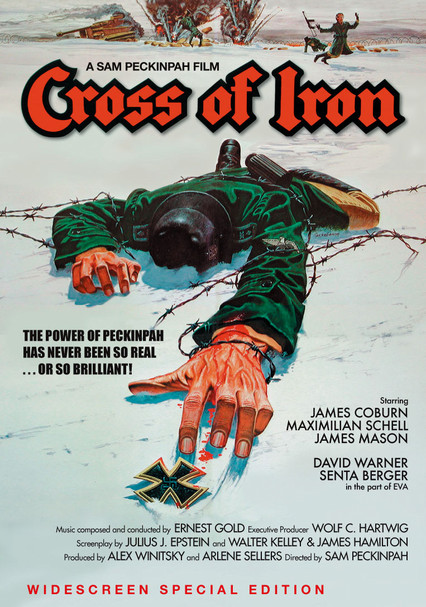
Cross of Iron-1977

Cross of Iron-1977

Director Sam Peckinpah

Starring James Coburn, Maximilian Schell

Scott’s Review #1,140

Reviewed May 8, 2021

Grade: B+

Cross of Iron (1977) is a film that sticks with you. I appreciate that it’s not a standard, cookie-cutter war film that too often graces the big screen decade after decade featuring different wars but applying virtually the same message. The tone is usually pro-United States with little explanation or defense of the other guys.

This is not one of those films.

That said, I could have used more of a straightforward approach because Cross of Iron is all over the place. It’s like a fragmented puzzle that doesn’t add up or come together but the experience is something both mind-blowing and unforgettable.

Sometimes confusing and unpleasant, it’s directed by Sam Peckinpah so anyone possessing knowledge of some of his other works knows what the experience will be like.

His best films, Straw Dogs (1971) and The Getaway (1972) are famous for their lightning-fast editing sequences galore and sudden still frames. Violence and mistreatment of female characters are also Peckinpah staples and Cross of Iron sure has those elements.

But it’s not on the level that Straw Dogs and The Getaway is as far as a solid storyline. Not even close.

The synopsis goes something like this. The time is World War II and Corporal Rolf Steiner (James Coburn) is a well-respected member of the German military and a recipient of the Iron Cross, Germany’s highest military honor. He leads a group of soldiers to battle somewhere in Russia, presumably.

Envious of Steiner’s Iron Cross award, Captain Hauptmann Stransky (Maximilian Schell), a Prussian officer clashes with Steiner when he joins the unit near the Russian front. Desperate to receive his own Iron Cross, Stransky takes the credit for a significant attack and sparks a heated rivalry with Steiner.

Mixed in with all this machismo drama between Stransky and Steiner are several brooding German soldiers, one French soldier, and a rescued Russian boy. A homosexual relationship between the French soldier and another soldier is discovered by Stransky and used as blackmail while Stransky himself may also be gay. Yet another soldier kisses a fellow soldier on the mouth.

Sadly, these story points go nowhere. And I didn’t care one iota about the Iron Cross.

To add to the confusion, a few of the German soldiers appear to be German while the others, especially Steiner, seem American. They frequently denounce Hitler which makes the viewer wonder why they are fighting for him. Are they forced to? Were many German soldiers not pro-Hitler but had to fight to avoid execution?

Again, these points are not explained.

The film introduction features children singing German songs amidst real-life footage of Hitler and Nazis and the conclusion also features children singing and still frames of children suffering during the war.

The sequences, while powerful, have nothing to do with the story since the story has nothing to do with children except the one lone Russian boy.

If you can get past the cloudy storylines Cross of Iron has some delicious stuff to chew on. Besides the fantastic editing, the film features one of the most intense and interesting scenes I’ve witnessed in a long time.

When the soldiers stumble upon a group of female Russian detachments things heat up. A despised Nazi Party member takes one of the women into a barn and rapes her. She bites off his penis and he kills her. Steiner allows the remaining women to exact revenge on the rapist and they beat him to death.

A couple of things stand out in this scene. As much as Peckinpah usually reduces his female characters to victims, in this scene there is a strong feminist angle which I love.

Were there Russian female soldiers in real life including a high-ranking major? Steiner allowing the women to kill the Nazis would make his group anti-Nazi?

There is a lot to ponder throughout and after watching Cross of Iron (1977). I’m not sure if I’m a huge fan of the film or ever need to see it again but maybe I should. So much goes on throughout the film that either adds or detracts from the experience that it’s a perplexing watch.

I’d add much more to the relationships between the characters, especially the male-male sexual dynamic to bring more substance.

The dynamic of Steiner taking the Russian boy under his wing had more to offer and I’d also reduce the number of battle scenes seemingly thrown in every so often to prove or justify that Cross of Iron is a war film.
The Great Escape-1963

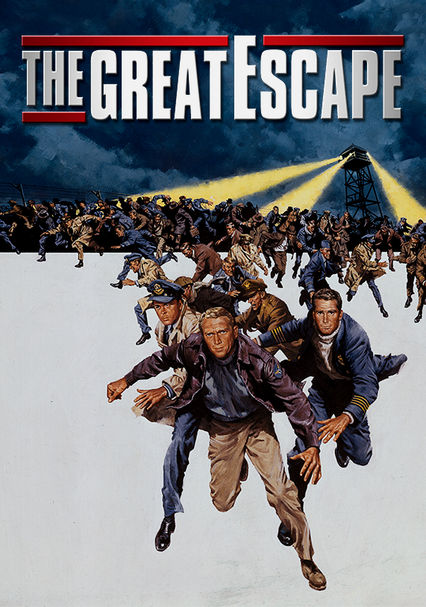
The Great Escape-1963

Director John Sturges

Starring Steve McQueen, James Garner, Richard Attenborough

Scott’s Review #1,053

Reviewed August 17, 2020

Grade: B

Often heralded as one of the great World War II action films of all time, there is little great about the first half of the interminable two-hour and fifty-three-minute running time.

With enough military silliness to make television’s Hogan’s Heroes seem like high drama, the first half of The Great Escape (1963) would be graded a mediocre C or a C- and that’s being generous.

The final hour is entirely different. The film kicks into high gear when the actual “great escape” is launched. Not only does the action begin, but the characters become more layered, emotional, and compelling.

Killer location shots of Germany and Switzerland occur at a zooming pace, and the comedy soon turns to tragedy.

I don’t understand why the decision was made to save all the goodies for the final act instead of dispersing them throughout the film, but I am glad it took off.

Directed by John Sturges, known for creating a similarly masculine and muscular offering from 1960, The Magnificent Seven,  he once again is lucky to cast several of Hollywood’s then hot, young stars like Steve McQueen and James Garner, and more relatable character actors like Donald Pleasence and Richard Attenborough who provide the acting grit.

While not on my list of great World War II films (Schindler’s List (1993) gets top honors), the film is recommended for the enthralling finale alone.

The film is based on Paul Brickhill’s 1950 nonfiction book of the same name, a firsthand account of the mass escape by British Commonwealth prisoners of war from German POW camp Stalag Luft III in Nazi Germany.

Unsurprisingly and shockingly, the actual events are significantly modified from the historical record, depicting a starkly fictionalized version of the escape, including Americans among the escapees.

Let’s discuss both portions, warts and all.

The changes are most irritating and done to make it more “Americanized” and, therefore, more appealing to mainstream audiences. This manipulation gnawed at me during most of the film since it’s factually incorrect.

There is a brief disclaimer at the beginning with a note saying the story is a work of fiction save for the escape portion, but this will inevitably be unnoticed or forgotten by the casual viewer.

Most of the first arc action is spent within the confinement of a massive, high-security, prisoner-of-war camp where the group of men is huddled, having escaped other camps or prisons. You would think the camp would be the equivalent of Alcatraz, but besides some barbed wire and not-so-threatening German soldiers with guns they rarely use, it’s not so intimidating.

Nonetheless, the group plots their elaborate, mostly underground escape upon arriving.

Whoever composed the musical score for the first section wanted to create a campy, situational comedy-style tone with brassy, patriotic tunes worthy of Gilligan’s Island.

This does nothing to create tension or danger, nor do the Nazi soldiers.

The men would be terrifying and rely on torture, but there is none of that to be found. Safe, but trying to be stern, this does not work as the German soldiers are played more like foils than those to be feared.

When the “great escape” is upon us, The Great Escape gets an A-plus for its thrills, action, and emotion.

A harrowing plane ride by Robert Hendley (Garner) and Colin Blythe (Pleasence) is juicy with tension and atmosphere. The plane exhibits trouble as the duo flies low across the German terrain, heading over the Swiss Alps for safety.

Meanwhile, Hilts (McQueen) steals a motorcycle and traverses the Germany/Switzerland border in a frantic chase scene while the Germans are in hot pursuit.

In a third sequence, other men flee via train in a cat-and-mouse pursuit.

Seventy-six POWs flee the camp, and a startling fifty are killed. Twenty-three are returned to the camp, and only three successfully escape.

If Sturges had built around the final hour and reduced the silly comedy style, probably attempting a contrasting theme to make the drama more imbalanced, he might have had a masterpiece.

Instead, The Great Escape (1963) is a twofold experience.

The comedy develops into a nail-biting, edge-of-your-seat thriller but suffers from too much historical inaccuracy to reach the depths of cinematic greatness.

Oscar Nominations: Best Film Editing

The Magnificent Seven-1960

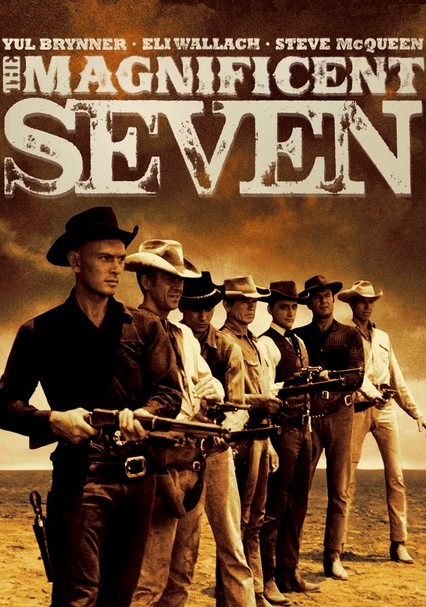
The Magnificent Seven-1960

Director John Sturges

Starring Yul Brynner, Steve McQueen

Scott’s Review #961

Reviewed November 22, 2019

Grade: B-

The Magnificent Seven (1960) is a Western in the classic sense that will satisfy fans of the genre. It features Hollywood stars of the day in heroic roles that give an aura of nationalism and conservative Americana.

Other than an outstanding musical score, a pleasant romance, and some male bonding, the film feels quite dated, with racial overtones that probably were not as irritating in the 1960s as they are now.

The film is a remake of the 1954 Japanese film Seven Samurai.

The bullied residents of a small Mexican village decide to hire seven American gunslingers to defeat a gang of bandits led by Calvera (Eli Wallach), who terrorizes the villagers regularly.

The Gunslingers are led by Chris Adams (Yul Brynner) and feature Vin (Steve McQueen), Bernardo (Charles Bronson), Lee (Robert Vaughn), Harry (Brad Dexter), Britt (James Coburn), and Chico (Horst Buchholz). Each is distinctive in some way- Lee is a veteran while Vin is a drifter, and so on.

The musical score is to be praised for its high energy and adventurous timing, especially during key scenes.

The introduction of the seven gunslingers is fun and popular for the Western genre, especially in television series of the time. This was a treat for audiences because most cast members were handsome, leading men.

The music also infuses the film with charisma and is perfect for the genre.

A romance between the hot-blooded Chico and the gorgeous Mexican girl Petra also works. An unlikely pairing, the couple has resounding chemistry and a West Side Story-style connection. Not supposed to be attracted to one another or hardly soul mates, the two blessedly share a happily-ever-after roll-up as the entire film does.

Westerns in the 1960s were meant to be crowd-pleasing and not especially daring. Chico and Petra are a nice addition and provide a bit of diversity.

Brynner and McQueen’s swagger is filled with machismo that might be annoying in a different film, but it works in The Magnificent Seven. They both look great, are clearly in their prime, and are well suited for a feature meant to satisfy the tastes of men and make the women swoon.

They prance around on their horses, looking serious, calm, and confident. However, the film’s target demographic is men and not teenage girls.

The over-arching story is irritating. The viewer is supposed to believe that the Mexican men are so incompetent that they do not even know how to shoot a gun or how to defend themselves.

This seems to be a gimmick and a pro-American stance more than a reality. The gunslingers swoop in and take complete control, showing the Mexicans how real men fight. It’s silly and trite and a prominent plot device.

It isn’t very kind, but standard for the genre.

The film meanders, and the viewer becomes restless in the middle because of the thirst for the inevitable climactic finale. Finally, we are treated to the battle between good and evil, where much blood is spilled, and even a few gunslingers are slain.

Laughable is how the characters die on cue but still look great while dying. The finale is marginally satisfying but predictable in its outcome.

Made when the Western was a popular genre and a box office success, decades later, the film feels dated and unnecessary.

Featuring big stars of the day, this is not surprising, and better genre films with more grit were soon to be on the way, think The Wild Bunch (1967), and are superior to The Magnificent Seven (1960).

Oscar Nominations: Best Music Score of a Dramatic or Comedy Picture