Category Archives: Wilford Brimley

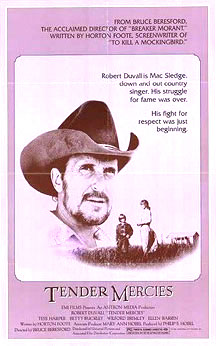
Tender Mercies-1983

Tender Mercies-1983

Director Bruce Beresford

Starring Robert Duvall, Tess Harper

Scott’s Review #1,279

Reviewed July 22, 2022

Grade: B+

Tender Mercies (1983) is a quiet, down-home film about a country musician struggling with alcohol addiction, god, and a tepid musical career. Anyone starting to elicit a yawn will have the same reaction I did when reading the premise.

It’s not the most original idea but the film works surprisingly better than I initially expected. The 1983 film is largely forgotten at this point but has a Cinderella story as its legacy.

Funding and a marketing push were limited, resulting in low box-office returns but the Academy sure took notice heaving five nominations it’s way.

It’s quite the departure for those expecting actor Robert Duvall to mirror his The Godfather (1972) and The Godfather: Part II (1974) characters.

Tender Mercies is an actor’s film, and it belongs squarely to Duvall who delivers a wonderful performance perfectly carved out for an Oscar nomination. He instills himself into the role of a drunken, washed-up, country star vowing to stay straight.

Duvall does more than act in it, crafting and performing his songs in a role standing side by side with his role in The Apostle (1998) as his very best.

He won the coveted Academy Award for Tender Mercies.

Though the tone is low-key, filming was anything but, and reports of disagreements and blow-ups between Duvall and director, Bruce Beresford, surfaced.

The Australian director was later made famous for Driving Miss Daisy (1989) at one point even considered quitting the production.

The story tells of alcoholic drifter Mac Sledge (Duvall), who awakens one day in the middle of rural Texas after a night of heavy drinking.

His surroundings are a run-down roadside motel and gas station.

He meets the owner, a young widow named Rosa Lee (Tess Harper), and offers to perform maintenance work at the motel in exchange for a room. Rosa, whose husband was killed in the Vietnam War, is raising her young son, Sonny (Allan Hubbard), on her own.

Mac and Rosa become smitten with one another, attending church, and forging a life of solitude together. Demons surface when it is revealed that Mac is a once-famous country singer with a currently famous ex-wife, Dixie Scott (Betty Buckley).

When the opportunity for a career comeback surfaces, Mac must choose between his new life and the life he let slip through his hands.

The story is very good for several reasons. At the forefront, Mac is a likable guy whom the audience pulls for. Instead of the tried-and-true story of a man battling his demons and being ‘saved’ by a woman, Mac is already on the road to recovery and has the desire to stay sober.

Rosa Lee and Sonny merely serve as steady influences versus the bright lights and broken hearts of the country music world.

Mac also has a chance to be a father figure to someone. The bad stuff has already transpired in the past, so the audience is spared having to endure a pile of shit in exchange for a big payoff at the end of the film.

There are a couple of negatives that keep the film from being a masterpiece.

On the wagon, Mac is tempted to down a bottle of whiskey after a tragedy, but he resists the urge choosing to pour the devil’s juice out onto the ground. Is that a big surprise?

Buckley does her best with a one-note character, clearly in existence as an obstacle to Mac’s happiness.

But, at its core, Tender Mercies is about relationships, and though a slow under texture, delicious are the low-key scenes between Mac and Rosa Lee, and Mac and Sonny. The scenes prove that good crisp dialog with grace and heart trumps car chases any day.

They discuss life!

The cinematography of remote Texas is magical in its vastness and its loneliness. Key expressions on the face of Duvall perfectly match the Western landscape.

I’m not a religious guy and I’m not a country & western guy but I enjoyed the story I was served up by Tender Mercies (1983) quite a bit.

The combination of superb acting, an emotionally charged character-driven story, and a fabulous glimpse at the dry state of Texas, made for a compelling, and relatively short viewing time of ninety minutes.

Oscar Nominations: 2 wins-Best Picture, Best Director-Bruce Beresford, Best Actor-Robert Duvall (won), Best Screenplay-Written Directly for the Screen (won), Best Original Song-“Over You”
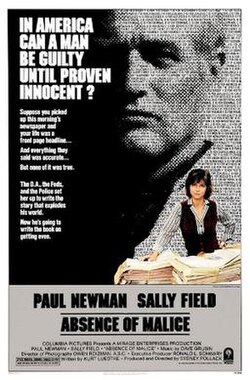
Absence of Malice-1981

Absence of Malice-1981

Director Sydney Pollack

Starring Paul Newman, Sally Field

Scott’s Review #1,055

Reviewed August 20, 2020

Grade: A-

Absence of Malice (1981) is a terrific, slick crime thriller that, while compelling and way above average in content, feels like a studio creation and a starring vehicle for its two A-list stars.

There is little wrong with this since Paul Newman and Sally Field are top-notch talents, and the resulting project has tension, thrills, and a relevant concept.

I loved the Miami locales, as the hot, steamy atmosphere set the right tone for sizzling romance and intrigue. Despite feeling manipulated by the casting, the film nonetheless feels fresh and authentic.

The film compares with 1976’s magnificent All the President’s Men in terms of story and look, though Absence of Malice is much more mainstream.

The former has more grit and dirt, while the latter adds some romance that may or may not have been a wise decision. The chemistry between Newman and Field is mediocre, but it’s the story that works.

In rock n roll terms, Absence of Malice is the opening act to All the President’s Men’s headliner. They make a perfect double-bill.

Field plays Megan Carter, an ambitious young journalist who writes a scathing article implicating Michael Gallagher (Newman), a successful liquor wholesaler with ties to a criminal family, in the disappearance of a labor leader.

When he confronts Megan, she sees his side, and the duo team up to find the truth. Complicating matters is their mutual attraction, which leads to romantic interludes.

The initial setup seems like a ploy to put Megan and Michael at odds, only for them to fall madly in love. Fortunately, the story has more depth than that.

Any trite 1980s or 1990s romantic comedy uses the same trick. No, not only do sparks fly, but the characters realize that Megan was duped into writing the article. This sets off a series of events to figure out who wants to frame Michael and why. And why Megan has been “chosen” to help see this through.

There is plenty of political espionage and other things to keep the audience engaged. Similar genre films would flood movie theaters throughout the decade, becoming watered down.

If Absence of Malice were released in 1988 or 1989, it would not have had the same effect as it did upon release in 1981.

The soggy 1980s style of filmmaking had not yet appeared, so I like to think of Absence as more of a 1970s film.

Sally Field is a Nancy Drew type, a sleuth determined to solve a mystery. She is assertive, yet feminine, with a trendy hairstyle.

Newman is, well, Newman. Aging handsomely with his dazzling blue eyes, he can charm the pants off any woman. I didn’t quite buy the romantic element, not because he is at least twenty years older than she. He is suave and charming, and she is so strait-laced that the romance doesn’t work.

The film would have been better as a buddy film with a male and a female buddy.

Supporting stars flesh out the film nicely, especially Melinda Dillon, who is fabulous as Teresa Perrone, Michael’s conflicted friend who serves as his alibi.

In a nicely crafted side story, she suffers because her abortion is revealed to the public. Teresa, a devout Catholic, must decide between life and death. It is admirable to give a supporting character a good, juicy story.

Pollack is the right director for the job, and he successfully crafts a thriller laden with liberal beliefs that serves up a message film without losing tension.

Absence of Malice (1981) has snippets of style and tone reminiscent of his other films, such as They Shoot Horses, Don’t They (1969), The Way We Were (1973), and The Electric Horseman (1979).

My mind wanders, thinking about a potential Robert Redford/Jane Fonda pairing instead of Field and Newman, or some combination of a Barbra Streisand/Newman/Redford/Fonda mix.

I am not sure if Absence of Malice (1981) is still on anyone’s radar, but some forty years later, the message couldn’t be timelier.

When government officials regularly attack journalists for providing “fake news” or “alternate facts,” this film is a refreshing reminder that, more often than not, they seek to uncover corruption and get to the truth.

Oscar Nominations: Best Actor-Paul Newman, Best Supporting Actress-Melinda Dillon, Best Original Screenplay