Category Archives: Dominique Sanda

The Conformist-1970

The Conformist-1970

Director Bernardo Bertolucci

Starring Jean-Louis Trintignant, Stefania Sandrelli, Dominique Sanda

Top 250 Films #34

Scott’s Review #212

70054715

Reviewed January 10, 2015

Grade: A

The Conformist, directed by Italian director Bernardo Bertolucci and based on the 1950s novel by Alberto Moravia, is a complex film that tells the story of one man’s complicated life during the Italian Fascist era (1922-1943).

Due to a traumatic childhood event, he is troubled and strives to “conform” to a “normal”, traditional lifestyle despite his underlying wounds and desires, which he struggles to repress.

The character in question is Marcello Clerici, played by Jean-Louis Trintignant, who works for the secret police in support of the Fascist government.

Marcello yearns for a quiet life that everyone else seems to have. He is set up with a beautiful new wife and is ordered to assassinate his college professor, who is a leader of an anti-Fascist party.

Throughout the story, Marcello is tormented by his troubled childhood in flashbacks, and the film delivers a marvelous, creative use of camera angles, style, and design.

It is a dreamlike film that makes full use of the protagonist’s childhood memories.

The film is a character study in the highest regard, yet it is also beautiful to look at, making it very multifaceted. Marcello is troubled, as evidenced by his backstory. In many ways, he is weak, refusing to accept who he is or admit his deepest desires.

Mixed in with the complexity of his character is a unique character named Anna (Dominique Sanda), the college professor’s gorgeous blonde wife, who appears to be bisexual, enticing both Marcello and his wife, Giulia, played by Stefania Sandrelli.

Marcello, in particular, becomes transfixed and obsessed with Anna.

A truly heartbreaking moment arrives later in the film and is my favorite scene in The Conformist. As the assassination attempt is made on a lonely and secluded, yet picturesque country road, the result is murder, betrayal, and surprise.

When one character nonverbally speaks to another, mainly through facial expressions, and emotionally and pathetically pleads for their life through a car window, it is as tragic as it is poetic.

The scene is wrought with drama and sadness.

Additionally, Marcello’s troubled childhood involving a homosexual experience with a chauffeur named Lino resurfaces years later in an unlikely way and leads to the shocking conclusion of the film.

The very last frame of the film leaves the viewer pondering what is to become of Marcello next.

Marcello’s mother and father add mysterious layers to the film. His father is securely an inmate in a mental hospital, while his mother is a boozy older woman who sleeps until noon.

While these characters are not explored as thoroughly as they might have been, this exploration does lead one to ponder why Marcello is the way he is and whether his parents have any bearing on his persona.

In a particularly fascinating scene, Anna seductively dances with Marcello’s wife at a crowded dancehall; they do the tango, even as, amid her affair with Marcello, she is clearly in love with his wife, making the dynamic confusing yet fascinating to view.

The Conformist heavily influenced storied directors such as Frances Ford Coppola, Martin Scorsese, and Steven Spielberg. A beautiful scene of leaves blowing in the wind almost mirrors a similar scene contained in Coppola’s The Godfather: Part II (1974).

A film as captivating as it is influential, The Conformist is an interesting watch for its style and the mystique that surrounds it.

Oscar Nominations: Best Screenplay Based on Material from Another Medium
1900 (Novecento)-1977

1900 (Novecento)-1977

Director Bernardo Bertolucci

Starring Robert De Niro, Gerard Depardieu, Dominique Sanda

Top 250 Films #201

Scott’s Review #984

Reviewed January 28, 2020

Grade: A

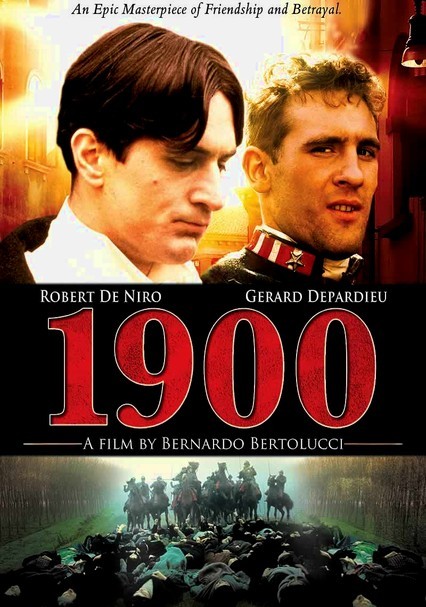
An epic to rival all epics, 1900 (Novecento) (1977) is a grandiose offering of monumental proportions featuring legendary actors and created by a brilliant director.

With a running time of a whopping 317 minutes in its original version, 1900 is known as one of the longest commercially released films ever made.

The cinematography is breathtaking, and the historical themes, such as friendship, class distinctions, and rivalry, are explored in depth.

The key is to let the experience marinate and blossom through a slow, patient build.

Brilliant director Bernardo Bertolucci’s tale follows the lives of two Italian men, a peasant named Olmo (Gerard Depardieu) and landowner Alfredo (Robert De Niro), both ironically born on January 1, 1900.

Inseparable as children, the two become estranged as their differing social statuses pull them apart. Their conflicts mirror the political events in Italy, as both fascism and socialism gained prominence there.

Here is a bit of background on the film.

Due to its length, the film was presented in two parts when originally released in many countries, including Italy, East and West Germany, Denmark, Belgium, Norway, Sweden, Colombia, Pakistan, and Japan.

In other countries, such as the United States, a single edited-down version of the film was released.

The latter is not the way to watch this film. I do not like heavily edited films, especially in an epic like 1900, so the full-length version is highly recommended.

The film opens on April 25, 1945, the day Italy is liberated from the fascists, and this is key to the political message Bertolucci crafts. As peasants revolt against the landowner, Alfredo (De Niro) and female laborers wield deadly pitchforks, creating an atmosphere of chaos.

We know nothing of Alfredo yet, but we know enough to realize he is rich and perceived as a tyrant. The natural reaction is to sympathize with them because they are oppressed.

As the film backtracks to the turn of the century, a more elegant scene emerges: the births of two infants, Alfredo and Olmo. The sequence is sweet, and both babies are bright and filled with promise.

Sadly, this is not meant to be.

A railway track is an important addition to the film, culminating in the finale.

The most interesting aspect of the film is the dynamic development of Alfredo and Olmo as they grow. Alfredo resents his family’s wealth and sides with Olmo, a socialist. Alfredo sees his family as false and Olmo and his family as genuine.

This aspect is timeless and can be related to by any viewer with any intelligent sense of the world today. The obvious analogy between the haves and have-nots is clearer than ever in this film. Frightening is that some have-nots are convinced they will one day become the haves.

The messages and feelings elicited in 1900 are strong and emotional. Aren’t all men created equal? On the surface, they are, but Alfredo and Olmo are not equal. As the birth scene reveals and as Bertolucci makes clear, they are born with advantages and disadvantages.

These characteristics are what they are, and as human beings grow and learn social norms, financial differences become more pronounced and humanistic connections weaker.

If the social aspects of the film or the brilliant cinematography are not enough to please a viewer, the historical lessons presented are second to none. One can revel in the political and historical excitement that characterized Europe throughout the forty-five years the film is set.

I wish Hollywood made more films like this.

1900 (Novecento) (1977) can be enjoyed as both a grandiose, dramatic period piece, revered for its majestic and flourishing design, and as a thought-provoking film about unresolved social class distinctions in the world.

I found the film a treasure that works on all levels and showcases just how good a director Bertolucci is.

This film is not his best-known work, but for fans of cinema as an art form, this is a must-see.

Une Chambre en Ville-1982

Une Chambre en Ville-1982

Director Jacques Demy 

Starring Dominique Sanda, Michel Piccoli

Scott’s Review #1,397

Reviewed September 10, 2023

Grade: A

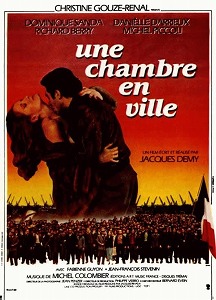
Une Chambre en Ville (also known as A Room in Town) is a 1982 French musical drama film written and directed by Jacques Demy, with music by Michel Colombier, and starring Dominique Sanda, Danielle Darrieux, and Michel Piccoli.

Those familiar with Demy’s other works like The Umbrellas of Cherbourg (1964) and The Young Girls of Rochefort (1967) will be aware that his preferred genre is the musical drama and in Une Chambre en Ville, the dialogue is entirely sung.

And those unfamiliar with his work are recommended to give his films a chance. They are flavorful and offer exceptional production design to say nothing of other ingredients.

I liken the film to be most similar to The Umbrellas of Cherbourg because the story involves two people destined to be together but who are thwarted by many obstacles threatening to ruin their happiness.

Demy creates a distinct Shakespearean Romeo and Juliet final ending in the best of possible ways.

The story is set during a workers’ strike in Nantes, France in 1955. A steelworker named Francois (Richard Berry) has a fling with the married daughter Edith (Dominique Sanda) of his widowed landlady, Margo (Danielle Darrieux).

His girlfriend Violette (Fabienne Guyon), who works in a shop and lives with her mother, wants to get married but he is unwilling, partly because they have no money and nowhere to live.

Oh, and he also has met Edith.

On the street, François is accosted by Edith who is a beautiful woman who wears only a fur coat and has decided to take up part-time prostitution to pay bills. Her husband owns a struggling television shop.

The two have a blissful night together in a cheap hotel and fall madly in love.

Une Chambre en Ville is at first jarring because the dialogue is in the form of a song. But after merely a few minutes I became invested and enamored with the characters. This occurs when Francois and Margo ‘discuss’ the strike and even though she is upper-class she supports the workers.

They quickly bond.

Before this though, the tone is set with black-and-white cinematography of the workers’ strike that quickly turns to color. My hunch is that Demy wanted to promote the seriousness of the situation and alert the audience that they were not watching a rosy musical with tap-along tunes.

There’s a message of pain, struggle, and depression which doesn’t make the film a downer either.

As with Demy’s other films, the art direction and set designs are gorgeous. The director has a talent for introducing the most fragrant colors like red, yellow, blue, and green, that are powerful and enshroud the characters in pizazz and vibrancy.

The set highlights are Margo’s apartment drizzling with red color and contemporary patterns and furniture and Edith’s husband’s television shop. The greenish hue reveals a tacky yet sophisticated French style. These and other sets are superior efforts.

The main attraction is Francois and Edith and I was smitten with them almost immediately. Some may think this is odd because basically, Francois dumps his nice girlfriend for a sexy prostitute who flashes her naked body to him and then beds him.

Nonetheless, I became enraptured. They make ‘love at first sight’ seem believable and possible. The thing to remember is they are both wounded by their circumstances and are reaching for their desires out of desperation.

The finale of Une Chambre en Ville is dazzling but painful to watch. I alluded to a Romeo and Juliet catastrophe and this is no joke as the star-crossed lovers meet a dire ending.

I won’t spoil the fun by revealing what happens.

Jacques Demy creates a film made in 1982 that feels nothing like a 1982 film as we are believably transported to 1955.

Une Chambre en Ville holds up as well as Demy’s films made two decades earlier and he proves none of his creativity and romantic dramatics have waned.

The Mackintosh Man-1973

The Mackintosh Man-1973

Director John Huston

Starring Paul Newman, James Mason, Dominique Sanda

Scott’s Review #1,058

Reviewed August 31, 2020

Grade: B

The Mackintosh Man (1973) is not one of legendary director John Huston’s best films.

Known for well-remembered titles like The African Queen (1951), The Maltese Falcon (1941), and The Misfits (1961) that all movie historians and fan buffs are familiar with (or should be), this project is rather lackluster, only picking up at the very end to offer a riveting ending.

The rest is mediocre, weighed down by a plot that lacks depth, a romance that falls short, and little in the way of answers or a good wrap-up.

If this sounds too harsh, I will say that anything starring Paul Newman is worth seeing. Huston hit the jackpot in the casting department, and the actor provides enough to raise The Mackintosh Man’s status to an adequate “B” ranking.

I hate the title as it took days for it to stay in my memory.

Huston attempts to make the film a taut thriller, which at times is achieved, especially during the climax, and mixes humor, but the humor rarely comes through, only getting in the way of what would have been better in a darker vein.

It feels like a weak attempt to turn Paul Newman into James Bond.

Back to Newman. With his handsome face and icy blue eyes, he makes any film compelling, but I never really bought him in the role. This could be because of how the character is written.

Newman is an American actor who plays a British secret agent pretending (sometimes) to be Australian. This is a busy ask even for an actor of Newman’s caliber. He was much better in Alfred Hitchcock’s critically panned but well-aged Cold War thriller, Torn Curtain (1966), in a similar role.

Dominique Sanda, brilliant in The Conformist (1969), has little screen time until the finale, when her character finally shows depth.

Newman plays Joseph Rearden, a British intelligence agent tasked with bringing down a communist spy ring. After purposely getting himself tossed in a high-security prison, he breaks out of the joint in an escape arranged by a mysterious organization.

Rearden then tries to track the group’s activities and unmask its shadowy leader, played by James Mason.

On paper, the premise sounds quite appealing, and with Newman, Mason, and Sanda in my pocket, my expectations were lofty, but not met.

I am not painting the film as bad by any means, just not as good as I anticipated. Certainly, some aspects work.

Reardon’s time in prison is appealing and might have influenced the not-yet-made Escape from Alcatraz (1979).

When a male prisoner makes a pass at Reardon on the lunch line, asking Reardon if he’d like to dance with him, he is kindly rebuffed. Does the prisoner cleverly respond with “maybe in a year or two”?

The scene is played for laughs but also contains a sweet innocence.

The Mackintosh Man is not a film in which a scene like this can be interpreted as anything more than a reaffirmation of Reardon’s (and Newman’s) masculinity, though.

From there, we get back to business.  He meets a convicted Russian spy, and the two conceive a successful prison break. How they escape so easily is hard to swallow, but they have help from an organization.

After the breakout, Reardon finds himself drugged and sent to Ireland. It turns out that Mackintosh organized the escapade in the hope that Reardon could infiltrate the Scarperers, gather information on the group’s leader, Sir George Wheeler (James Mason), and prove that he was a Russian spy.

Just writing this out feels too confusing, which is the film’s main problem.

Reardon has a flirtation with an eccentric, tall, bad girl straight out of a Kubrick film, before connecting better with Mrs. Smith (Sanda), and culminating in a harrowing climax aboard a luxury yacht, with the gorgeous backdrop of Malta.

The sequence almost makes the rest of the film forgivable, as a lot of action suddenly develops, and the landscape is gorgeous. A deadly and unexpected shooting occurs after an incident involving drugged champagne or white wine.

I advise watching The Mackintosh Man (1973) with the knowledge that the slowness and the confusion of most of the film are worth watching for the fantastic finish.

Events and plot points may not necessarily all be spelled out, but the yacht scene and Malta locales are tremendous.

Newman carries the film with good acting from Mason and Sanda supporting the star.