Westworld-1973
Director Michael Crichton
Starring Richard Benjamin, James Brolin, Yul Brynner
Scott’s Review #1,056
Reviewed August 25, 2020
Grade: A-
I have seen the film version of Westworld (1973) before and after having watched the current hit HBO television series, brilliant in its complexities.
Many are not even aware that the series is based on a film, and that is a pity because the film is good stuff with lots to digest in a short time.
Admittedly, watching it in present times, given the series’s extreme psychology, the film has so much more it could have offered, but it’s still a great watch.
One must always remember the time period a film was made in for proper context and comparison.
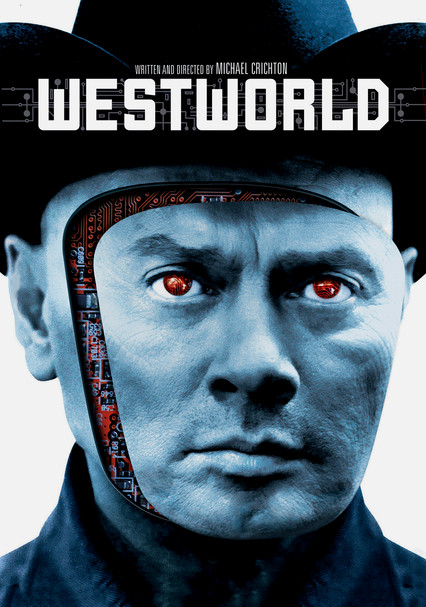
Yul Brynner nearly steals the film with a spectacular, creepy performance as a wide-eyed, futuristic android cowboy to Richard Benjamin and James Brolin’s regular guys out for an escapist good time.
Much of the film could be conceived as a buddy film with a bevy of homoerotic elements brimming beneath the surface if one is aware. These tidbits spice things up in an already escapist and futuristic world.
A titillating, high-tech adult-themed amusement park serves as the film’s backdrop. Participants can choose any of the three worlds: the Western World, the Medieval World, or the Roman World. All feature lavish, realistic trimmings and ooze realism.
The inhabitants are robots, not real people, so they can be shot, stabbed, or made love to depending on the personal tastes of those who wish to indulge in their wildest fantasies.
The island is very exclusive, and the experience comes at a high cost.
Peter (Benjamin) and John (Brolin) are businessmen who adore the Wild West, so they select the Western World. They enjoy frolicking with desperadoes, gunslingers, and dance-hall girls who appear as if they are human beings.
Enjoying their adventures, the technicians notice odd behavior from the androids. Small at first, events escalate quickly when a gunslinger (Brynner) goes on a rampage with Peter and John as his targets.
Since the television series is fleshed out so well and the motivations and the stories of the androids are examined at length, it makes it easy to ask why the film does not, or rather, wishes it had.
On the one hand, it is creepy not knowing what makes Brynner’s gunslinger tick; on the other hand, I want to know.
I also wanted to know more about the guests. Why were they there, and what are their lives in the real world like?
One way the film is superior to the series is in the way Peter and John are written.
Is it my imagination, or do the pair seem a little closer than merely friends? Do they wish to escape their lives to be together? Are the wives and children waiting at home for them?
A scene of Peter bathing is erotic, especially as he must abandon the tub mid-soak to battle a foe. He is the Marlboro man personified, though Benjamin’s too recent turn as the twit father from Diary of a Mad Housewife (1970) ruins any masculinity he has.
The climax is riveting.
Since we are unsure of the gunslinger’s motivations, we are unsure what he will do. A frightening scene unfolds as the gunslinger intently walks down a corridor, his expressionless eyes attentively stalking his prey. This still gives me the chills.
When the android is sprayed with acid, its face becomes freakish and psychotic-looking. This adds to the fright of an already frightening character. When Peter frantically traverses the park in search of help, his peril is heightened as he finds dead guests and damaged robots everywhere.
The severity of the situation is finally realized.
Crichton deserves much of the credit since he not only directed but wrote the screenplay, and this was his debut! The pacing is excellent, and something is going on at all times, making the film feel as entertaining as it is intelligent.
The dazzling cinematography of the world allows the viewer to see the differences.
Westworld is riddled with intriguing questions that go unanswered, which adds to the tension.
Impossible not to compare the film to the series as much as we might like not to. Westworld (1973) is a freakish, creative adventure that I wanted so much more from, having seen the complexities and story possibilities crafted for the series.
I am not a fan of remakes, but in this case, a modern retelling is not a bad idea. Some accuse the film of being cheesy, over-the-top, or “too 70s,” but I disagree.
I like the hidden trimmings and messages mixed with the good fun.