Category Archives: Jenny Runacre

The Mackintosh Man-1973

The Mackintosh Man-1973

Director John Huston

Starring Paul Newman, James Mason, Dominique Sanda

Scott’s Review #1,058

Reviewed August 31, 2020

Grade: B

The Mackintosh Man (1973) is not one of legendary director John Huston’s best films.

Known for well-remembered titles like The African Queen (1951), The Maltese Falcon (1941), and The Misfits (1961) that all movie historians and fan buffs are familiar with (or should be), this project is rather lackluster, only picking up at the very end to offer a riveting ending.

The rest is mediocre, weighed down by a plot that lacks depth, a romance that falls short, and little in the way of answers or a good wrap-up.

If this sounds too harsh, I will say that anything starring Paul Newman is worth seeing. Huston hit the jackpot in the casting department, and the actor provides enough to raise The Mackintosh Man’s status to an adequate “B” ranking.

I hate the title as it took days for it to stay in my memory.

Huston attempts to make the film a taut thriller, which at times is achieved, especially during the climax, and mixes humor, but the humor rarely comes through, only getting in the way of what would have been better in a darker vein.

It feels like a weak attempt to turn Paul Newman into James Bond.

Back to Newman. With his handsome face and icy blue eyes, he makes any film compelling, but I never really bought him in the role. This could be because of how the character is written.

Newman is an American actor who plays a British secret agent pretending (sometimes) to be Australian. This is a busy ask even for an actor of Newman’s caliber. He was much better in Alfred Hitchcock’s critically panned but well-aged Cold War thriller, Torn Curtain (1966), in a similar role.

Dominique Sanda, brilliant in The Conformist (1969), has little screen time until the finale, when her character finally shows depth.

Newman plays Joseph Rearden, a British intelligence agent tasked with bringing down a communist spy ring. After purposely getting himself tossed in a high-security prison, he breaks out of the joint in an escape arranged by a mysterious organization.

Rearden then tries to track the group’s activities and unmask its shadowy leader, played by James Mason.

On paper, the premise sounds quite appealing, and with Newman, Mason, and Sanda in my pocket, my expectations were lofty, but not met.

I am not painting the film as bad by any means, just not as good as I anticipated. Certainly, some aspects work.

Reardon’s time in prison is appealing and might have influenced the not-yet-made Escape from Alcatraz (1979).

When a male prisoner makes a pass at Reardon on the lunch line, asking Reardon if he’d like to dance with him, he is kindly rebuffed. Does the prisoner cleverly respond with “maybe in a year or two”?

The scene is played for laughs but also contains a sweet innocence.

The Mackintosh Man is not a film in which a scene like this can be interpreted as anything more than a reaffirmation of Reardon’s (and Newman’s) masculinity, though.

From there, we get back to business.  He meets a convicted Russian spy, and the two conceive a successful prison break. How they escape so easily is hard to swallow, but they have help from an organization.

After the breakout, Reardon finds himself drugged and sent to Ireland. It turns out that Mackintosh organized the escapade in the hope that Reardon could infiltrate the Scarperers, gather information on the group’s leader, Sir George Wheeler (James Mason), and prove that he was a Russian spy.

Just writing this out feels too confusing, which is the film’s main problem.

Reardon has a flirtation with an eccentric, tall, bad girl straight out of a Kubrick film, before connecting better with Mrs. Smith (Sanda), and culminating in a harrowing climax aboard a luxury yacht, with the gorgeous backdrop of Malta.

The sequence almost makes the rest of the film forgivable, as a lot of action suddenly develops, and the landscape is gorgeous. A deadly and unexpected shooting occurs after an incident involving drugged champagne or white wine.

I advise watching The Mackintosh Man (1973) with the knowledge that the slowness and the confusion of most of the film are worth watching for the fantastic finish.

Events and plot points may not necessarily all be spelled out, but the yacht scene and Malta locales are tremendous.

Newman carries the film with good acting from Mason and Sanda supporting the star.

The Witches-1990

The Witches-1990

Director Nicolas Roeg

Starring Angelica Huston

Scott’s Review #483

20282991

Reviewed September 20, 2016

Grade: B-

The Witches (1990) is a G-rated family film with a slightly dark tone that is done softly as the film is targeted at children. However, it is a film that adults may love too.

I found the film to be entertaining, with impressive special effects, and a dazzling comedic performance by Angelica Huston, but ultimately The Witches has a silly quality, though admittedly not trite, that does not completely make it a success in my book.

The film is based on a Roald Dahl children’s book – with predictably a child as the central character- similar to other Dahl novels that became films like James and the Giant Peach and Charlie and the Chocolate Factory.

I cannot help but wonder if my mediocre rating of The Witches has to do with the fact that I have not read the novel, as I have the other aforementioned novels in his collection.

Our hero in the story is Luke- a  kindly, innocent young boy living in Norway with his parents and grandmother- Helga. When his folks are tragically killed, his grandmother takes him to London to begin a new life for themselves.

When Helga falls ill, they stay at a seaside resort where they stumble upon a convention of witches disguised as the Royal Society for the Prevention of Cruelty to Children.

Luke and his plump friend Bruno become victims of the witch’s plot to turn children into mice. The witch group is led by the Grand High Witch (Huston), whom the other witches fawn over with grandiose praise.

Huston is fantastic as she overacts the part she plays- this is not a bad thing but makes the role quite fun and energetic.

When she transforms from a glamorous woman to a shriveled monster, the transformation is interesting to watch and an impressive part of the film.

Furthermore, the way that Luke and Bruno interact when they are mice is also cute and a positive to the film.

I enjoyed the aspect that, if watched closely, can be seen involving the reveal that numerous witches are men with female wigs on. This successfully gives the witches a grotesque, obviously mannish quality and emits a chuckle of pleasure at the same time.

Still, there is something slightly childish or juvenile about the offering- while the film appears dark on the surface. The subject is rather played for laughs instead of going full steam ahead as a dark film.

Undoubtedly this is due to the target audience that the film is going for. For instance, the hotel manager and his affair with a hotel maid seem slightly unnecessary.

The Witches (1990) is a decent offering due to respect for the creative aspects that it elicits- I just felt the story might have been done a bit more seriously.

Additionally, the ending feels slightly forced and abrupt- a Hollywood-intended ending perhaps?

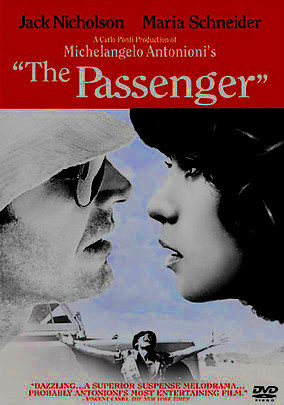
The Passenger-1975

The Passenger-1975

Director Michelangelo Antonioni

Starring Jack Nicholson, Maria Schneider

Scott’s Review #259

70042799

Reviewed July 19, 2015

Grade: A

A true art film in every sense of the word, The Passenger (1975) is a thinking man’s film, not for those content to munch on popcorn and escape the day’s stressors.

It’s custom-made for a film fan willing to ponder its meaning, revel in its slow pace, and appreciate it as an art form.

The Passenger is tough to “get” for most of its over-two-hour running time, but its complexities are also its most beautiful qualities.

To say that the film will leave the viewer with questions is quite an understatement, but it is pleasing to analyze and draw conclusions about its meaning.

Michelangelo Antonioni directed this film and is well known for Blowup (1966) and Zabriskie Point (1970), neither of which I have seen as of this writing.

Jack Nicholson stars as a journalist named David Locke, who is on location in Africa (specifically the Sahara Desert in Chad).

David’s assignment is to produce a documentary film. While there, he mysteriously assumes the identity of a businessman named Robertson, who he finds dead in his hotel room.

This task is easy because David and Robertson look very much alike. As events unfold, it becomes clear that Robertson is involved in arms dealing and smuggling related to the ongoing civil unrest in the country.

Flashbacks reveal David’s former life, including his friendship with the businessman and his relationship with his wife, Rachel, and these scenes are interwoven with the current action until the narrative becomes more linear.

The film is complex, to say the least. The initial scene, in which David spontaneously decides to switch identities, is excellent. We wonder what David’s motivations are, and what is the appeal of his taking over another man’s life? Who is the man? Why is David so unhappy in his own life?

The film succeeds immeasurably because the plot is not simply told to the audience, as in so many other mainstream films. Events seem genuine and not forced for plot purposes.

In the current time, wherever in London, Rachel sadly mourns the assumed “death” of her husband David, though we learn that Rachel has secrets of her own she has been hiding and suffers from tremendous guilt.

To further complicate matters for everyone, she is attempting to find the businessman, since she has learned that he was the last person to see her husband alive. Also mixed into the story is a mysterious young woman whom David meets when the story moves to Barcelona, Spain.

What makes The Passenger so compelling to me is its intricacies- story as well as camera styles. The seven-minute-long shot towards the end is brilliant filmmaking, and the climax is quietly intense.

The camera focuses on a hotel room, then switches to the parking lot, and returns to the hotel room. I was transfixed by the character of David, struggling to empathize with him while all the while enjoying an intelligent character study interwoven with a story of political intrigue.

I do not claim to understand everything about The Passenger and will surely need more viewings to make sense of it all, but the film fascinates me.

In a time of mediocre films, how refreshing to stumble upon a forgotten relic from 1975 and have a renewed appreciation for film as an art form.