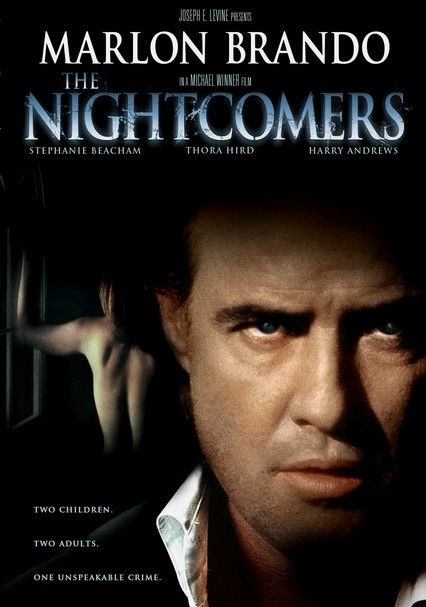
The Nightcomers-1972
Director Michael Winner
Starring Marlon Brando, Stephanie Beacham
Scott’s Review #1,080
Reviewed November 11, 2020
Grade: B-
The Nightcomers (1972) is a disappointing prequel to Henry James’ 1898 novella The Turn of the Screw, which had already been adapted into the 1961 film The Innocents.
The dreadful title is neither catchy nor specific to the film. The lackluster and unmemorable result is jarring, given the masterpiece that is The Innocents.
It’s unclear whether the intention was to build on the film or to base it directly on the novella, forgetting The Innocents.
It’s not worth the effort to ruminate over the answer.
The most interesting comparison is that the film was released the same year as The Godfather (1972), in which the iconic role of Vito Corleone, the mafia head of household, and arguably the best role of Marlon Brando’s career, was created.
Mirrored against his role as a bizarre gardener named Peter Quint, with a broken Irish accent, one can guess why one role is memorable and why the other isn’t.
Flora (Verna Harvey) and Miles (Christopher Ellis) are recently orphaned children living in a vast English estate. Their absent guardian pays for the housekeeper, Mrs. Grose (Thora Hird), and governess, Miss Jessel (Stephanie Beacham), to keep things running smoothly.
Jessel and Peter embark on a torrid and sometimes abusive relationship that the children witness and emulate through play-acting. Flora and Miles suffer from isolation and must use their imaginations to make the best of their idle days.
Watching in sequence with The Innocents is not encouraged.
The Nightcomers is best served as a stand-alone product. The events and continuity are muddy and will confuse the most astute viewer.
Flora is much older than she is in The Innocents, even though the action takes place before those events. The characters being played by different actors doesn’t help.
Finally, The Nightcomers contains none of the ghostly mystique and spookiness that The Innocents does. So, it is advisable to put The Innocents out of mind.
Admittedly, events do come together in the final act, which is the best part of the film.
When two deaths occur simultaneously, they are both quite shocking and powerfully filmed. I felt more emotionally invested in the final ten-minute sequence than in the rest of the film.
Brando has one emotional scene worthy of his talents. Given the actor’s powerful chops, he can make any scene believable, but this is the cream of the crop material.
Stephanie Beacham is an okay casting choice, but I never felt the chemistry or connection between Jessel and Quint. Their relationship didn’t work for me.
Suspension of disbelief is required to get through a scene where a character drowns in what looks like two feet of water, making the scene lose some power.
Harvey and Ellis, as the children, are okay, but nothing spectacular. I am jaded, but I compare them again to The Innocents, and those actors are just better and more haunting, especially Miles.
The subject of mental illness and the distinction between reality and imagination is not explored in The Nightcomers.
The production is not a total dud, containing enough exterior elements of the plush and English landscape to please and make viewers feel they are in the country manor themselves.
The interior scenes are just as good. The children gallop through the enormous house to their heart’s delight, making the viewer feel like a kid along with them.
The sadomasochistic scenes between Peter and Miss Jessel are quite titillating and border on the X-rated. During the bedroom scenes, I nearly blushed from embarrassment. But, as erotic as they are, they also don’t do much to further the plot or add to the story.
They have a kinky sex life- so what?
There is also a weird suggestion of incest since Flora and Miles imitate what Quint and Jessel do; how far would they take it? The plot has good potential, but the film and direction aren’t executed well, and things don’t come together.
If you’ve never heard of The Innocents (1961), then The Nightcomers (1972) is recommended.
If viewing a cinematic masterpiece is desired, however, stick with the former and never look back.