Category Archives: David Warner

The Omen-1976

The Omen-1976

Director Richard Donner

Starring Gregory Peck, Lee Remick

Top 250 Films #110

Top 40 Horror Films #21

Scott’s Review #331
60002150

Reviewed January 8, 2016

Grade: A

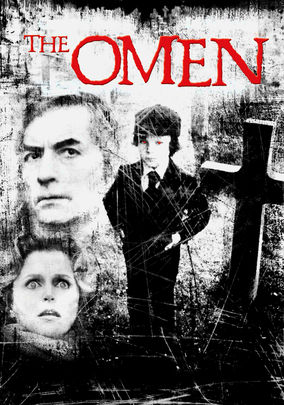
On the heels of similarly themed supernatural horror films, and all three classics, in my view, The Omen (1976) follows suit with a religiously minded, terrifying piece that resembles both The Exorcist (1973) and Rosemary’s Baby (1968).

All three films are cherished gems and among my favorite horror films.

The Omen (the last to be released) is quite possibly the weakest entry, having taken much from the other two films, and at the forefront is a child encompassed by devilish forces.

But to say “weaker” implies it is not good, which is not the case- The Omen is a masterpiece.

Set mostly in London, the film begins in Rome. Gregory Peck plays a powerful diplomat, Robert Thorn. Robert’s wife, Katherine (Lee Remick), has just given birth to a baby, who dies.

Unbeknownst to her, Robert and a priest have taken a newborn whose mother has just died, thereby fooling Katherine into thinking she has delivered a healthy baby boy. They name their child Damien.

Soon, Robert is named U.S. Ambassador to the United Kingdom- an astounding honor. Still, his and Katherine’s lives spin out of control as strange events surrounding Damien begin to occur, and they realize the child is not “right”.

I adore the many aspects of The Omen. The locale of sophisticated and royal London is perfect. The Thorns live in a grand, palatial estate, oozing with potential horror elements.

During a vast party for little Damien’s fifth birthday, the attendees are gathered on the perfectly manicured grounds of the Thorn home. It is a bright and cheery afternoon.

Suddenly, from the top-floor bedroom window, Damien’s fresh-faced nanny publicly hangs herself from the window, proudly shouting, “This is all for you, Damien”!

This scene is one of the most horrific and surprising scenes in the film.

When Damien’s new nanny shows up, she is off-putting and sinister. The inclusion of a pack of black dogs hovering around the estate is fiendish, and an innocent trip to the zoo results in the scared animals fleeing from Damien as if he were the antichrist, which, of course, he is revealed to be.

Fantastic is the religious element of The Omen, a sure measure to frighten and freak out audiences brave enough to watch this film.

Who will not be on edge as a sweet-looking little kid is assumed to be the devil?  Religious elements in horror have been prevalent throughout the ages.

Perhaps it is the Italian and British accents and settings that add layers of fear to the film.

What I love most about the film is its cynicism. The Omen is not a happy film by any means, nor does it result in a happy ending- Satan wins in the end.

Two memorable scenes are the pole through the heart of the priest scene and the gruesome decapitation of a photographer by a sheet of glass. In both scenes, Satan causes the deaths.

The finale of the film is incredibly compelling and downright shocking- the face-off of Robert and Damien in a church, and the prevailing conclusion sets the stage for a sequel, which, of course, there was more than one.

The sinister smile at the end of the film is immeasurably evil.

The Omen (1976) is a film I love to watch and revel in the fright when the chills creep up my back.

What a fantastic film.

Oscar Nominations: 1 win-Best Original Score (won), Best Original Song-“Ave Satani”

Titanic-1997

Titanic-1997

Director James Cameron

Starring Leonardo DiCaprio, Kate Winslet

Top 250 Films #160

Scott’s Review #327

1181461

Reviewed January 6, 2016

Grade: A

1997’s Titanic is a sweeping, gorgeous epic, directed by James Cameron, that is perfection at every level. This film has it all: romance, disaster, gorgeous art direction, and flawless attention to detail.

The film will make you laugh, cry, and fall in love with the characters, despite knowing the inevitable outcome. The film is based on the real-life sinking of the RMS Titanic in 1912 after the ship tragically collided with an iceberg.

I have witnessed this film be derided for being a “chick flick” or too “sappy”, but I vehemently disagree and feel it is a classic for the ages.

Titanic successfully re-invented the Hollywood epic.

Jack Dawkins (Leonardo DiCaprio) is a penniless artist who meets high-class socialite Rose DeWitt (Kate Winslet) aboard the luxurious Titanic, headed from the coast of England to the United States on its maiden voyage.

Rose is engaged to cagey Cal Hockley (Billy Zane).

Depressed, Rose contemplates diving overboard to her death, but Jack saves her and convinces her otherwise. They spend time together and he draws her portrait. As their romance blossoms, Cal catches on and plots revenge.

In the mix is Rose’s snobbish mother, Ruth, played by Frances Fisher.

The main theme of the film is social class and the difference that separates the haves from the have-nots.

James Cameron desired perfection from this film and he sure got what he wanted. Every detail of Titanic is flawless and historically accurate, from the dining room silverware to the costumes to the set pieces barely visible in the background.

Cameron even had a replica of the original Titanic built for filming purposes- with limitations, but what a vast undertaking this must have been. That, along with the smoldering romance between Jack and Rose, is what makes Titanic one of my favorite films.

Two fantastic scenes are when Jack is taken under the wing of Molly Brown, played by Kathy Bates. Molly is not the snob that many of the other upper class is, and lends Jack a tuxedo so that he will look dapper for Rose. She also tenderly teaches him the appropriate way to use silverware.

Tragically, the other scene is more melancholy- a gorgeous classical piece plays in the background as the vast ship is engulfed in water and slowly sinks, causing many deaths.

At well over three hours in length, the conclusion of the film is quite sprawling- and one has the feeling of being aboard the ship. By this time I was invested in the characters, both lead and supporting and the tragedy that ensues is both a marvel and heart-wrenching.

Titanic (1997) is a film that simply must be viewed on the big screen for full effect, and is a timeless masterpiece that has aged perfectly.

Oscar Nominations: 10 wins-Best Picture (won), Best Director-James Cameron (won), Best Actress-Kate Winslet, Best Supporting Actress-Gloria Stuart, Best Original Dramatic Score (won), Best Original Song-“My Heart Will Go On”, Best Sound Effects Editing (won), Best Sound (won), Best Art Direction (won), Best Cinematography (won), Best Makeup, Best Costume Design (won), Best Film Editing (won), Best Visual Effects (won)

Straw Dogs-1971

Straw Dogs-1971

Director Sam Peckinpah

Starring Dustin Hoffman, Susan George

Top 250 Films #215

Scott’s Review #733

Reviewed March 19, 2018

Grade: A

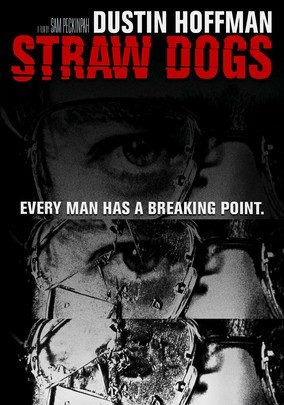
Straw Dogs (1971) is famed director Sam Peckinpah’s most startling and most controversial film.  Hardly an easy watch, it will provoke disturbing and uneasy reactions, but it is a work of art, teetering on the edge of being an all-out art film.

Viewers will cringe during intense scenes but will also marvel at the film’s mastery of this classic, bringing on a whirlwind roller coaster ride as story elements spiral out of control to a frenetic, powerful climax.

Intellectual American mathematician, David Sumner (Dustin Hoffman), moves with his sexy British wife, Amy (Susan George), to a Cornish countryside, the town in which she grew up, where they proceed to encounter problems, both within their marriage, and external factors, as an angry mob of blue-collar workmen, threaten their home life.

When non-violent David is pushed to the limit, questions of morality are brought to light, as Amy faces her demons and bouts with brutality and victimization.

The film, made in 1971, pushes the envelope significantly in its display of violence.

Several years earlier, 1967’s Bonnie and Clyde and Peckinpah’s own The Wild Bunch (1969) were the films that really got the ball rolling. Still, Straw Dogs continues the trend of the brutal violence that overtook American cinema at the time.

While watching the film for the second time, I was struck hard by the feeling that I was watching something important.

Amy’s rape scene is the most brutal scene of all to watch for the sheer way in which it can be interpreted. Later, when Amy replays the scene in her mind, the audience is forced to relive the experience.

Not content to only include the rape scene, Peckinpah wants the viewer to dissect the scene- the fact that Amy is assaulted by not one, but two men, and reacts differently to each of them, is the key here.

The scene is complex in that Venner, the first assailant, is hunky and presumed to be a former beau, and she eventually relents to his advancesbut does she enjoy the act? When Scutt enters the picture, however, things turn from tender and ambiguous to violent and dirty.

Undoubtedly, an influence on director Quentin Tarantino is the final sequence of the film- a scene fraught with tension, violence, and grit.

Now trapped in their house amid a mob of angry, drunk men, hell-bent on revenge, David and Amy must both bond with each other and match antics with the men.

I experienced visions of 2015’s The Hateful Eight through the claustrophobic, cabin-like setting and the quick edits that Peckinpah uses throughout the film.

A sad scene, and at least a portion of the reason for the townsfolk’s rage, is a scene reminiscent of Frankenstein when a hulking and mentally challenged man accidentally harms a young girl. Not knowing his strength and meaning to protect the girl instead of killing her, the menfolk of the town respond in a nightmarish and witch-hunt manner.

Suddenly, David becomes the defender and protector of this man.

David’s character change is interesting, and the great Hoffman adds layer upon layer of complexity to the role. At first, a peaceful man, due to circumstances, he soon becomes the assailant, creating traps and weapons, intent on maiming his prey.

Hardly a violent man, this change of character is evident in our earlier scene, where David nurses a wounded bird.

In addition to Hoffman’s traditionally outstanding performance, Susan George delivers the perfect blend of bitchiness, spoiled-brat tantrums, and, later, guilt-ridden angst and fear.

The villains are perfectly cast and believable as bored, simple-minded, and horny, small-town boys just itching for trouble.

Lush is the gorgeous United Kingdom countryside featured in Straw Dogs, as frequent exterior scenes are shot, revealing lavish and plush mountainous areas- the sweeping beauty of the landscape counterbalancing the brutality shown in other sections of the film.

Mixing super quick editing with a dark, compelling screenplay, with underlying themes of questioning one’s manhood, Straw Dogs is a provocative and edgy tale of violence and revenge in a small town, that gives new meaning to the fear of “home invasion” and feeling vulnerable.

Thanks to a great cast and lots of other facets, Straw Dogs (1971) is a timeless (and brutal) treasure.

Oscar Nominations: Best Original Dramatic Score

Cross of Iron-1977

Cross of Iron-1977

Director Sam Peckinpah

Starring James Coburn, Maximilian Schell, James Mason

Scott’s Review #1,140

Reviewed May 8, 2021

Grade: B+

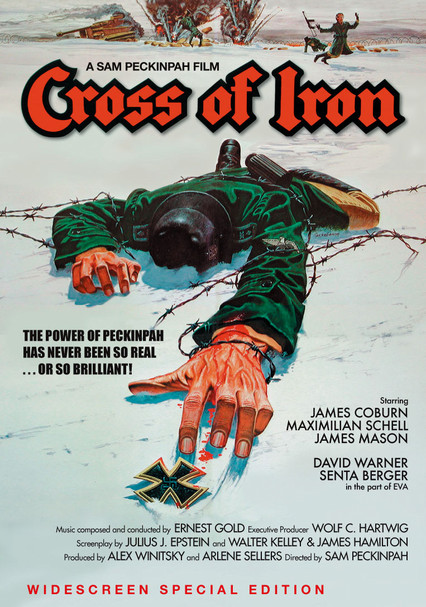
Cross of Iron (1977) is a film that sticks with you. I appreciate that it’s not a standard, cookie-cutter war film that too often graces the big screen decade after decade, featuring different wars but applying virtually the same message.

The tone is usually pro-United States, with little explanation or defense of the other guys.

This is not one of those films.

That said, I could have used a more straightforward approach because Cross of Iron is all over the place. It’s like a fragmented puzzle that doesn’t add up or come together, but the experience is something both mind-blowing and unforgettable.

Sometimes confusing and unpleasant, Sam Peckinpah directs it, so anyone familiar with some of his other works knows what the experience will be like.

His best films, Straw Dogs (1971) and The Getaway (1972), are famous for their lightning-fast editing sequences galore and sudden still frames. Violence and mistreatment of female characters are also Peckinpah staples, and Cross of Iron sure has those elements.

But it’s not on the level that Straw Dogs and The Getaway are, as far as a solid storyline. Not even close.

The synopsis goes something like this. The time is World War II, and Corporal Rolf Steiner (James Coburn) is a well-respected member of the German military and a recipient of the Iron Cross, Germany’s highest military honor. He leads a group of soldiers to battle somewhere in Russia, presumably.

Envious of Steiner’s Iron Cross award, Captain Hauptmann Stransky (Maximilian Schell), a Prussian officer, clashes with Steiner when he joins the unit near the Russian front.

Desperate to receive his own Iron Cross, Stransky takes the credit for a significant attack and sparks a heated rivalry with Steiner.

Mixed in with all this machismo drama between Stransky and Steiner are several brooding German soldiers, one French soldier, and a rescued Russian boy.

A homosexual relationship between the French soldier and another soldier is discovered by Stransky and used as blackmail, while Stransky himself may also be gay. Yet another soldier kisses a fellow soldier on the mouth.

Sadly, these story points go nowhere. And I didn’t care one iota about the Iron Cross.

To add to the confusion, a few of the German soldiers appear to be German while the others, especially Steiner, seem American. They frequently denounce Hitler, which makes the viewer wonder why they are fighting for him. Are they forced to? Were many German soldiers not pro-Hitler but had to fight to avoid execution?

Again, these points are not explained.

The film’s introduction features children singing German songs amidst real-life footage of Hitler and Nazis, and the conclusion also features children singing and still frames of children suffering during the war.

The sequences, while powerful, have nothing to do with the story since the story has nothing to do with children except the one lone Russian boy.

If you can get past the cloudy storylines, Cross of Iron has some delicious stuff to chew on. Besides the fantastic editing, the film features one of the most intense and interesting scenes I’ve witnessed in a long time.

When the soldiers stumble upon a group of female Russian detachments, things heat up.

A despised Nazi Party member takes one of the women into a barn and rapes her. She bites off his penis, and he kills her. Steiner allows the remaining women to exact revenge on the rapist, and they beat him to death.

A couple of things stand out in this scene. As much as Peckinpah usually reduces his female characters to victims, this scene has a strong feminist angle, which I love.

Were there Russian female soldiers in real life, including a high-ranking major? Steiner allowing the women to kill the Nazis would make his group anti-Nazi?

There is a lot to ponder throughout and after watching Cross of Iron (1977). I’m not sure if I’m a huge fan of the film or ever need to see it again, but maybe I should. So much goes on throughout the film that it either adds to or detracts from the experience, making it a perplexing watch.

I’d add much more to the relationships between the characters, especially the male-male sexual dynamic, to bring more substance.

The dynamic of Steiner taking the Russian boy under his wing had more to offer, and I’d also reduce the number of battle scenes seemingly thrown in every so often to prove or justify that Cross of Iron is a war film.

The Concorde…Airport ’79-1979

The Concorde…Airport ’79-1979

Director David Lowell Rich

Starring Alain Delon, Susan Blakely, George Kennedy

Scott’s Review #1,078

Reviewed November 7, 2020

Grade: B

The fourth and final installment of the popular Airport film franchise, The Concorde…Airport ’79 (1979) has an appealing and sophisticated international flavor, mainly French culture, that may turn off some viewers seeking a more traditional and domestic offering.

The three previous installments contained a wholesome Americana quality that is lacking in this one. The rich culture is the high point for me in a film that by all accounts is not very good.

By the late 1970s, the disaster genre had all but crashed and burned so the film was commercially unsuccessful, and the franchise thus abandoned.

The plot is utterly ridiculous even by disaster standards and my hunch is that ideas of what could go wrong on an airplane were hard to find. After all, it’s not easy to top an airliner crashing and sinking into the ocean, leaving most passengers unscathed.

This time we experience an airplane flying upside down (more than once!), nose-diving (more than once!), and nearly doing backflips and summersaults (more than once!).

Disappointing is the limited amount of deaths that occur despite these treacheries unless you count a shooting inside an apartment and a suicide that have little to do with the plane ride.

Back to my original point, the cultured and vibrant foreign presence, specifically Paris and its lustrous and historic offerings, is the high point of The Concorde…Airport ’79.

The City of Lights is heavily featured as a team of American Olympic athletes traveling from Washington D.C. to Moscow by way of a layover at Charles De Galle airport. The heavenly site of the Eifel Tower is an immediate identifier as French pilot, Captain Paul Metrand (Alain Delon), flies the state-of-the-art Concorde to the United States to transport its passengers to the games.

There is a strong French flavor to this film. During the Paris layover, George Kennedy’s Joe Patroni, now a pilot, befriends a gorgeous woman named Francine, whom he bonds with over dinner.

They, and others, embark on a fabulous French bistro and have the time of their lives. Who cares that she is later revealed to be a prostitute? The setting oozes with French goodness, food, and sexy accents.

One peculiarity is why the trip goes from Paris to Washington D.C. back to Paris and then on to Moscow. It’s a bit confusing and unnecessary.

Unintentionally funny is how the Concorde is attacked by a drone en route to Paris, and then a bomb is planted on the plane before takeoff to Moscow. Trouble occurs in the same plane with the same passengers.

You would think anyone with half a brain would sit the second leg out, perhaps hopping on the nearest boat or train out of town.

The main story is secondary and quite superfluous. Robert Wagner plays Kevin Harrison, a corrupt arms dealer who plots the destruction of the Concorde because news reporter and girlfriend, Maggie Whelan (Susan Blakely) has evidence of his weapons sales to communists.

He plans to blow up the plane, killing all the passengers, instead of hiring an assassin to kill only Maggie when she lands and before she can tell authorities.

The plot is completely story-driven.

Several celebrity cameos are added mostly for comic relief and largely go nowhere.

Jimmie Walker as the pot-smoking, saxophone-playing Boise, and Martha Raye’s bathroom-crazed Loretta are ridiculous by any standards. Charo’s one scene as Margarita, a woman who sneaks her dog on board and is subsequently kicked off the flight is a time waste.

I would have rather witnessed another scene of Loretta needing to use the restroom or Boise getting high.

And Susan Blakely overacts throughout the film.

Despite all these hard knocks, The Concorde…Airport ’79 (1979) is good entertaining fun, not to be taken seriously, and encouraged for fans of the genre.

There is much fun to be had with the guest stars, once A-list, now B or C-list, and the crash-landing finale over the snowy Alps is pretty cool.

Just know what you are getting yourself into.

Mary Poppins Returns-2018

Mary Poppins Returns-2018

Director Rob Marshall

Starring Emily Blunt, Lin-Manuel Miranda

Scott’s Review #848

Reviewed December 29, 2018

Grade: A-

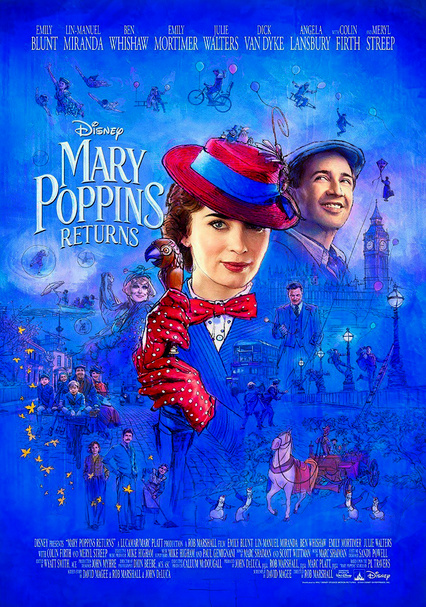
Mary Poppins Returns is a charming mixture of reboots and sequels to the immeasurably glorious original, Mary Poppins (1964).

Although it is impossible to live up to the magic of that film, the 2018 version comes quite close with a delightful turn by Emily Blunt, numerous Hollywood stalwarts in small roles, and gleeful musical numbers sure to leave audiences humming upon their exit from theaters.

Events begin to percolate twenty-five years after the original story, and the setting is 1935 London amid the Great Depression. His recently deceased wife, Michael Banks (Ben Wishaw), lives in the house he grew up in with his three children and housekeeper (Julie Walters) in tow.

His sister Jane lives and works nearby as a labor organizer.

Faced with the dreary reality that the historic Banks house may be foreclosed, Mary Poppins (Blunt) arrives elegantly on her umbrella to restore order and save the day.

Though her character does not overtake the film, Emily Blunt is dynamic in the title role. Her prim and proper good British charm and sensibilities crackle with wit and poise. It is tough to imagine anyone but Blunt in the role, as she puts her stamp on it so well.

With a smirk and a quick, matter-of-fact tone, the character is no-nonsense and utterly kind. The casting of Blunt is spot-on as she becomes Mary Poppins.

The London setting is adorable and fraught with good culture and sophisticated manners. Including the storied Big Ben is meaningful to the tale in a significant way and a teachable moment for children unfamiliar with London.

Furthermore, including a negative period in history—the Great Depression—is immeasurably positive.

The supporting characters are rapturous and a treat for elders familiar with the original Mary Poppins film. Meryl Streep plays Topsy, Mary Poppins’s eccentric eastern European cousin to the hilt, but never teeters over the top.

Colin Firth adds snarky charm as the villainous bank president, and Angela Lansbury gives grandmotherly zest as The Balloon Lady, an ode to the original novel.

Finally, Dick Van Dyke is a delight as the heroic Mr. Dawes Jr. who comes to the rescue at the last hour.

The real winners, though, are the enchanting musical numbers. With the lovely London landscape in full view, Mary Poppins Returns gets off to a spectacular groove with “(Underneath The) Lovely London Sky”.

Performed by the charming Lin-Manuel Miranda in the role of Jack the Lamplighter, Mary Poppins’ sidekick, the star has what it takes to keep up with Blunt. This is evident as the duo mesmerizes and entertains with a colorful number, “A Cover is Not the Book”, alongside an animated music hall.

Finally, fans will revel in the naughty and clever “Turning Turtle”, performed by Streep.

The costumes and lighting are both big hits. As Jack lights and defuses the street lights, we see the luminous dawn and sunsets, which give the film a nice touch.

During the film’s conclusion and subsequent race against the stroke of midnight, moonlight is featured, giving the film a warm glow.

The period piece costumes are lush, but not garish, adding flavor and capturing the period perfectly.

Although it lacks the oomph of the original Mary Poppins (but really, who expected that?), Mary Poppins Returns (2018) is nonetheless enchanting and inspiring in every way that a remake or sequel should be.

Given the mixing of humans and animations, the film is polite, polished, and filled with authentic zest: a fine creation and splendid entertainment.

Oscar Nominations: Best Original Score, Best Original Song-“The Place Where Lost Things Go”, Best Production Design, Best Costume Design