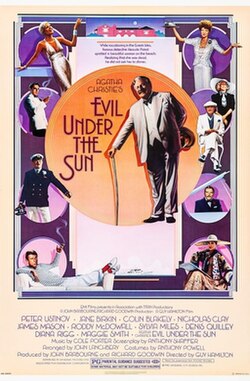
Agatha Christie’s Evil Under the Sun-1982
Director Guy Hamilton
Starring Peter Ustinov
Scott’s Review #1,065
Reviewed September 29, 2020
Grade: B+
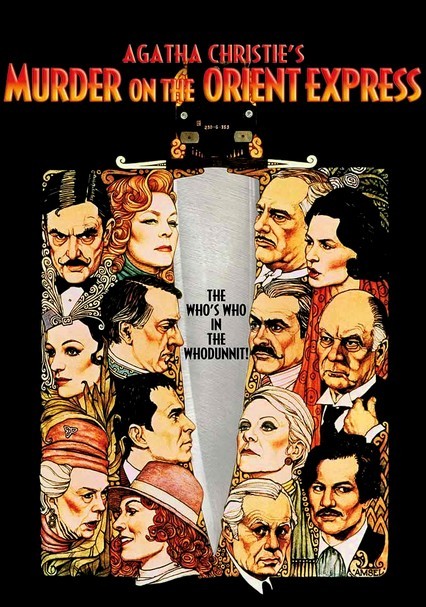
Following the success of Murder on the Orient Express (1974) and Death on the Nile (1978), Agatha Christie’s Evil Under the Sun (1982) is of a similar formula and is an entertaining yarn.
The experience is like savoring a favorite meal- we know what we will get, and we dive in with pleasure.
Director Guy Hamilton, famous for directing four James Bond films, takes the director’s chair and keeps the action moving quickly, crafting an enjoyable effort with a bit more humor than Christie’s novel, on which it is based.
Nearly on par with the two films, save for more predictability, this one is nonetheless a fine and joyous offering.
The setup remains the same, only the setting changed, as the affluent characters flock to a swanky resort area for fun and frolicking amid the Adriatic island with a saucer full of secrets and enough intrigue to last a lifetime.
Peter Ustinov returns as Detective Poirot in a very good effort. The man sleuths his way to a final revelation common in these films as the whodunit culminates in unmasking the murderer or murderers and bringing them to justice.
Spoiler alert- there are two killers. The juicy reveal takes place as all the suspects gather, nervously fretting about possible accusations.
I found it easy to figure out the culprits since they are portrayed as the most secretive, but it’s fun watching them unravel and hearing the explanation of their motivations. Also enjoyable is how each character has a specific ax to grind with the victim.
Agatha Christie’s Evil Under the Sun is a solid, classic whodunit done very well, with well-written characters and stellar acting.
The action starts mysteriously in the North York Moors when a hiker finds a strangled, female victim. Quickly, Hercule Poirot is asked to examine a diamond belonging to rich industrialist, Sir Horace Blatt (Colin Blakely).
The diamond is deemed a fake, and suspicion is cast upon Blatt’s mistress, the famous actress Arlena Stuart Marshall (Diana Rigg).
Events then shift to the resort island, leaving us to ponder what the dead woman at the beginning has to do with anything. In good time, the audience finds out, and this is ultimately satisfying.
As usual, a large principal cast is introduced along with well-known stars.
Daphne Castle (Maggie Smith) owns the lavish hotel and caters to Arlena’s put-upon husband, Kenneth (Denis Quilley), and stepdaughter, Linda (Emily Hone). At the same time, Arlena openly flirts with the yummy Patrick (Nicholas Clay), who has fun prancing and preening while wearing next to nothing.
Other characters are the husband-and-wife producers Odell and Myra Gardener (James Mason and Sylvia Miles), gay writer Rex Brewster (Roddy McDowell), and Patrick’s ailing wife, Christine (Jane Birkin).
Each has an issue with Arlena, who is the intended murder victim.
Like Murder on the Orient Express and Death on the Nile, the setting is the character itself. Though not a train or a boat, the sunny and sandy island is the perfect locale.
The water, a noon cannon, suntan lotion, and a watch are the items most important in the whodunit, but wait, there’s more!
A tennis match, the cliffs, and a by-the-minute timeline are of utmost importance to figure out the mystery. The point of a film like this, as with the treasured Agatha Christie books, is deducing the whys and hows of the murder.
Delicious are the scenes featuring Daphne and Arlena going toe-to-toe, and there are just not enough of them. Bitch versus bitch, as they trade barbs and snickering insults with glee, Smith and Rigg enjoy their roles, and the audience is treated as such.
Rigg is great as the bad girl, relishing in offending nearly everyone she encounters, and Smith speaks volumes with her eyes.
As for the male characters, Nicholas Clay gets my vote for the sexiest man of the year. With his lean, toned, bronzed chest and white shorts, which he confidently pulls up to reveal his bare butt cheeks as he struts near the pool, he can have any girl he wants (and possibly guys), and adds layers to the film.
The biggest riddle is what he has in common with his wife, Christine, who is saddled with health issues and is not fun to be around.
Staying largely true to the novel, Agatha Christie’s Evil Under the Sun (1982) will satisfy its intended audience.
A herculean author penning characters like Hercule Poirot and Miss Marple, everyman, and everywoman sleuths, this film was the last to be a big-screen affair.
Made-for-television movies would soon follow.
A lavish landscape, bitchy characters, scheming characters, murder, and mayhem are the recipe of the day for a good time.