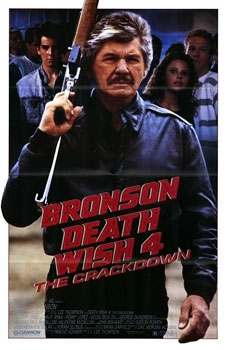
Death Wish 4: The Crackdown-1987
Director J. Lee Thompson
Starring Charles Bronson
Scott’s Review #1,319
Reviewed November 29, 2022
Grade: C+
I have an interesting relationship with the Death Wish films. Besides the first and maybe its follow-up, they pretty much suck, and that’s being kind.
They possess a machismo and right-wing, pro-National Rifle Association stance that’s not my cup of tea.
To make matters worse, poor acting, stagey action sequences, an explosive overuse of smoke ammunition, and endless clichés riddle the screen in nearly every scene.
Sure, there’s usually some heartwarming romantic moment or a justification for the killings, but the series is solidly amateurish.
With my nose to the grindstone, I somehow, someway, plodded through all five of the Charles Bronson film series installments and lived to tell.
I refuse to see the tepidly reviewed, unrelated 2018 incarnation starring Bruce Willis.
But the funny thing is, with all the cinematic negatives, the Death Wish films are fun in a campy, silly way. Hardly high art, they instead provide the viewer with fluff and a quick ninety-minute experience in shoot ’em-up revenge-seeking bloodletting.
With Death Wish 4: The Crackdown (1987) the filmmakers cleverly leverage the 1980s excess with a witty subtitle channeling the crack epidemic of the day set against the backdrop of lusty Los Angeles and the drug carnage seeping over the United States border from neighboring countries.
Some thirty-five years later, the premise is dated to say nothing of being riddled with stereotypes, but at the time, the plot must have seemed downright modern.
Paul Kersey (Bronson), who is no stranger to vigilante justice, is pulled back into the underworld of gritty Los Angeles when the daughter of his new girlfriend, Karen (Kay Lenz), dies after an overdose of crack cocaine.
Intent on dishing out a healthy dose of vigilante justice, he goes after the drug lord who ultimately supplied the crack, apparently forgetting to focus on the social issue of why the young girl was taking drugs in the first place.
The First Lady Nancy Reagan’s famous anti-drug slogan, ‘Just say no,’ fell on deaf ears.
As he hunts down the kingpin’s henchmen, Paul starts taking out a large part of the city’s drug-dealing population on a violent killing spree while posing as a dimwitted bartender.
The acting is laughably bad from Bronson on down to the bit players.
My favorite bad scene is when an interracial couple squabbles on their way out to dinner from the luxurious high-rise apartment they inhabit.
As she sits in the limo, brooding and cursing her mate who forgot something from the apartment, he is suddenly hurled from his penthouse onto the limo as she shrieks with anguish, after wishing him dead only seconds prior.
Director J. Lee Thompson, well past his prime in the late 1980s, forgot to tell his actors to add a bit of humor to the horrendous line delivery.
Or, he might have just phoned the whole thing in himself.
The film is by-the-numbers, and one attempt at a twist toward the end is an inspired effort. A pivotal character is shockingly killed, and it ain’t Paul who meets his maker either.
I didn’t see this surprise coming.
Nonetheless, despite the myriad of bad qualities contained within Death Wish 4: The Crackdown, the bad guys do get their just desserts, which are delightful to witness.
Death Wish 4: The Crackdown (1987) is best served up on a rainy afternoon when the viewer can munch on popcorn and lazily escape the day away with solid cinema trash.
