Tag Archives: Biography

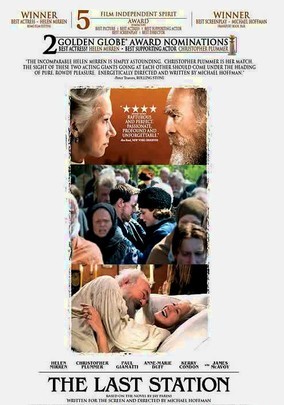
The Last Station-2009

The Last Station-2009

Director Michael Hoffman

Starring Christopher Plummer, Helen Mirren

Scott’s Review #569

Reviewed December 28, 2016

Grade: A-

The Last Station (2009) is a wonderful film.

It contains many worthwhile elements- history, culture, good drama, and great acting. Starring seasoned veterans such as Christopher Plummer and Helen Mirren, the fantastic acting is as good as it gets.

The film tells the story of the final year in the life of famous Russian author Tolstoy and the relationship he has with his family- specifically his wife, Sofya, and his disciples.

The year is 1910 and Tolstoy is ailing. He has had a stormy yet passionate relationship with his wife for decades, which is explored in the film.

The film’s main point is greed and in-fighting for control of a great literary figure’s legacy and money.

The main strong point of The Last Station is the relationship between Tolstoy and Sofya- both characters are headstrong and opinionated, but also madly in love, which leads to many sessions of battle.

This is a film of substance.

Director Michael Hoffman also mixes some humor with the heavy drama.

In conclusion, you might need to use some hankies.

Oscar Nominations: Best Actress-Helen Mirren, Best Supporting Actor-Christopher Plummer

Independent Spirit Award Nominations: Best Feature, Best Director-Michael Hoffman, Best Female Lead-Helen Mirren, Best Supporting Male-Christopher Plummer, Best Screenplay

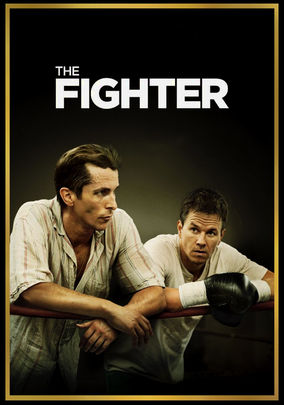
The Fighter-2010

The Fighter-2010

Director David O. Russell

Starring Mark Wahlberg, Christian Bale

Scott’s Review #546

Reviewed December 11, 2016

Grade: A-

The Fighter (2010) is an excellent film. Being a sports film there are the inevitable cliches, which make the entire sports film genre rather predictable.

But this film is a very well-done story and based on real-life figures (the Ward brothers).

Tremendous acting by Wahlberg, Bale, and Melissa Leo, in the role of Mama Ward- a role of a lifetime.

The telling is a true story of Mickey Ward, a boxer from Massachusetts, and his battle to stardom, dealings with family members, and his love life.

The characters may be ever slightly overdone in the rugged, rough, Bostonian way, almost appearing New Jersey-Soprano-ish instead of New England, but the message is clear- they are in the boxing world and are tough guys (and gals).

This film is much more character-driven than many similar sports movies, thank goodness and the casting is spot-on. There are the inevitable final boxing match and the standard reaction shots, but again sports films are riddled with cliches.

The real win is with the character’s layered, complexities as they love and hate each other.

Bale and Leo deserved their Oscars for their respective roles in The Fighter (2010), specifically Bale for the shocking weight loss and spot-on character imitation.

Oscar Nominations: 2 wins-Best Picture, Best Director-David O. Russell, Best Supporting Actor-Christian Bale (won), Best Supporting Actress-Melissa Leo (won), Amy Adams, Best Original Screenplay, Best Film Editing

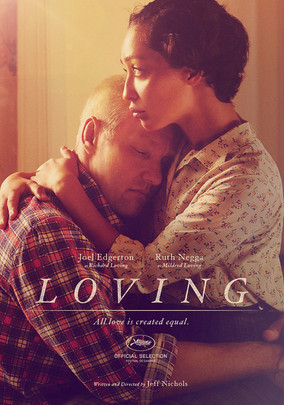
Loving-2016

Loving-2016

Director Jeff Nichols

Starring Joel Edgerton, Ruth Negga

Scott’s Review #527

80099974

Reviewed November 26, 2016

Grade: A

Loving (2016) is a quiet film.

Subdued and poignant, it is an important historical story to tell and jarring to be transported back to the 1950s Southern style, where interracial marriage was not only illegal, but children of interracial couples were barely considered human beings.

This is to say nothing of the views of their parents, specifically of law enforcement.

Sadly, circa 2016, we all should be aware that racism is still alive and well in the United States, and this film is a reminder of how much further we need to go.

The true story of the landmark 1967 Loving vs. Virginia Supreme Court case is the basis for this film.

The time is 1958 in Virginia, and a sweet, working-class couple, Richard and Mildred, are very much in love. Richard-white and Mildred-black are met with some sideways glances around town but generally have a strong, supportive family and friend structure, although both families are pretty poor.

They enjoy spending time with friends in bars and racing cars.

When Mildred becomes pregnant, Richard purchases a plot of land for them and asks Mildred to marry him. Despite the challenges this will create, they are wed in Washington, D.C. Once they return to Virginia, they are arrested for violating anti-miscegenation laws prohibiting interracial marriage.

The couple eventually sued the state of Virginia, leading to a unanimous Supreme Court ruling a decade later.

As a film, Loving is thoughtful and introspective.

The audience questions who we are to decide who someone loves. This can apply to same-sex couples as easily as interracial couples.

The film, led by director Jeff Nichols, creates many quiet scenes of thoughtfulness on the faces of leads Edgerton and Negga.

Furthermore, several scenes of peril encompass the film.

The Lovings constantly threaten to be discovered as they secretly return to their forbidden home state to give birth to their son, only wanting Richard’s mother to perform the birth. The tense scene where Mildred is dropped off on a deserted back road is well shot; the camera constantly focuses on the road and the threat of a car coming by at any moment.

Edgerton, a fantastic actor and director, performs tremendously as a quiet, stoic, blue-collar man who is madly in love with his wife and sees nothing wrong with it simply because it is not the norm.

He is poorly educated, but Edgerton gives him underlying intelligence and a basic understanding of cherished love and more than once calmly utters, “But I love my wife.”

To him, it is that simple. Richard will also use any necessary measures to protect his family, as any man would. Edgerton’s squinting blue eyes portray suspicion, warmth, and love.

Negga is equally compelling as calm and loyal Mildred.

One might expect Mildred to finally explode with rage as she faces obstacle after obstacle, raising three kids in an environment she does not want, yet she never does.

Negga embodies the character with sweetness, wide-eyed passion, and longing for a better life. Mildred tries not to get her hopes up with each impending court date, but Negga successfully portrays the character with many different emotions and complexities.

My favorite scenes of hers involve Mildred gazing at her husband, her eyes filled with love and pride.

Nichols wisely does not spend much time in the courtroom, a positive aspect of the film. Sure, we get the occasional scene of Richard and Mildred facing the court, but the film does not take a different approach than necessary.

Despite a landmark decision coming from Loving’s marriage, the film is a love story between a good man and a good woman who happens to be of different races.

What a lesson every viewer can learn from Loving (2016).

Oscar Nominations: Best Actress-Ruth Negga

Independent Spirit Award Nominations: Best Director-Jeff Nichols, Best Female Lead-Ruth Negga

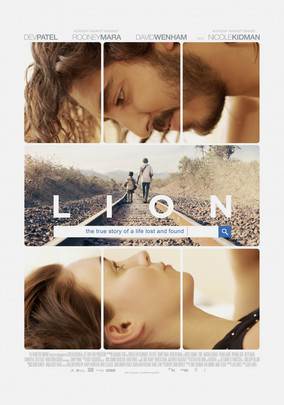
Lion-2016

Lion-2016

Director Garth Davis

Starring Dev Patel, Nicole Kidman

Scott’s Review #521

80108447

Reviewed November 19, 2016

Grade: A-

Lion (2016) is an enthralling, humanistic drama about family, lost loved ones, and the search to find them, as seen through the eyes of the same character as a child and an adult.

It features fantastic acting, specifically from stars Dev Patel (Slumdog Millionaire-2008) and Nicole Kidman, and also features lavish cinematography of the Indian and Australian countryside.

The film is based on a non-fiction book named “A Long Way Home.”

Introduced to a poor neighborhood in India in 1986, we meet five-year-old Saroo, a wide-eyed boy who idolizes his big brother. Their beautiful mother carries rocks for a living and relies on the boys to watch their younger sister.

The boys steal coal to help eliminate their mother’s hardships. Their father is absent.

Saroo accidentally gets on an empty train when he insists on accompanying his brother on a night job. He is transported thousands of miles away, losing his family in the process.

Twenty-five years later, and long since adopted by an Australian family, Saroo attempts to find his long-lost family using new technology- Google Earth.

In a lesser film, this subject matter might have been a sappy affair, predictable, and contrived.

But Lion soars with humanistic, emotional flair, and heartfelt, without any manipulations.

The first third of the film is focused on five-year-old Saroo. We witness his confusion, desperation, and scrapes with potential kidnappers, child molesters, and undesirables. We also see how resilient and intelligent he is, wisely outmaneuvering foes and savvy enough to avoid monstrous people.

As much as I enjoyed this film segment, it lasted slightly too long. I was ready to see Saroo as an adult and the encompassing problems to come, but this is a tiny gripe in an otherwise extraordinary film.

Lion takes off when Patel plays Saroo, who is now all grown up. Adopted by an Australian couple, John and Sue Brierley, he has lived a life of love, respect, and encouragement.

The Brierleys are a selfless couple who, in addition to Saroo, have adopted another Indian boy with deep emotional issues. This has caused hardship and problems in the household. Their reasoning for adopting is poignant; rather than bring their biological children into the world, why not save two children who need to be saved?

Patel and Kidman give emotional and raw performances. Patel is quite a find as he plays conflicted and haunted very well and is convincing in the lead role.

We witness his conflict as he struggles with not knowing what has become of his family in India, imagining their worry and the devastation of not knowing what has become of him. He also avoids telling Sue, his adoptive mother, who has her hands full with other emotional issues.

Kidman, who always delivers, is raw, emotional, and sympathetic.  As Sue struggles to be strong, her facial expressions are subtle and contained, yet dying inside with underlying pain is exceptionally relayed by Kidman in an award-worthy portrayal.

Director Garth Davis cleverly adds several scenes of Saroo longingly looking out into the ocean or simply gazing in the distance, imagining and self-reflective.

What makes these simple scenes great is through Saroo’s imagination, he imagines being with his birth mother; she is still young, and he is now an adult. Similarly, he imagines being with his brother; his brother is still ten, but Saroo is now an adult.

These are quiet, beautiful scenes that add layers to this film.

Lion (2016) is a wonderful experience in great storytelling, led by effective acting performances and a compelling screenplay that gives honesty in film-making to the true story that the film is based on.

The film is heartwarming and can be enjoyed by anyone.

Oscar Nominations: Best Picture, Best Supporting Actor-Dev Patel, Best Supporting Actress-Nicole Kidman, Best Adapted Screenplay, Best Original Score, Best Cinematography

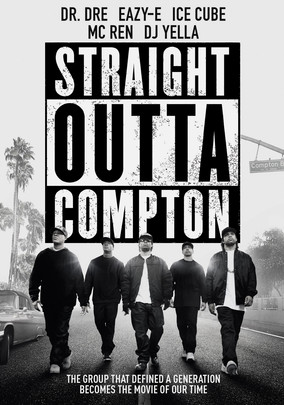
Straight Outta Compton-2015

Straight Outta Compton-2015

Director F. Gary Gray

Starring O’Shea Jackson Jr., Paul Giamatti

Scott’s Review #517

80041415

Reviewed November 12, 2016

Grade: B-

The rap group N.W.A. was a highly influential and controversial unit to emerge from Compton, California in the late 1980s and featured soon-to-be solo rap artists Ice Cube and Dr. Dre.

Another member, Eazy-E, rounds out the trio featured in this film along with their manager Jerry, played by Paul Giamatti.

Straight Outta Compton (2015) tells their story.

Ice Cube and Dr. Dre produced the film along with Eazy-E’s widow, Tomica Woods-Wright, and Ice Cube’s real-life son, O’Shea Jackson, Jr. portray Ice Cube.

The film is interesting as a way of learning about the rap group and their rise to and fall from stardom, but the film has a very slick and glossy style that detracts from the grittiness of the subject matter.

It feels very Hollywood and overly produced.

Especially, since the language is atrocious- almost overly, as if the point was being shoved down our throats.

Additionally, the acting, except for Giamatti, is not too impressive.

Lastly, the violence portrayed and the gang stuff seems a bit stereotypical for my tastes.

The film begins in 1986 and we meet a trio of friends. Determined to provide a raw, honest style of poetry to their music, they eventually meet their manager, Jerry, who takes them under his wing and leads them to their success.

Predictably, with success comes jealousy and contract disputes. The film delves into this subject matter as the partying and drug use, womanizing, and violence, all lead to the rap group’s constant struggles with the police force, especially since one of their top songs is anti-police.

Impressive is the real-life footage used of the 1991 beating of taxi driver Rodney King by the Los Angeles Police Department and the subsequent riots that occurred after the officers were found not guilty of any wrongdoing.

The racial tension in this city was interesting to revisit and palpable to the film’s subject matter.

The acting was noticeable to me and not in a good way. The young actor who plays Dr. Dre (Corey Hawkins) was fine, but the others (Jackson) and Jason Mitchell as Eazy-E were average at best. In any of their dramatic scenes where they appear to be angry, it just does not work, and the scenes lack grizzle and intensity.

Conversely, any dramatic scene that held any gusto belonged to Giamatti, who was excellent in his part. He makes the others seem better, but in other ways, their inexperience is evident compared to his.

In any event, he only makes the scenes he appears in more genuine. Early in the film, when Jerry lashes out at police officers, it is a meaty scene and forceful.

The filmmakers go for a message of violence and swearing in this film, but despite this, Straight Outta Compton still seems safe and overly produced. This may have had to do with the bright, slick cameras used.

It has a studio, high-budget appearance that does not completely work. I wanted it to look grittier and dirtier and see more of the seedy side of the business instead of merely being explained to me.

Women in this film are not treated very well and the characters who are the girlfriends are written sympathetically, but not given much substance to sink their teeth into.

Contrasting, Death Row Records CEO “Suge” Knight is portrayed as a maniacal, violent man.

Straight Outta Compton is a guy’s film.

I had difficulty relating to any of the central characters except perhaps Giamatti’s and it becomes unclear if Jerry had been ripping off the members of the rap group or if that is merely their perception. He seems to care about the members so that part is undefined.

Perhaps this film might hold more appeal for fans of N.W.A., which I never was, and rap is not my preferred style of music. I can appreciate the biographical way the film explains the trio’s story, ups and downs, reunions, death, and violence, but this film could have been much better and is flawed by its over-stylized filming.

Oscar Nominations: Best Original Screenplay

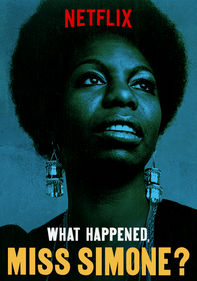
What Happened, Miss Simone?-2015

What Happened, Miss Simone? -2015

Director Liz Garbus

Starring Nina Simone

Scott’s Review #499

70308063

Reviewed October 25, 2016

Grade: B+

Nina Simone, who died in 2003 at seventy, was an iconic singer and pianist with a musical style all her own. As important as her soulful musical creativity, Simone was also a civil rights activist during the restless 1960s and was outspoken about black power and racial discrimination.

This led to much controversy.

What Happened, Miss Simone? (2015) tells her story in a thorough, rich fashion.

Executive produced by her daughter, Lisa Simone Kelly, who is interviewed throughout the documentary, the piece is standard fare, using interviews and performances by Simone.

We experience her upbringing in North Carolina, her acceptance into the prestigious Juilliard, her family’s reliance on her for money, and her years of struggle performing in dingy nightclubs.

I loved seeing the old clips of her performances. They are raw, gritty, and full of something special- poetic almost. Simone had trouble relaxing as she gave every ounce of energy in her shows and knew no other way to be.

Simone is like no other and the documentary does not need to explain this. Her performances tell it all. Not one to phone in performance and arguably not really “performing” at all, Simone was as real as they come. She immersed herself into her music – and seemed to drift off into another reality.

As an activist, Nina Simone is shown to be controversial, not against supporting violence by blacks against whites in the name of freedom.

Simone had tumultuous relationships with both her husband and daughter and has claimed to have been beaten repeatedly and forced to work.

Clear comparisons to other singers such as Aretha Franklin are explored. There is an element to Simone that other singers of that day did not have. She had a style all her own and did not “play the game” to achieve her success.

Instead, she chose to only be true to herself.

This is not a slight against Franklin, but the documentary states that if Simone had been happier, she might have had more commercial appeal, but would she have been satisfied with that?

I doubt it as she was an intense soul.

Shocking to me are claims of physical abuse vocalized by her daughter, but this is explained away as a result of her mental illness and not herself at times. Prescription drugs and diagnoses were not what they are now in those days.

From a critical perspective, the documentary delivers what it should, an overview of this amazing talent, warts and all. We see her from the child until retiree, and cannot help but pity her in a way because of her apparent mental illness, which caused her not always to be the charming celebrity we would want her to be.

What Happened, Miss Simone? (2015) helped me learn something fresh about an artist I wasn’t familiar with. That is what a documentary should do.

Oscar Nominations: Best Documentary-Feature

Howl-2010

Howl-2010

Director Rob Epstein, Jeffrey Friedman

Starring James Franco

Scott’s Review #491

untitled

Reviewed October 9, 2016

Grade: B+

Howl (2010) is a compelling courtroom drama biopic starring James Franco who is wonderfully cast.

This role, despite being in a small film with little recognition, cements Franco’s talents as an edgy actor who is willing to tackle challenging work rather than sticking to mainstream safe fare.

Franco has become one of my favorite young actors. He is so diverse and believable in any role he takes on.

The story is about 1950s poet Allen Ginsberg and his trial to determine whether his poems were art or should be banned for being indecent.

Much of the action transpires inside the courtroom and the film wisely mixes animation (in scenes of Ginsberg reading his poetry) in between traditional scenes.

The film allows the viewer to get to know the characteristics of Ginsberg. He was troubled (his sexuality, delusions, stints in a mental hospital), for sure, but also had a true, authentic love of writing and poetry, which is inspiring in an age of digital technology.

Sometimes good old-fashioned words are the truest art.

Howl (2010) is an interesting little film.

Jimi: All Is By My Side-2014

Jimi: All Is By My Side-2014

Director John Ridley

Starring André 3000

Scott’s Review #487

70292988

Reviewed September 30, 2016

Grade: A-

Jimi: All Is By My Side (2014) was not quite the film I was expecting it to be. It was better!

I was not expecting poor work since the film received a Best Male Lead Independent Spirit Award nomination for André 3000 (rapper) in the title role.

I expected an overview of the rise and fall of famed rocker Jimi Hendrix. Instead, I was treated to a more introspective piece than I imagined.

The film is a British production.

Interestingly, the film denied any Jimi Hendrix songs familiar to audiences, but only songs were written in 1966 and 1967.

This surprisingly turns out to be positive for the film.

The awesome achievement of this film is its non-conformity and being an independent film, lots of freedoms were undoubtedly given.

This is a good thing.

Had this film been targeted for a showing at local theaters, it may have been a run-of-the-mill affair, focusing on the star and the star only.

It is also shot in a less-than-glossy way, giving it an almost grainy, gritty look that I found added something.

Impressively, the supporting characters, specifically three females whom Hendrix has relationships with throughout his initial rise to fame, are prominently featured, and the story shifts at times to their perspectives and feelings, not just Hendrix’s.

The film does not focus on Hendrix’s untimely death.

We meet Hendrix (compellingly played by André 3000) performing guitar in a sparsely attended bar in New York City. He is discovered by Linda, the girlfriend of Rolling Stones guitarist Keith Richards, as she becomes both smitten with Hendrix and recognizes his immense talents.

Slowly, he is discovered (mainly in London) and rises to fame.

However, the film is not only focused on his success but his personal life.

Besides Linda, Hendrix becomes involved with a volatile groupie and fixture in the 1960s London music scene, Kathy, and cultured American Ida. Instead of the female characters being written as one-dimensional and dizzy, all three are quite intelligent and layered.

While each has feelings for the star, they are forced to be reckoned with in their own right, and we grow to care about their characters as individuals.

A scene involving Jimi violently beating girlfriend Kathy with a telephone during an argument has been refuted by friends as being fictitious- Hendrix was known as a gentle, peaceful man.

A controversy has emerged surrounding the accuracy of this film in general, but I thought it quite introspective and fascinating.

Independent Spirit Award Nominations: Best Male Lead-André 3000

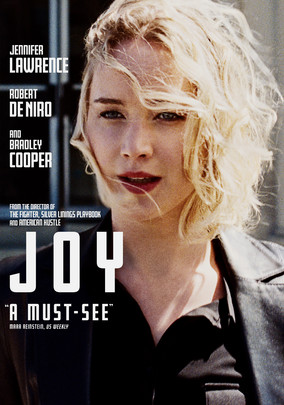
Joy-2015

Joy-2015

Director David O. Russell

Starring Jennifer Lawrence, Bradley Cooper, Robert DeNiro

Scott’s Review #485

80064513

Reviewed September 24, 2016

Grade: B-

Joy is a safe, mainstream, female-centered 2015 film, a biopic written for current star Jennifer Lawrence. She was nominated for a Best Actress Academy Award for her role and she carries the film.

Still, despite her performance, the film is nothing special and is written in a ho-hum manner.

It is simply not very compelling and the supporting characters are not utilized as they could have been. Despite being based on a true story, the writing is lazy and the plot far-fetched.

I expected more.

The film is another collaboration between director, David O. Russell, and big stars of the time- Lawrence, Bradley Cooper, and Robert DeNiro- all used in previous Russell films.

Lawrence plays Joy, a struggling Long Island mother of two, who is divorced from her husband (who still lives in the basement of her house), with multiple family members living with her, forming a support unit.

The sense is that Joy is the breadwinner of the family.

The story is narrated by Joy’s grandmother, who she calls Mimi (Diane Ladd). Mimi always knew Joy would be a success and we see a few scenes of Joy as a child, surviving her dysfunctional family and her parent’s disputes.

DeNiro plays her womanizing father, divorced from her mother (Virginia Madsen), who lies in bed all day watching soap operas. Cooper plays opportunist, QVC executive, Neil Walker, who takes a liking to Joy and helps her achieve her dream as a successful businesswoman after she patents an idea for a new, high-powered mop.

The authenticity of the time, 1989, and through the 1990s is apparent, as we see Joy working for Eastern Airlines, a company that would fold several years later. Also authentic were the automobiles of the time and the dresses and hairstyles.

These points the film does very well. And how cute was it to see famous daytime television stars such as Susan Lucci, portraying soap opera stars, as Joy’s mother lives her life vicariously through their tangled and bizarre soap lives?

Several scenes occur on the television set as we get glimpses of the soap stories.

The film as a whole, though, feels too neat.

Predictably, Joy faces obstacles on her way to success.  Already struggling financially, she takes out a second mortgage on her house. At first, she cannot give away mops, let alone sell them.

On the brink of giving up, she finishes a meeting with execs who laugh at her product, but Walker is there to give her a break because she has a pretty face.

Predictably, things do not go well and there is a rather dull subplot about a company in Texas trying to steal Joy’s idea. When she goes and threatens them they immediately back down and obediently give in to her every whim.

This is both unrealistic and uninteresting.

I would have liked to have seen a messy back-and-forth or some court scenes, but the Texas company is portrayed as nothing but the villain.

The writing has either plot holes or contains missed opportunities altogether and many questions abound. Despite many scenes of Joy’s past we end up knowing little.

Her entire family lives with her in a suburban Long Island house- why does Joy own the house and not her mother or grandmother? Why does Joy have a rivalry with her half-sister, Peggy? Why does Joy’s father own an auto garage and still need to stay with Joy? Why is Joy’s mother mostly in bed?

Madsen as the mother is rather cartoonish and unnecessary to the plot as is Ladd- a dynamic actress given little of substance.  I did not buy DeNiro as a cad nor in love with his wealthy new girlfriend Trudy (though seeing Isabella Rossellini in the part is a win), conveniently there to be Joy’s financer.

Despite an enormously talented cast, which is fantastic to see, most of the supporting parts could have been played by any actors, as the roles are not all that challenging, and the film itself is certainly a vehicle to showcase Jennifer Lawrence, David O. Russell’s current “it” girl.

This is not a slight towards Jennifer Lawrence since she is the best part.  She successfully portrays Joy as a sympathetic, strong-willed, fair, decent human being, with enormous struggles, and a blue-collar sensibility.

Great performance, but I wish the writing and the other talents involved in the film were given better material.

Oscar Nominations: Best Actress-Jennifer Lawrence

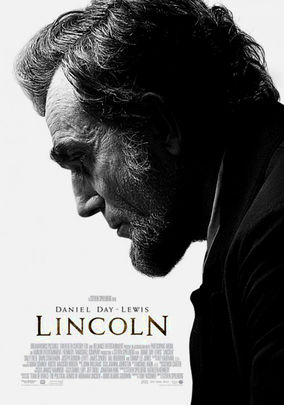
Lincoln-2012

Lincoln-2012

Director Steven Spielberg

Starring Daniel Day-Lewis, Sally Field, Tommy Lee Jones

Scott’s Review #476

70251896

Reviewed September 10, 2016

Grade: A

Lincoln is a 2012 film, which received a slew of Academy Award nominations. There appear to be differing opinions about the film itself, however.

Lincoln has audiences divided over whether it’s a brilliant film or a snore-fest.

My opinion leans decisively toward the former.

I recognize that (especially the first half) the film is slow-moving, but I found it engrossing and well-made.

Even the subtle aspects (costumes, art direction, lighting) are masterfully done.

I found Daniel Day Lewis’s (Abraham Lincoln) lengthy stories intriguing, not dull and found it to be a wonderful history lesson.

Steven Spielberg does what he does best- he creates a Hollywood film done well. He also has done controversial, shocking, or experimental, but the mainstream fare is his forte.

This film is not for everyone, but if you can find the patience it will be an enlightening experience. If nothing else, a thing or two may be learned.

Oscar Nominations: 2 wins-Best Picture, Best Director-Steven Spielberg, Best Actor-Daniel Day-Lewis (won), Best Supporting Actor-Tommy Lee Jones, Best Supporting Actress-Sally Field, Best Adapted Screenplay, Best Original Score, Best Sound Mixing, Best Production Design (won), Best Cinematography, Best Costume Design, Best Film Editing

Trumbo-2015

Trumbo-2015

Director Jay Roach

Starring Bryan Cranston, Diane Lane

Scott’s Review #449

80057100

Reviewed July 11, 2016

Grade: B+

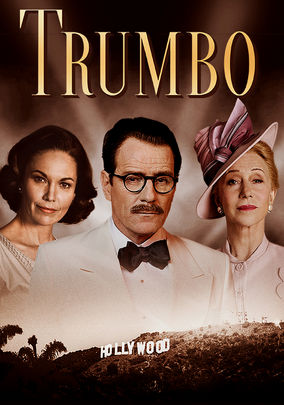
Trumbo, starring Bryan Cranston, who is suddenly in everything these days, is a 2015 biography drama about Dalton Trumbo, a famed, talented Hollywood screenwriter blacklisted in the 1950s.

Cranston is center stage in the film, and very good.

The film has a crisp, glossy look and excited me with its ode to old Hollywood and its mixture of real-life interspersed newsreels.

Great stuff for a classic film buff!

The sets, costumes, and art direction travel back to the 1940s and 1950s, but throughout I had a constant feeling of a modern film dressed to resemble an older one and never felt true authenticity.

Still, good effort and a well above-average Hollywood film.

A treat for cinema lovers or even those folks interested in seeing some classic black-and-white footage- a young Ronald Reagan is seen testifying, presumably against those feared to be communists.

Following World War II there was panic throughout the United States, including liberal Hollywood, to oust anyone with thinking deemed “un-American”.

If this sounds like a dated way of thinking now, the United States was not always as diverse as in 2016.

The infamous “Hollywood 10”, included ten screenwriters who were Communists, or at least had communist beliefs and sympathies. The story in Trumbo focuses on Dalton Trumbo, a quirky screenwriter, always with a classy cigarette, and holder, in hand.

His story is told and the audience sees his passion for fairness in the United States. He sees nothing wrong with being a communist.

The supporting characters are excellent. John Goodman, in the role of Frank King, B movie director, who gives Trumbo a chance to write under a pseudonym, and Helen Mirren and David James Elliott, as villainous Hedda Hopper and John Wayne, respectively.

Diane Lane could have been given more to do as the loyal wife of Trumbo, but sadly, Hollywood is not a woman’s world.

If I were to have any criticism of this film it is that Trumbo is mainstream fare and not high on the edgy factor, which is only a mild complaint.

There is nothing wrong with that, but the film screams Hollywood branded.

For instance, throughout Trumbo’s two-year prison sentence, he faces no real threats, no beatings, no abuse, nothing. He emerges from prison with a few gray hairs and life goes on. When Trumbo’s friend battles, and finally succumbs to lung cancer, there are no long-suffering scenes, making the film on the soft side.

Again, an observation of the type of film Trumbo is more than a complaint.

The scenes of Trumbo with his three children as the film periodically ages the children with older actors are touching, especially scenes with his oldest daughter, Nikola, are sweet. She grows up to be just like her father.

Trumbo earnestly explains to young Nikola, why he is a communist and asks what she would do if someone else was without food- her response is to share- a simplistic and sweet scene.

Ah, through the eyes of a child, the world is so innocent.

Trumbo goes back to the Hollywood of old- clean, glamorous, and extravagant, both in the film and the retro use of old footage.

It is a nonthreatening film that explains the story of Dalton Trumbo in a safe, thorough way.

I enjoyed it tremendously.

Oscar Nominations: Best Actor-Bryan Cranston

Marina Abramovic: The Artist Is Present-2012

Marina Abramovic: The Artist Is Present-2012

Director Matthew Akers, Jeff Dupre

Starring Marina Abramovic

Scott’s Review #436

70232038

Reviewed July 1, 2016

Grade: B+

The wonderful thing about documentary features is that they can introduce the viewer to a world of knowledge or provide an experience that you may not ordinarily be exposed to.

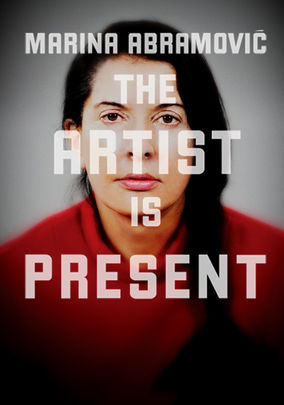
This is the case for me with Marina Abramovic: The Artist Is Present (2012).

Knowing nothing about this inspiring artist prior, I had no idea who she was going into this documentary and had no exposure to performance art.

The film does a great job of telling Marina’s career history, extreme discipline, and the honesty of her work. The documentary is also a biography as it gives a history lesson of who she is and the various obstacles she has hurdled in her life.

Marina is portrayed as an extreme artist and it was a wonderful experience learning about her.

Seeing a video of The Museum of Modern Art in nearby New York City was a treat since I have been to the museum before.

Independent Spirit Award Nominations: Best Documentary Feature

Behind The Candelabra-2013

Behind the Candelabra-2013

Director Steven Soderbergh

Starring Michael Douglas, Matt Damon

Scott’s Review #411

70274808

Reviewed June 18, 2016

Grade: A

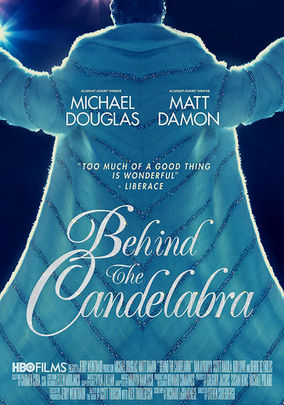
I thoroughly enjoyed this HBO film based on the life of Liberace, whom I was too young to know much about before viewing this movie.

The excesses of his lavish lifestyle are explored completely.

The standouts are Michael Douglas and Matt Damon who are both exceptional in their portrayals of Liberace and his young lover. Both were unrecognizable at times and completely embodied their characters.

I can’t attest to the absolute truth of the story, but the HBO film does a nice job of mixing joy, passion, heartbreak, sadness, and competition throughout.

The story undoubtedly bears a likeness to many Hollywood troubled relationships past and present.

Legend-2015

Legend-2015

Director Brian Helgeland

Starring Tom Hardy

Scott’s Review #405

80057599

Reviewed May 24, 2016

Grade: B+

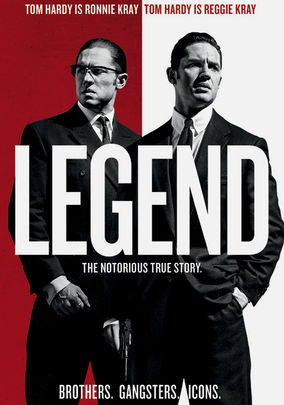
Tom Hardy is one of my favorite modern film actors (he should have won the 2015 Oscar for his riveting performance in The Revenant, in my humble opinion) and in Legend (2015) fans are treated to a dual role by the handsome Brit.

Hardy portrays Reggie and Ronald Kray, two of London’s most feared and brutal gangsters.

The film belongs to Hardy in every way, shape, and form, the locales of London are fantastic, and more than one scene is jaw-dropping violent, but the film meanders quite a bit and the vocals of Ron Kray are quite difficult to understand.

Still, impressive effort as a whole.

The time is late 1950s London. Reggie Kray, the more mainstream of the Kray brothers, is a feared member of the organized crime community.  He is coddled by his mother and can do no wrong in her eyes. This makes any relationships difficult as his mum disapproves of his mates.

He falls in love with Frances Shea, a young woman who narrates most of the film, so it is told from an outsider’s perspective. Reggie’s brother Ron has recently been released from a mental hospital and if off of his medications, is certifiably crazy, and very volatile.

He is gay and makes no bones about it.

Ron and Reggie have a love/hate relationship, and this dynamic is the most interesting aspect.

Thanks to Hardy, as the writing is not Legend’s strongest suit, we see two very different characters, even though they look alike. In the myriad of scenes shared between the brothers, it appears that two actors are playing the roles which is to Hardy’s credit.

An important scene emphasizes the relationship between the two. When a rival dares to mention Reggie’s wife’s name disparagingly, he points a gun and fires at the man’s head.

Fortunately, the gun is not loaded, so the audience breathes a sigh of relief. Yet, a worse fate awaits the victim. After the deed is done, Reggie whispers in Ron’s ear that he killed the man “because I can’t kill you”.

This means Reggie would kill Ron if he could- shocking since they are brothers. To add to this, it is implied that he would kill his brother with the same savageness as his victim.

This makes the audience ponder.

Impressive is Ron’s sexuality, especially since he is not written stereotypically. He is brutal, masculine, and hardcore. The fact that Ron Kray was a real figure is important to note. His entourage of boyfriends follows him around in dedication.

Who can blame them as his charisma oozes- think of an unstable James Bond.

The twin’s relationship is the best part of the film, but as a mob film, Legend meanders quite a bit, so much so that it becomes tough to identify what the point is, if not for Hardy.

Save for Frances, none of the supporting characters are written with interest and are all rather forgettable.

The wonderful Chazz Palminteri is wasted in the role of Angelo Bruno, head of a Philadelphia crime family and friend of the Krays. There is little meaning or interest in his role.

A mediocre story, but with leading characters with depth, makes Legend (2015) an interesting film that flies under the radar and receives little notice.

Hopefully, if nothing else, it continues the success that Tom Hardy is currently achieving in modern film.

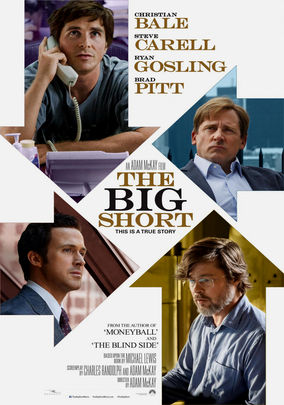
The Big Short-2015

The Big Short-2015

Director Adam McKay

Starring Christian Bale, Steve Carell

Scott’s Review #369

80075560

Reviewed January 10, 2016

Grade: A-

The Big Short (2015) is a confusing film and is its intention and also its genius.

Throughout some of the film, I was uncertain how much I liked it (or got it) and found many of the characters unlikeable, but at the conclusion, I realized that is exactly what the filmmakers intended is a clever tactic and makes The Big Short a success.

On the surface, the film has some humor but a very dark story at its core and left me a bit depressed and terrified at the conclusion.

I am happy that the film is receiving accolades and is the “thinking man’s” hit movie of the season.

To attempt to summarize the film, the film begins in 2005, approximately two years before the financial crisis of 2007-2008.

Eccentric hedge fund manager Michael Burry (Christian Bale), realizes the U.S. housing market is unstable and predicts a crash.

He attempts to profit by betting against the market, a move laughable to all around him, especially the banks who anticipate a windfall at Michael’s expense. Trader and fellow market managers, Jared Vennett and Mark Baum (played by Ryan Gosling and Steve Carrell) catch wind of Michael’s theory and try to get in on the action.

There is a sub-plot involving two younger investors also attempting to profit through the guidance of a retired banker (played by Brad Pitt).

The financial collapse is a tender subject and certainly no laughing matter, especially since it is so recent and affects many people.

The Big Short is touted as a comedy, which is strange. I found the audience didn’t know exactly what to laugh at or when. The film’s “laughs” were cynical, witty, and sometimes wicked. Many people do not get this type of humor.

In real life, people were kicked out of their homes and lost their jobs, pensions, etc. and it was all the result of greed, which The Big Short hammers home.

Several scenes include frat-boy investor/trader types getting rich by enabling almost anyone to afford a new house. Little did these people realize that there was a catch.

The film paints a jaded picture of Wall Street. The rich get richer at the expense of the middle class and the poor. It is an age-old sad tale.

Performance-wise, Carrell and Bale are the standouts. They both play characters who are damaged. Bale’s Michael is socially awkward, and has a false eye, but is also a genius. Carrell’s Mark is angry, grizzled, and is in therapy as a result of his brother’s suicide.

Both actors are great and have developed into worthy, credible acting talents. Worth mentioning, are small, but meaningful roles by Melissa Leo and Marisa Tomei.

The Big Short is shot interestingly, and highly unusual. From time to time, the action will stop and a famed celebrity (Selena Gomez, a world-renowned chef, or a model in a bubble bath) will explain the events, thus far, or give some review.

Also, more than once the actors will turn to the camera and speak directly to the audience. A personal touch that I found effective.

In the end, not much in life has changed, which is the message, and a frightening one. As one character brilliantly puts it “people will go back to blaming the poor and the immigrants”, which is a sad message.

After millions lost everything, not much has changed in the world and The Big Short makes that very clear. The people responsible have gotten away with crime, the banks bailed out, and a new scheme is undoubtedly in place.

It’s a sad world.

The Big Short (2015) is a gritty, harsh look at reality and a terrific film.

Oscar Nominations: 1 win-Best Picture, Best Director-Adam McKay, Best Supporting Actor-Christian Bale, Best Adapted Screenplay (won), Best Film Editing

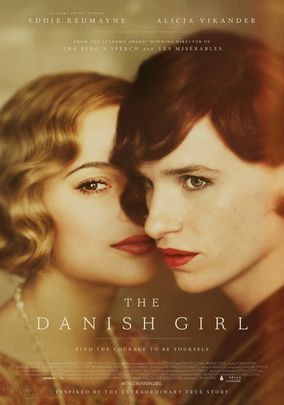
The Danish Girl-2015

The Danish Girl-2015

Director Tom Hooper

Starring Eddie Redmayne, Alicia Vikander

Scott’s Review #310

80058477

Reviewed December 29, 2015

Grade: A-

The Danish Girl (2015) tells the loosely based story of Danish painters and married couple Lili Ebe and Gerda Wegener and Lili’s struggles as the first known recipient of sex reassignment surgery, unheard of at the time that it was (1930).

The film showcases terrific acting (Eddie Redmayne and Alicia Vikander especially) and a journey of one person’s struggle with gender identity.

The subject matter is important and timely as the recent transgender movement has emerged at the forefront of social issues today.

A happy, young couple living in Copenhagen, and married for six years, Gerda and Einar are inseparable and madly in love. They are best friends and help each other with their art. Because of a female model’s tardiness, Gerda convinces Einar to stand in for the female model.

This event triggers a lifelong identification as a female named Lili Elbe. Lili has emerged sporadically since childhood.

Through painful self-assessment and encouragement from progressive loved ones, Lili decides to go through with a highly experimental and risky sex change operation.

Gushing with sensitivity and tenderness and groundbreaking, though I bet even more so if made ten years ago, one feels for both lead characters as it is important to note that they both go through emotional turmoil.

It would be easy to lessen Gerda’s emotions and, perhaps with a lesser actress this might have happened, but Vikander (unknown to me before seeing this film) gives an emotional performance that is raw and exudes empathy.

One can imagine how they would feel if their spouse identified as the opposite sex. Confusion, blame, anger, and sorrow, would all be common reactions. Gerda is strong, brave, and helpful while crumbling beneath the surface.

Vikander brings all of this to the screen flawlessly.

Similarly, Redmayne brings depth and empathy to his role.  Redmayne’s Einar is masculine, but there is something sensitive and slightly feminine to him from the start.

Was this purposely done to soften the blow? He also appears to be very slightly built. Redmayne lost weight to portray this role and have a softer appearance.

Actors can easily dress up in drag, but the emotional investment needs to be there and Redmayne makes the viewer care about Lili. One is teary-eyed along with Lili as she sees no other choice but to undergo the risky operation. We see the desperation in Lili’s eyes thanks to Redmayne’s acting skills.

I loved how supportive the characters are in the film. Granted, Einar/Lili and Gerda travel in liberal and progressive circles, but for 1930, this was wonderful to see.

Of course, Copenhagen and Paris are open-minded cities, but Lili’s childhood friend Hans, a sophisticated, macho guy, offers support. The same goes for the Doctor taking on Lili’s surgery.

These aspects lend to a delicate, peaceful film of encouragement.

To be clear, Lili is not gay, and this is made crystal clear during the film as she meets a gay man, and the distinction between them is made. She does, however, identify and feel that she is a woman. She was born with the wrong parts.

The greatest aspect of The Danish Girl is its powerhouse acting and compelling subject matter. One’s gender is a given for most, but watching a riveting drama about someone who is unrestful with their gender is eye-opening and still rather taboo.

2015 was a year of progressive transgender films and The Danish Girl is towards the top in its class and graceful in dealing with the subject matter in a judgmental-free way.

Oscar Nominations: 1 win-Best Actor-Eddie Redmayne, Best Supporting Actress-Alicia Vikander (won), Best Production Design, Best Costume Design

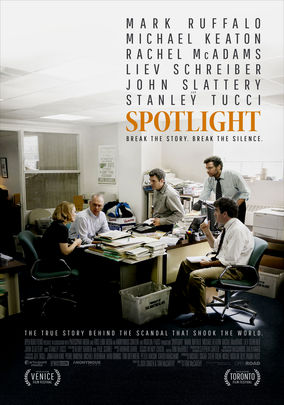
Spotlight-2015

Spotlight-2015

Director Thomas McCarthy

Starring Michael Keaton, Mark Ruffalo, Rachel McAdams

Scott’s Review #294
80061341

Reviewed December 9, 2015

Grade: B+

Spotlight (2015) is a film with an important story to tell.

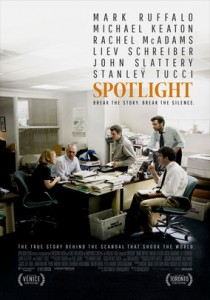
A telling of true events that occurred within the Catholic Archdiocese for ages, Spotlight’s focus is specifically on the Boston scandals, as a team of reporters working for the Boston Globe uncovered and exposed a multitude of child molestation cases committed by priests.

They were subsequently covered up, leaving victims paid off to keep quiet. The number of proven cases in Boston alone is staggering.

Starring are a plethora of talents including Michael Keaton, Mark Ruffalo, and Rachel McAdams, who lead the pack.

They make up the “Spotlight” team at the newspaper,  an investigative unit that works on special stories as they arise.

Their new boss, Marty Baron (ironically a Jewish man), played compellingly by Liev Schrieber, takes over as head of the department. He quizzically asks why the story is not already a priority. Suddenly it is a hot-burner issue and the film delves into an investigation to uncover the facts.

Spotlight is a minimalist film. There is nothing cinematically unique or razzle-dazzle about it, but somehow that is okay.

In some aspects, the film reminds me of the 1975 thriller All The Presidents Men, starring Dustin Hoffman.

For instance, the bleak, bare news rooms-sterile in their look, are similar- cubicle after cubicle,  harsh lighting, and generic conference rooms.

This is the filmmaker’s intent.

Also, the fast, energetic pacing, successfully emitting the tight deadlines newspaper folks face, transfers perfectly on film.

The sexual abuse scandal is a cold, harsh reality and the film introduces several victims, who, now as adults, are forever scarred. Some attend support groups, some take drugs, one is sadly not “all there”. Another, now a gay man, was singled out by a priest during a vulnerable period in the then-young boy’s, life.

It is a heartbreaking reality that many victims in the film are based on real cases.

Let’s focus on Schrieber’s character for a minute.  He gives such an understated yet compelling performance there is a risk it will wind up being overlooked. He calmly, yet passionately initiates the case. It is not a showy performance and subdued but a compelling one if enough attention is paid to it. He is a standout.

Unfortunately, the film does not delve much into the defense (if any) of the Catholic church. Did they do anything but deny the allegations? Why were the victims paid off? Not much is noted from the church’s point of view.

In real life, the Catholic church did hide the abuse that transpired for decades.

A slight negative is that the film does not delve into the characters’ personal lives.

Michael Keaton’s character, Robby Robinson, is arguably the lead character, spearheading the case,  though very little is known about him.

Is he married? happily? Yes, he is a workaholic, but what else?

Ruffalo’s Michael Rezendes is separated from his wife, but little is known to the reasons.

Finally, McAdam’s Sacha is probably the most fleshed-out. She is happily married, close with her religious grandmother, and hurt by the scandal. But we do not know her in-depth either.

I found myself wanting to know more about these people.

All in all, Spotlight (2015) is a superior film deserving of the recognition it is receiving. Intense, gritty, and filled with honesty, it is a story that needed to be told and has been told well.

Oscar Nominations: 2 wins-Best Picture (won), Best Director-Tom McCarthy, Best Supporting Actor-Mark Ruffalo, Best Supporting Actress-Rachel McAdams, Best Original Screenplay (won), Best Film Editing

Independent Spirit Award Nominations: 5 wins-Best Feature (won), Best Director-Tom McCarthy (won), Best Screenplay (won), Best Editing (won), Robert Altman Award (won)
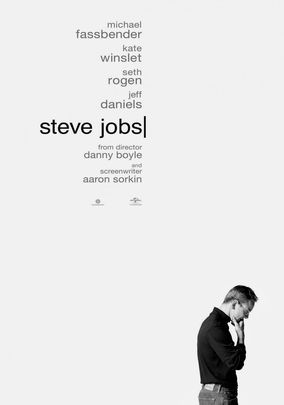
Steve Jobs-2015

Steve Jobs-2015

Director Danny Boyle

Starring Michael Fassbender, Kate Winslet

Scott’s Review #288

80049358

Reviewed November 25, 2015

Grade: B+

Steve Jobs is a name that almost everyone has heard of. Most associate him with Apple products or at least know that he is some technological genius who has influenced the modern world in some fashion.

His name is a household one.

The film Steve Jobs (2015) presents a slice of his life, mostly focusing on his professional leap to success, his damaged personal life, and his inability to stay close to people within his circle.

Michael Fassbender plays the title role. He looks nothing like Steve Jobs, but this did not bother me.

It is quickly revealed that Steve Jobs is a competitive, cut-throat, and sometimes unkind man. He is driven, ambitious, and willing to do what it takes to succeed in business. He is also complex and as the film rolls along we witness the complexities of this man, arguably deemed a “genius”.

But where he has flaws is in his personal life as the film makes abundantly clear.

Kate Winslet is excellent in the supporting role she plays. Joanna Hoffman, Jobs’s loyal marketing executive, stays in his corner through the years, enduring ups and downs, yet their relationship never goes beyond the platonic. They are colleagues and both are absorbed in their creations.

Her character is a bit under-explored as we never are exposed to much of her personal life. Winslet in a rare “dowdy” role, makes the most of Joanna as she is the type of woman who throws herself into her work at the expense of her private life.

The film is primarily set during the three important software launches and, predictably, all are filled with issues and stress.

The bulk of the first act occurs in 1984 when Jobs and Hoffman struggle and fret during an Apple Macintosh launch in front of an auditorium filled with industry types eager to see the new technology.

The scene is tense as the new computer will not say “hello” as advertised and Jobs demands lead engineer, Andy Hertzfeld, fix it.  The scene escalates in its intensity.

We immediately bear witness to the fact that Steve Jobs is a shark. He is demanding and unlikable and the film is not afraid to stress that fact as the action continues.

We are next introduced to Jobs’s personal life. A beautiful young woman arrives at his office with a young girl. They are both on the brink of being destitute and thrown out of their home, yet Jobs refuses to help them and coldly calculates the probability that the young girl (Lisa) is biologically not his.

As the film chugs along Steve Jobs has a turbulent relationship with Lisa as the film spans the period from 1984-1998.

The film is a character study of sorts and we learn the complexities of Jobs. Fassbender gives a nuanced performance allowing the audience to absorb these character traits and ultimately feel emotional sympathy for him.

I admire this character study of Steve Jobs and feel that I know him quite a bit more, on a human level, than I once did.

Perhaps the supporting characters might have been fleshed out a bit more, but in large part, Michael Fassbender’s portrayal of a real-life person makes this film successful.

Oscar Nominations: Best Actor-Michael Fassbender, Best Supporting Actress-Kate Winslet

Black Mass-2015

Black Mass-2015

Director Scott Cooper

Starring Johnny Depp, Joel Edgerton

Scott’s Review #278

Black_Mass_(film)_poster

Reviewed September 28, 2015

Grade: B+

A dark tale of crime, corruption, and Irish mob ties encompass Black Mass (2015), a drama based on the life and times of infamous Boston crime lord Whitey Bulger.

Set primarily in Boston, with a segue to sunny Miami during the 1970s and 1980s, the film mainly focuses on the intricate dealings between Bulger and childhood friend John Connelly. Now FBI, he uses Bulger as an “informant” to secretly bring down an Italian mafia figure, but slowly becomes more involved in Bulger’s sinister world.

Beginning in 1975, the film is authentic in its use of the styles, cars, and looks of the times in Boston during that period. Plausibility is apparent, and powerful acting is shown from top to bottom.

The stellar cast of Black Mass and the hefty cast features an array of well-known and capable actors, adding realism.

Led by Johnny Depp as Whitey, Depp gives an eerie, hypnotic performance as his bright blue eyes sparkle in a devious way.

Whitey is ruthless and will do whatever is needed to keep power and control. Like Connelly, Joel Edgerton is arguably the film’s lead character, though Depp gets top billing. Edgerton, in real life handsome, appears frumpy, and as a regular Joe type.

Supporting turns by Benedict Cumberbatch, as Whitey’s powerful Senator brother, is crafty and sleek, but corruption shrouds him.

Kevin Bacon, Dakota Johnson, Peter Sarsgaard, and Julianne Nicholson portray smaller yet pivotal roles and all do a fine job.

The screenplay is intelligently written. The story is quite dark and there are no laughs or light moments.

There are numerous deaths, the victims shot at point-blank range, but also two deaths in particular, where the victim’s suffering is prolonged and the scenes are cringe-worthy. The film is very violent and given the subject matter, is riddled with foul language.

One impressive aspect of Black Mass is the character-driven tale and that it is based on a real-life person adds to this.

Not only is Bulger fleshed out, but John Connelly is written very well. Gradually becoming immersed in the crime world as opposed to the world of law, we see Connelly sink deeper and deeper into Bulger’s world, and not so unwillingly either.

He loses his wife Marianne (Nicholson) along the way as she tires of the danger and corruption surrounding her. A chilling scene occurs when Bulger confronts Marianne in her bedroom, after observing negative vibes from her, and warns her in a flirtatious way, never to cross him.

As he caresses her face and slowly firms his grip, it is a rather frightening scene.

The dialogue is crisp. When Bulger is invited to a steak dinner at Connelly’s house, there is awkward tension at the dinner table. Jovial small talk over the preparation of the delicious marinated steak everyone is eating comes to the forefront as Bulger asks Connelly’s partner to reveal his family secret recipe for the favorite steak he has ever eaten.

When the partner eagerly confesses the recipe, he is coldly quizzed whether he would give up Bulger’s secrets as easily.

This is one of the best scenes in the film.

Comparisons to Goodfellas (1990) are evident but without the fun. I thought of The Departed (2006) throughout the viewing as well.

I think director Scott Cooper goes for and successfully achieves, good straight-forward, dark story-telling. Take the number of killings. The organized crime world is dirty, intense, and unkind and Black Mass portrays this well.

Black Mass (2015) is a success on many levels. The superior acting, detailed writing, and truthfulness create a good film. Just be sure to remember it’s a heavy one.

Unbroken-2014

Unbroken-2014

Director Angelina Jolie

Starring Jack O’Connell, Garrett Hedlund, Domhnall Gleeson

Scott’s Review #260

70305949

Reviewed August 1, 2015

Grade: B

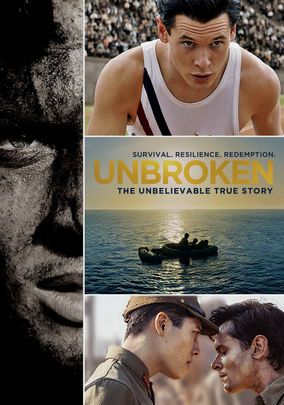
Unbroken (2014) tells the true story of Olympic athlete Louis Zamperini, a runner during the World War II period, who was also serving in the military during this tumultuous time in history.

His story is one of bravery, courage, and endurance, as he survives a hellish experience in a Japanese prisoner of war camp after having crashed in the Pacific Ocean, stranded for forty-seven days as if that were not enough to break a man.

Mainstream Hollywood fare to the hilt, this film is surprisingly directed by Angelina Jolie (a woman) and written by the Coen brothers, the latter usually emitting less traditional and more quirky fare than this film.

Jolie directs what is arguably a “guys movie” that contains very few women in the cast, and the ones who do appear are either loving mothers or giggling schoolgirl types, so the big names associated with Unbroken surprise me.

I would have taken this work as a Clint Eastwood film.

Unbroken, expected to receive several Oscar nominations, was shut out of the major categories.

Visually, Unbroken is slick, glossy, and shot very well- it looks perfect. The cinematography, sound effects, and costumes look great.

The cast of good-looking young men looks handsome even while battered and bruised and half-starved. While in a way this is a compliment, it is also not one. Unbroken lacks any grittiness and plays it quite safe. Even the scenes of abuse and beatings lack an edge to them.

This is not to say that the film is not good. It is good.

I found myself inspired by the lead character of Louis, played by Jack O’Connell, for his resilience during his ordeals. O’Connell gives a very good performance as his motto, “If I can take it, I can make it” is repeated throughout, and who will not cheer at his accomplishments?

Zamperini, who has traditional Italian parents having relocated to the United States, is strict but fair. Louis’s older brother, Peter, is his best friend and is the person who has the most faith in him. At first, Louis is on the verge of becoming a punk, in trouble with the law, if not for the interference of his brother, who gets him interested in the sport of running.

As the years go by and war erupts, Louis embarks on a tour of duty in the military and his plane crashes in the water providing yet another test of courage and stamina. Louis is strong and always the leader of the group he is intertwined with.

The scenes of the three survivors stranded on the raft for days become slightly tedious, but perhaps this is the intention, as they eat raw fish and raw birds to survive. Much of the remaining action is set in two Japanese war camps as Louis (and others) struggle to survive until the massive war has ended- they do not know if they will live or die.

The central antagonist- a vicious Japanese sergeant named “Bird”, perplexed me. Blatantly targeting Louis and administering cruel beatings and heaping tests of strength upon Louis, presumably out of jealousy because Louis was an Olympic athlete, why did Bird not simply kill him?

His motivations were also odd- In one scene, Bird tearfully tells Louis that he knew they would be friends from the beginning and seems to admire him. Bird’s father, going by a photo, seems a hard, mean man. Is this why Bird is so vicious? Bird’s character is not well thought out.

Also, every single Japanese character is portrayed in a very negative light, which sadly is common in war movies. Surely, despite being a war, there had to have been a few Japanese people who were not cruel.

Character development and depth are not a strong suit of this film.

Unbroken is a good, solid, war drama with an inspiring message of triumph, faith, and determination.

Indeed, it is a positive message to viewers of all ages.

The abuse/torture scenes are tough to watch, but the result is a feel-good story.

The snippets of the real Louis Zamperini are wonderful to watch.

Oscar Nominations: Best Sound Editing, Best Sound Mixing, Best Cinematography

Love and Mercy-2015

Love and Mercy-2015

Director Bill Pohlad

Starring John Cusack, Paul Dano

Scott’s Review #258

80017274

Reviewed July 17, 2015

Grade: B+

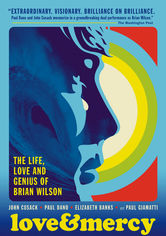
The life and times of the Beach Boys’ famous and troubled lead singer, Brian Wilson, is finally played out on the big screen (apparently many attempts were made to make a film) as Love and Mercy (2015) chronicles his difficult upbringing, unrivaled success, and his interesting life in later years.

He suffered from schizophrenia, traveled down a paranoid, nervous path, and was manipulated by a family friend who served as his doctor and main caregiver.

Thankfully, he weathered the storm due to his future wife, and remarkably still performs and entertains in 2015.

His musical career began in the 1960s.

The biopic features many well-known Beach Boys tunes to hum along to and be entertained by. It’s not a happy film nor a downer either.

It’s somewhere in the middle of the two and the life story of a rock star.

There is a risk in this. If the film is too sentimental it will fail. Love and Mercy do it correctly.

The film is not a sing-along, trip-down-memory lane film for lighthearted film fans. Rather, it is dark, murky, and troubling at times (the psychedelic scene when a young Brian is imagining different voices and noises in his head is rather frightening).

Wilson is played by two actors, first in the 1960s and later in the 1980s.

Paul Dano stars as a young Wilson in the early stages of his career, filled with passion for life, art, music, and talent beyond belief, but clearly in the onset stages of paranoia, thanks to his critical father. He is a demanding, angry man, possibly envious of Brian’s talents as a songwriter, who always wanted more from Brian.

Wilson’s father managed Brian and his brothers success but at a huge cost, and was ready to bail when the “next big thing” came along.

Miraculously, through conflict with his father and other members, Wilson completed the Beach Boys masterpiece, Pet Sounds, a groundbreaking album from the late 1960s. The film shows the struggles faced to achieve this success.

In later years John Cusack takes over the role of Brian. By this point in his life, he is damaged and he is a full-blown neurotic, insecure, and dependent on his psychotherapist, Dr. Landy, brilliantly played by Paul Giamatti.

Landy has control of Wilson’s assets and will destroy anyone who interferes in this.

The scenes in which he screams at and berates a drugged-out Brian Wilson to create music are tough to stomach. When Wilson romances their future wife Melinda Ledbetter, played by Elizabeth Banks, she ultimately saves his life as she is determined to rescue Brian from the wicked abuse and adjust the toxic levels of medications he was kept on.

I left the movie theater unsure of the factual accuracy and pondered the following questions.

Did Brian’s wife swoop into his life and “save” him as neatly as the film explains? How instrumental was the maid in this process? Was the Wilson brothers’ father as much a monster as the movie portrayed him? Was Giamatti’s vicious psychotherapist role true to life or were the aspects of Love and Mercy embellished ever so slightly for moviemaking magic?

One wonders, but from a film perspective, Love and Mercy (2015) works well as a work that takes risks, does not go for softness or niceness, and gives a character study that is quite admirable.

Independent Spirit Award Nominations: Best Supporting Male-Paul Dano

Wild-2014

Wild-2014

Director Jean-Marc Vallee

Starring Reese Witherspoon, Laura Dern

Scott’s Review #249

80013281

Reviewed June 21, 2015

Grade: B+

Wild (2014) is a personal story of a young woman’s 1995 challenge to hike the 2,650-mile Pacific Crest trail as a form of therapy for her divorce and her recovery from drug addiction.

The film stars Reese Witherspoon in a thoughtful biography of a real-life figure, Cheryl Strayed, and is adapted from a novel entitled Wild: From Lost to Found on the Pacific Trail.

The film depicts Cheryl’s struggles to survive in the remote area of northern California through various weather patterns, and her interesting encounters with strangers.

The film is a showcase for Witherspoon as she takes center stage, appearing in almost every frame of the film.

Her producing the project undoubtedly has something to do with this. Regardless, it is a winning turn for Witherspoon as she is excellent. She portrays the role with vigor, emotional rawness, and vulnerability, which comes across on-screen.

She deserved her Oscar nomination for this part.

What sets her apart from other actresses who may have gotten this part is that Witherspoon is a small woman, which makes her physical struggles to commandeer trails and wilderness while hauling a large backpack containing her necessities, believable.

Shot using many flashbacks of Cheryl’s life before the enormous hike, we are introduced to the character of Cheryl and her challenging life before. We know that she is a recovering addict, but we do not know what led to these events.

Living in Minneapolis, she is very close to her mother Bobbi, played by Laura Dern, who tragically dies. This leads to a path of destructive behavior for Cheryl and ultimately to her divorce from her husband Paul, who periodically sends Cheryl care packages along her journey.

The bond that Cheryl shares with her mother, a struggling woman herself, is deep. Bobbi has difficulties raising a family and striving to improve her education and life and this is explored during the flashback scenes featuring Cheryl as a teenager.

I love the encounters Cheryl faces along the trail and feel it adds depth to the film.

Few and far between are these gems of interchange since she is mostly alone with nature, and the characters are interesting. Alone in the dark and desperate for a meal, she flags down a farmer named Frank.

At first, it appears Frank may be dangerous and wielding a gun so Cheryl is wary as she goes home with him for dinner.

Happily, Frank is married to a kindhearted woman named Annette, and the three of them enjoy a lovely feast. Later, she encounters a young boy whose mother has died. They bond as the boy sings a song that his mother used to sing to him, and when the boy leaves, Cheryl sobs in emotion for her mother.

These small snippets of real-life conversations and togetherness make the film feel happy and we root for Cheryl to accomplish her enormous feat.

Thanks to a bravura performance by Witherspoon, Wild (2014) is much more than a woman surviving on her own in the wilderness. It is encased in quiet emotion and understated supporting performances that give layers to a human story.

Oscar Nominations: Best Actress-Reese Witherspoon, Best Supporting Actress-Laura Dern

American Sniper-2014

American Sniper-2014

Director Clint Eastwood

Starring Bradley Cooper, Sienna Miller

Scott’s Review #223

American_Sniper_poster

Reviewed February 22, 2015

Grade: A-

American Sniper (2014), directed by Clint Eastwood, is a war film told from the viewpoint of a soldier- or a sniper.

A character study if you will.

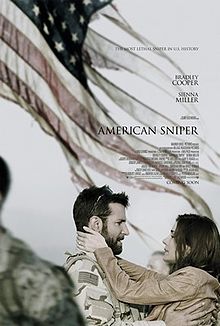
Starring Bradley Cooper as Chris Kyle, deemed the deadliest marksman in U.S. military history, he has 255 kills. The film begins pre-9/11 as Kyle views coverage of the 1998 U.S. Embassy attacks and enlists in a grueling training program to become a Navy Seal sniper.

Flashbacks reveal Kyle as a child being taught to hunt deer and shoot a rifle by his demanding father. He is eventually sent to Iraq following the 9/11 terror attacks and the film continues to showcase Kyle’s military career and multiple tours of duty ending years later.

His wife Taya is played by Sienna Miller.

I am not sure the bevy of controversy that American Sniper has stirred is warranted. I see the film simply as a very good mainstream, action movie. Yes, it does have the overdone Americana machismo and Texas swagger, but it is an Eastwood film! This masculinity is at the heart of many of his films.

I do not view the film as politically charged.

The film leans neither Republican nor Democratic and seems to take a middle-of-the-road viewpoint.

It is a tale of a war hero, but it questions the wars fought and the casualties involved both American and otherwise. Sure, Kyle is a good ole, red-blooded American, but as he and Taya watch the 9/11 attacks on television, they are watching CNN, not Fox News.

His close military buddy asks “Why are we here?” referring to Afghanistan- there is inference by Eastwood to question what this is all about.

I hope audiences keep this in mind.

One concern I do face as I ponder the film is whether American Sniper will send some audience members back to a time when the world was fearful of Muslims and at risk of the recent ISIS terror situations, I hope that people are smart enough to realize that NOT all Muslims are terrorists.

It is only a minuscule portion that is evilly inspired.

The major terrorist in American Sniper, known simply as The Butcher, is despicable, but plenty of other Muslims are innocent and victims of The Butcher’s brutality.

I love how the film has depth. Cooper is as resilient as the troubled sniper. He is portrayed as human, a nice, all-American guy. He wrestles with the choice of shooting a woman and a young boy who died at the risk of them carrying a bomb and killing members of his squad- he does not want to kill them, but rather is excellent at his job.

He is a perfect shot.

In the heat of the moment, under extreme pressure, he must ask himself, “Should I pull the trigger and end their lives”? “what if they are innocent pedestrians?”.

He becomes, in a sense, addicted to his duty of going overseas to Iraq and Afghanistan and justifies his service as “protecting Americans”.

This leads to a troubled personal life as Taya becomes frustrated with his frequent tours of duty, which he readily chooses to do. He suffers from Post-Traumatic Stress disorder but refuses to acknowledge this. He almost kills the family dog in a fit of uncontrolled rage; he temporarily confuses sounds from an auto shop as military warfare.

My admiration for the acting ability of Bradley Cooper increases with each role I see him in. He is a marvel. From recent dynamic performances in American Hustle (2013) and The Place Beyond the Pines (2012) to this role, I am convinced he can play any part successfully and convincingly.

He has sure come a long way from The Hangover (2009).

American Sniper (2014) is an enormously creative and commercial success and deserves to be. Layered, and character-driven, it is worlds above the typical male-driven action film.

Oscar Nominations: 1 win-Best Picture, Best Actor-Bradley Cooper, Best Adapted Screenplay, Best Sound Editing (won), Best Sound Mixing, Best Film Editing

Big Eyes-2014

Big Eyes-2014

Director Tim Burton

Starring Amy Adams, Christoph Waltz

Scott’s Review #216

70095129

Reviewed January 18, 2015

Grade: B

Big Eyes (2014) tells the true story of Margaret Keane, a talented artist, famous for the “big eyes” waif collection, whose husband manipulated her and took credit for her works during the 1950s and 1960s.

A con artist, he passed himself off as a talented artist, but in truth, he scammed other artists and had no artistic talent of his own.

He was also mentally unstable.

Due to his charisma and ability to wine and dine, with influential people, combined with his marketing talents, he made millions in profits from his wife’s art.

Amy Adams and Christoph Waltz portray Margaret and Walter Keane.

Tim Burton directs the film.

Adams and Waltz are the main appeals in this film. They share tremendous chemistry, when they are courting one another and subsequently when they despise each other and fight a bitter divorce battle in court over the rights to Margaret’s paintings.

I love Christoph Waltz in whatever he appears in as his charisma and acting ability astound me.

Adams is quite effective and believable as the passive, loyal, and talented Margaret Keane.

As compelling performance as Adams gives, one issue with the film is that I did not feel as sympathetic towards Margaret Keane as the film probably intended.

I like the character very much and was rooting for her in the courthouse scenes to be awarded rights to her paintings and cheered when she escaped to Hawaii with her daughter to begin a new life.

But, she willingly went along with her husband’s plot, as they both decided a female artist would not sell like a man could (it was the 1950s), and they made millions from her art. They lived in a gorgeous house, had wonderful dinners, and were able to maintain an extravagant lifestyle- not so bad.

It was not as if Walter stole all of her money and left her homeless. She enjoyed a nice lifestyle.

So, my sympathy for her was affected.

A positive of Big Eyes is how Margaret continues to uncover Walter’s deceptions. She first learns he has taken credit for her work then finds out that he is not even an artist and has conned another painter into giving Walter credit for their work.

The buildup to these reveals is excellent.

The film is a change of pace for Tim Burton. Big Eyes is not a dark film and is quite bright and colorful. Some interesting sets and art direction are similar to his other works- Edward Scissorhands and Beetlejuice.

Big Eyes (2014) is an enjoyable film largely made successful by the talents and appeal of its two stars.

Independent Spirit Award Nominations: Best Screenplay

The Imitation Game-2014

The Imitation Game-2014

Director Morten Tyldum

Starring Benedict Cumberbatch, Keira Knightley

Scott’s Review #213

70295172

Reviewed January 15, 2015

Grade: A

The Imitation Game (2014) tells the story of Alan Turing, a confident and brilliant British mathematician who was responsible for cracking Nazi Germany’s Enigma code, which led to the Allied forces winning World War II.

The film also delves into Turing’s complex and sad personal life and the audience grows to know his upbringing largely told via flashbacks as a small boy at boarding school.

The film is tragic yet wonderfully made and is a powerful viewing experience in human storytelling.

The film has two aspects going on. The first is the hiring of Turing by the Government Code and Cypher School at Bletchley Park to crack the code and the numerous struggles faced in accomplishing this feat.

Turing is not easy-going. He is arrogant, quick-witted, and even smug. However, through his friendship with Joan (Keira Knightley), an intelligent woman on the team of scholars, we see a human side to him as they forge a lifelong bond.

The other is of his personal life which is a bit more mysterious and comes into play during the second half. Keeping a secret about his personal life, he is homosexual, which in the time the film is set (1940’s England), is illegal.

Alan and Joan agree to marry, in large part to appease her parents, but circumstances change these plans.

Benedict Cumberbatch, who portrays Turning, deserves praise for his impressive portrayal. He successfully gives depth and a wide range of emotions to the character.

He begins as a self-centered man but becomes layered, guarded, and protective due to his private life of which he is forced to hide a great deal.

Keira Knightley’s character supports Cumberbatch’s character of Alan as she becomes engaged to him and later in life becomes his biggest champion. Her character, besides being quite intelligent, is also kind and giving.

The ending will give the viewer many tears and cause to think of the enormity of World War II in terms of the vast amount of casualties. The facts listed just before the credits roll are awe-inspiring and gut-wrenching.

The Imitation Game is not a war movie per se since it does not deal with battle scenes. It is more of a drama dealing with the effects of war. Many figures are presented and some characters are affected.

For instance, in one scene, the group (led by Turing) must make a heartbreaking decision not to stop an impending attack, which will cause many deaths- including a character’s brother- instead of choosing to keep mum to save thousands more.

It is a powerful scene.

The Imitation Game (2014) successfully and heartbreakingly tells the story of a heroic figure who received no accolades while living, instead of being ostracized, and not until posthumously, did he receive his due.

Sadly, this was too little too late.

Oscar Nominations: 1 win-Best Picture, Best Director-Morten Tyldum, Best Actor-Benedict Cumberbatch, Best Supporting Actress-Keira Knightley, Best Adapted Screenplay (won), Best Original Score, Best Production Design, Best Film Editing