Category Archives: Billy Magnussen

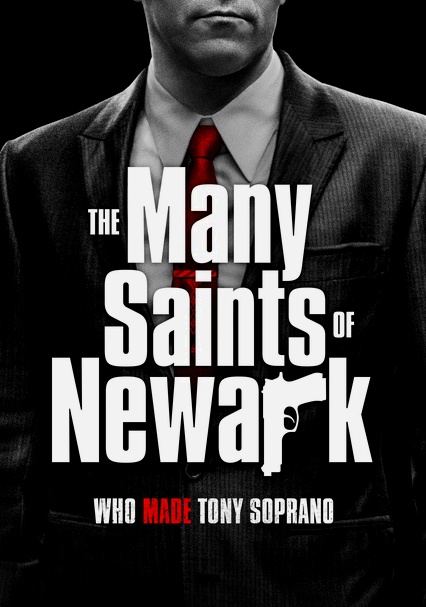
The Many Saints of Newark-2021

The Many Saints of Newark-2021

Director Alan Taylor

Starring Michael Gandolfini, Alessandro Nivola, Vera Farmiga

Scott’s Review #1,272
Reviewed July 4, 2022

Grade: B

Fans of the iconic HBO series The Sopranos, which ran from 1999 to 2007, have been chomping at the bit since the announcement of the soon-to-be-released The Many Saints of Newark (2021).

The film is a prequel to the series, centering on a young Tony Soprano. The kicker is that the actor who portrays Tony in the movie (Michael Gandolfini) is the real-life son of James Gandolfini, who played Tony in the series.

To add mustard to the on-paper perfect setup is that the film is written by David Chase, the writer and creator of The Sopranos. This ensures rich character development and dedication to the rich history.

What could go wrong?

The answer is that nothing is ‘wrong’ with The Many Saints of Newark. It’s not as brilliant as the series, and it seems unnecessary to have been made, especially after such a long gap.

While the film meanders at times, this gave me time to thoughtfully ruminate that perhaps The Many Saints of Newark would have been better as a limited series.

There are so many characters, and too few of them are familiar to audiences of The Sopranos. The two-hour and change running time couldn’t possibly provide enough time to get to know many of them, and I longed to.

On the upside, the film is shot exceptionally well, and the costumes, sets, and design of the 1960s and 1970s are incredible with superior accuracy.

It succeeds in transporting the audience to what Newark, New Jersey, was like during that time. Additionally, the film bears a striking resemblance to The Sopranos and is influenced by the legendary 1991 offering Goodfellas and other mafia-laden films.

Young Anthony Soprano (Gandolfini) is growing up in one of the most tumultuous eras in Newark’s history, as rival gangsters begin to challenge and desecrate the powerful DiMeo crime family.

As the year 1967 emerges and Newark is now an increasingly race-torn city, events take on a violent and historical tone.

Conflicted by the changing times is Tony’s Uncle Dickie (Alessandro Nivola), whom he idolizes much more than his own father, Johnny (Jon Bernthal), or domineering mother, Livia (Vera Farmiga).

The Many Saints of Newark depicts how Tony will eventually become the mob figure Tony Soprano!

Besides looking like his father, Gandolfini is not the best actor in the world, but he does his best with a small role billed as the lead. He hardly appears until thirty minutes before the film concludes, and he never carries the movie as one would expect the character to.

The real star of the film is Dickie (Nivola), who is terrific. The storyline follows his conflict and a damaged relationship with his father, wonderfully played by Ray Liotta, and his father’s horny wife, Giuseppina, who later becomes his mistress.

A shocking scene occurs when Dickie beats a significant character to death by repeatedly slamming their head against a steering wheel. The death will hold forever repercussions for Dickie, emotionally and otherwise.

The problem is that even though Dickie is a great character, the audience doesn’t know him, which is a significant issue.

Despite flaws with the marginally adequate casting, the uneven writing, and the focus on unfamiliar characters, there are other small treats to enjoy.

The film is peppered with familiar characters like Paulie, Big Pussy, and Carmella as younger people. Even though they don’t have much to do with the story, their mere presence feels like an old home week.

The racial tensions are another win, and actor Leslie Odon Jr. adds a winning formula to his character of Harold McBrayer, a black associate of Dickie’s.

I haven’t watched an episode of The Sopranos since it ended in 2007, and it may be advantageous to watch The Many Saints of Newark immediately after. Situations, history, and characters will be fresher in one’s mind, and it may result in more cohesiveness.

Or maybe the film shouldn’t have been made fourteen years after the series ended.

Regardless, The Many Saints of Newark (2021) is a pretty solid effort but completely underwhelming, especially when compared with such a groundbreaking television series.
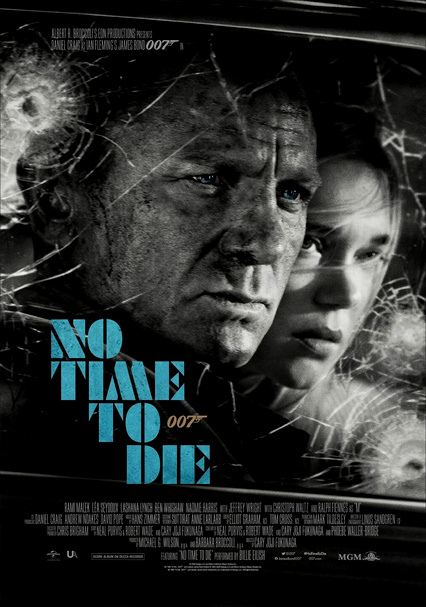
No Time to Die-2021

No Time to Die-2021

Director Cary Joji Fukunaga

Starring Daniel Craig, Léa Seydoux, Rami Malek

Scott’s Review #1,236

Reviewed March 6, 2022

Grade: A-

Celebrating the twenty-fifth in the iconic James Bond film franchise, No Time to Die (2021) is Daniel Craig’s fifth and final appearance as the British MI6 agent.

As of this writing, it is yet to be determined who will next step into the shoes of the legendary character, but Craig was able to make the character his own since his debut in Casino Royale (2006).

He retains his hunky and muscular portrayal with a sullen and serious tone.

No Time to Die is visually and stylistically similar to the recent handful of films that came before it, with a slick and modern look and feel.

The difference is that the film is about relationships and has a shocking conclusion that nearly rivals Mrs. James Bond’s death in On Her Majesty’s Secret Service way back in 1969.

James Bond utters a few quips or one-liners, and we can agree that Craig does not play the character in the same way that Roger Moore did. But, there exists a dark and dreary tone throughout and more than one surprising death.

It’s a serious affair.

I love the parallels to On Her Majesty’s Secret Service that emerge mainly in the beginning and end of the film.

The inclusion of the famous Louis Armstrong song ‘We Have All the Time in the World’ recalls both love and loss experienced by Bond and is played in full during the closing credits.

This is a special treat for fans of that film, myself included. I felt emotionally connected to No Time to Die, which was a significant score for it.

In an extended opening sequence, a young girl named Madeleine witnesses the murder of her mother by terrorist Lyutsifer Safin in a failed attempt to murder her father, Mr. White (appearing in Casino Royale). Madeleine shoots Safin (Rami Malek), but he survives and rescues her after she falls into a frozen lake. This connects them for life.

In the present, after the capture of villain Blofeld, Madeleine (Léa Seydoux) is vacationing in Southern Italy with Bond when Spectre’s assassins ambush him. He incorrectly assumes Madelaine has betrayed him, and he ends their relationship after they escape death.

Depressed, Bond retires to Jamaica but returns to action after his friend Felix Leiter (Jeffrey Wright) from the CIA turns up asking for help. The mission to rescue a kidnapped scientist turns out to be far more treacherous than expected, leading Bond onto the trail of a mysterious villain armed with dangerous new technology.

With the emotional and relationship investments successfully sealed, any worthy Bond film should have great action with interesting locales, stellar villains, and relevant Bond girls. In this regard, the film gets a solid B+ with those as mentioned earlier, bumping it up a notch.

The chase throughout southern Italy is fabulous, with delicious scenery of the culturally lavish country getting the film off to a fast start.

Other sequences in Chile and Cuba show the sophistication and investment in quality locales. Naturally, London is heavily featured, and I adore the grand and frequent aerial views that allow prominent landmarks to be discovered.

Although actor Malek can be creepy in his roles and play a dastardly villain, I wasn’t delighted with the character of Safin. Not appearing in an obvious fashion until midway through his screen time is limited, and his motivations murky- I wanted more.

The casting is terrific, but the character is underwhelming and not explored to his full potential.

Christoph Waltz’s limited appearance as an imprisoned Blofeld is excellent, and double agent Logan Ash (Billy Magnussen) and scientist Obruchev (David Dencik) prove quality secondary villains.

The storyline with Felix and the returns of Moneypenny, Q, and M (now played by Ralph Fiennes) is solid.

Main Bond girl Madelaine did not win me over at first, but by the end, I was heavily invested, especially since she is a powerful female character and a true romantic partner to Bond. A new female 007, played by Lashana Lynch, is a progressive inclusion that breathes new life into MI6.

May both appear in the future?

Time, and perhaps another viewing, will determine how No Time to Die (2021) ranks compared to other Bond films. At a hefty two hours and forty-three minutes, the film drags in the middle section, and some characters receive limited exploration.

The nods to history and the heavy emotional investment kept me glued to my seat.

Oscar Nominations: 1 win-Best Original Song-“No Time to Die” (won), Best Sound, Best Visual Effects

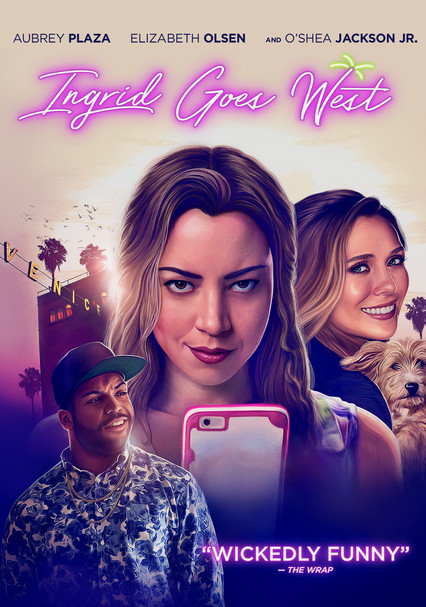
Ingrid Goes West-2017

Ingrid Goes West-2017

Director Matt Spicer

Starring Aubrey Plaza, Elizabeth Olsen

Scott’s Review #832

Reviewed November 16, 2018

Grade: A-

Ingrid Goes West (2017) is a deliciously wicked black comedy that boldly addresses the current obsession with social media.

Combined with a dynamite performance by young actress Aubrey Plaza and witty writing, the small independent film is a summertime treasure and has received two Spirit Award nominations.

The film is a breath of fresh air and a fine achievement by new director Matt Spicer.

The film immediately catapults the audience into the action as we are treated to a closeup of a sobbing Ingrid Thorburn (Plaza).

We immediately know that she is not well when she fumes with the realization that she has not been invited to her Instagram friend’s wedding and proceeds to interrupt the reception and attack the bride with pepper spray.

Ingrid is carted off to a mental hospital for analysis and recovery.

Once released, we learn that Ingrid’s mother has recently died, leaving her a tidy sum of money as an inheritance. Ingrid suddenly becomes obsessed with Taylor Sloane (Elizabeth Olsen), a popular and narcissistic young woman whom she follows on Instagram.

Taylor becomes Ingrid’s idol as she decides to move to Los Angeles and insinuates herself into Taylor’s life. She stalks Taylor and steals her dog only to pretend she rescued it, thereby becoming her close friend.

Gradually, Ingrid’s actions become more and more psychotic as Taylor catches wind of Ingrid’s antics.

Aubrey Plaza is perfectly cast as the unstable, manipulative title character. She possesses such strong comic timing, and with her wide eyes, nervous mannerisms, and determination to get what she wants, the audience roots for and falls in love with her.

On paper, we should dislike the character as she takes advantage of nearly everyone in her path, but Plaza embodies her with empathy and smarts. It is delightful to watch how she gets out of scrape after scrape with her quick thinking.

Plaza truly excels in the role.

Bold and calculating are words to describe Olsen’s performance as the selfish Taylor, and this may very well be why it is easy to root for Ingrid.

The character is so plastic and conniving that seeing her as the foil is intensely satisfying. Olsen usually plays good girl roles and possesses a girl-next-door quality, but in this part, she nestles nicely into a bitch role.

Olsen also uses excellent timing with her characters’ dialogue delivery, so much so that Olsen and Plaza had me in stitches during their one-on-one scenes.

I adore the Los Angeles setting. It is beyond appropriate for a film about phoniness, obsession, and plastic personas.

Beneath the sunny veneer lies darkness and tomfoolery in every direction, and besides Ingrid’s landlord/somewhat boyfriend, Dan (O’Shea Jackson Jr.), there are not many likable characters.

Attending party after party and lavish clubs, restaurants, or getaways, being involved in the “scene,” and the City of Angels is the perfect backdrop.

One gripe that knocks Ingrid Goes West down a rung is how the character of Taylor’s artist husband Ezra (Wyatt Russell) is written.

In one of the more authentic scenes, Ingrid realizes as she has a poolside heart-to-heart with the depressed Ezra that his wife is not the girl he knew when she moved to L.A. He and Ingrid seem to connect, but shortly after, it is as if the conversation never happened, and he is ferociously taking his wife’s side again.

A more admirable approach, and one I was hoping for, is that Ingrid and Ezra would ride off into the sunset, but the film misses this opportunity.

The entire film is a clever piece of work. From the performances to the dark humor and the witty dialogue, Ingrid Goes West (2018) succeeds on nearly all levels.

A modern-day Single White Female (1992) with a social media slant, the film goes for the gusto and gets there. I cannot wait to see more from up-and-coming star Aubrey Plaza, as the actress has the comic and dramatic chops to go very far.

Independent Spirit Award Nominations: 1 win-Best First Screenplay, Best First Feature (won)

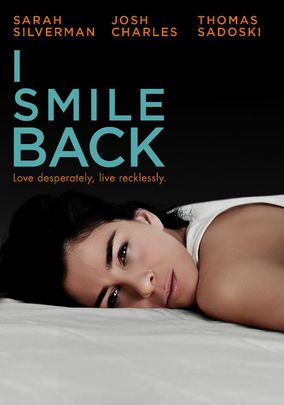
I Smile Back-2015

I Smile Back-2015

Director Adam Salky

Starring Sarah Silverman

Scott’s Review #654

Reviewed June 13, 2017

Grade: B+

As a fan of Sarah Silverman, the comedienne, I was anxious to see the 2015 film, I Smile Back, which garnered her a Screen Actors Guild Award nomination.

Silverman tackles a heavily dramatic role in a film that teeters on being a pure “downer”. Many fans expecting the actress’s comic wit to be featured need not see it.

Rather, I embraced the performance and found the film to be an independent film treat, thanks to Silverman’s powerful performance. She nails the part and carries it to success.

I Smile Back is a small film that I wish had garnered more viewers.

Laney Brooks (Silverman) appears to have it all. She lives an affluent existence in Westchester County, New York with her handsome husband, Bruce (Josh Charles), and their two young children.

With a gorgeous house, dinner parties, and friends, who could ask for anything more?

Bored and troubled by a tough childhood and “daddy issues”, Laney tends to drink too much, abuse drugs and prescription pills, and carry on an affair with her best friend’s husband, all while managing to run a household.

As she gradually spirals down a darker path, Laney sees her perfect world slowly crumble around her.

Throughout the film, I asked, “Are we supposed to root for Laney or dislike her?”

Director Adam Salky does not make it easy to like her.

In addition to her substance abuse use (or over-use), Laney is rather selfish. From the small scenes when Laney drops off her kids from school and is annoyed when the crossing guard and a teacher refuse to give her special treatment, she mutters insults under her breathe as she grabs a cigarette and heads for her scandalous rendezvous.

But when she is put in great peril later in the film, following one of her benders, I could not help but feel deep sympathy for her.

It is a bit unclear what the audience should feel.

This leads me to conclude that the film belongs to Silverman.

What impresses me most is how believable she is in most scenes. She packs creative lunches for her kids and plays fun birthday cake decorating games with them, but in the next breathe snorts cocaine and rails at a neighbor lady for not celebrating Thanksgiving.

Thanks to Silverman, she plays these scenes with gusto.

Some critics have complained about the script, but I find no real fault. While not the strongest element, it is fine, nonetheless.

I Smile Back is a low-budget indie drama that serves its purpose- it does not delve too deeply into the how’s and why’s of her addiction, and a nice scene with Laney’s father (Chris Sarandon) offers no concrete evidence of why this man drove her to drugs by his abandonment.

The film seems to be more about proving a good performance by Silverman than anything else.

Sarah Silverman commands great respect for her dark portrayal in I Smile Back.

This role, combined with her recent turn in Showtime’s Masters of Sex television series, portraying a pregnant lesbian in the 1960s, proves that she has what it takes to compete with the great dramatic actresses of today.

She is much more than a stand-up comic. Here’s to hoping for more drama from this talented lady in the years ahead.

Bridge of Spies-2015

Bridge of Spies-2015

Director Steven Spielberg

Starring Tom Hanks, Mark Rylance

Scott’s Review #399

80050060

Reviewed April 28, 2016

Grade: B+

Tom Hanks teams with Stephen Spielberg once again in another A-list Hollywood film.

Like Saving Private Ryan (1998), Bridge of Spies (2015) is in the historical vein. This time, the Cold War is featured; the film begins in 1957.

The camera work, the artwork, and the set decorations are second to none as the film looks and feels authentic.

As interesting as the overall result is—it felt like I was watching a well-made film—there was also something missing, which did not make it truly riveting, and that is why it received a B+ rating.

With Spielberg and Hanks on board, one will get a quality film.

Hanks portrays James B. Donovan, a Brooklyn attorney specializing in insurance law, but a wiz at negotiation and experienced with the Nuremberg trials.

He is assigned to defend suspected spy Rudolf Abel (Mark Rylance) in what is assumed to be an open-and-shut case, his guilt is considered a given.

Abel has been arrested by the FBI and is thought to be a Russian spy. They are willing to release him on the condition that he reveal Soviet contacts, but he refuses.

Meanwhile, an American pilot, Frances Powers, is captured in Soviet territory and taken hostage. To make matters more complicated, an American graduate student, Pryor, is trapped behind the Berlin Wall in East Germany and not allowed by the Germans to leave.

The pressure is on Donovan to defend Abel in the United States but to make a deal to return the three men to their respective countries.

Hanks, a great actor, is his typical stoic, capable self, and his portrayal reminds me of his role in Captain Phillips (2013), calm, well-mannered- a clear yet quiet leader.

The role is not flashy compared to other legendary Hanks roles (Forrest Gump-1994, Philadelphia-1993). The film centers around Hanks and caters to his acting style. His character is always at the forefront.

Hanks never gives a bad performance and I admire him in almost anything.

Let’s discuss the role and the portrayal by Mark Rylance in his Oscar-winning role.

Giving a very subdued, nuanced performance, he is good and low-key in what could have been an energetic, over-the-top performance if written that way, but I am not sure I would have handed him the golden statuette over a few of the other nominees in the 2015 Supporting Actor category.

This isn’t a criticism, but I am unsure if he warrants an Academy Award.

Bridge of Spies is very detail-oriented and every set piece- from late 1950s cars, clothing, hairstyles, and home furnishings is spot on.

The film was expensive to produce and no expense seems to have been spared.

The film travels from Brooklyn to the Soviet Union, to Germany, and gives off a patriotic, Americana flare, which is true to life in the given time. There was such a sense of country and community.

Nothing makes this more apparent than the distasteful glares coldness and hatred displayed by many characters towards Donovan.

To counteract this, when Donovan is ultimately more the hero, he is revered and celebrated.

As great as the film looks, there is something slightly disconnecting about it. I was left wanting more from a story perspective and feeling slightly disengaged throughout parts of it. I was never riveted or blown away despite realizing I was watching a well-made film.

This can happen if the story is less compelling than the way the film looks as with Bridge of Spies.

After I finished watching I felt that I did not need to see the film again, in contrast to truly great films where one can watch over again.

A slight mention is that Bridge of Spies is a “guy’s film”. Amy Ryan, a great actress, does all she can with the only real female role in the film in that of Donovan’s dutiful, supportive wife, a role written one-dimensionally hundreds of times.

It is a shame her character is not fleshed out. The typical worried scenes or fretting for her husband to return home to his family are purely reactionary and do not further the plot.

In this sense, the film deserves criticism for being too traditional.

Bridge of Spies is a good effort but not a tremendous film. It is the type of film I liked but did not love.

Perhaps, the names Spielberg and Hanks on the marquee had me expecting more.

Oscar Nominations: 1 win-Best Picture, Best Supporting Actor-Mark Rylance (won), Best Original Screenplay, Best Original Score, Best Sound Mixing, Best Production Design

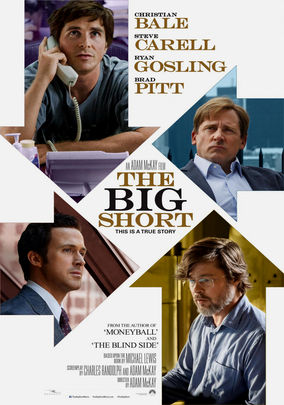
The Big Short-2015

The Big Short-2015

Director Adam McKay

Starring Christian Bale, Steve Carell

Scott’s Review #369

80075560

Reviewed January 10, 2016

Grade: A-

The Big Short (2015) is a confusing film and is its intention and also its genius.

Throughout some of the film, I was uncertain how much I liked it (or got it) and found many of the characters unlikeable, but at the conclusion, I realized that is exactly what the filmmakers intended is a clever tactic and makes The Big Short a success.

On the surface, the film has some humor but a very dark story at its core and left me a bit depressed and terrified at the conclusion.

I am happy that the film is receiving accolades and is the “thinking man’s” hit movie of the season.

To attempt to summarize the film, the film begins in 2005, approximately two years before the financial crisis of 2007-2008.

Eccentric hedge fund manager Michael Burry (Christian Bale), realizes the U.S. housing market is unstable and predicts a crash.

He attempts to profit by betting against the market, a move laughable to all around him, especially the banks who anticipate a windfall at Michael’s expense. Trader and fellow market managers, Jared Vennett and Mark Baum (played by Ryan Gosling and Steve Carrell) catch wind of Michael’s theory and try to get in on the action.

There is a sub-plot involving two younger investors also attempting to profit through the guidance of a retired banker (played by Brad Pitt).

The financial collapse is a tender subject and certainly no laughing matter, especially since it is so recent and affects many people.

The Big Short is touted as a comedy, which is strange. I found the audience didn’t know exactly what to laugh at or when. The film’s “laughs” were cynical, witty, and sometimes wicked. Many people do not get this type of humor.

In real life, people were kicked out of their homes and lost their jobs, pensions, etc. and it was all the result of greed, which The Big Short hammers home.

Several scenes include frat-boy investor/trader types getting rich by enabling almost anyone to afford a new house. Little did these people realize that there was a catch.

The film paints a jaded picture of Wall Street. The rich get richer at the expense of the middle class and the poor. It is an age-old sad tale.

Performance-wise, Carrell and Bale are the standouts. They both play characters who are damaged. Bale’s Michael is socially awkward, and has a false eye, but is also a genius. Carrell’s Mark is angry, grizzled, and is in therapy as a result of his brother’s suicide.

Both actors are great and have developed into worthy, credible acting talents. Worth mentioning, are small, but meaningful roles by Melissa Leo and Marisa Tomei.

The Big Short is shot interestingly, and highly unusual. From time to time, the action will stop and a famed celebrity (Selena Gomez, a world-renowned chef, or a model in a bubble bath) will explain the events, thus far, or give some review.

Also, more than once the actors will turn to the camera and speak directly to the audience. A personal touch that I found effective.

In the end, not much in life has changed, which is the message, and a frightening one. As one character brilliantly puts it “people will go back to blaming the poor and the immigrants”, which is a sad message.

After millions lost everything, not much has changed in the world and The Big Short makes that very clear. The people responsible have gotten away with crime, the banks bailed out, and a new scheme is undoubtedly in place.

It’s a sad world.

The Big Short (2015) is a gritty, harsh look at reality and a terrific film.

Oscar Nominations: 1 win-Best Picture, Best Director-Adam McKay, Best Supporting Actor-Christian Bale, Best Adapted Screenplay (won), Best Film Editing

Into the Woods-2014

Into the Woods-2014

Director Rob Marshall

Starring Emily Blunt, Meryl Streep

Scott’s Review #241

70305948

Reviewed May 8, 2015

Grade: B

Based on the stage production of the same name, Into the Woods (2014) is a feature-length Disney film that incorporates several different fairy tales into the main story.

The film is a fantasy musical with numerous songs performed by the cast, featuring a large ensemble of seasoned actors.

The classic fairy tales are modern versions of Little Red Riding Hood, Rapunzel, Jack and the Beanstalk, and Cinderella.

The action mainly revolves around a baker and his wife (James Cordon and Emily Blunt) who are sad and lonely because they cannot conceive a child due to a long-ago curse put upon the baker’s family by a witch- played by Meryl Streep.

Circumstances surrounding the baker’s father caused the once beautiful witch to be turned ugly. The witch offers a bargain to the baker and his wife- if they bring her four items (a white cow, a red cape, yellow hair, and a gold slipper) for a special potion, she will lift the curse, enabling them to conceive a child and live happily ever after.

This prompts the couple into the dark forest to obtain the requested items. From this point, the couple intersects with other characters from the fairy tales as they all question various aspects of their lives.

There are subsequent stories- the witch is Rapunzel’s adoptive mother and keeps her locked in a tower to prevent her from being hurt by the world.

Cinderella (Anna Kendrick) escapes her taunting stepsisters and attends a ball only to flee when noticed by the handsome prince (Chris Pine).

Jack attempts to sell beans to provide food for his mother- and Little Red Riding Hood brings sweets to her Grandmother but is confronted by the Big, Bad, Wolf (Johnny Depp), a strange Woman Giant is stomping through the forest searching for Jack.

All these stories revolve around the baker and his wife’s efforts to retrieve the witch’s requests.

The production and art direction in the film is great. I love the dark, gloomy forest, which translates so well on the screen and gives the magical effect of a mysterious, secret forest.

I enjoyed the songs quite a bit- especially the catchy “Into the Woods”. However, some of the songs are quite one-dimensional and bland and not discernible from each other, let alone memorable.

The duet of the Prince’s, “Agony” is silly and useless to the plot, with gyrations, and dance moves.

Meryl Streep- dynamic in anything she appears in again steals the show as the vile witch turns beautiful at the end. She has a fantastic solo number mid-story, entitled “Stay with Me”.

One drawback I found with the film is, at times it drags a bit and I was not sold on the casting of Anna Kendrick as Cinderella.  Something about her performance was lacking, perhaps she was not as sympathetic or convincing as another actress might have been.

Also, I would have enjoyed seeing Johnny Depp as the Wolf be more prominently featured and a larger role for the Woman Giant. As integral as she is to the plot, it was tough to get a clear glimpse of her face let alone anything more substantial.

An entertaining feast of fairy tales immersed in one film, Into the Woods (2014) has some compelling moments but lost opportunities that bring it far from the reaches of a masterpiece level.

A solid film, but not a great film.

Oscar Nominations: Best Supporting Actress-Meryl Streep, Best Production Design, Best Costume Design