Category Archives: Melissa Leo

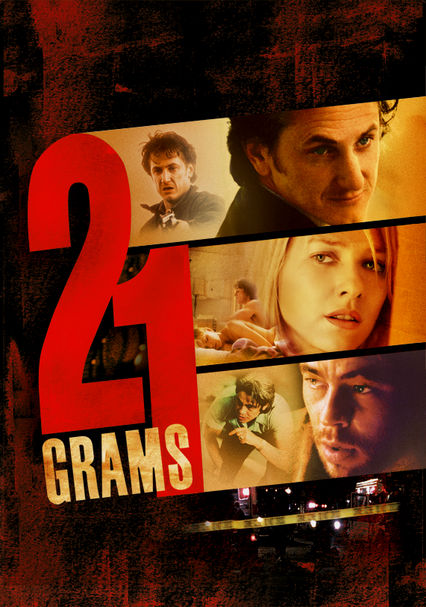
21 Grams-2003

21 Grams-2003

Director Alejandro G. Iñárritu

Starring Sean Penn, Naomi Watts, Benicio Del Toro

Scott’s Review #990

Reviewed February 14, 2020

Grade: A

21 Grams (2003) is an independent drama containing crisp writing, top-notch acting, and a unique directing style by Alejandro G. Iñárritu.

An early work by the acclaimed director, he delivers a powerful exposure to the human condition using intersecting storylines.

The result is a powerful emotional response that resonates among viewers taking the time to let the story evolve and marinate.

Outstanding filmmaking and a sign of things to come for the director.

The film is the second part of screenwriter Guillermo Arriaga’s and Iñárritu’s Trilogy of Death, preceded by Amores Perros (2000) and followed by Babel (2006), 21 Grams interweaves several plot lines in a nonlinear arrangement.

Viewing the films in the sequence is not required to appreciate and revel in the gorgeous storytelling and mood.

The story is told in a non-linear fashion and focuses on three main characters, each with a “past”, a “present”, and a “future” story thread. Events culminate in a horrific automobile accident, which is the overall story. The sub-story fragments delve into the lives of the principals as the audience learns more about them.

Ultimately, all three lives intersect in dramatic fashion leaving the viewer mesmerized and energized by the deep connections.

Paul Rivers (Sean Penn) is a successful, married college mathematics professor who desperately needs a heart transplant. He and his wife are considering having a baby in case he should die.

Cristina Peck (Naomi Watts) is a recovering drug addict now living a happy suburban life with a loving husband and two young children.

Jack Jordan (Benicio Del Toro) is a former convict who is using his newfound religious faith to recover from drug addiction and alcoholism and live a happy existence with his wife and kids. After the car accident, each life takes a shocking turn forever changing things.

The multiple timelines and back-and-forth storytelling are an excellent part of 21 Grams, adding layers upon layers of potential entanglements among the characters. This could be a confusing quality, but instead, it provides mystique and endless possibilities.

What worked so well in the outstanding Traffic (2000) is used by Inarritu and delivers. The recipe of clever plotting characters the audience cares about and top-notch acting is created, mixed, and served on a silver platter.

Penn, Watts, and Del Toro are stellar actors who give their characters strength, sympathy, and glory. Each has suffered greatly and faced (or faces) tremendous obstacles in life, soliciting feelings from viewers.

All three are good characters, trying to do the right thing, and grasp hold of any sliver of happiness they can find. They have moral sensibilities without being judgmental, delicious is how each character interacts with the others, but in differing ways.

The film is not happy and not for young kids, but the brilliant elements will leave the film lover agape at the qualities featured. The dark, muted lighting of the film is perfect for the morbid stories told throughout and the common themes of anguish, courage, and desperation.

The clever title refers to an experiment in 1907 that attempted to show scientific proof of the existence of the soul by recording a loss of body weight (said to represent the departure of the soul) immediately following death.

Only the second full-length film in Inarritu’s young career, 21 Grams is brilliant in human emotion and connections. The powerful director would go on to create Babel (2006) and The Revenant (2015), two vastly different films but with similar hearts.

21 Grams (2003) is a wonderful introduction to good things to come while utilizing crafty acting and layered writing to create a gem well worth repeated viewings.

Oscar Nominations: Best Actress-Naomi Watts, Best Supporting Actor-Benicio del Toro

Independent Spirit Award Nominations: 1 win-Special Distinction Award (won)

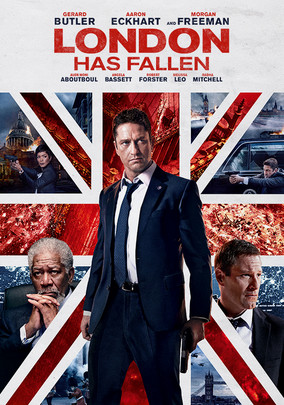
London Has Fallen-2016

London Has Fallen-2016

Director Babak Najafi

Starring Gerard Butler, Aaron Eckhart

Scott’s Review #608

Reviewed January 13, 2017

Grade: D

Save for many enjoyable, incredible London shots of mostly aerial views, London Has Fallen (2016) is a complete drivel of an experience.

The film’s attempt at being a red-blooded, patriotic film comes across as insulting and racist, with a machismo that is cringe-worthy.

The dialogue is terrible, and the “us against them” mantra has been done to death in film, mainly in the 1980s and 1990s. To quote one reviewer, “London Has Fallen is Donald Trump in film form.”

I don’t understand how the film convinced such a talented cast to appear (it must have been money), and several parts are so small (Robert Forster, Melissa Leo, Jackie Earle Haley) that they are nearly glorified extras.

The plot is painfully contrived, to say nothing of the ludicrous nature of the entire story.

To retaliate against a drone strike killing a Pakistani leader, terrorists take advantage of the death of the UK Prime Minister to assassinate several world leaders who have gravitated to London to attend funeral services.

The President of the United States (played by Aaron Eckhart) is naturally in attendance, and his murder is thwarted by top Secret Service official Mike Banning (Gerard Butler), our film’s hero.

The rest of the film involves the President and Mike running throughout London, attempting to catch the terrorists and bring them to justice while avoiding death.

The London locales are superb, but sadly, they mainly appear at the film’s beginning and end. The London Eye, the Thames River, the Underground, and various metro stations are featured.

The numerous London bridges also get some exposure.

The best part is how the film showcases London’s vastness, not just the up-close shots of historic places like Westminster Abbey or Buckingham Palace.

Undoubtedly, London is known for those gems, but the aerial views give the viewer an appreciation of all London offers.

I loved only this aspect of the film.

The supporting roles are abysmal, and given the more artistic parts they’ve received in the past; one imagines the actors cringing as they read the scripts for some of them.

I hesitate to think what possessed Leo, Forster, and Haley to accept meaningless roles save for a hefty paycheck. Each played a member of the President’s staff and was reduced mainly to reactionary shots.

As an ill-fated Secret Service Director, Angela Bassett and Radha Mitchell, as Banning’s weary-looking, pregnant wife, get more screen time but are treated to equally uninteresting roles.

Overall, the performances are forgettable. Respectable actors Butler and Eckhart merely phone in their vapid, dull lines, failing to make any of them believable.

The film never bothers with character development or anything beyond fundamental good and evil roles. Every character is either 100% good or 100% bad.

It is made crystal clear that the Americans are the good guys, and the foreigners (all Middle Eastern or Asian actors, of course) are simply the bad guys.

The motivations of the “bad guys” are never explained, and one cheesy line after another is written for the “good guys.”

During the finale, Banning professes that “we have been here for thousands of years and always will be” as he beats a lousy guy senselessly. Good grief. I’ve seen better dialogue on a network television drama.

And there is never any doubt about how the film will end. There is an American mole who has used his power to enable all of the assassinations, but when the mole is revealed, it is a character we have never seen before, so who cares?

Indeed, the film will soon be forgotten for its poor story, cliche-ridden script, and numerous stereotypes, but the fantastic London shots were inspiring and lovely.

I would have been happy with one hour and forty minutes of those.

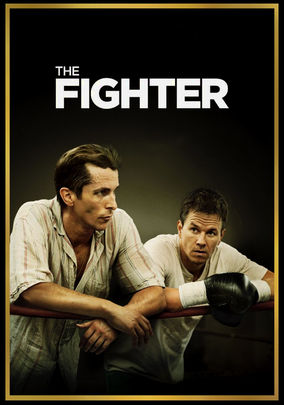
The Fighter-2010

The Fighter-2010

Director David O. Russell

Starring Mark Wahlberg, Christian Bale

Scott’s Review #546

Reviewed December 11, 2016

Grade: A-

The Fighter (2010) is an excellent film. Being a sports film there are the inevitable cliches, which make the entire sports film genre rather predictable.

But this film is a very well-done story and based on real-life figures (the Ward brothers).

Tremendous acting by Wahlberg, Bale, and Melissa Leo, in the role of Mama Ward- a role of a lifetime.

The telling is a true story of Mickey Ward, a boxer from Massachusetts, and his battle to stardom, dealings with family members, and his love life.

The characters may be ever slightly overdone in the rugged, rough, Bostonian way, almost appearing New Jersey-Soprano-ish instead of New England, but the message is clear- they are in the boxing world and are tough guys (and gals).

This film is much more character-driven than many similar sports movies, thank goodness and the casting is spot-on. There are the inevitable final boxing match and the standard reaction shots, but again sports films are riddled with cliches.

The real win is with the character’s layered, complexities as they love and hate each other.

Bale and Leo deserved their Oscars for their respective roles in The Fighter (2010), specifically Bale for the shocking weight loss and spot-on character imitation.

Oscar Nominations: 2 wins-Best Picture, Best Director-David O. Russell, Best Supporting Actor-Christian Bale (won), Best Supporting Actress-Melissa Leo (won), Amy Adams, Best Original Screenplay, Best Film Editing

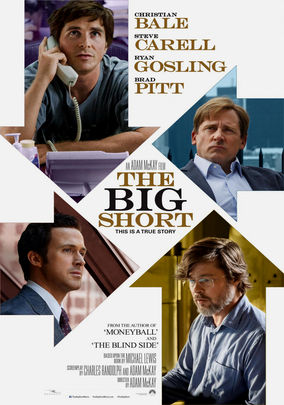
The Big Short-2015

The Big Short-2015

Director Adam McKay

Starring Christian Bale, Steve Carell

Scott’s Review #369

80075560

Reviewed January 10, 2016

Grade: A-

The Big Short (2015) is a confusing film and is its intention and also its genius.

Throughout some of the film, I was uncertain how much I liked it (or got it) and found many of the characters unlikeable, but at the conclusion, I realized that is exactly what the filmmakers intended is a clever tactic and makes The Big Short a success.

On the surface, the film has some humor but a very dark story at its core and left me a bit depressed and terrified at the conclusion.

I am happy that the film is receiving accolades and is the “thinking man’s” hit movie of the season.

To attempt to summarize the film, the film begins in 2005, approximately two years before the financial crisis of 2007-2008.

Eccentric hedge fund manager Michael Burry (Christian Bale), realizes the U.S. housing market is unstable and predicts a crash.

He attempts to profit by betting against the market, a move laughable to all around him, especially the banks who anticipate a windfall at Michael’s expense. Trader and fellow market managers, Jared Vennett and Mark Baum (played by Ryan Gosling and Steve Carrell) catch wind of Michael’s theory and try to get in on the action.

There is a sub-plot involving two younger investors also attempting to profit through the guidance of a retired banker (played by Brad Pitt).

The financial collapse is a tender subject and certainly no laughing matter, especially since it is so recent and affects many people.

The Big Short is touted as a comedy, which is strange. I found the audience didn’t know exactly what to laugh at or when. The film’s “laughs” were cynical, witty, and sometimes wicked. Many people do not get this type of humor.

In real life, people were kicked out of their homes and lost their jobs, pensions, etc. and it was all the result of greed, which The Big Short hammers home.

Several scenes include frat-boy investor/trader types getting rich by enabling almost anyone to afford a new house. Little did these people realize that there was a catch.

The film paints a jaded picture of Wall Street. The rich get richer at the expense of the middle class and the poor. It is an age-old sad tale.

Performance-wise, Carrell and Bale are the standouts. They both play characters who are damaged. Bale’s Michael is socially awkward, and has a false eye, but is also a genius. Carrell’s Mark is angry, grizzled, and is in therapy as a result of his brother’s suicide.

Both actors are great and have developed into worthy, credible acting talents. Worth mentioning, are small, but meaningful roles by Melissa Leo and Marisa Tomei.

The Big Short is shot interestingly, and highly unusual. From time to time, the action will stop and a famed celebrity (Selena Gomez, a world-renowned chef, or a model in a bubble bath) will explain the events, thus far, or give some review.

Also, more than once the actors will turn to the camera and speak directly to the audience. A personal touch that I found effective.

In the end, not much in life has changed, which is the message, and a frightening one. As one character brilliantly puts it “people will go back to blaming the poor and the immigrants”, which is a sad message.

After millions lost everything, not much has changed in the world and The Big Short makes that very clear. The people responsible have gotten away with crime, the banks bailed out, and a new scheme is undoubtedly in place.

It’s a sad world.

The Big Short (2015) is a gritty, harsh look at reality and a terrific film.

Oscar Nominations: 1 win-Best Picture, Best Director-Adam McKay, Best Supporting Actor-Christian Bale, Best Adapted Screenplay (won), Best Film Editing

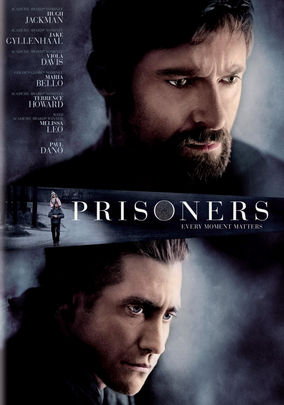
Prisoners-2013

Prisoners-2013

Director Denis Villeneuve

Starring Hugh Jackman, Jake Gyllenhaal

Scott’s Review #75

70273235

Reviewed June 27, 2014

Grade: B+

The film Prisoners (2013) weaves a gripping, taught, psychological tale amid a well-acted stellar cast of Hugh Jackman, Jake Gyllenhaal, Maria Bello, Viola Davis, and Paul Dano for starters.

That is what separates it from other similar, yet mediocre thriller types.

The gray, somber, Pennsylvania town is a perfect backdrop for a story involving child abduction and a father that seeks a confession from the presumed kidnapper.

The mood and cinematography are impressive and the bleakness is perfect for the tone- a cold Thanksgiving holiday weekend in a working-class, steel town.

At two hours and twenty-six minutes, the film is lengthy, but on the edge of your seat.

What intrigued me most was the audience conflict of whom to root for. Is the father purely innocent? Is the kidnapper guilty? Is someone else involved?

These questions go through the viewer’s mind during the film.

Prisoners possess a major drawback in the high number of plot holes and questions asked after the film.

The kidnapper’s motivations are weak and never fully explained. Portions of the story do not add up and make little sense.

The film is similar in style to Zodiac (2006) and Mystic River (2003).

Prisoners (2013) is an intense, thrill ride to be enjoyed, but not over-analyzed.

Oscar Nominations: Best Cinematography