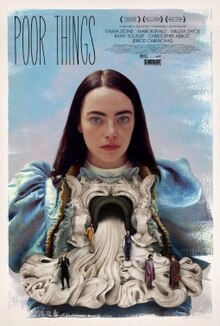
Poor Things-2023

Poor Things-2023

Director Yorgos Lanthimos

Starring Emma Stone, Mark Ruffalo, Willem Dafoe

Top 250 Films #244

Scott’s Review #1,413
Reviewed December 27, 2023

Grade: A

Yorgos Lanthimos is a peculiar director and the suggestion is for potential viewers to be familiar with his work before seeing his latest film release, Poor Things (2023).

I’ve said recently that other directors like Alexander Payne, Todd Haynes, Quentin Tarantino, and Martin Scorcese can easily be added to this list with a style not for everyone but that Cinemaphiles will salivate for style and texture alone.

Anyone who has seen Lanthimos’s Dogtooth (2009) or The Lobster (2016) will know exactly what I mean.

With Poor Things, he hits a grand slam home run that might garner him some Academy Awards in what can be arguably classified as his most progressive film.

Mentions like the art direction, cinematography, set design, and fantastic performance by Emma Stone must be immediately celebrated and called out as highlights.

The film is hardly mainstream or conventional and way out there channeling a parallel to Frankenstein with frightening and gothic sets and sequences galore.

All with a twisted and refreshing feminist quality.

Ultimately, I was satisfied with the knowledge that I had witnessed a cinematic marvel that encourages repeated viewings.

During the nineteenth century in London, England, Bella Baxter (Stone), is a young woman brought back to life by the brilliant and unorthodox scientist Dr. Godwin Baxter (Willem Dafoe) who is referred to as ‘god’.

He inserts the tender brain of the baby she was carrying when she leaped from a bridge to her death suicide style.

Under Baxter’s protection and supervision, Bella is eager to learn but acts like a toddler with limited speech and motor skills. She teeters around smashing plates with gleeful joy as she discovers her surroundings.

With superior intelligence and a hunger for the worldliness she is lacking, Bella runs off with Duncan Wedderburn (Mark Ruffalo), a slick and horny lawyer, on a whirlwind adventure across the continents from Lisbon, Portugal to Paris, France, and back to London.

Free from the knowledge and the prejudices women of her time were forced to endure, Bella grows steadfast in her purpose to stand for equality and liberation. She challenges societal norms with her vision and determination.

I can’t think of anyone else to play the role of Bella other than Stone. With wide eyes filled with wonder, she infuses her character with comedy and wit as she asks questions many women have but never dare to utter aloud.

Especially in Victorian London.

Ruffalo is outrageous and Dafoe is hideously stoic. Both actors bring star quality and wacky performances in different ways.

The look of the film is to die for as Lanthimos offers a looming fairy tale set design led by cinematographer Robbie Ryan.

The European cities of Lisbon, Paris, and London are given their chapters in the film and their focus. The waterfront in Lisbon in particular resembles the real city in a gothic and foreboding way.

The hotel in Paris where Bella becomes a prostitute is regal and polished. Bella wonders aloud why the male customers get to decide which woman they want to spend time with instead of the reverse.

It’s a fair question.

Her friend and fellow prostitute introduces her to socialism while Madame Swiney (Kathryn Hunter) explains capitalism.

Finally, the musical score by Jerskin Fendrix offers shrieking classical strings mixed with haunting pizazz and perfectly timed arrangements. They promote tension and drama at just the right moments.

2023 was a fabulous year for women in cinematic terms but not so much by the United States Supreme Court but that’s another story. The bombast and box office enormity of Greta Gerwig’s Barbie is followed by Lanthimos’s celebration of the thought-provoking Poor Things.

Both elicit insightfully quirkiness that successfully bulldozes over traditional gender norms with messages that women can do whatever they set out to do which is a vital quality for young minds to be exposed to.

Oscar Nominations: 4 wins-Best Picture, Best Director-Yorgos Lanthimos, Best Actress-Emma Stone (won), Best Supporting Actor-Mark Ruffalo, Best Adapted Screenplay, Best Film Editing, Best Cinematography, Best Costume Design (won), Best Production Design (won), Best Original Score, Best Makeup and Hairstyling (won)

A Star Is Born-2018

A Star Is Born- 2018

Director Bradley Cooper

Starring Bradley Cooper, Lady Gaga

Top 250 Films #245

Scott’s Review #819

Reviewed October 10, 2018

Grade: A

On paper, by the time a film reaches its fourth remake (think- superhero franchises), there is a risk of either utter redundancy or a lack of interest (or both!).

Months before A Star Is Born (2018) was released to theaters, a tremendous buzz emerged, particularly about the stars (Bradley Cooper and Lady Gaga). Considering the latter had never starred in a film before, the word of mouth was surprising.

The hype can be believed as the film is a tremendous effort with something to offer everyone.

The story begins with a boozy country crooner, Jackson Maine (Bradley Cooper), performing a sold-out show. He needs pills to take the stage and suffers from gradual hearing loss, but he is nonetheless a famous and popular star.

Following the concert, Jackson meets Ally (Lady Gaga), a waitress who moonlights singing French songs at a drag bar. They immediately bond as he encourages her to celebrate her talent despite her insecurities.

As events unfold, the pair dive into a passionate romance as her career skyrockets while he deteriorates from drug and alcohol abuse.

On the surface, a film such as A Star Is Born risks being hokey, formulaic, or otherwise generic. The premise dictates this: a successful star meets an insecure up-and-comer, romance ensues, and they face obstacles and internal conflict on the road to success.

Sounds like material custom-made for a Hallmark television movie or something lightweight, especially given the remake of a remake factor.

Instead, every element of A Star Is Born works perfectly.

Of enormous praise is how Bradley Cooper both directs this film and has the central male role. As a director, he incorporates some interesting camera shots, including a long shot of Ally walking down an alley, rehearsing a song for a performance.

Also, the numerous concert scenes are very well done. Impressive since this is Cooper’s directorial debut.

An enormous win for the film is the chemistry between Cooper and Gaga, which is evident in the first moments when the two appear on screen together. Their chemistry is purely electric, almost magical as they rapidly bond and connect.

Their connection is not only physical but also based on their love of music and the artistry associated with creating good music. This bond is slowly tested as Ally’s career takes off and her manager steers her in a more pop-oriented direction, infuriating Jackson.

Even through turmoil, the chemistry between the two actors is palpable in every scene.

My two favorite scenes include the one in which Jackson and Ally first meet in the drag bar. The lovely French tune (Edith Piaf’s “La Vie en rose”) that she performs is cultural and rife with talent. As Jackson gazes at her from the bar, his gleaming eyes are filled with amazement and pride. He is immediately smitten with her talent and poise, and this scene sets the tone for the film.

The second comes at the film’s conclusion, as Ally belts the heartfelt “I’ll Never Love Again”. Performing to a subdued audience, the song is performed as a close-up of Ally to the tremendous visual effect.

The musical numbers are heartfelt and emotional without being sappy. From treasures such as “Shallow” and “Maybe It’s Time” to the thunderous “Black Eyes” and pop-driven “Why Did You Do That?”, the soundtrack contains something for everyone.

Cooper, already an acting champ, astounds as he is so good, while Lady Gaga, a novice to film acting, looks like a pro. We believe in her struggles, doubting her star potential as she is deemed “too ugly” to make it in the music business.

Gaga successfully showcases her pain, doubt, and eventual bombast at her sudden success.

Mention must be given to Sam Elliott, the veteran actor who gives a dynamic supporting turn as Bobby Maine, Jackson’s older brother and manager. Elliott does not have a showy role or a big emotional scene—he doesn’t need to. In the actor’s quiet way, he infuses the character with pent-up anger but also with unconditional love and affection for his brother.

Harboring rage and turmoil for each other, the best scene between Elliott and Cooper comes towards the film’s end when Jackson admits his love for Bobby. The emotion on Elliott’s face is raw in this important scene.

A Star Is Born (2018) is a superlative remake and one for the ages. This fan favorite will easily go down in the record books.

With a memorable musical soundtrack, outstanding acting and directing, and characters audiences can relate to, a classic in the making is not too difficult to imagine.

Oscar Nominations: 1 win-Best Picture, Best Actor-Bradley Cooper, Best Actress-Lady Gaga, Best Supporting Actor-Sam Elliott, Best Adapted Screenplay, Best Original Song-“Shallow” (won), Best Sound Mixing, Best Cinematography

Three Days of the Condor-1975

Three Days of the Condor-1975

Director Sydney Pollack

Starring Robert Redford, Faye Dunaway, Max von Sydow

Top 250 Films #246

Scott’s Review #1,206

Reviewed December 11, 2021

Grade: B+

Three Days of the Condor (1975) is an edge-of-your-seat thriller starring Robert Redford and Faye Dunaway, two big stars of the 1970s.

The film is directed by the respected Sydney Pollack, most famous for Out of Africa (1985) and Tootsie (1982).

He knows how to entertain while providing a good, juicy romance.

The quick pace and frenetic editing make the film move along, and the frequent exteriors of Manhattan and Brooklyn are great. Good-looking stars and a dangerous European bad guy played by Max von Sydow certainly help.

My only criticism is that Three Days of the Condor is quite similar and familiar to other espionage or political thrillers like All the President’s Men (1976) or Chinatown (1974) that emerged during the 1970s.

This is small potatoes by comparison with the compelling and action-oriented theme, though.

On a seemingly ordinary day, Joe Turner (Redford), a bookish CIA codebreaker, is tasked with fetching lunch for his colleagues. When he returns, he finds that they have all been murdered. Horrified, Joe flees the scene and tries to tell his supervisors about the tragedy, but quickly learns that CIA higher-ups were involved in the murders.

With no one to trust and a determined hitman named Joubert (Max von Sydow) on his tail, Joe must somehow survive long enough to figure out why his agency wants him dead. He kidnaps Kathy Hale (Dunaway), who he hopes will assist him in his peril.

The opening segment is the best part of Three Days of the Condor. The massacre of the entire office is shocking and bloody, and Pollack infuses the necessary elements of suspense in this key scene.

The scolding, chainsmoking receptionist who keeps a gun in her desk drawer is the first to die and no match for her assassins. As they go about the office, kicking down doors and wreaking havoc, it’s a hope that someone is spared.

We also wonder about their motivation.

And the tense elevator scene involving Turner and Joubert is fabulous.

Particularly worth mentioning is the inclusion of a female Asian character, hinted at as a possible love interest of Turner’s. Tina Chen’s character, Janice, is intelligent and sexy.

Her flirtations with Turner, unfortunately, never go anywhere, as she is part of the lunchtime slaughter, but some Asian representation in mainstream film during this time is a positive.

I fell in love with Kathy’s cozy and stylish Brooklyn apartment. Assumed to be very close to the Lower Manhattan financial district, the set is beautifully dressed. It provides depth and texture to her character, whom we barely know at first.

She has good taste and sophistication and sees something in Turner, although he has just accosted her at random.

It was a stretch to buy Robert Redford as nerdy or anything other than a platinum blonde hunk, but the actor does a satisfactory job leading the film. I couldn’t stop comparing Redford and Brad Pitt at that age, as the two stars look similar.

The chemistry between Redford and Dunaway is palpable and key to the film. If little or none existed, it would have detracted from the believability when they become lovers, it feels natural, a satisfying culminating moment for the audience, and proper to the story.

Providing enough action to enthrall viewers in the thriller genre, Three Days of the Condor (1975) is slick yet believable. Capitalizing on the paranoia that the fresh Watergate scandal had resulted in when the film was made, it still holds up well as a film decades later.

Oscar Nominations: Best Film Editing

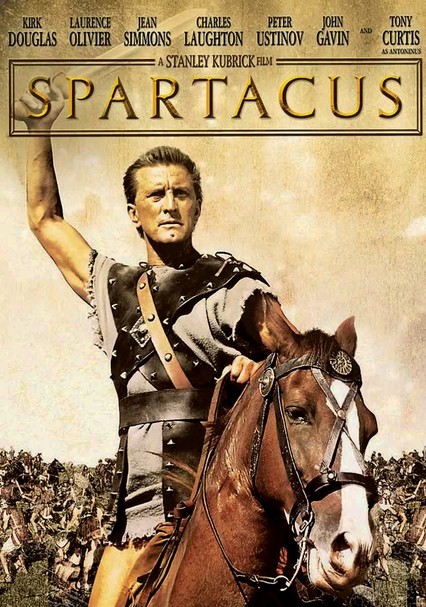
Spartacus-1960

Spartacus-1960

Director Stanley Kubrick

Starring Kirk Douglas, Laurence Olivier, Jean Simmons

Top 250 Films #247

Scott’s Review #1,250

Reviewed April 30, 2022

Grade: A

Typically, when influential director Stanley Kubrick’s name is uttered, films such as The Shining (1980), 2001: A Space Odyssey (1968), and Barry Lyndon (1975) are immediately thought of, and for obvious reasons.

The haunting, moody musical score, the long camera shots, the dark humor, and the clever camera tricks are easy to pinpoint.

1960, the director was hired to direct the gorgeous epic Spartacus after Hollywood star Kirk Russell unceremoniously fired the first director.

None of the previously mentioned elements are easy for me to notice and are more or less absent, but a grand battle scene in a luscious green field is very reminiscent of Barry Lyndon. This is likely because Spartacus was not Kubrick’s film entirely; instead, it belonged to others with more clout.

Spartacus is a brilliant film for many reasons. Some epics suffer from a hokey, cliched feel and can be overwrought, predictable, and tired.

The rebellious Thracian Spartacus (Russell), born and raised a slave, is sold to Gladiator trainer Batiatus (Ustinov). After training to kill for the arena, Spartacus turns on his owners and leads the other slaves in rebellion.

As the rebels move from town to town, their numbers increase as escaped slaves join their ranks. Under the leadership of Spartacus, they make their way to southern Italy, where they intend to cross the sea and return to their homes.

Spartacus is grand, sweeping, cinematically significant, and everything else you’d expect from a 1960s Hollywood epic with enormous stars of its day. Looking beneath the surface, the film is riddled with interesting tidbits like bisexuality, homoeroticism, and violence, more in tune with an art film or modern war film than the safety of a movie made during this time.

Particularly noteworthy is that Dalton Trumbo wrote the screenplay. One of the Hollywood Ten, he refused to testify before the House Un-American Activities Committee in 1947 during the committee’s investigation of alleged Communist influences in the motion picture industry.

After the release of Spartacus, it marked the beginning of the end of the Hollywood Blacklist for Trumbo and other affected screenwriters.

Thank goodness.

In a famous scene, recaptured slaves are asked to identify Spartacus in exchange for leniency; instead, each slave proclaims himself to be Spartacus, thus sharing his fate.

The suggestion is that this scene was meant to dramatize the solidarity of those accused of being Communist sympathizers during the McCarthy era.

Besides the political importance, Spartacus showcases a beautiful romance between Spartacus (Russell) and Varinia (Jean Simmons), a gorgeous slave girl. The tenderness and authenticity are palpable as many of their early scenes involve no dialogue but only longing and expression through both actors’ eyes.

I celebrated the connection between the actors at the forefront of much romance. Russell carries the film with calm masculinity, quickly making him heroic and likable.

He is the charismatic, good guy who has been wronged and ill-fated.

A sequence oozing with machismo and homoeroticism occurs when evil Crassus (Olivier) is bathed by his slave boy Antoninus (Tony Curtis). He seductively explains that while sometimes he prefers snails, he also likes oysters. The implication is that he is bisexual, brazenly so, and expects the youngster to become his sex slave.

The warmth of the bathtub and the luxurious atmosphere contrast with the proximity and touch of both male characters.

In 1960, this scene was way ahead of its time.

The conclusion of Spartacus is melancholy and surprising. Having bested Rome’s cruelty, one might have expected to see Spartacus and Varinia happily ride off into the sunset.

This doesn’t happen, and the film is more affluent in it. There is pain and despair as there were in real life. Wisely sparing complete doom and gloom, the ending is satisfying as one central character escapes a deadly demise and conjures ahead.

Spartacus (1960) is one of the greats. It has muscle and texture, and many below-the-surface nuances are ripe for discussion. For these reasons, it’s a must-see.

Oscar Nominations: 4 wins-Best Supporting Actor-Peter Ustinov (won), Best Art Direction-Color (won), Best Cinematography-Color (won), Best Costume Design-Color (won), Best Film Editing, Best Music Score of a Dramatic or Comedy Picture

Death in Venice-1971

Death in Venice-1971

Director Luchino Visconti

Starring Dirk Bogarde, Björn Andrésen

Top 250 Films #248

Scott’s Review #1,014

Reviewed April 22, 2020

Grade: A

Death in Venice (1971) is a haunting and tragic story of a depressed middle-aged man who becomes obsessed with a fourteen-year-old Polish boy while on holiday in Venice.

The story, on the surface, is dark and dour, not for the judgmental or the closed-minded. With a deeper dive and a haunting musical score, the film provides beauty and impressionism.

The film is based on the novella Death in Venice by German author Thomas Mann, published in 1912 as Der Tod in Venedig.

Gustav von Aschenbach (Dirk Bogarde) is a lonely composer who travels to Venice for health reasons and a recipe for recovery. His maladies are unclear at the start, but are assumed to be sent to the picturesque city as a form of therapy.

While enjoying a tranquil holiday, he spots Tadzio (Björn Andrésen), a stunning, youthful beauty staying with his family at the luxurious Grand Hôtel des Bains, just as Gustav is.

Their encounters run rampant as they are viewed by the audience from afar, but never speak to each other.

This is the brilliance of Death in Venice. A more standard approach may have been to make the story more forceful.

If Gustav had approached, harassed, or even molested Tadzio, the direction of the film would have vastly changed, and he would have been deemed a pervert.

Suddenly, the film would have been about a pedophile preying on a youngster, rather than incorporating a beautiful subtext of longing and unfulfilled passion.

The masterful classical numbers that open and close the film help to achieve this mindset.

The controversial subject matter, still taboo by today’s progressive standards, is not gratuitous but is quite obsessive. Worthy of mention is that Gustav’s plight begins harmless enough as he appreciates a beautiful image, almost like gazing at a sculpture- think Michelangelo’s David- since we are in Italy.

But when he begins to follow Tadzio and see him more and more, his desperation increases as his health deteriorates. For a while, it is unclear whether the boy even realizes he is an object of affection. It is Gustav’s feelings and emotions that are most explored.

As a side story, the city of Venice is gripped by a cholera epidemic, and the city authorities do not inform the holiday-makers of the problem for fear that they will flee the vital city.

In 2020, amid the vicious COVID-19 pandemic gripping the world, this classic film takes on a whole new importance. As Venice officials downplay the epidemic while tourists increasingly fall ill, a modern realism is conjured for the audience.

Death in Venice, as the title should make clear, is not a love story; otherwise, it would be called Love in Venice. Gustav’s lust for Tadzio is unrequited. Neither is Gustav’s sexuality clear, though he is assumed to be bisexual.

In one of the film’s saddest scenes, also the finale, Gustav lounges on the sandy beach in ill health, dressed in an improper white suit. He sees Tadzio playfully frolicking with an older boy, and afterward walks away and turns back to look at Gustavo.

As Tadzio outstretched his arms toward the water, Gustav did the same as if he was enveloping the boy. The moment is breathtaking.

Many symbolic and meaningful scenes occur, like when Gustav visits a barber who insists he will return his customer to his youth. The results are ghastly.

Dyeing his grey hair black, whitening his face, and reddening his lips to make him look younger leaves a macabre, somber image of a man feebly attempting to turn back the hands of time, something we can all relate to. His heavily made-up face is meant to hide his insecurities.

Incorporating an ingenious mix of beauty, tragedy, obsession, and loneliness, Italian director Luchino Visconti crafts a brilliant and painful dissection of human emotion.

The subject matter of Death in Venice (1971) will not appeal to all viewers. Still, those brave enough to traverse the sometimes-rocky waters will find an underlying treasure and a meaningful cinematic experience.

Oscar Nominations: Best Costume Design

Eraserhead-1977

Eraserhead-1977

Director David Lynch

Starring Jack Nance, Charlotte Stewart

Top 250 Films #249

Top 40 Horror Films #38

Scott’s Review #541

Reviewed December 10, 2016

Grade: B+

Eraserhead is one of the oddest films that I have ever seen. The film is an early (1977) David Lynch film, shot entirely in black and white.

It is a surrealist horror film.

Entrancing is the locale of the film- a bleak wasteland, of sorts, in an even bleaker town. The name is unknown.

Factory worker Henry Spencer (Nance) is garish in appearance/with spiky hair and wild eyes; he is peculiar, to say the least.

He trods day after day, to and from his job, meeting interesting, yet grotesque characters. He has an inhuman child with a snake-like face.

Henry meets an odd woman while carrying groceries home, and his apartment is filled with rotting vegetation.

While not one of Lynch’s best works, since the “plot” is incomprehensible to follow or make very much sense of, still, Eraserhead is a blueprint for his later works, with odd visuals and even odder characters. It is to be revered for its imagination alone.

The film is fascinating in its weirdness, but I probably never need to see it again.

It’s a must-see for any David Lynch fan for the warped experience.

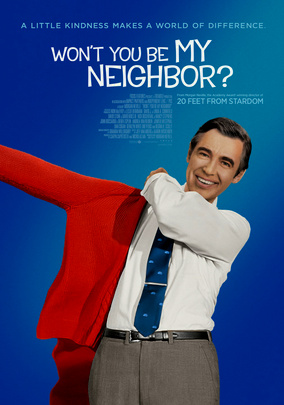
Won’t You Be My Neighbor?-2018

Won’t You Be My Neighbor? -2018

Director Morgan Neville

Starring Fred Rogers

Top 250 Films #250

Scott’s Review #783

Reviewed July 5, 2018

Grade: A

As much as I enjoy the documentary genre, it has never been close to the top of my favorites list. Many films of this ilk are very good, providing some relevant facts about a subject matter that may be taboo to me, but sometimes, it is somewhat interesting.

Few are great.

Along comes a documentary that is emotional, inspiring, and lovely. Won’t You Be My Neighbor (2018), based on the life of Fred Rogers, is simply outstanding.

Won’t You Be My Neighbor? Chronicles the life and rise to popularity of a kindly, mild-mannered man from Pittsburgh, Pennsylvania, with a simple message of kindness towards children.

Beginning as a local television personality, his show centered around children and produced positive messages for them.

Universally known as Mister Rogers, the documentary explains his determination, eventual fame, his ability to enrich lives, and his need to introduce heavy subject matters to children to expose them rather than shelter them from it.

In today’s tumultuous time, boy, is he missed!

I fondly remember watching the PBS television show Mister Rogers’ Neighborhood as a child. The program offered a feast of creativity every half hour.

Featuring the Neighborhood of Make-Believe, a magical trolley transports the viewer to a world of puppets (voiced by Rogers). Other poignant moments occur when Rogers sings the catchy theme song at the top of every show.

The episodes are filled with simple yet important messages of self-acceptance, diversity, and kindness toward others.

At the conclusion of each episode, Rogers sang the song “It’s Such a Good Feeling” in a way that made any child watching feel secure, loved, and embraced.

Rogers sadly died in 2003- his wife, grown children, and various former cast members relay cherished memories and inspirational stories about the creative genius. Rumored to have had an insecure childhood, he was a champion at ensuring children felt worthy and accepted for who they are.

The documentary also shows how Rogers fought in court for necessary funding via news flashbacks.

My emotional reaction surprised me quite frankly. I expected a nostalgic trip back to childhood with flashbacks from the show, some interviews, and a jovial good time. Instead, I was utterly blown away by how touching and humanistic the documentary was and the abovementioned expectations.

Sure, old clips (some black and white) brought back memories as puppets Daniel Striped Tiger, Madame, and King Friday XIII made appearances. Still, the flood of tears that accompanied the memories was unexpected.

Never preachy, the documentary holds the same level of genuine goodness as Rogers does. For audiences watching the film, the question of when someone will well up in tears is the wrong question—it’s how often?

Examples of the most touching scenes are when Rogers accepts a young, gay actor for who he is when his family members do not. A disabled child who uses a wheelchair sings a heart-wrenching duet with Rogers.

Finally, as Rogers gives a commencement speech at a college university, a teary graduate explains why he gave her a special preschool education.

Perhaps the most poignant moment occurs in the final moments of the documentary. When many of the film participants are asked to think for just a moment about someone who taught them kindness, whether alive or dead, the sequence is monumental in feeling.

A quick foray into the current political climate in the United States is only briefly skated around, carefully so as not to ruin the sweetness of the overall experience.

Director Morgan Neville perfectly paces his documentary so that it never drags.

The flow is perfectly structured at one hour and thirty-four minutes. The first half is a bit lighter and more fun, while the second half culminates with a more serious and introspective tone.

Won’t You Be My Neighbor? (2018) is a brilliant documentary film and one of the best I have ever seen.

Independent Spirit Award Nominations: 1 win-Best Documentary Feature (won)