Tag Archives: Paul Mescal

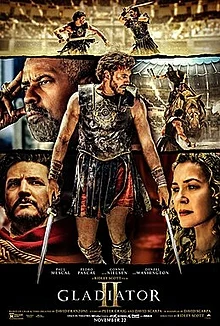
Gladiator II-2024

Gladiator II-2024

Director Ridley Scott

Starring Paul Mescal, Pedro Pascal, Denzel Washington

Scott’s Review #1,456

Reviewed December 21, 2024

Grade: B+

Ridley Scott, who directed Gladiator (2000), returns to the fold to direct Gladiator II almost twenty-five years later. Both are epic proportions and center on the barbaric yet luscious Ancient Roman Era.

It’s the type of film best seen in the theater on a large screen with loud surround sound. It’s bloodier than the first Gladiator.

Scott wisely incorporates snippets of the original’s ending to familiarize the audience with the events and ties a significant character to characters from the first film, both dead and alive.

The great thing about Scott directing both films is that despite the long gap between them, they feel very much aligned and have a similar tone.

When the film begins, we are told that Rome is nearly ruinous and led by tyrants. The peacefulness after Maximus’s (Russell Crowe in Gladiator) death is sadly gone.

Rome is now ruled by corrupt twin emperors, Geta (Joseph Quinn) and Caracalla (Fred Hechinger). They are barbaric and evil and use scare tactics to keep the masses in line.

We meet Lucius (Paul Mescal) when the emperors of Rome steal his home and kill his wife. He has unrelenting rage in his heart, and it’s revealed that he is the rightful heir to Rome and witnessed his father’s (Maximus) death at the hands of his uncle as a young boy.

With the empire’s future at stake, he looks to the past to find the strength and honor needed to return the glory of Rome to its people.

The fact that Lucius is the rightful heir and that his mother, Lucilla (Connie Nielsen), is still alive and now remarried to General Acacius (Pedro Pascal) provides immediate rooting value.

Combined with the viciousness of the current regime, we want the good guys to beat the bad guys. The bloody battles and the machismo nature of the story make it a muscular vehicle sure to appeal to a male audience.

It’s that type of film.

However, there is much to see visually to titillate one’s loins. Mescal looks chiseled and cut in his gladiator attire, sweatily and bloodily fighting others to the death. His hunky nature and dreamy blue eyes only make the character a sure crowd-pleaser.

Mescal also looks enough like Crowe to make the heritage believable.

Pascal and Denzel Washington are terrific in supporting roles. Washington, as Macrinus, a motivated leader intent on having the throne for himself, is bisexual, though this is hardly explored other than one line of dialogue.

A rumored kiss between Macrinus and another male character was reportedly scrapped, and shame on the powers that be for that. Too much for mainstream audiences?

The central LGBTQ+ presence is saved for the more unhinged twin ruler in a more stereotypical form.

There is little unpredictability since we know from the start that Lucius will conquer the tyranny and save the Roman people from further chaos.

But, the violent matches between gladiators and vicious beasts and one another are entertaining to watch and enthralling in their violence.

The visuals of a mock Roman Colosseum and palatial dining areas are well constructed and look real enough to transport us to the Roman Era.

Politically, the twins are compared to present-day tyrannical rulers in office and a rogue’s gallery of appointed officials. Although it can be argued that the twins are somewhat played for laughs, the fact that dictators like this rule is scary.

Gladiator (2000) packs more emotional punch than Gladiator II (2024), but watching them in parallel would be fun. From a story perspective, they link well and have the same look and feel.

Oscar Nominations: Best Costume Design

All of Us Strangers-2023

All of Us Strangers-2023

Director Andrew Haigh

Starring Andrew Scott, Paul Mescal, Claire Foy

Scott’s Review #1,439

Reviewed September 22, 2024

Grade: A

A moody, dark-lit experience, All of Us Strangers (2023) is a dreamy affair in all the best ways. It’s a bit of a ghost story combined with a love story and can be challenging to explain. 

Especially noteworthy are some elements like the lighting and mood which serve as enhancers. The lavish setting of London, England, and its surroundings are presented as lonely and depressing.

Loneliness is an encompassing description of the film summing up the character-driven story set mostly in an enormous yet almost vacant luxury high-rise apartment.

The vacant building is an effective backdrop to the main character’s experience.

We get inside his head and travel down a tunnel of self-reflection and acceptance just as he does. It’s unclear what is imagined or real, raising the stakes and catapulting the viewer into a world of questions.

The best pleasure comes after finishing the film and wondering how all the pieces come together or even if they do. I wasn’t sure what happened in the conclusion but the overall experience left me thinking. 

The British film follows a lonely screenwriter named Adam who works as a television writer. He develops an intimate relationship with his mysterious male neighbor while revisiting memories from the past involving his parents.

Andrew Haig directs the film and Andrew Scott plays the screenwriter from which the story is his vehicle. Paul Mescal plays his neighbor and love interest.

Haigh is best known for efforts like 45 Years (2015) and Lean on Pete (2017). Both are quiet films and character-driven. All of us Strangers is the best of the trio, though.

The film also has some teary moments of sweetness mostly shown through an LGBTQ+ lens but the film is not only for members or allies of the community but for anyone with a heart or craving something cerebral.

Viewers who have lost parents far too soon before feelings are expressed and only cherished memories remain will find All of Us Strangers to resonate mightily.

Specific to the LGBTQ+ community, what gay man wouldn’t want to travel thirty years into the future and have deep conversations with his parents about his lifestyle? Having missed those prominent years because of death. 

In the story, Adam’s parents died in a car accident when he was a child. Since he never ‘came out’ to them he travels to their house outside of London and imagines conversations with them separately and together. 

The best scenes are between Andrew Scott and Claire Foy who plays Adam’s mother. They are lengthy and poignant and brilliant acting by both are showcased. 

In an ideal fantasy, his mother would leap into Adam’s arms and champion his lifestyle becoming his most ardent supporter. Haig writes the scenes better than that as real-life situations might play out with conflict and misunderstandings.

The mother wants to understand and support but has hesitancies and ideas about a lifestyle different than Adam’s. The scenes become tense and complex not because of shouting but because of a deep struggle for understanding.

Not to be outdone by Foy’s performance in the unique relationship between father and son deliciously played by Jamie Bell. 

Adam has resented his father’s emotional distance for years never forgetting how he needed his father’s support as a child and never got it.

In a powerful scene, Adam and his father embrace. The embrace is one that Adam needed as a child.

The film is for everyone because why wouldn’t anyone want to visit their dead parents years later? Even if still alive there are things between parent and child never said or expressed. 

So many scenes are emotional, poignant, and meaningful in All of Us Strangers. 

The finale is trippy and made me recall David Lynch’s Mulholland Drive (1992) where what is real may not be and who we think a character’s life is all about may not be so.

Though wrapped in fantasy, All of Us Strangers (2023) is focused on grief through a deep emotional lens and uses superior acting to tell its story.

Independent Spirit Award Nominations: Best Film, Best Director-Andrew Haigh, Best Lead Performance-Andrew Scott

The Lost Daughter-2021

The Lost Daughter-2021

Director Maggie Gyllenhaal

Starring Olivia Colman, Dakota Johnson

Scott’s Review #1,232

Reviewed February 21, 2022

Grade: A

Throughout The Lost Daughter (2021), there is a constant feeling of dread that may result in viewer anxiety. We know that bad things are coming, but we do not know how or when. This makes for good drama done exceptionally well by director Maggie Gyllenhaal in her astounding debut.

She has acted for years and has made the transition to writer/director.

Gyllenhaal adapts her film from a novel written by Italian author Elena Ferrante. The experience is extremely female-centered, and having a female pen both book and film makes it a rich and authentic project.

The result is a brilliant depiction of motherhood and choices, making it essential for everyone to see and appreciate this film.

However, the film is not for everyone, nor will it please those seeking a conventional work about mother and daughter love and moments of happily skipping through the field of daisies. It has feel-good moments, but it’s much darker than some might expect.

For me, those aspects are what make The Lost Daughter so damned amazing.

We meet middle-aged Leda (Olivia Colman) when the woman embarks on a seaside vacation in Greece. She begins to observe a young mother, Nina, played by Dakota Johnson, and her daughter, Elena, on the beach and becomes obsessed with them.

Leda unwisely butts heads with the mother’s menacing extended family, who may be mafia-related.

Leda begins to have memories of her early motherhood when she struggled to raise two young girls while balancing her career as a professor. When she spontaneously steals Elena’s doll, she becomes increasingly obsessive, battling moments of rage and emotion.

Colman is a perfect choice for the central character. From the first moment she appears on the screen, we know there is conflict surrounding her. She is consumed by anger and either guilt or tension.

The actress is outstanding at portraying Leda’s complexities through her eyes and facial expressions. Many shots of Leda quietly observing events or sitting on the beach, deep in thought, are powerful.

Though a quiet film, The Lost Daughter never drags or lags, thanks to Gyllenhaal’s perfect portrayal of a doleful atmosphere. I was dying to know Leda’s secrets, and the interspersing flashbacks to a young Leda, wonderfully played by Jessie Buckley, finally provide resolution.

But that’s just the beginning of the fun. Once Leda’s backstory is revealed, and Gyllenhaal makes us wait quite a while for the reveal, there are more places for the film to go, like what about the stolen doll?

The viewer will not only wonder why Leda stole the doll but also why she won’t return it, especially when it’s known how desperately the family wants it back. Will they kill her when they find out she has it?

Beneath all the drama, a lingering question is posed to the viewers. Do I want to be a parent? The film is not only for women, but men can certainly ask themselves the same question.

The inclusion of a male character played by Ed Harris is evidence of this. In his youth, he struggled with being a father.

The film has a sense of purpose and meaning that many films lack. A film that poses questions and makes the viewer squirm a bit is top-notch for me. The basic story of a lone woman on vacation evolves into a tale of intensity and psychological warfare within oneself and one’s feelings.

The Lost Daughter (2021) is a complicated watch, but it offers a lesson in outstanding acting, directing, writing, and how atmosphere and mood can enhance a story layered with intrigue.

As shocking and unsettling as moments are, I was left feeling satisfied that I had seen something of worth and merit.

I can’t wait to see what Gyllenhaal does next.

Oscar Nominations: Best Actress-Olivia Colman, Best Supporting Actress-Jessie Buckley, Best Adapted Screenplay

Independent Spirit Award Nominations: 3 wins-Best Feature (won), Best Director-Maggie Gyllenhaal (won), Best Screenplay (won), Best Supporting Female-Jessie Buckley