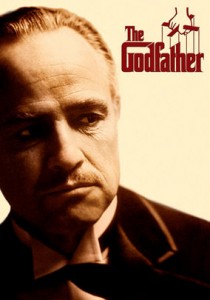
The Godfather-1972
Director Frances Ford Coppola
Starring Marlon Brando, Al Pacino, James Caan
Top 250 Films #4
Scott’s Review #196
Reviewed November 24, 2014
Grade: A
The Godfather (1972) is one of the most identifiable and brilliant film masterpieces of all time. It is so ingrained in pop culture and film history that it was a blueprint for 1970s cinema, and its legend deserves to live on.
The film has not aged poorly nor been soured by over-exposure. It is as much a marvel today as it must have been when it was initially released in theaters.
The film revolves around the Corleone family- a mob family living in New York. They are high-powered, wealthy, and influential with politicians and law enforcement alike. They are the cream of organized crime families.
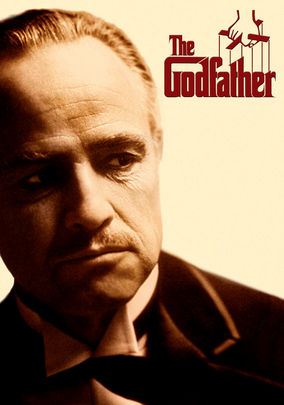
The patriarch of the family is known as “The Godfather”; his real name is Don Corleone, played by Marlon Brando.
The eldest son, hot-headed Sonny, is played by James Caan. Middle son Fredo, played by John Cazale, is dim-witted and immature, serving as the family’s weak link.
Finally, the youngest son is the central character in the film. Michael, played by a very youthful Al Pacino, has just returned home from World War II, a decorated and Ivy League-educated hero.
Throughout the film, Michael wrestles with steering the Corleone family business toward the straight and narrow or continuing the death, bloodshed, and corruption that currently plague the family.
Rounding out the Corleone family is Tom Hagen, an Irish surrogate son of sorts, who serves as the family attorney. Connie, the temperamental and emotional sister, and Mama Corleone, the passive wife of Don, complete the prominent family.
The supporting characters are numerous, ranging from family friends and relatives to corrupt mobsters and those introduced while Michael lives in Italy.
The brilliance of The Godfather lies in the richness of its numerous characters, as well as its structure and pacing.
Even minor characters are vital to the film, and every scene is essential and effortlessly paced, so that they neither seem rushed nor dragged out; the film is immeasurably character-driven.
My favorite character is Michael Corleone, as he is the most troubled and complex of all. Pacino plays him to the hilt as, initially, a nice guy trying to do the right thing, going against the grain, and non-traditional- he proposes to a WASP woman who has no Italian heritage.
When events unfold in a particular way, Michael suddenly becomes the family’s leader, despite being the youngest son, and the character’s complexities deepen from this point.
Specifically, the revenge-killing sequence is brilliant, keeping the viewer on the edge of their seat through a car ride, a meal at a restaurant, and a men’s room scene, until all hell finally breaks loose, all the while Michael is conflicted, unsure, and intense.
Has he veered too far from being a nice guy? Can he salvage the family business without being ruthless? Michael faces a battle of good vs. evil.
The scenes are brilliantly structured- the grand opening scene alone is beautiful as the audience is introduced to the entire family- cheerfully dancing and frolicking during a bright and sunny outdoor wedding (Connie’s) at the Corleone estate, while inside a dark interior study, a man begs Don Corleone to help avenge his raped and beaten daughter by having her attackers killed.
Several scenes in The Godfather are my personal favorites —the aforementioned restaurant scene, where Michael is faced with a dilemma involving a corrupt policeman and a high-powered figure. One can feel the tension in this extended scene.
The scene in a Hollywood mansion where poor, innocent, horse Khartoum meets his fate in the most gruesome way imaginable.
Later, Michael’s beautiful Italian wife, Apollonia, has an explosive send-off.
Towards the end of the film, there is an improvised scene set in a tomato garden, with an elderly Don Corleone playing with his young grandson.
Finally, the brutal scene at the toll booth involving Corleone’s son, Sonny, is mesmerizing, murderous, and flawlessly executed.
The lack of any strong female characters and how women are treated (either beaten or passively following their husbands) is bothersome.
Unfortunately, this was still the case circa the 1940s.
One could argue that Kay Adams, played by Diane Keaton, is the strongest female character because she questions the Corleone family’s motives and tries to keep Michael honest and trustworthy. She has little in common with the other female characters.
Lines such as “I’m gonna make him an offer he can’t refuse” and “Don’t forget the cannolis” are unforgettable and quote-worthy.
The film’s finale is breathtaking—a combination of bloody killings and a peaceful scene in which Michael accepts the honor of becoming his nephew’s godfather. As he pledges his devotion to God and denounces Satan, the murders he orchestrated are simultaneously being executed.
The character, while complex, suddenly becomes a hypocrite.
Some view Michael as strictly a hero whose choices should not be questioned or analyzed; others see him as a complex, tortured, and flawed character rather than a hero.
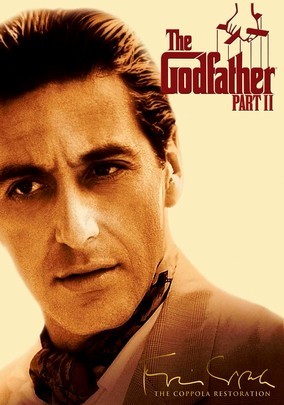
One must watch The Godfather and The Godfather Part II (1974) as companion pieces, as Part I is slightly more straightforward and easier to follow than the more complex and layered sequel.
The Godfather (1972) is storytelling and filmmaking at its absolute best and continues to influence films to this day.
Oscar Nominations: 3 wins-Best Picture (won), Best Director-Francis Ford Coppola, Best Actor- Marlon Brando (won), Best Supporting Actor- James Caan, Robert Duvall, Al Pacino, Best Screenplay Based on Material from Another Medium (won), Best Costume Design, Best Sound, Best Film Editing