The Godfather: Part II-1974
Director Frances Ford Coppola
Starring Al Pacino, Robert DeNiro
Top 250 Films #2
Scott’s Review #197
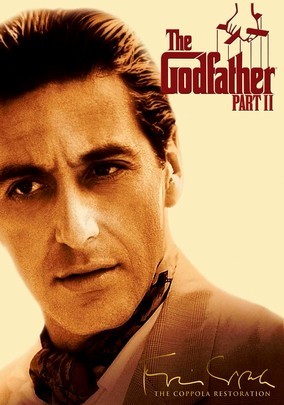
Reviewed: November 25, 2014
Grade: A
Frances Ford Coppola’s sequel (and, technically, a prequel) to the highly regarded and successful The Godfather (1972) is one of the rare sequels to equal, if not surpass, the original in greatness, creativity, and structure.
The Godfather Part II (1974) feels more profound, more complex, and ultimately richer than The Godfather- and that film itself is a masterpiece. Part II is much darker in tone. Francis Ford Coppola had complete freedom to write and direct as he saw fit, with no studio interference.
The results are immeasurable in creating a film masterpiece.
The film is sectioned into two parts, which is an exciting and practical decision.
The story alternates between the early twentieth century, following Don Corleone’s life, now played by Robert DeNiro, as his story is explained- left without a family and on the run from a crime lord, Don escapes to the United States as a young boy and struggles to survive in the Little Italy neighborhood of New York City.
He obtains a modest job as a grocery stockboy and finally celebrates his eventual rise to power in the mafia.
The other part of the film is set in 1958, as Michael Corleone faces a crumbling empire, with both rivals and the FBI investigating him and holding Senate committee hearings in Washington, D.C., and a failing marriage to Kay (Diane Keaton).
Betrayal is a common theme of the film, as Michael’s wife, brother, and mobster allies are revealed to be cagey enemies. Michael becomes increasingly uncertain and mistrustful of almost everyone around him. Is Kay a friend or foe? Is Fredo plotting against him? He even begins lashing out at Tom Hagen on occasion.
What makes The Godfather Part II so brilliant, and in my opinion richer than The Godfather, is that it is tougher to watch- and that is to its credit. Now, instead of being a warm, respected member of a powerful family, Michael is questioned, analyzed, and betrayed.
New, interesting characters are introduced, including Hyman Roth, played by Lee Strasberg, a former ally of Don’s, and Frankie Pentangeli, played by Michael V. Gazzo. These characters are intriguing, and their allegiances remain unknown throughout most of the film: are they loyal to the Corleones or deadly enemies?
The character of Michael evolves from conflicted to all-out revenge-minded, including seeking revenge against members of his own family. Michael is now a dark, angry character- gone is the nice, decorated war hero with his whole life ahead of him.
He is much older and has changed.
Similar to the original Godfather, the opening scene is a large celebration- this time, Anthony Corleone’s first communion celebration.
Additionally, the film’s finale features the deaths of several significant characters, one after another.
Unique to this film are the multiple-location scenes, featuring New York, Nevada, Italy, Florida, and Cuba, which make for an enjoyable segue throughout and a more substantial budget.
The blow-up confrontation between Michael and Kay reaches a devastating, shocking climax. When Michael punches Kay in a sudden rage, the audience feels punched as well.
The incredible scene at the end of the film, with the entire family gathered around for Don’s fiftieth birthday in 1942, is a special treat for viewers; familiar faces make cameo appearances.
I love these aspects of the film.
The rich history of Don is the most significant aspect of The Godfather Part II, known as “Godfather” and patriarch of the family. His life as a boy and a young father is explained, showing how he became one of the most powerful men in the crime world.
I love how he remains a decent man and helps people experiencing poverty and the victims of the ruthless Don Fanucci, his predecessor. He loves his wife and children, but also loves his neighbors and helps them, believing in the principle of fairness.
Ultimately, the characters of Don and Michael are worlds apart.
The Godfather Part II (1974) is one of the most complex and well-written films in movie history- studied in film school, discussed, imitated, and championed.
It remains vital and should be viewed and analyzed repeatedly.
Oscar Nominations: 5 wins-Best Picture (won), Best Director-Francis Ford Coppola, Best Actor-Al Pacino, Best Supporting Actor-Robert De Niro (won), Michael V. Gazzo, Lee Strasberg, Best Supporting Actress-Talia Shire, Best Screenplay Adapted from Other Material (won), Best Original Dramatic Score (won), Best Costume Design, Best Art Direction (won)
