Tag Archives: Michael V. Gazzo

Alligator-1980

Alligator-1980

Director Lewis Teague

Starring Robert Forster, Robin Riker, Michael V. Gazzo

Scott’s Review #1,491

¸â.

Reviewed August 18, 2025

Grade: B-

Alligator (1980) capitalizes on the Jaws (1975) and Jaws 2 (1978) craze with a similarly themed ‘creature that attacks humans’ idea.

The stalking musical score is essentially the same as Jaws, and the film includes a copied underwater camera shot of a victim in peril trying to reach a boat.

The late-night offering is adequate, though amateurish and cheaply made, with enough stock characters to make for a comical offering, whether intentional or unintentional.

The romantic chemistry between the two leads, Robert Forster and Robin Riker, is surprisingly genuine and sweet, which barely lifts this effort above mediocrity.

The kills are underwhelming and quickly become redundant as a leg or arm is chomped off a victim with little more than systematic style as the doomed person desperately attempts to escape being the giant alligator’s next meal.

Set in Chicago, the film follows Detective David Madison (Forster) and a reptile expert, Dr. Marisa Kendall (Riker), who team up to track an enormous, ravenous man-eating alligator flushed down the toilet years earlier as a baby.

The reptile terrorizes and attacks residents without capture after escaping from the city’s toxic sewers.

An inane explanation is provided, involving the alligator mutating to a humongous size due to feeding on animals used as test subjects for an experimental growth formula intended to increase agricultural livestock meat production.

The plot-driven story assuredly pairs David and Marisa as romantic counterparts from the get-go, so there is little doubt they will wind up together. A weak attempt at a spat between the couple is perplexing and a waste of time.

Thank goodness the actors have a decent amount of chemistry, which compels during scenes when they trapse around the metropolis trying to catch the reptilian murderer.

Marisa is written well as a self-assured, intelligent female doctor, though inexplicably, she lives with her overbearing mother. David has a mediocre backstory involving an incident where he should have saved his partner’s life but failed.

The death setups are outrageously satisfying as cookie-cutter stock characters quickly get their comeuppance. For example, the villainous Slade (Dean Jagger), an influential local tycoon responsible for the experiments, is crushed by a car that the alligator flattens.

This follows Slade’s selfish attempt to save his skin at the expense of another character, whom he locks out of his car.

Interestingly, Alligator features Jagger, an Oscar-winning actor (for 1949’s Twelve O’Clock High) and Oscar-nominated actor Michael V. Gazzo (for The Godfather Part II, 1974).

The grand finale is delicious B-movie style. The alligator goes on a rampage through a high-society wedding hosted at Slade’s mansion, eating a maid serving guests at the reception and killing Slade, the mayor, and Slade’s chief scientist for the hormone experiments, who was also his intended son-in-law.

The shrieking women and scrambling guests hilariously try to outrun the creature amid flying champagne glasses, wedding cakes, and delicate dining dishes.

This scene is worth the price of admission.

The rest of the experience is ludicrous as the alligator escapes notice in the city of millions. He crawls down urban streets and hides in dark alleys at whim, occasionally eating a villain or two.

Like any horror film of the 1970s or 1980s, Alligator perfectly sets up a sequel, a la Alien (1979), with a spawn being hatched in the sewer.

Playing more like a light comedy than a scary film, Alligator (1980) has moments of satisfaction. But most of it is an attempt to capitalize financially on an idea that has been used before, making it feel more like a ripoff movie than anything original.
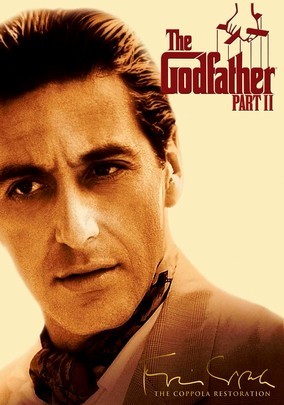
The Godfather: Part II-1974

The Godfather: Part II-1974

Director Frances Ford Coppola

Starring Al Pacino, Robert DeNiro

Top 250 Films #2

Scott’s Review #197

60011663

Reviewed: November 25, 2014

Grade: A

Frances Ford Coppola’s sequel (and technically also a prequel) to the highly regarded and successful The Godfather (1972) is one of the rare sequels to equal, if not surpass, the original in its greatness, creativity, and structure.

The Godfather Part II (1974) feels more profound, more complex, and ultimately richer than The Godfather- and that film itself is a masterpiece. Part II is much darker in tone. Francis Ford Coppola had complete freedom to write and direct as he saw fit, with no studio interference.

The results are immeasurable in creating a film masterpiece.

The film is sectioned into two parts, which is an exciting and practical decision.

The story alternates between the early twentieth century, following Don Corleone’s life, now played by Robert DeNiro, as his story is explained- left without a family and on the run from a crime lord, Don escapes to the United States as a young boy and struggles to survive in the Little Italy neighborhood of New York City.

He obtains a modest job as a grocery stockboy and finally celebrates his eventual rise to power in the mafia.

The other part of the film is set in 1958, as Michael Corleone faces a crumbling empire, with both rivals and the FBI investigating him and holding Senate committee hearings in Washington, D.C., and a failing marriage to Kay (Diane Keaton).

Betrayal is a common theme of the film, as Michael’s wife, brother, and mobster allies are revealed to be cagey enemies. Michael becomes increasingly uncertain and mistrustful of almost everyone around him. Is Kay a friend or foe? Is Fredo plotting against him? He even begins lashing out at Tom Hagen on occasion.

What makes The Godfather Part II so brilliant, and in my opinion richer than The Godfather, is that it is tougher to watch- and that is to its credit. Now, instead of being a warm, respected member of a powerful family, Michael is questioned, analyzed, and betrayed.

New, interesting characters are introduced, including Hyman Roth, played by Lee Strasberg, a former ally of Don’s, and Frankie Pentangeli, played by Michael V. Gazzo. These characters are intriguing, and their allegiances remain unknown throughout most of the film: are they loyal to the Corleones or deadly enemies?

The character of Michael evolves from conflicted to all-out revenge-minded, including seeking revenge against members of his own family. Michael is now a dark, angry character- gone is the nice, decorated war hero with his whole life ahead of him.

He is much older and has changed.

Similar to the original Godfather, the opening scene is a large celebration- this time, Anthony Corleone’s first communion celebration.

Additionally, the film’s finale involves the deaths of several significant characters one after the other.

Unique to this film are the multiple-location scenes, featuring New York, Nevada, Italy, Florida, and Cuba, which make for an enjoyable segue throughout and a more substantial budget.

The blow-up confrontation between Michael and Kay is devastating and shocking in its climax. When Michael punches Kay in a sudden rage, the audience feels punched as well.

The incredible scene at the end of the film, with the entire family gathered around for Don’s fiftieth birthday in 1942, is a special treat for viewers; familiar faces make cameo appearances.

I love these aspects of the film.

The rich history of Don is the most significant aspect of The Godfather Part II, known as “Godfather” and patriarch of the family. His life as a boy and young father is explained, so we see how he became one of the most powerful men in the crime world.

I love how he remains a decent man and helps people experiencing poverty and the victims of ruthless Don Fanucci, his predecessor. He loves his wife and children, but also loves his neighbors and helps them, believing in the principle of fairness.

Ultimately, the characters of Don and Michael are worlds apart.

The Godfather Part II (1974) is one of the most complex and well-written films in movie history- studied in film school, discussed, imitated, and championed.

It remains vital and should be viewed and analyzed repeatedly.

Oscar Nominations: 5 wins-Best Picture (won), Best Director-Francis Ford Coppola, Best Actor-Al Pacino, Best Supporting Actor-Robert De Niro (won), Michael V. Gazzo, Lee Strasberg, Best Supporting Actress-Talia Shire, Best Screenplay Adapted from Other Material (won), Best Original Dramatic Score (won), Best Costume Design, Best Art Direction (won)

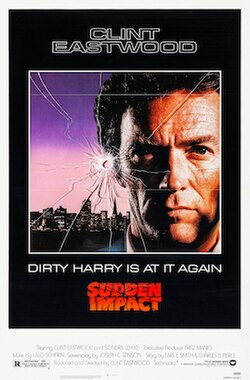
Sudden Impact-1983

Sudden Impact-1983

Director Clint Eastwood

Starring Clint Eastwood, Sondra Locke

Scott’s Review #1,388

Reviewed August 12, 2023

Grade: B+

The groundbreaking and highly influential Dirty Harry, released in 1971 spawned four sequels. Sudden Impact (1983) is the third. It is directed, produced by, and stars Clint Eastwood (making it the only Dirty Harry film to be directed by Eastwood himself) and co-starring Sondra Locke, the star’s longtime girlfriend.

On the surface, the film is standard fare and relatively conventional featuring slick cinematography, a predictable story, shoot ’em-ups, and cartoon villains.

It’s also quite bloody and violent with a theme of justice being served.

Exactly what you’d expect from any action/thriller to come out in the two decades following the original.

The cliches and story setups had by 1983 been seen in so many crime thriller genre films that they feel tired and stale and can be predicted at length.

The expected Dirty Harry catchphrase in Sudden Impact is, “Go ahead, make my day” which is probably what the film is best remembered for though some assume the famous line appears in Dirty Harry.

This isn’t a glowing testament for Sudden Impact.

United States President Ronald Reagan embarrassingly used the “make my day” line in a March 1985 speech threatening to veto legislation raising taxes.

The secret weapon of Sudden Impact though is the inclusion of Locke who is a tour de force in acting and raises the film quite a bit. Her romance with Eastwood (on and off the silver screen) simmers with chemistry making Sudden Impact feel like a much better film than it is.

Jennifer Spencer (Sondra Locke) is a thirty-something blonde bombshell who along with her much younger sister was gang raped, but the crime went unpunished. She now hunts down those responsible one by one and gruesomely shoots them in the testicles before killing them.

She’s not a gal to be messed with.

The murders attract the attention of Harry Callahan (Eastwood), who is on a forced vacation due to his violent approach to police work.

The case gets complicated when Harry develops a relationship with Jennifer, and it’s up to Harry to make the right decision when Jennifer’s life is threatened for a second time.

Locke and Eastwood always do well with marginal material- think Bronco Billy (1980) or Every Which Way But Loose (1978). Both of those films are more comical so it’s riveting to see them co-star in a violence-based thriller.

Not to dwell on Locke (okay, I must), but she’s the best part of Sudden Impact. The first scene involves one of her vigilante murders and her cold, calm, steadiness is magnificent. Through icy eyes, she is filled with rage though is wise and calculating.

When she is not blowing balls to bits, Jennifer leads a successful life as an author and escapes to a whimsical carnival town outside San Francisco to focus on her work. She also finds time to finish killing the remaining members of the gang of rapists.

Locke mesmerizes in every scene she appears in.

Eastwood is good too but his character is the same grizzled, sick of criminal, guy with a gun he’s been since the beginning. Harry’s arguments with the suits in the top office are tired and the actors cast are handily stock types.

The win is Eastwood’s scenes with Locke. As they share dinner there is a romantic tenderness that perfectly offsets the rest of the story. We ask, will he send her to prison or let her go when he inevitably finds out she’s the killer?

Is she justified?

The rapists are cartoon-like and poorly cast and there is no character development. The main villain, Mick (Paul Drake) shrieks and wails and delivers his dialogue in over-the-top fashion. He’s a poor man’s ‘Scorpio’ who he tries to emulate.

A female villain, an assumed lesbian named Ray Parkins, in a purely politically incorrect fashion, has every lesbian stereotype imaginable.

I liken Sudden Impact (1983) to a McDonald’s meal. A greasy Big Mac, fries, and a shake. It’s not fine dining but it’s satisfying and one knows exactly what to expect. Only in this case, Locke is the special sauce.

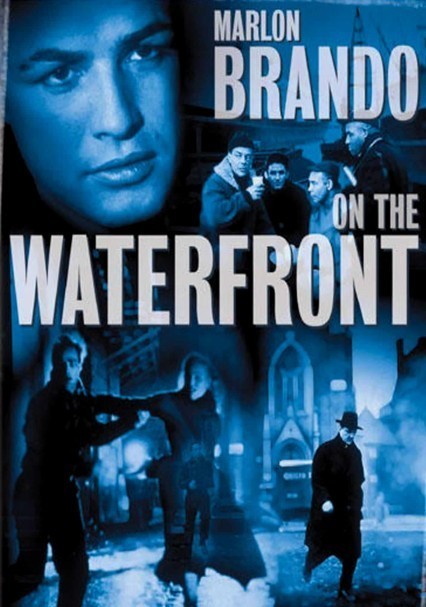
On the Waterfront-1954

On the Waterfront-1954

Director Elia Kazan

Starring Marlon Brando, Eva Marie Saint

Scott’s Review #876

Reviewed March 9, 2019

Grade: A

Led by one of the best acting performances of all time, On the Waterfront (1954) was an essential and relevant film when made and is still influential in the modern era.

Director Elia Kazan and newly minted Hollywood star Marlon Brando collaborate on a film spectacle as much a character study as a tale of morality and social injustice.

The musical soundtrack score composed by Leonard Bernstein only enhances an already astounding picture that is deservedly referenced as a masterpiece.

Terry Malloy (Brando) is a washed-up former local boxer who now spends his days slaving away as a dockworker on the dingy waterfronts of Hoboken, New Jersey. Terry’s brother Charley (Rod Steiger) works for a vicious mob boss, Johnny Friendly (Lee J. Cobb), who controls the area.

The police are aware of the ongoing corruption but are limited by the lack of evidence and witnesses to regular crimes. When a fellow dockworker is killed, Terry falls for the victim’s sister, Edie (Eva Marie Saint), leading him to rethink his priorities.

The positive aspects of On the Waterfront are enumerable. Meritful cinematography and location sequences, enshrined in the rich story and flawless acting, give the film authenticity. The film was shot almost entirely on location in New York and New Jersey, using actual docks and outdoor sequences.

The dingy, water-soaked locales are riddled with secrets and dark violence, brought to new levels through realism and grittiness.

Never looking more masculine or more handsome, though his portrayal of Stanley in A Streetcar Named Desire (1951) is a close second, Marlon Brando achieves riches in the world of stellar acting.

He is rugged yet compassionate, macho yet tender, and pours his heart into the role of Terry. One cannot help wondering if the self-professed method actor became Terry during filming.

With both vulnerability and strength, Brando embodies the character so well that he has become my favorite of all the film roles he has undertaken.

The supporting players dutifully flesh out the resounding cast with gusto. Special mentions go to Karl Malden as Father Barry and Steiger as Charley. Like Barry, Malden brings warmth, patience, and benevolence in a world of crime and deceit. He attempts to console and mentor the folks in his world and is eventually beaten for his honesty and earnestness.

Charley is a different story, selling his soul to the devil and accepting the cards he has been handed, choosing to join with Friendly. At a crucial moment, he makes another devastating choice that changes his life forever.

Few films can proudly boast a scene or dialogue that remains timeless and imprinted on cinematic history, but On the Waterfront contains a scene of this caliber.

During a tremendously important moment in the film, Terry has a conversation with Charley and makes an impassioned statement-“I coulda’ been somebody. I coulda been a contender”, laments Terry to his brother, “Instead of a bum, which is what I am – let’s face it.”

This line is a historic piece of writing and is true to the character.

The film is more powerful and truthful because it represents Elia Kazan’s real-life plight. In the early 1950s, the director famously informed a government committee about suspected Communists, while many of his colleagues chose to go to prison rather than name names.

Many Hollywood actors, directors, and screenwriters were blacklisted for decades to come. On the Waterfront is frequently deemed an allegory to the director’s plight and is a personal story.

On the Waterfront (1954) is sometimes violent and all-times realistic, painting a portrait of one man’s struggle to overcome the lousy life given to him to do the right thing.

Thanks to gorgeous direction, an explosive lead performance by Brando, and all the pieces fitting perfectly in unison, the film is one of the greats and will remain one that generations will discover.

Oscar Nominations: 8 wins-Best Motion Picture (won), Best Director-Elia Kazan (won), Best Actor-Marlon Brando (won), Best Supporting Actor-Lee J. Cobb, Karl Malden, Rod Steiger, Best Supporting Actress-Eva Marie Saint (won), Best Story and Screenplay (won), Best Music Score of a Dramatic or Comedy Picture, Best Art Direction, Black-and-White (won), Best Cinematography, Black-and-White (won), Best Film Editing (won)