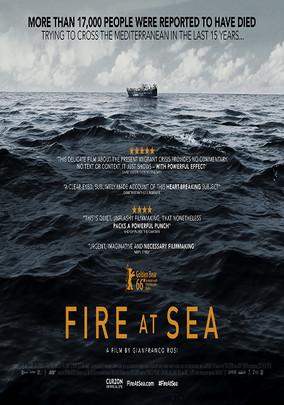
Fire at Sea-2016
Director Gianfranco Rosi
Scott’s Review #671
Reviewed August 12, 2017
Grade: B+
Fire at Sea earned a coveted 2017 Best Documentary Feature Oscar nomination, but it received largely negative reviews from viewers.
This may not be as surprising as it seems.
The documentary was also Italy’s entry in the Best Foreign Language Film category but was not chosen.
It is a hybrid between a “typical” film and a documentary, making it all the more unique.
The lackluster comments are undoubtedly due to the documentary’s slow pace and the way it intersperses story snippets that don’t weave into the main message.
Compounded by the length (one hour and fifty-four minutes is very long for a documentary), the work will not go down in history as a rousing crowd-pleaser.
But it is an important film.
The story follows a group of modest individuals living on a tiny Sicilian fishing island named Lampedusa, between Sicily and Libya.
The island is prominent for being a rescue area for migrants forging a treacherous journey from African countries (mainly Libya and Sudan) to the island for safety and medical treatment.
The film implies that migrants do not stay on the island for long. Lampedusa serves as a temporary sanctuary.
The film does not explain where the migrants go or what happens to them after medical treatment.
After a slightly tedious start, I immersed myself in the various stories and began to appreciate the slow pace.
I found this calming.
We see snippets of daily events: a young boy and his friend carve a face out of cactus plants. Later, the boy undergoes an eye exam and is told he needs glasses. We then see a lengthy scene of his family eating pasta.
We also meet a resident doctor, a grandmother, a disc jockey, and a scuba diver.
Admittedly, I began to wonder what a young boy preparing a slingshot or a grandmother preparing sauce had to do with the documentary’s main subject, migrants coming to the island.
Then I realized that director Gianfranco Rosi was telling a human story. The ordinary lives of Lampedusa citizens contrast with the fleeing, terrified migrants.
I was able to put all the pieces together.
Fire at Sea is unusual because it is told without narration, with dialogue in Italian and subtitles. These are additional unique aspects of the project, but I admired its essential message.
The most powerful scene in the film is a quiet one in which a resident doctor describes his experiences with the migrants.
He professes that any decent person should help any needy soul and describes the grisly task of performing autopsies on the people (many women and children) who do not survive the harrowing journey across the Mediterranean Sea.
Many die of hunger and thirst or are burned by the diesel fuels from the tiny boats they are stuffed into.
His long yet powerful account will move one to tears.
This testimonial speaks volumes regarding the influx of needy individuals, mainly from Syria, who need help from neighboring countries.
Some have been kind and have let individuals into their countries, while others have shunned the migrants (namely, in 2017, the United States).
The doctor’s honest account captures the message of humanity that Fire at Sea represents.
Another powerful scene emerges towards the end of the documentary, as several African men are rushed from their ship to another ship and tended to by rescuers.
Sadly, the barely alive yet conscious men are not long for this world, as a few minutes later, we see a series of body bags lined up containing the deceased men.
This tragic realization speaks volumes about the need for such humanistic individuals in Lampedusa.
Fire at Sea (2016) is worth watching. It is a story about the fiery waters the residents could see from afar during World War II.
It teaches kindness and decency and reminds us that some people are just good, generous souls, all but willing to help those in need.
We can all learn from this documentary.
Oscar Nominations: Best Documentary Feature