Tag Archives: Dudley Sutton

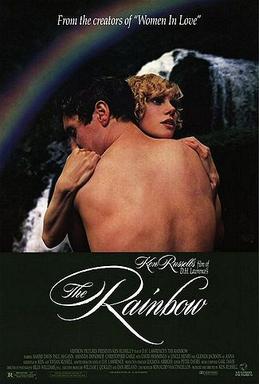
The Rainbow-1989

The Rainbow-1989

Director Ken Russell

Starring Sammi Davis, Paul McGann, Amanda Donohoe

Scott’s Review #1,409
Reviewed November 5, 2023

Grade: A-

Continuing my exploration of more obscure films by the British director comes The Rainbow, a 1989 picture adapted from a 1915 D.H. Lawrence novel.

Russell fans will know that he also adapted 1970s Women in Love from Lawrence so there is a tie-in between films.

Even though The Rainbow was made nearly two decades after Women in Love, it’s a prequel. The antics of the Brangwen sisters are explored as they grow up in rural England specifically one sister’s burgeoning sexuality and desires.

One could take The Rainbow as a feminist film that centers mainly on the eldest sister.

Born to a rich landowner, played by Christopher Gable, in the final days of the Victorian era (the late 1800s), Ursula (Sammi Davis) blossoms into a beautiful young woman full of imagination and promise.

She is quite free-spirited and begins to feel trapped by her surroundings. Still, her life changes when she has an erotic experience with Winifred (Amanda Donohoe), an adventurous and bisexual teacher.

From that point on, Ursula puts all of her passion and creativity into the pursuit of sexual fulfillment. She prefers men and develops a relationship with the dashing Anton (Paul McGann).

But she is constantly frustrated and continues to suffer from anguish and under-fulfillment as her development years go by.

Davis is delightful and mesmerizing as the lead character. Her flowing blonde locks which she eventually cuts give her a wholesome schoolteacher persona. But she is peppered with sassiness and experimentation which Davis flawlessly executes.

Donohoe, who starred in another Russell film, the bizarre The Lair of the White Worm (1988) smolders with sophistication and sensuality. Winifred easily takes Ursula under her wing and teaches her the pleasures of sex.

Eventually marrying Ursula’s wealthy Uncle Henry she doesn’t decline into dull matrimony but remains a mentor and source of temptation to Ursula.

McGann, as Anton brings a boyish yet masculine flavor to the film and succeeds as the main love interest for Ursula. Becoming a soldier, he smolders most during his plentiful nude scenes running around forests and up mountains with Ursula in tow.

These scenes are the zestiest as Russell plugs his all-too-familiar bizarre sequences of lust and bare flesh into the film.

There are many nude scenes to salivate over turning the prim and proper Victorian upper-crust characters into horny animalistic creatures.

The dynamics between Ursula, Anton, and Winifred are my favorite because it’s not played as a traditional love triangle with one pair to root for. It’s more sexual and interesting than that.

Not everything in The Rainbow works, however.

Even though I’m very familiar with Women in Love the connection to that film is tough to capture. Gudrun (the other sister) is the main focus in Women in Love but only has a small role in The Rainbow. To make matters more confusing, Ursula (in The Rainbow) is more similar to the character of Gudrun (in Women in Love).

Also, Glenda Jackson (who plays Gudrun in Women in Love) is cast as the mother in The Rainbow. The role is unspectacular especially compared to the brilliant portrayal Jackson did in Women in Love.

She doesn’t have much to play except being their mother.

I finally decided to stop thinking about Women in Love and enjoy The Rainbow on its own merits.

Admittedly, the final sequence does satisfy as Ursula forges ahead to a new life which brings us back to the start of Women in Love.

Reminiscent of E.M. Forster’s adaptations like A Room with a View (1985), Maurice (1987), or Howards End (1992), the quaint English cottages, landscapes, and villages are wonderful and capture a specific time capsule.

The Rainbow (1989) transported me to another time and offered a character study meshed in sexuality, coming of age, and feminist power.
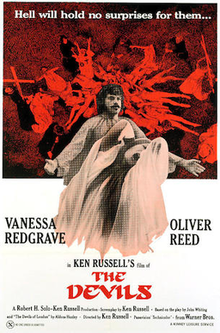
The Devils-1971

The Devils-1971

Director Ken Russell

Starring Oliver Reed, Vanessa Redgrave

Scott’s Review #1,403

Reviewed October 4, 2023

Grade: A

Ken Russell, best known for directing the outstanding Women in Love (1970) and The Who’s Tommy (1975), creates a disturbing opus about perversion and scandal within the Roman Catholic Church in medieval times.

The film’s graphic portrayal of violence, sexuality, and religious blasphemy ignited shocked reactions from censors, and it initially received an X rating in both the United Kingdom and the United States. It was banned in several countries and heavily edited for exhibition in others.

This alone will pique the interest of open-minded, curious viewers. It sure did mine.

The film is ironically entitled The Devils (1971) and stars Russell Stalwart Oliver Reed, who also appeared in the aforementioned films.  Reed leads the charge as a sexy, rugged man who beds many women and is the center of a convent full of nuns’ nasty and naughty thoughts.

Vanessa Redgrave also appears as a lustful and evil nun with a hunchback.

During the period of seventeenth-century France, Father Grandier (Reed) was a priest whose unorthodox views on sex and religion influenced a passionate following of nuns, including the sexually obsessed Sister Jeanne (Redgrave).

When the power-hungry Cardinal Richelieu (Christopher Logue) realizes he must eliminate Grandier to gain control of France, Richelieu vows to destroy the man. He portrays Grandier as a Satanist and spearheads a public outcry to destroy the once-loved priest’s reputation.

The Devils is outrageous and bizarre in only the best of possible ways. Who doesn’t love a healthy dose of nun orgies and simulating fellatio on a large candlestick? One nun violently masturbates as another looks on, giggling sadistically.

The camera loves Reed and Redgrave, who, interestingly, are not a couple in the film. These British actors were at the height of their careers in 1971, and both portrayed roles that must have been tremendously challenging.

Despite being set in France, the film opens in a naughty way with a nearly nude dance performed by skinny Louis XIII (played with wacky delight by Graham Armitage). Rumored to be gay, the king traipses around in colorful costumes and later shoots protestants dressed as gorillas for sport.

There are themes of exorcising and burning at the stake, and mentions of the warring Catholics and Protestants, so there is a seriousness amid the antics and shenanigans.

It took me a little while to become fully immersed in the chaotic land of Loudon, a town in western France where the film is set. In truth, a second viewing really helped me settle in and have a sense of what was going on.

The best films really are like fine wines.

Russell’s attempts to irritate and incite the overly religious are quite satisfying in a wicked way. As much as he mocks religion by making the traditionally sexually conservative filled with lust and animalistic sexual prowess, there is much more going on.

Beneath the surface, he challenges the ridiculousness of religion, which cinema lovers will embrace and delight in. There are history lessons to be had, though, and the film provides exceptional details of the political upheavals and tyranny that occurred.

The thunderous musical score by Peter Maxwell Davies is fabulous, especially during The Devil’s final act, when a central character endures a broiling on a wooden stake.

Those who own the wonderful Blu-Ray version of the film can enjoy various outtakes, cast interviews, and behind-the-scenes information.

An added delight for knowledgeable film fans is the inclusion of character actor Murray Melvin, famous for playing Reverend Runt in the classic Barry Lyndon (1975). He plays Father Pierre Barre.

The Devils (1971) is a perverse and operatic extravaganza of lunacy. It’s caked with sex and nudity and blasphemy that I loved every bit of. The dangerous tone can be studied and thought about long after the film ends.