Category Archives: Peter Boyle

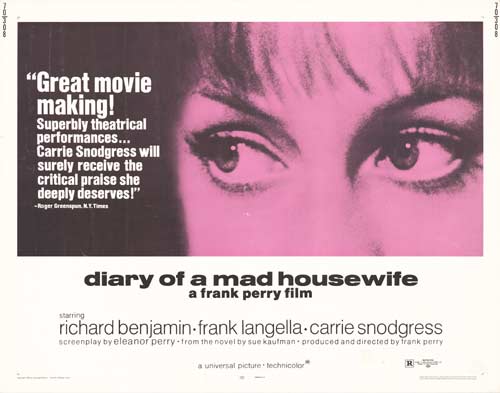
Diary of a Mad Housewife-1970

Diary of a Mad Housewife-1970

Director Frank Perry

Starring Carrie Snodgress, Frank Langella

Top 250 Films #86

Scott’s Review #189
MPW-36461

Reviewed November 5, 2014

Grade: A

The film version of Diary of a Mad Housewife (1970), based on the best-selling novel by Sue Kaufman, is a tremendous, unique story of one woman’s frustration with her irritating life.

A superb Carrie Snodgrass stars as a haggard, insecure, yet affluent housewife named Tina Balser, living in New York City with an unpleasant family.

The family is led by Tina’s verbally abusive and neurotic husband, Jonathan- a successful attorney, played flawlessly and instead comedically by Richard Benjamin, and her two brattish daughters, Sylvie and Liz.

Bored, Tina decides to embark on an affair with crude artist George Prager, wonderfully played by Frank Langella. She teeters on the edge of an emotional breakdown throughout the film and trudges through life depressed and disappointed with all aspects of her life except for her affair with George.

George, however, is a womanizer and openly has other conquests besides Tina.

The film’s brilliant idea is to tell the story strictly from Tina’s point of view. All of the action centers on her character, which makes the film so enjoyable.

On the surface, one might argue she has everything- she is intelligent, well-educated, and affluent. A stay-at-home mother, she is treated like a servant by her husband, Jonathan, as he constantly berates her appearance and criticizes her activities- she is always doing something incorrectly.

The film, though, is not a downer. It is a dry, satirical comedy that reminds me very much of a Woody Allen film. Tina is depressed, yes, but she goes through life with a realistic, almost chin-up, outlook. Her marriage to Jonathan is loveless, yet why doesn’t she leave him?

Her affair with George is sexually satisfying, but she has no intention of pursuing anything further with him, nor does he want to. Tina dotes on her husband- planning dinner parties, sending Christmas cards, and various other wife duties.

I’m not sure that the film’s true intent is to show Tina as either a strictly sympathetic character or as completely downtrodden- the film is not a moral tale nor is it a schmaltzy, woman victimized and will rise against the world’s generic drama- it is witty and filled with black humor.

Despite her unkind husband, I found myself, in a way, envying Tina’s life, and I think the film expects that of the viewer. I never got the impression that Tina was suicidal in any way.

It’s not that type of film.

Instead, she has wealth, and she goes to fancy restaurants, but she also has a very needy husband- he does not abuse her in a physical sense, nor is she reduced to tears by his outbursts.

She gets annoyed, merely accepts that this is the way life is, and gets by with an occasional swig of alcohol while doing dishes or preparing dinner, or when the dog has “an accident” on the living room rug and Tina’s kids cannot wait to tattle on her.

She is a sophisticated woman, trapped in an unhappy yet financially secure relationship.

Diary of a Mad Housewife is an interesting character study for all women to view and perhaps even slyly wink at.  Many women would champion Tina. She is a likable, sarcastic, fabulous chick. Audiences will find themselves drawn to her and even falling in love with her before long- I know I did.

Without the talents of Carrie Snodgrass, who completely carries this film, it would not be the wonder that it is. An excellent satire, the film is not as wry or satirical as the novel, but how many films are?

The novel delves deeper into the role of the Balsers’ maid, who is barely mentioned in the film, yet she plays a larger role in the Kaufman novel.

I loved the portrayal of Jonathan by Richard Benjamin, who must receive some honor for the most annoying character ever in the film when he repeatedly screams for his wife by bellowing “teeeenaaaaa!”, or initiating sex by asking “Would you like a little roll in dee hay?”, one wants to choke him.

The way Tina’s daughters whine “mudder” instead of “mother” is comically brilliant. And her simmering hatred of all of them is dark hysteria.

Diary of a Mad Housewife is a genius and should not be forgotten.

Oscar Nominations: Best Actress-Carrie Snodgress
Young Frankenstein-1974

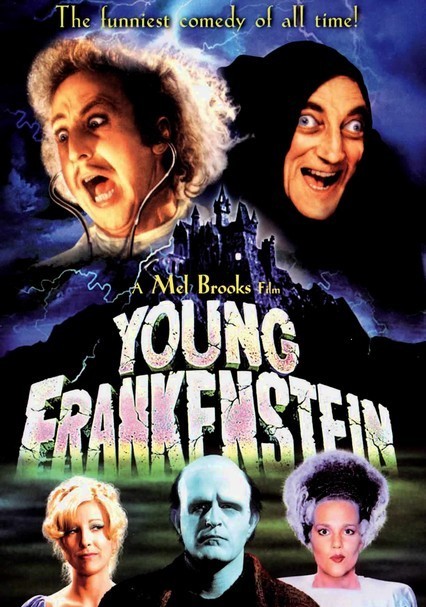
Young Frankenstein-1974

Director Mel Brooks

Starring Gene Wilder, Peter Boyle, Teri Garr

Scott’s Review #1,347

Reviewed February 27, 2023

Grade: A

Young Frankenstein (1974) is one of the funniest, most authentic examples of slapstick comedy done right. The physical timing, facial expressions, and dialogue delivery are sheer perfection from the well-known cast.

Many of whom are stars of the comedy genre.

The fact that director Mel Brooks took a classic horror film as distinguished as Frankenstein (1931), and made a cross-genre sequel, is pure brilliance.

Even better is the incorporation of black-and-white filmmaking resembling the 1930s masterpiece so the setting feels similar. This is aided by the recreation of the original set designer Kenneth Strickfaden’s lab equipment from the 1931 film. 

Brooks co-wrote the screenplay with star Gene Wilder, a comic legend, and the writing is brilliant crackling with wit and energy.

The 1970s film watched decades later has lost none of its original appeal holding up astoundingly well after most of the cast and director have left this world. It can be watched over the Halloween season for the proper atmosphere or at any time.

Ideally, recommended is to watch Frankenstein either before or after seeing Young Frankenstein for ideal pleasure.

Respected medical lecturer Dr. Frederick Frankenstein (Wilder) learns, much to his chagrin, that he has inherited his infamous grandfather’s estate in Transylvania, Romania.

The original Frankenstein’s reputation is so tarnished that Frederick wants nothing to do with the name even going so far as changing the pronunciation of his surname to “Fronkensteen”.

Begrudgingly arriving at the castle, Dr. Frankenstein soon begins to recreate his grandfather’s experiments with the help of servants Igor (Marty Feldman), Inga (Teri Garr), and the rigid Frau Blücher (Cloris Leachman).

After he creates his monster (Peter Boyle), a new set of complications ensue with the arrival of the doctor’s fiancée, Elizabeth (Madeline Kahn), and the unleashing of the frightening beast on the small town.

Comedy and horror are worlds apart but Brooks and Wilder pay respect and tribute to the classic horror film by not mocking it but instead embracing it and enhancing the story with Young Frankenstein.

You could say it’s a sequel in addition to a spoof made over forty years later.

The characters are the best part and each one is enveloped by its actor in fine form. Led by Wilder as the mad scientist, bug-eyed Igor (pronounced ‘Eyegor’ naturally) explained to be the grandson of Igor in Frankenstein, is a personal favorite of mine followed by Garr as the secret romantic interest for Wilder.

My favorite scenes are when Igor reveals that he took the wrong brain for Frankenstein’s experiment belonging to ‘Abby Normal’ instead of ‘Abnormal’ as the label read.

Inga and Frederick have instant chemistry leaving Kahn’s Elizabeth in the dust as far as a romantic triangle. Hilarity between the pair occurs in the final sequence when, after a lobotomy, she is delighted to realize that Frederick has received the monster’s “enormous Schwanzstucker”.

This is not to diminish Boyle, Leachman, or Kahn who each do their part to make Young Frankenstein an ensemble. Apt viewers will spot Gene Hackman in the role of Harold, the blind man.

As an aside, Brooks brilliantly pays tribute to Bride of Frankenstein (1934) by giving Elizabeth the same hairstyle.

The double entendre is fast and furious from knockers to the male anatomy.

The only scene that didn’t wow me was the sequence where Frankenstein and his creation perform “Puttin’ on the Ritz”. The monster singing and dancing was too amateurish for me but for some, it’s a favorite scene.

A parody that works on nearly every level and is the best of all the Brooks films (even barely usurping my forever fondness for 1977’s High Anxiety), Young Frankenstein (1974) is a treasure.

Silly, devoted, and creative, it revives a classic in only the best of ways and is filmmaking 101 in how to create a proper spoof.

Oscar Nominations:  Best Adapted Screenplay, Best Sound

The Friends of Eddie Coyle-1973

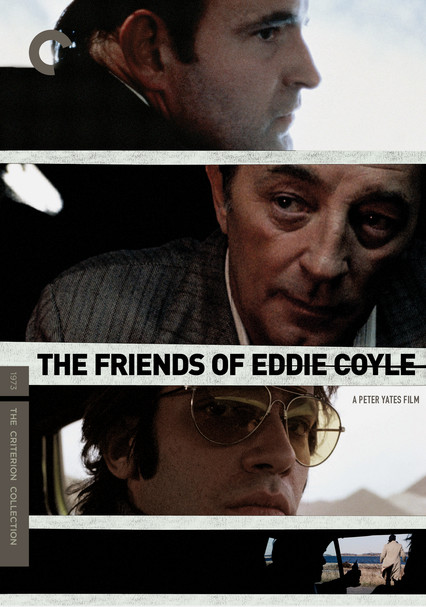
The Friends of Eddie Coyle-1973

Director Peter Yates

Starring Robert Mitchum, Peter Boyle

Scott’s Review #1,151

Reviewed June 11, 2021

Grade: B+

Borrowing heavily from the standard cop thriller films that emerged during the early 1970s but containing a unique cynicism and a point of view all its own, The Friends of Eddie Coyle (1973) is a taut and engaging crime thriller that will please fans of the genre but never bailing on those cinema fans seeking a more intellectual experience.

The Boston landscape is plentiful and a treat for fans of locale shoots and 1970s qualities.

A superior film based against the many similar films to be created during the decade, there is a moroseness that encompasses the experience. I felt sorry for the main character and The Friends of Eddie Coyle lacks a clear good guy versus bad guy standard. This helps the film.

What I’m trying to say is that those crime thriller fans desiring a clear hero or standard characterization might be unsatisfied or miss the point, though the bank robbery scenes alone are worth the price of a ticket.

Some say Robert Mitchum, cast in the title role gives his finest film performance but I wasn’t entirely blown away.  The film is an ensemble and at times Eddie Coyle feels like a supporting character.

Think Ma Rainey in Ma Rainey’s Black Bottom (2020).

Instead, I ruminated over his brilliant performances in my two favorite films of his, The Night of the Hunter (1955) and Ryan’s Daughter (1970).

His performance is fine but all the actors bring their A-game.

Aging low-level Boston gunrunner Eddie Coyle (Mitchum) is fearful of the possibility of several years of jail time for participating in a truck hijacking in neighboring New Hampshire. Having a wife and kids dependent on him, and feeling old and desperate, he volunteers to funnel information to Dave Foley (Richard Jordan), an ATF agent.

Eddie buys some guns from another gunrunner, Jackie Brown (Steven Keats), then gives him up to Foley, but the agent isn’t satisfied. Panicked, Eddie decides to also give up the gang of bank robbers he’s been supplying, only to find that Foley already knows about them, and the mob believes Eddie snitched.

These events do not bode well for poor Eddie who now has a mark on his back.

The Friends of Eddie Coyle has a handful of plots happening simultaneously. There is Eddie’s predicament, the saga of the bank robbers and the bank owners they put in peril, and a bartender played by Peter Boyle (of television Everybody Loves Raymond fame), who is also an informant.

The stories intertwine but sometimes not quite enough and a conclusion over how the players relate is sometimes unclear.

From the get-go, I was reminded of Dirty Harry (1971) which arguably propelled the cop/crime thriller/crime drama to mainstream audiences.

Dave Grusin gets credit for the music composition and creates a similar score to Dirt Harry with funky tempo, and time-relevant arrangements. They work and fit the times perfectly.

Differing from Dirty Harry, which is a superb film in many ways, is the messaging. Whereas, Dirty Harry professes a good vs. bad approach and a conservative pro-gun stance, The Friends of Eddie Coyle doesn’t partake in schooling the audience on the viewpoints of most cops.

The bad guys are complex and nuanced characters with worries and fears to wrestle with themselves.

The location sequences are plentiful and give the film authenticity and Boston appreciation. The classic Boston Garden is featured as two characters attend a Boston Bruins hockey game. The Charles River, downtown, and surrounding areas like Quincy are featured. Director, Peter Yates certainly creates a blue-collar, Irish-represented community.

Lovers of classic 1970s American automobiles will be in heaven. I spotted a Ford Galaxy, a Chevy Impala, and similar full-sized cars. One character drives a green muscle car. I mean, there are tons and tons of car sequences in this film.

With the seedy Boston underworld, a terrific performance by Robert Mitchum, and enough guns, car chases, and bank robberies to satisfy the action audience, The Friends of Eddie Coyle (1973) is a win.

The film didn’t stick with me as much as I would have liked but it’s a striking entry in the crime thriller genre.