Category Archives: James Wilby

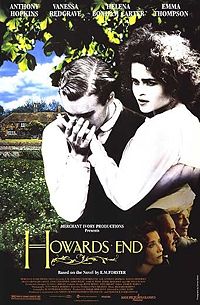
Howards End-1992

Howards End-1992

Director James Ivory

Starring Emma Thompson, Helena Bonham Carter, Anthony Hopkins

Top 250 Films #79

Scott’s Review #702
Reviewed December 1, 2017

Grade: A-

Howards End is my favorite film adaptation of E.M. Forster’s novel, which was also adapted into a film during the 1980s (1985’s A Room with a View and 1987’s Maurice are the other two notable works).

The novels were written during the early 1900s and set during the same period, focusing on class relations in 20th-century England.

The film is lovely and picturesque, telling an interesting story about romance and drama between the haves and have-nots during this period.

The film was a success and received heaps of Academy Award nominations in 1993.

Margaret Schlegel (Emma Thompson), an upper-middle-class intellectual and member of London’s bourgeoisie, befriends wealthy and sophisticated yet shockingly conservative Ruth Wilcox (Vanessa Redgrave).

The two women strike up a powerful friendship, which results in her beloved country home being left to Margaret when Mrs. Wilcox, ailing, dies.

To complicate matters, Margaret falls in love with a businessman (and husband of Ruth), Henry (Anthony Hopkins), while Margaret’s sister Helen briefly becomes engaged to Paul Wilcox (Joseph A. Bennett), Henry’s son.

The two families’ lives further intersect when they become neighbors in London, and the true owner of the beloved “Howards End” is questioned.

Added to the mix are several other characters of various social backgrounds, having connections to the families.

The writing in Howard’s End is rich and emotional, with each character perfectly fleshed out, including both supporting and lead characters.

Thompson and Hopkins, both sensational actors, have tremendous chemistry, and, unsurprisingly, Thompson won Best Actress in this competitive year.

Thompson carries the film seamlessly with her upper-middle-class ideals- not conservatively rich, but far from working-class- she epitomizes poise, grace, and empathy for those less fortunate than she.

Hopkins, on the other hand, is calculating and confident, yet charismatic and sexy as an old-school, controlling businessman.

Somehow, these two characters complement each other exceptionally well despite their varied background.s

The role of Helen may very well be Helena Bonham Carter’s finest. Not being an enormous fan of the actress, who is overrated and too brooding in my opinion, I enjoy portraying an interesting character in Helen.

Lovelorn and earnest, yet somewhat oblivious, she develops a delicious romance with the young clerk, Leonard Bast, my favorite character in the film.

Living with Jacky, a woman of dubious origins, he is the ultimate nice guy and sadly winds up down on his luck after heeding terrible business advice.

Bast, thanks in large part to actor Samuel West, who imbues his character with an innocent, good-guy quality, deserves major props.

The cinematography featured in Howards End is beautiful, with extravagant outdoor scenes- the lavish gardens of Howards End- just ravishing and wonderful.

Kudos, too, to the art direction, set design, and costume departments for making the film look so enchanting.

There is something so appealing about the look of this film, and director James Ivory undoubtedly deserves praise for pulling it all together into a suave picture. Whether the scene calls for sun or rain, tranquil or bustling, every scene looks great.

If I were to knock any points from this fine film, it would be at two hours and twenty-two minutes. Howards End drags ever so slightly, and many scenes involve the characters merely chatting with each other, with little action.

But this criticism is small potatoes when compared to the exceptional writing and well-nuanced character development displayed throughout the piece.

Admittedly, and perhaps shamefully, I have not read any of the Forster novel. Still, Howard’s End appears to be the film that is most successfully adapted, gleaming with textured finesse, grace, and style.

With the film’s finest actors along for the experience and intricate, fine storytelling, Howards End (1992) is a film well worth watching.

Oscar Nominations: 3 wins-Best Picture, Best Director-James Ivory, Best Actress-Emma Thompson (won), Best Supporting Actress-Vanessa Redgrave, Best Screenplay Based on Material Previously Produced or Published (won), Best Original Score, Best Art Direction (won), Best Cinematography, Best Costume Design

Independent Spirit Award Nominations: Best International Film
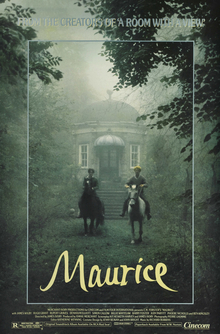
Maurice-1987

Maurice-1987

Director James Ivory

Starring James Wilby, Hugh Grant, Rupert Graves

Top 250 Films #111

Scott’s Review #14

Reviewed June 17, 2014

Grade: A

A brilliant film adaptation of E.M. Forster’s novel, set at Cambridge University at the turn of the twentieth century, it tells the story of oppression and the social norms of the time.

It is a gorgeously shot film, with beautiful landscapes, photography, and costumes.

Reminiscent of the British films “A Room with a View” and “Howard’s End”, it is a male love story set in a time when such sexuality was forbidden, and lives were ruined because of it.

The film’s characters make choices: some repress, others celebrate, with differing results. In the middle of it all is a beautiful love story.

Maurice (1987) is a timeless, brave treasure.

Oscar Nominations: Best Costume Design

A Room with a View-1986

A Room with a View-1986

Director James Ivory

Starring Helena Bonham Carter, Julian Sands

Scott’s Review #695

Reviewed November 3, 2017

Grade: B+

A Room with a View (1986) is one of four major films to be based on famed British author E.M. Forster’s novels- Howards End (1992) and A Passage to India (1986), and Maurice (1987) being the other three.

The foursome shares common elements, such as the vast English countryside and class distinctions, which lead to heartaches and passion.

In the case of A Room with a View, the film traverses from artistic Florence, Italy, to a cozy village in England.

The film is a period drama mixed with lots of authentic, unforced good humor, and at its core is a solid romantic drama, though, compared with the aforementioned other films, it is not quite on par.

It is still an entertaining watch, given the dismal year of cinema circa 1986.

The film was considered one of the best releases that year and received a handful of Oscar nominations, winning for Costume Design, Adapted Screenplay, and Art Direction.

Cultured and oftentimes brooding, Lucy Honeychurch (Helena Bonham Carter), goes on holiday to Florence with her rigid and conventional older cousin Charlotte (Maggie Smith), who also serves as her chaperone.

While enjoying the artistry of the European city, Lucy meets and falls madly in love with free-spirited George Emerson (Julian Sands), who is also visiting Florence with his easy-going father, Mr. Emerson (Denholm Elliott).

The men seem oblivious to Lucy’s (and Charlotte’s) Victorian-era upbringing, which attracts Lucy and appalls Charlotte.

Months later, the would-be lovers reunite in England and spend time overcoming obstacles that threaten their love, while admitting to themselves that it is blossoming.

As Lucy has become engaged to snobbish Cecil Vyse (Daniel Day-Lewis), a sophisticate deemed suitable by her family to marry Lucy, the pair lacks the romantic connection that she shares with George.

Day-Lewis, on the cusp of becoming a breakout star and a brilliant talent, gives Cecil a somewhat comical yet endearing persona that makes him the main foil while also breathing sympathy into the character. This is especially evident during the Lucy/Cecil break-up scene.

The standout performance in A Room with a View is the comic brilliance of Smith as the manipulative and witty Charlotte Bartlett, evident throughout.

Smith injects vigor and comic wit into her character, as Charlotte seemingly makes one blunder after another, using her self-deprecating manner to her advantage to humorously manipulate other characters into doing things her way.

A risqué and quite hysterical all-male frontal nudity scene occurs mid-way through the film and, while not advancing the plot in any way, steals the entire film in its homoerotic and free-spirited way.

As the Reverend, young George, and Lucy’s energetic brother, Freddy, walk along a beautiful path, they decide to skinny-dip in a pond, where they horseplay and wrestle completely in the buff.

As they chase each other around the pond, grab each other, and lightly smack bottoms, one cannot help but wonder if this scene set the tone for 1987’s gay-themed period piece based on another E.M. Forster novel, called Maurice.

A coincidence? I think not. As the trio of rascals comes upon the properly dressed girls on the path, hilarity ensues.

The art direction and costumes are of major excellence in A Room with a View, as the film “looks” like a 1910 rather than 1986, with the actors donning early twentieth-century styles.

Every scene is a treat from this perspective, as we wonder who will wear what next.

As with the other aforementioned E.M. Forster films, class distinctions and expectations are a major element in A Room with a View and make Lucy and George all the more likable as a couple.

Still, overall, there is something slightly amiss in the story department.

I did not find Helena Bonham Carter, an actor I like, overall very compelling as Lucy, and I think this leads to the story being slightly less than it might have been with another in the role.

We may root for Lucy and George, but if the pair do not wind up together, it is more of a pity rather than a travesty.

To summarize A Room with a View, the story is good, not great, and other key components to the film are much better than the central love story of Lucy and George, but are therefore secondary to the main action.

Given a Charlotte romance, the film’s best character would have catapulted it to an exceptional grade. Imagine the possibilities.

Or more of the two, Miss Alan’s and their gossipy nature, or even a story of the rugged nude horseplay among men.

Many of the aspects that could have made A Room with a View (1986) great were too often on the sidelines.

Oscar Nominations: 3 wins-Best Picture, Best Director-James Ivory, Best Supporting Actor-Denholm Elliott, Best Supporting Actress-Maggie Smith, Best Screenplay Based on Material from Another Medium (won), Best Art Direction (won), Best Cinematography, Best Costume Design (won)