Tag Archives: Divine

Polyester-1981

Polyester-1981

Director John Waters

Starring Divine, Tab Hunter, Edith Massey

Scott’s Review #1,527
Reviewed April 6, 2026

Grade: A-

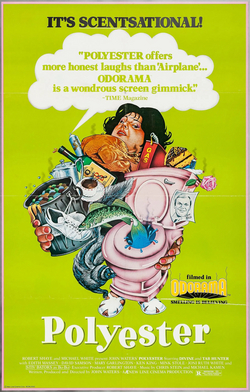
Polyester (1981) is the film that brought raunchy director John Waters to the mainstream, some well-deserved respectability, and what better timing than the 1980s, a time of conservatism.

To many, the film is vile, outlandish, raunchy, and numerous other adjectives, steering many viewers away from even seeing it. But compared to his earlier works of filth, such as Pink Flamingos (1972) and Female Trouble (1974), Polyester is quite tame and accessible.

In fact, the film is one of New Line Cinema’s earliest releases.

I see Polyester as a bridge between his early 1970s works and the sentimentality of his later works.

Waters’ stalwarts like Divine, Edith Massey, Mink Stole, and others return to the fold to wreak havoc on virgin film goers who may not be familiar with his dark comic situations.

An attention-grabbing gimmick called Odorama, in which moviegoers can smell what they are viewing on-screen using special scratch-and-sniff cards, is a unique add-on to the film.

Scents like roses, pizza, and farts are a few examples.

In the story, a frustrated middle-class housewife, Francine Fishpaw (Divine), tries to maintain her sanity while managing her dysfunctional household. Her husband, Elmer (David Samson), the owner of a controversial adult theater, is sleeping with his secretary, Sandra (Mink Stole).

Meanwhile, her delinquent teen son, Dexter (Ken King), and pregnant teen daughter, Lulu (Mary Garlington), have problems of their own.

But when Francine meets handsome and wealthy Todd Tomorrow (Tab Hunter), the owner of a theater specializing in art films, her life takes a positive turn.

The biggest change from Waters’ previous works, which were always set in his hometown of Baltimore, is that the setting is a more upscale suburban neighborhood rather than the rank slums of downtown.

The Fishpaws reside in a powder blue house with a paved driveway and shutters. While not a mansion, it’s respectable, and they forge a decent lifestyle. Francine dreams away the days while dutifully cooking and cleaning for her husband and fixing his evening cocktail, while enduring jokes about her weight.

The story is told from Francine’s perspective, and she is joined by her best friend and former maid, Cuddles (Massey), who is now wealthy after an enormous sum of money was left to her by a former client.

The ladies chat over fattening cake, discussing Francine’s numerous problems and her scheme to catch her philandering husband in the act of cheating.

Francine’s pale blue phone rings constantly with one nuisance after another.

The film is a satire of suburban life in the early 1980s, involving topics such as divorce, abortion, adultery, alcoholism, racial stereotypes, foot fetishism, and the religious right.

Naturally, in wacky form.

My favorite sequence comes when a religious right group prances around Francine’s house protesting Elmer’s pornographic theatre. When one woman smacks Francine, she proudly proclaims, ‘That’s from Jesus.

Later, when on a shopping trip to try on dresses with Cuddles, a hungover Francine pukes in her handbag to the horror of a stuffy saleswoman.

It makes a mockery of religion, particularly Catholicism, as when wicked nuns enter the story in relation to a pregnant Lu-Lu. Shown as ridiculous, they are able to ‘reform’ Lu-Lu into the straight and narrow.

Polyester is filled with terrific moments tamer than Pink Flamingos and Female Trouble, but nonetheless laugh-out-loud and raucous.

For those curious about a John Waters film, left of center from the normal yet important Hairspray (1988), but still nicely subversive, Polyester (1981) is a great choice.

Pink Flamingos-1972

Pink Flamingos-1972

Director John Waters

Starring Divine, David Lochary, Mink Stole

Top 250 Films #165

Scott’s Review #359

70032618

Reviewed January 9, 2016

Grade: A

One of the truest and best late-night gross-out films of all time, Pink Flamingos (1972) breaks down barriers I never thought possible in film and contains one of the most vomit-inducing scenes ever to grace the movies.

The film is certainly one of a kind and will only be appreciated by a certain type of film-goer. Pink Flamingos is raw, entertaining, and must be seen to be believed.

Outrageous in every way and shot in a documentary style, the film features weird close-ups and amateurish camera angles, only adding to the fun.

I love the film.

In what director John Waters famously dubbed the “Trash Trilogy”, along with similar films Desperate Living and Female Trouble, Pink Flamingos has the dubious honor of being the best of the three.

Waters’ stalwart, Divine, plays Babs Johnson, an underground criminal who lives a meager existence in a trailer with her mentally challenged son, Crackers, and her bizarre, egg-obsessed mother, Edie (Massey). Babs’s companion, Cotton, joins them.

In an attempt to win the “Filthiest Person Alive” contest and usurp Babs from achieving this distinction. The Marbles (Mink Stole and David Lochary) set out to destroy her career.

Pink Flamingos is complete and utter over-the-top fare, but I have fallen in love with the film over the years.

Let’s say it is a type of film that is an acquired taste, and one will eventually revel in the madness or be disgusted with its bad taste.

Waters, a truly creative person, breaks new ground in filth. On a budget of no more than $10,000, it is impressive how he pulled this off.

The antics that Babs and the Marbles engage in are downright crude, but the extreme nature of the fun is exactly what is to love about the film. Hysterical is the character of Babs’s mother, Edie.

Confined to a crib and constantly inquiring about the Egg Man, she is obsessed with eggs and wants to eat nothing else. She eventually marries the Egg Man. The character is entertaining beyond belief.

The Marbles run a clinic in which they sell stolen babies to lesbian couples for cash.  When they send Babs a box of human excrement and a card that says “fatso”, the war between the two sides is on.

The highlight of the film is the main sequence in which Babs holds a birthday party. A male contortionist flexes his anus in rhythm to the song “Surfin’ Bird”, which may be the only film featuring an anus.

How Waters got away with some of this stuff is mind-blowing.

The most disturbing scene occurs at the very end, when Babs watches a dog do “its business” on the street and then picks up the excrement and eats it, revealing to the audience a toothy (and brown) smile.

Reportedly, Divine did this act. As the film ends, Babs truly is “The Filthiest Person Alive”.

Thanks to the genius of John Waters and Divine, and the superlative supporting cast, Pink Flamingos (1972) is a reminder that creativity and unique humor need not conform to a specific style or follow a road map.

Waters throws out any film criteria, instead creating a masterpiece of warped fun and disgust.

Female Trouble-1974

Female Trouble-1974

Director John Waters

Starring Divine, David Lochary, Mary Vivian Pearce

Top 250 Films #168

Scott’s Review #146

70032612

Reviewed August 4, 2014

Grade: A

Female Trouble (1974) is a deliciously naughty treat by the famous Independent film legend, John Waters.

Not exactly family-friendly, it is a gem for those desiring more left-of-center fare with depravity and gross-out fun mixed in for good measure.

The film’s theme is “crime is beauty,” and it is dedicated to Manson family member Charles “Tex” Watson.

Meant for adult, late-night viewing, the film tells the story of female delinquent Dawn Davenport, who angrily leaves home one Christmas morning after not receiving her desired cha-cha heels as a Christmas present.

Her parents, religious freaks, disown her, and she is left to fend for herself on the streets of Baltimore.

The film then tells of her life story of giving birth and subsequently falling into a life of crime in the 1960s.  Her friends Chicklet and Concetta are in tow as they work various jobs and embark on a career of theft.

Female Trouble stars Waters’ regulars Divine, Mink Stole, Edith Massey, Cookie Mueller, and others.

Interestingly, Divine plays a dual role- Dawn Davenport (in drag, of course) and also the father of her bratty child, Earl Peterson.

Dawn and Earl have a less-than-romantic interlude on a dirty mattress on the side of the road when he picks her up hitchhiking, which results in the birth of Taffy.

Also featured is the hilarious feud between Dawn and her love interest’s (Gator) Aunt Ida, as the women engage in tactics such as acid throwing and chopping off of limbs as they constantly exact revenge on each other.

Favorite scenes include Dawn’s maniacal nightclub act, in which she performs an acrobatic routine and then begins firing a gun into the crowd. Another is of Dawn’s dinner party with Donald and Donna Dasher- serving a meal consisting of spaghetti and chips, Taffy’s tirade hilariously ruins the evening.

This film is not for the prudish, squeamish, or uptight crowd, but a ball for all open-minded, dirty fun-seekers. The film contains one over-the-top, hilarious scene after another.

The line “just cuz you got them big udders don’t make you somethin’ special” is a Waters classic.

Female Trouble is one of a series of outrageous cult classics featuring the legendary camp star Divine.

Not meant to be overanalyzed, or some might say, analyzed at all, Female Trouble (1974) is unabashedly trashy and makes no apologies for its outrageousness.

Hairspray-1988

Hairspray-1988

Director John Waters

Starring Ricki Lake, Divine

Top 250 Films #170

Scott’s Review #130

60025089

Reviewed July 23, 2014

Grade: B+

Hairspray (1988) is one of director John Water’s later and much more mainstream comedies.

Influencing the Broadway musical of the same name that was created years later and inspiring a successful remake in 2007, the film is a wonderful watch one late at night accompanied by spirits.

It is fun, fun, fun.

The film tells the story of a cute, yet insecure, overweight teenager named Tracy Turnblad, wonderfully portrayed by Rikki Lake. Tracy lives in Baltimore in the racially conflicted 1960s, and she battles to appear on a local talent show.

With Waters directing, one might expect comedic raunchiness, but Hairspray is quite tame. It is the only Waters film to be rated PG, the others are rated X.

Not to be outdone, however, Hairspray does contain its share of light naughtiness.

The film itself, while campy and over the top, is important since it does its best to break down racial barriers, including interracial relationships, and sends an important message.

Tracy and her best friend Penny Pingleton judge people for who they are, not on race, income, or anything else.

Those characters in Hairspray who are written as racist or less than welcoming to interracial cohabitation (again the film is set in the early 1960s) look like buffoons and not with the progressive social times.

The supporting cast is high caliber- Divine and Jerry Stiller are perfectly cast as Tracy’s open-minded yet cautious and concerned parents.

Famous musicians appear in cameos- most notable are Debbie Harry, Ric Ocasek, and Sonny Bono in small but zesty roles.

The musical dance numbers are plentiful and perfectly fit the time of the film.

Hairspray (1988) is entertaining, relevant, and free with a powerful message mixed in with the entertainment.

Independent Spirit Award Nominations: Best Feature, Best Director-John Waters, Best Female Lead-Ricki Lake, Best Supporting Male-Divine, Best Supporting Female-Debbie Harry, Best Screenplay