Tag Archives: Ruben Östlund

Triangle of Sadness-2022

Triangle of Sadness-2022

Director Ruben Östlund

Starring Harris Dickinson, Charlbi Dean, Woody Harrelson

Scott’s Review #1,374
Reviewed July 2, 2023

Grade: A

When I realized the director of Triangle of Sadness (2022) had directed Force Majeure (2014) and The Square (2017), I became very interested in seeing it.

I’m not sure I ultimately ‘got’ The Square, but Force Majeure was a thought-provoking slice of cinematic brilliance that I still think about from time to time.

Sure, Triangle of Sadness was rewarded with three Academy Award nominations, which it deserved. Still, Ruben Östlund has a knack for challenging his audience to think outside the box, both cinematically and otherwise, with a robust examination of social classes.

He crafts a subject matter about class systems and the haves and have-nots that has been explored in film many times before. But, in Triangle of Sadness, it feels fresh and fraught with many different possible directions.

The wicked dark comedy explores political talking points such as capitalism, communism, and socialism, and challenges conventional ways of thinking.

It’s on par with the popular HBO series The White Lotus, but on steroids.

I cannot recommend the film more highly, primarily geared toward those seeking expressive and deeply textured films with some meaning.

Despite the dreary title, it’s far from a dour experience. There are quite a few laugh-out-loud moments, especially in scenes featuring severe vomiting amid seasickness.

The rich and famous embark on a luxury cruise with fine dining and servants galore. But after a devastating storm leaves several passengers and staff stranded together on a deserted island, the power exchange begins to shift, and the social hierarchy is turned upside down.

Events mainly surround a celebrity model couple, Carl (Harris Dickinson) and Yaya (Charlbi Dean), who are invited on the luxury cruise for promotional purposes. Yaya is a social media influencer.

They are joined by a Russian oligarch, Dimitry, and his wife, Vera, as well as an elderly couple, Clementine and Winston, who have made their fortune manufacturing grenades and other weapons. Therese, a wheelchair user only capable of speaking a single phrase in German following a stroke, and Jarmo, a lonely tech millionaire who flirts with Yaya.

Besides possibly Therese, there is no a sympathetic rich character to be found.

The yacht staff are more sympathetic, although we don’t get to know all the characters very well.

Highlights include the head of staff, Paula, who demands that the staff obey the guests without question, Abigail, a cleaning woman, and the yacht’s captain, Thomas Smith (Woody Harrelson), who spends his time drunk in his cabin and despises the absurdity of the guests’ wealth.

The main events on the ship take a while to get to, and the film is divided into chapters. Part 1: Carl and Yaya, Part 2: The Yacht, and Part 3: The Island.

I realized after the fact that the point of the slow build is to show the dynamic between Carl and Yaya, the main characters. Both models and living life based on their looks, they are wildly insecure, bickering over money and gender roles.

While not likable nor complete assholes either, enjoyable is a chance to get a fleshed-out perspective on where they are coming from.

My adoration for the film largely stems from not knowing what is going to happen but knowing that at some point the shit is going to hit the fan.

The setup is perfect, especially the put-upon staff. While they are not abused, the relationship is clear. The passengers are in a position of power; the staff is not.

This will soon change.

Late in the game, I unexpectedly found myself rooting for a minor character who takes center stage in the last chapter, turning events upside down.

Comparisons can also be found in the recent Best Picture winner Parasite (2019) and classic international films such as Swept Away (1974) and L’Avventura (1960).

These are all brilliant films, and my hunch is that Triangle of Sadness (2022) will hold up well, perhaps achieving even greater acclaim as the years go by.

Oscar Nominations: Best Picture, Best Director-Ruben Östlund, Best Original Screenplay
The Square-2017

The Square-2017

Director Ruben Östlund

Starring Claes Bang, Elisabeth Moss

Scott’s Review #814

Reviewed September 28, 2018

Grade: B+

The Square (2017) is an eccentric, highly interpretive Swedish-language film that does not always make perfect sense, as a more mainstream film would.

This is both a positive and a negative, as the film’s ultimate message is admirable, though some parts are perplexing and downright bizarre.

The film was undoubtedly commended for its bravery and cutting-edge approach and received an Oscar nomination for Best Foreign Language Film—subsequently, it lost to A Fantastic Woman (2017).

The film’s primary setting is the X-Royal Art Museum in Stockholm, Sweden. The action centers mainly around the museum’s new creative director, Christian (Claes Bang), attempting to introduce a new installation called “The Square.”

A misunderstanding with a youthful public relations firm hired to make the exhibit as accessible as possible leads to controversy.

The film also interjects various subplots that are generally interesting but do not always make logical sense.

Bang is quite compelling in the lead role and the film’s best part for me. He is charismatic and a good father to his two daughters. He helps people experiencing homelessness- even going so far as to help a young woman when nobody else will, only to find his wallet stolen- an unfortunate victim of a scam.

Furthermore, Christian’s desire to create “The Square” is humane and admirable- a safe zone for trust and compassion. The character is a good guy but is also concerned with his status.

Common themes of satire and human beings’ natural hypocritical nature abound. For example, in one scene, Christian, proud to drive his flashy Tesla car and give money to the homeless, is afraid to be seen in a run-down apartment house.

Later, a man with Tourettes syndrome disrupts an interview at the museum and is looked down on by “open-minded people” as a result. The latter scene is quite amusing as the man erupts with various expletives at the most inopportune times.

My favorite sequence occurs approximately midway through the film. As bizarre as the scene, it is riveting in its momentum and bravery.

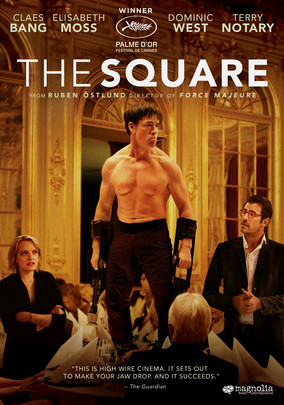
When a group of well-dressed museum members gathers for a lavish dinner to watch a human art show, a bare-chested man who only grunts emerges and slowly antagonizes guests.

He begins pulling one woman’s hair while chasing an angry man from the hall. This scene is shocking, intense, and thought-provoking.

But what the scene means is perplexing.

A treat for me was viewing the famous Stockholm museum’s frequent interior and exterior scenes- which I was privy to have visited in 2016.

This experience was so fresh that it brought back wonderful memories of not only the museum but also the gorgeous city of Stockholm itself.

The chemistry between Christian (who is Swedish) and an American reporter, Anne (Elisabeth Moss), does nothing for the film. It feels wholly disjointed and unnecessary, and there is little connection between the two characters.

Engaging in a one-night stand, the duo has a dispute about a used condom. Does Christian think that Anne is desperate enough to use his sperm and impregnate herself? The resulting spat between the two seems meaningless.

The Square (2017) is a very tough film to review.

Oftentimes disjointed and impossible to make heads or tails of, one would be wise to simply “experience” the film on its own merits. I am not sure.

I mainly need to view it again and try to figure out the plot because I am uncertain if that was the intent of director Ruben Oslund.

Having directed the wonderful Force Majeure (2014), a more straightforward and superior film, The Square is worth a watch in its own right.

Oscar Nominations: Best Foreign Language Film

Force Majeure-2014

Force Majeure-2014

Director Ruben Östlund

Starring Johannes Bah Kuhnke, Lisa Loven Kongsli

Scott’s Review #280

80007252

Reviewed October 4, 2015

Grade: A

As a huge fan of foreign language films, I was delighted to stumble upon this inventive and thought-provoking treat Force Majeure (2014).

A Swedish film set in the Alps of eastern France, the film is a family drama that is powerful, emotional, and especially psychological. The best films leave you absorbed in thoughtful conversation or introspection, and this film successfully did both for me.

Tomas (Johannes Bah Kuhnke) and Ebba (Lisa Loven Kongsli) are an attractive couple in their mid-thirties vacationing with their two young children, Vera and Harry. Everyone is excited about the holiday as Tomas is away from work for a full week.

They are a family of affluence and sophistication based on the luxurious mountaintop hotel they stay in.

However, there is a subdued level of tension among them.

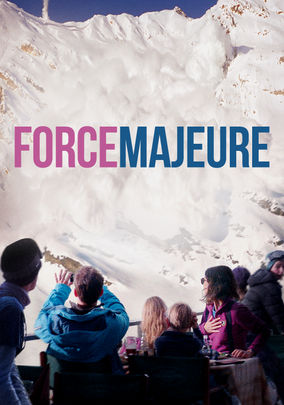
On the second day, they enjoy lunch at the hotel on an outdoor patio along the snowy mountainside. As a controlled avalanche begins to head their way there is suddenly panic as everyone flees for safety.

The avalanche is feared out of control, but thankfully only mist, and everyone safely returns to lunch.

However, Tomas’s instinctual reaction to the terror sets off a wave of debate for the remainder of the film. The family experiences a range of emotions and subsequently engages their friends in the conflict as they discuss and analyze the event.

The heart of the film is Ebba’s rage and Tomas’s guilt.

What I adore most about this film is its intelligence. It is smart and well-written. From a pacing perspective, it is slow and may turn some viewers off.

Simple scenes feature the family brushing teeth or napping- scenes in which not much happens.

But the intense psychological aspect lying beneath the surface makes up for these uneventful scenes. Smart dialogue between characters is my favorite. Ebba sits in the lobby sipping a drink with her friend, a sophisticated, promiscuous woman, who is vacationing alone to get a break from her husband and children.

She picks up men for fun and has no hang-ups about it. This particular scene is laced with interesting discussion. Ebba cannot understand her friend’s life choices and freedom and reveals that she is afraid of being left alone- she comes across as judgmental and insecure whereas the friend is confident and secure.

It is a “coffee talk” moment but reveals so much about the characters.

Later, Tomas and Ebba chat with their friends Matts and Fanni. When the discussion turns to the avalanche experience, the situation is analyzed by Matts, leading to tension for all. Matts sides with Tomas, whereas Fanni sympathizes with Ebba.

The disagreement stays with Matts and Fanni throughout the night as they reveal their conflict and put themselves in the other couple’s shoes.

Towards the end of Force Majeure events become strange as Matts and Tomas embark on a relaxing guy’s day out on the ski slope. As they sip drinks and listen to music an attractive female flirtatiously tells Tomas that her friend thinks he is the sexiest man she has ever seen.

Tomas feels like a million bucks and the audience is happy for him- however, the woman quickly returns and informs them that she was mistaken and her friend was referring to another man.

This escalates into a near fight and little dialogue is used throughout the scene. Rather, expressions are widely used. Later, a bizarre scene involves Tomas being accosted by frat boys and forced to guzzle beer- is this imagined or real?

We never find out.

Force Majeure is a spectacle. Scenes of the crisp, white, cascading snow are beautiful. The avalanche scene is amazing and creepy as the snow rapidly comes into view and gets closer and closer to the diners.

Will they be killed we wonder? The climactic scene as the departing vacationers travel by bus down a windy road is quite scary as the inept bus driver has difficulty navigating the bus. Will it crash killing everyone? Is he purposely driving recklessly on a suicide mission? The looming mountainside to the bottom is frightening and fascinating.

Intellectual, curious, and bizarre, Force Majeure (2014) is an international film worth checking out for a unique, cerebral experience.

Independent Spirit Award Nominations: Best International Film