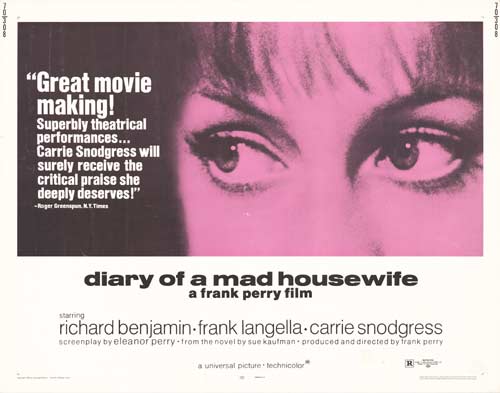
Diary of a Mad Housewife-1970
Director Frank Perry
Starring Carrie Snodgress, Frank Langella
Top 250 Films #86
Scott’s Review #189
Reviewed November 5, 2014
Grade: A
The film version of Diary of a Mad Housewife (1970), based on the best-selling novel by Sue Kaufman, is a tremendous, unique story of one woman’s frustration with her irritating life.
A superb Carrie Snodgrass stars as a haggard, insecure, yet affluent housewife named Tina Balser, living in New York City with an unpleasant family.
The family is led by Tina’s verbally abusive and neurotic husband, Jonathan- a successful attorney, played flawlessly and instead comedically by Richard Benjamin, and her two brattish daughters, Sylvie and Liz.
Bored, Tina decides to embark on an affair with crude artist George Prager, wonderfully played by Frank Langella. She teeters on the edge of an emotional breakdown throughout the film and trudges through life depressed and disappointed with all aspects of her life except for her affair with George.
George, however, is a womanizer and openly has other conquests besides Tina.
The film’s brilliant idea is to tell the story strictly from Tina’s point of view. All of the action centers on her character, which makes the film so enjoyable.
On the surface, one might argue she has everything- she is intelligent, well-educated, and affluent. A stay-at-home mother, she is treated like a servant by her husband, Jonathan, as he constantly berates her appearance and criticizes her activities- she is always doing something incorrectly.
The film, though, is not a downer. It is a dry, satirical comedy that reminds me very much of a Woody Allen film. Tina is depressed, yes, but she goes through life with a realistic, almost chin-up, outlook. Her marriage to Jonathan is loveless, yet why doesn’t she leave him?
Her affair with George is sexually satisfying, but she has no intention of pursuing anything further with him, nor does he want to. Tina dotes on her husband- planning dinner parties, sending Christmas cards, and various other wife duties.
I’m not sure that the film’s true intent is to show Tina as either a strictly sympathetic character or as completely downtrodden- the film is not a moral tale nor is it a schmaltzy, woman victimized and will rise against the world’s generic drama- it is witty and filled with black humor.
Despite her unkind husband, I found myself, in a way, envying Tina’s life, and I think the film expects that of the viewer. I never got the impression that Tina was suicidal in any way.
It’s not that type of film.
Instead, she has wealth, and she goes to fancy restaurants, but she also has a very needy husband- he does not abuse her in a physical sense, nor is she reduced to tears by his outbursts.
She gets annoyed, merely accepts that this is the way life is, and gets by with an occasional swig of alcohol while doing dishes or preparing dinner, or when the dog has “an accident” on the living room rug and Tina’s kids cannot wait to tattle on her.
She is a sophisticated woman, trapped in an unhappy yet financially secure relationship.
Diary of a Mad Housewife is an interesting character study for all women to view and perhaps even slyly wink at. Many women would champion Tina. She is a likable, sarcastic, fabulous chick. Audiences will find themselves drawn to her and even falling in love with her before long- I know I did.
Without the talents of Carrie Snodgrass, who completely carries this film, it would not be the wonder that it is. An excellent satire, the film is not as wry or satirical as the novel, but how many films are?
The novel delves deeper into the role of the Balsers’ maid, who is barely mentioned in the film, yet she plays a larger role in the Kaufman novel.
I loved the portrayal of Jonathan by Richard Benjamin, who must receive some honor for the most annoying character ever in the film when he repeatedly screams for his wife by bellowing “teeeenaaaaa!”, or initiating sex by asking “Would you like a little roll in dee hay?”, one wants to choke him.
The way Tina’s daughters whine “mudder” instead of “mother” is comically brilliant. And her simmering hatred of all of them is dark hysteria.
Diary of a Mad Housewife is a genius and should not be forgotten.
Oscar Nominations: Best Actress-Carrie Snodgress