Ex Machina-2015

Ex Machina-2015

Director Alex Garland

Starring Domhnall Gleeson, Alicia Vikander, Oscar Isaac

Scott’s Review #410
80023689

Reviewed June 17, 2016

Grade: B+

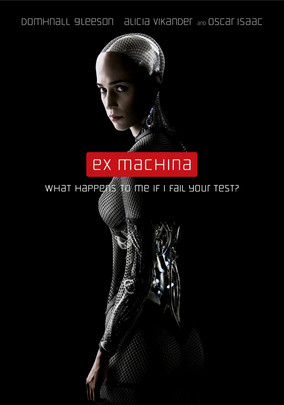
Ex Machina (2015) reminds me of another recent science-fiction film, Her (2013), with more of a female empowerment edge. The latter is more of a romantic drama with undercurrents of love.

In contrast, Ex Machina has a cynical tone and elements of imprisonment and psychosis, even narcissism.

The film features excellent visual effects and a futuristic mystique, making it a successful treatment.

Directed by first-timer Alex Garland, who could very well be a director to watch rise the ranks with subsequent projects.

Young, fresh-faced computer programmer, Caleb Smith (Domhnall Gleeson), wins a week-long trip to remote Alaska, to spend it with his mysterious boss, Nathan Bateman (Oscar Isaac), the CEO of a software company.

Caleb must arrive at the luxurious, sprawling estate via helicopter as it is in a deserted area of the world and exists on mile after mile of the gorgeous landscape.

Nathan, played by Oscar Isaac, is both charismatic and creepy. He lives alone save for a beautiful Asian servant named Kyoko, who speaks no English, and a female robot named Ava (played by rising star Alicia Vikander).

Caleb’s assigned task is to study Ava and determine whether he can relate to her as a human while knowing she is a robot. It is soon revealed that Nathan plans to reprogram Ava, thereby killing her. Caleb schemes to rescue Ava, but is all that it seems?

With a cast of only four principals, it is not difficult to assess each character and their relations with each other. Caleb is the least complex of the four or rather, the one with motivations readily apparent.

The others are shrouded in mystery. Caleb expects a fun getaway but instead finds himself amid experimentation. Is Nathan’s desire to perform psychological tests on Ava, by way of Caleb, genuine?

The audience can sense immediately that there is something off about Nathan. Merely in his thirties, how could he amass such financial success so soon?

Why is he, a servant, and a robot the only inhabitants? Why does the helicopter pilot refuse to venture further than the drop-off point?

Some of these questions are answered, some remain unanswered. It is part of what makes the film mysterious and complex. Could Ava be the one doing her share of experimentation or manipulation?

Alicia Vikander deserves much praise for her role as Ava and some would argue that the talented young actress should have won the Best Supporting Actress trophy for this role instead of for The Danish Girl (2015).

I’m not sure I would leap to the same conclusion, but she does amass a ton of subdued emotion as Ava. She is complex and profound. She longs for exposure to the outside world and would love to cross a crowded street to see all the faces and different types of people.

Like Nathan, there is also something not right about Ava.

Is she calculating or simply soulful? But how can she be, she is a robot.

I compared her to another famous film robot/computer- HAL from 2001: A Space Odyssey (1968).

Along with Vikander, Isaac steals the film in a role that mixes creep with genius. He sits around his estate in comfy clothes a blue-collar man might wear drinking beer and studying Ava. He has sexual relations with his servant and she is expressionless.

He does not treat her well so we do not root for his character. At the same time, his character is tough to read. Is he experimenting on Ava or Caleb?

Visually, Ex Machina has a sleek blend of modern, crisp CGI, not at all usurping the story. There is also a scene of bloodletting that chills as much as any good horror film would.

Garland was heavily influenced by 2001: A Space Odyssey and Altered States (1980) and made the film with as little budget as possible and without outside influences that might change his vision.

I commend this and wish more filmmakers would follow suit.

Ex Machina (2015), while perhaps not perfect, could be a blueprint for what is to come from this young director.

Oscar Nominations: 1 win-Best Original Screenplay, Best Visual Effects (won)
Gett: The Trial of Vivian Amsalem-2014

Gett: The Trial of Vivian Amsalem-2014

Director Ronit Elkabetz, Shlomi Elkabetz

Starring Ronit Elkabetz, Simon Abkarian

Scott’s Review #409

80013601

Reviewed June 9, 2016

Grade: B+

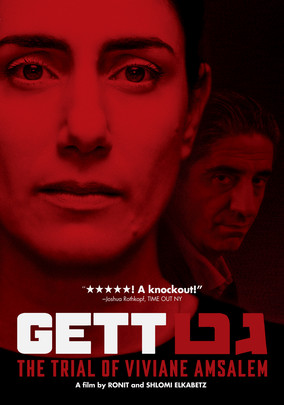
Gett: The Trial of Vivian Amsalem (2014) is the third in a trilogy of films focusing on the title character Vivian Amsalem and her unhappy marriage to her husband, Elisha.

The unhappiness is hers and he sees no reason to end the marriage.

It is a film about culture, religion, and modern views versus traditional ones.

I was unaware the film was a trilogy until after I finished watching and began conducting some research as I prepared to review it. It is not required to view the first two films  (To Take A Wife and Shiva) to enjoy this film as I suspect they are each a chapter not continuations.

Vivian is a tall, beautiful woman, though she is weary and haggard when we first lay eyes on her in the stifling courtroom, where she sits and spends much of her time. She has long dark hair and intense eyes- she appears driven and quite modern and of liberal thinking, a feminist perhaps.

She is frustrated because her yearning for an independent life has been thwarted by her husband. She would like a divorce after over twenty years. Having met him at age fifteen, his is the only life she has known.

Since he will not agree to the divorce, the courts will not grant her the decision she wants. Since he has not abused her and gives her everything she desires, the judges have no grounds to grant her the divorce.

This is the conflict of the film.

Gett: The Trial of Vivian Amsalem has a clear religious message, which is an interesting component for an American viewer.

How simple it is to divorce somebody in Western civilization and how different the measure is in Israel. Jewish religious law is quite restrictive.

Vivian faces an enormous ordeal. She does not love her husband yet cannot end her loveless marriage. The film is fraught with a clear conflict and one’s interpretation of right and wrong.

Almost set as a play since the film has merely one set- the courtroom- this aspect is effective at showing frustration, exasperation, and even rage.

All the while, Gett, has a sly sense of humor, and I could not help but smirk at a few of the supporting character portrayals.

I sensed a Pedro Almodovar (a famous Spanish director) influence in the quirky, sly writing, and his themes of political freedom.

Character after character is called into the courtroom to testify as witnesses to Vivian and Elisha’s happy marriage- each attorney looking for evidence to cement their client’s point of view.

In contrast, to Vivian’s fierce independence, a mature neighbor couple of Vivian and Elisha heralds them as the perfect couple. Soon, the wife is grilled revealing that she is submissive to her husband and lives in an entirely different world than Vivian.

To be critical, the film drags slightly, but I wonder if this is the director’s intent. The tone is a suffocating one- Vivian and her attorney languish in the same courtroom for five long years as delay after delay occurs.

Throughout the numerous testimonies, an accusation is raised that is an interesting component of the film and an aspect I wondered about very early on- was an affair brewing between Vivian and her attorney? It is alluded to, but never confirmed, rather shrouded in mystery.

One wonders.

From an acting perspective, Ronit Elkabetz is fantastic, I am saddened she did not receive an Oscar nomination, but some buzz about this actress was expressed when the film was released. Her scene of pure rage towards the end of the film is brilliant. All the years of bottled-up emotions come flowing out in one great performance.

Gett: The Trial of Vivian Amsalem (2014) is an intense experience in tedium, frustration, and ultimately rage, but is never stuffy or too serious as evidenced by humorous supporting characters. It is for patient film fans seeking an emotional, human experience.

The Way He Looks-2014

The Way He Looks-2014

Director Daniel Ribeiro

Starring Fabio Audi, Ghilherme Lobo

Scott’s Review #408

70307130

Reviewed June 4, 2016

Grade: B+

The Way He Looks is a foreign language film (Brazilian) from 2014 that tells a coming-of-age story about a blind high school student, who develops feelings for the new kid in town. The other boy has rapidly become his new best friend and the boys, while unsure of the other’s sexual preferences, fall in love.

The film is a charming story about a modern romance, now becoming more prevalent today.

Leonardo (known as Leo) is a blind high school student struggling to be his true self.  His close friend Giovana (Tess Amorim) is in a similar situation as neither has ever been kissed, yet they feel adolescent desires- they are lonely but share a close bond.

Regardless of his disability, Leo is quite independent, despite having parents who border on smothering. One day, a new student named Gabriel volunteers to sit behind Leo in class and strike up a friendship.

Giovana, unaware of Leo’s sexual preferences, develops a crush on Gabriel.

The film then tells a sweet story about a young, blossoming, romance. The main characters do not face particularly tough obstacles from outside sources, but rather from each other as their feelings and emotions are fragile.

In addition to romance, the film focuses on the friendships between Leo, Gabriel, and Giovana.

The Way He Looks is a warm film. It is sweet, compassionate, and tenderhearted. The viewer witnesses a budding romance between two teenagers and the fact that they are both males is secondary- that is how charming the film is.

The audience will root for Leo and Gabriel because they are nice kids. Giovana, the outsider, also has a rooting factor- she is in no way a villain, nor does she harbor resentment for either Leo or Gabriel, but rather yearns for her first romance and happiness.

The film wisely does not turn her into an emotional wreck, or a psycho. Sure, she gets drunk at a party, but this is only to escape her feelings.

I recoiled at the scene after scene of Leo’s parents either fretting about something, worried sick about Leo coming home late or worried that something may happen to their son.

Relax already. Life is not meant to be spent frazzled because your son is blind.

The parents are not the strongest written characters in the film and are rather secondary characters. The case is the same for the bullies, the slutty girl, and the teacher.

The film belongs to Leo, Gabriel, and Giovana.

The supporting characters in The Way He Looks are meant to react to the central characters.

The Way He Looks is about a same-sex, young romance. Charming, not too heavy, with likable characters, who one can root for. There are no bombs, car chases, or explosions needed.

The Way He Looks (2023) is a slice of life that is simple, pure, and true.