Category Archives: Best Picture Oscar Winners

Everything Everywhere All at Once-2022

Everything Everywhere All at Once-2022

Director Daniel Scheinert, Daniel Kwan (Daniels)

Starring Michelle Yeoh, Ke Huy Kwan, Stephanie Hsu

Scott’s Review #1,337

Reviewed January 26, 2023

Grade: A

Released in March 2022, Everything Everywhere All at Once is a film that built momentum throughout the year, resulting in an astonishing eleven Academy Award nominations.

Traditionally, films vying for awards season attention and subsequent praise and honors are released in the fourth quarter, while earlier releases are relegated to the discount racks.

But Everything Everywhere All at Once breaks the mold thanks to being a visionary, absurd comedy that demands the appreciation it has received.

As of this writing, it is the highest-grossing film released by A24, a champion of independent and quality cinema.

Evelyn Wang (Michelle Yeoh) plays a flustered and bedraggled immigrant mother who runs a laundromat along with her goofy husband Waymond (Ke Huy Kwan).

They reside in the laundromat with Evelyn’s irritable father, Gong Gong (James Hong), and daughter Joy (Stephanie Hsu), who is gay.

In trouble with an IRS inspector, Deirdre (Jamie Lee Curtis), Evelyn is contacted from a parallel universe and told that only she could save the world. She must quickly learn to channel her newfound powers and fight through the timelines of the multiverse to save her home, her family, and herself.

Everything Everywhere All at Once is not conventional and is admittedly a complete mess, meant in the finest of ways.

It takes the cinematic formula and tips it on its ass, but intelligently incorporates heartfelt scenes and gripping performances so that the viewer falls in love with the characters before knowing what’s hit them.

I semi-cried when I heard the film was an action mix with science fiction and superhero multiverses, none of which are my genre of choice. The film goes beyond that with a sensory overload, a warped onslaught of colorful wackiness that includes hot dog fingers, butt plugs, and a drag performance.

You can’t make this up, kids.

Michelle Yeoh kicks ass (literally!) and gets the role of a lifetime. At sixty years old, she has played a Bond girl in Tomorrow Never Dies (1997) and a rich bitch Mom in Crazy Rich Asians (2018), decent roles, but nothing like Evelyn.

Directors, the Daniels, show through Evelyn’s character how her life has disappointed her. Never appreciated by her father and living in a state of doldrums, she becomes an angry and frustrated young woman, but eventually develops into a person who enjoys the small moments of human connection in her life.

We can all learn from Evelyn.

What a treat to see Jamie Lee Curtis chew up the scenery playing Deirdre. Displaying her gut, wearing a bizarre grey wig, she plays part IRS agent, part lesbian lover, depending on which universe she inhabits, and is a hoot.

Ke Huy Kwan is famous as the child actor from Indiana Jones and the Temple of Doom in 1984, and not much since. He somersaults back into the acting spotlight in the role of Evelyn’s kind husband.

Finally, Stephanie Hsu is a gem as Stephanie, who wants to be loved by her mother. The actor has a bright future ahead of her.

These actors get to play four or five different characters, showcasing their acting chops.

Stylistically, the film is off the wall. Dizzying special effects and absurd editing bombard the viewer with ‘stuff’ that can be analyzed from a technical perspective for weeks.

But at the end of the film, you will shed a tear or two at the emotion that sneaks up from behind in the most wonderful way. Quiet scenes between the noisy ones show humanity and love for one another.

Everything Everywhere All at Once (2022) has reaffirmed my appreciation of film and the creativity and beauty that can be mastered.

Oscar Nominations: 7 wins-Best Picture (won), Best Director-Daniel Kwan and Daniel Scheinert (won), Best Actress-Michelle Yeoh (won), Best Supporting Actor-Ke Huy Kwan (won), Best Supporting Actress-Stephanie Hsu, Jamie Lee Curtis (won), Best Original Screenplay (won), Best Original Score, Best Original Song-“This is a Life”, Best Costume Design, Best Editing (won)

Independent Spirit Award Nominations: 6 wins-Best Feature (won), Best Director-Daniel Kwan and Daniel Scheinert (won), Best Lead Performance-Michelle Yeoh (won), Best Supporting Performance-Ke Huy Kwan (won), Jamie Lee Curtis, Best Breakthrough Performance-Stephanie Hsu (won), Best Screenplay (won), Best Editing (won)

Nomadland-2020

Nomadland-2020

Director Chloé Zhao

Starring Frances McDormand, David Strathairn, Swankie

Scott’s Review #1,116

Reviewed February 24, 2021

Grade: A

Frances McDormand, a fantastic actor in anything she is in, absolutely kills it in Nomadland (2020), an emotional film with startling realism and respect for strength and truth.

Mostly a documentary lookalike, the drama has heart while wisely incorporating real-life people versus actors in a story with enough weepy moments to go well with the dynamic cinematography.

It’s a character study in the highest regard and a lesson in what compassion is.

Chloé Zhao, who directs, also directed Songs My Brother Taught Me (2015) and was nominated for a couple of Independent Spirit Awards, which nobody saw.

Zhao has such zest and flavor for the Western American landscape, which can be both isolating and beautiful. She incorporates plenty of sunrises, sunsets, and wide shots that go well with the theme of the story she tells.

She’s well on her way to much-deserved stardom.

Following her husband’s death by cancer and her rural Nevada company town decimated, Fern (McDormand) packs up her van and starts driving, having no idea where she’s headed.

Becoming a modern-day nomad, she scrounges for work doing odd jobs and experiencing adventure along the way as she travels across the West. She meets interesting individuals, mostly nomads who try to survive, facing hardships.

McDormand may have delivered her best performance with Nomadland. Forever associated as Marge Gunderson in Fargo (1996), she is unafraid to get down and dirty in her role.

As for Fern, she has a nude scene and a scene sitting on the toilet. She also has various close-up scenes appearing tired, worried, or otherwise bleak. She wears no makeup. It’s a testament to McDormand’s craft and artistic ability to appear this way.

I admire her tremendously.

While McDormand carries the film, others must be mentioned for their terrific work. David Strathairn, who has been around forever, is one of those character actors who consistently deliver great work.

As a potential love interest for Fern, he is patient and admiring, even offering to have her move in with him and his family. A gorgeous house awaits her, but she prefers to be on the road and alone.

The non-actors make the film as rich and lovely as can be with their tales of truth, struggle, and desire. Swankie is a seventy-five-year-old woman dying of cancer.

She wants nothing to do with hospitals or treatment, but wants to live her remaining months in peace and tranquility among the wildlife in Alaska. She does just that, leaving the world on her terms.

When Fern learns that Swankie has died, she and the other nomads pay tribute to her life.

The greatness of Nomadland lies in its portrayal of a sense of community and family amongst a group of people who are otherwise dismissed or forgotten. It’s reminiscent of what the exceptional Boogie Nights (1997) did with the porn industry. It humanizes them when many dehumanize them, and it’s lovely to watch.

In a teary scene, Fern opens up to Bob, a nomad leader, about her loving relationship with her late husband, and Bob shares the story of his adult son’s recent suicide.

Bob espouses the view that goodbyes are not final in the nomad community, as its members always promise to see each other again down the road.

What a poignant statement.

Nomadland (2021) inspires those who want to do their own thing and be independent spirits. The film says that it’s okay to be your person, and I take that to heart. Be true to yourself, and good things will come. Well, at least you’ll have self-dignity and a soul.

The film contains exceptional acting, directing, editing, and cinematography. Some could perceive it as a downer, but I found it quite uplifting and inspirational.

I always say a great film will leave you thinking about it, and I’m still thinking about Nomadland.

Oscar Nominations: 4 wins-Best Picture (won), Best Director-Chloé Zhao (won), Best Actress-Frances McDormand (won), Best Adapted Screenplay, Best Cinematography (won), Best Film Editing

Independent Spirit Award Nominations: 4 wins-Best Feature (won), Best Director-Chloé Zhao (won), Best Female Lead-Frances McDormand, Best Cinematography (won), Best Editing (won)

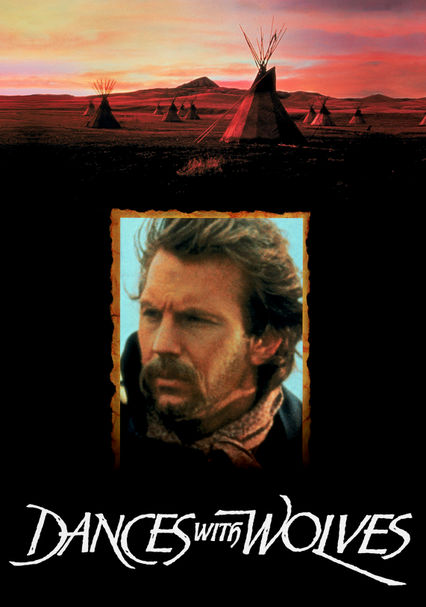
Dances with Wolves-1990

Dances with Wolves-1990

Director Kevin Costner

Starring Kevin Costner, Mary McDonnell

Scott’s Review #1,091

Reviewed December 14, 2020

Grade: A

A western epic of grand proportions, Dances with Wolves (1990) is a quiet, yet bombastic story of one man’s yearning to understand and appreciate a different culture.

The liberal-leaning story is of dire importance in American history, which is my main love of it. This project matters and it has sincerity and truth. The content and the gorgeous, sweeping cinematography make this a must-see on the big screen for full appreciation.

Sort of like Lawrence of Arabia (1962), western style.

The lovely musical score is well-paced and simply gorgeous, only enhancing the experience and appreciation of the film.

The directorial debut of a then inexperienced and up-and-coming star, Kevin Costner, success catapulted him into the big leagues, garnering tremendous respect among the Hollywood community.

He also produced the film and used his own money when the budget ran over. The accolades were justified, leading him to become an A-list star.

He never achieved anything comparable to Dances with Wolves again.

The time is 1863 when the United States was embroiled in the Civil War. Union soldier John Dunbar (Kevin Costner), depressed and suicidal, is injured in battle and receives a hero’s praise. He requests to be transferred to the western frontier, where he lives in solitude.

He slowly befriends the local Sioux tribe and eventually becomes an honorary member, falling in love with a white woman, Stands with a Fist, (Mary McDonnell), who was raised by the tribe.

They name him Dances with Wolves. Chaos erupts when the Union Army arrives to snatch the land at any cost.

Never the greatest actor in the world, but certainly competent, this is the role of a lifetime for Costner. That Dances with Wolves is Costner’s project is crucial. He had a vision and saw that vision to fulfillment.

To my knowledge, the studio didn’t interfere and strive for control but gave Costner the freedom to do whatever he wanted. It shows in the final product.

The romance between Dances with Wolves and Stands with a Fist is tender, alive, and without standard obstacles. No silly misunderstandings or drama. Theirs doesn’t need any trimmings. The chemistry between Costner and McDonnell is strong.

At over three hours in length, the film has time to carefully pace these brilliant moments.

The film is a political vehicle to teach the audience the ravages and unfairness that Native Americans suffered at the hands of the White Man, and that is huge. Too often the issue is skimmed over or diminished in school textbooks so it’s nice to see the truth given its due.

Dances with Wolves serves as an educational tool and no happy ending is provided. How great would it be if the film were shown in high schools and colleges around the United States?

I love how the film, a western, avoids the stereotypes always included in that genre. No good guys are wearing white or bad guys wearing black, no shoot ’em ups at local saloons, and no cowboys to save the day.

Dances with Wolves provides a character study with pivotal thoughts and motivations from the three central characters.

Graham Greene must be mentioned as an integral part of the supporting cast. His authenticity is illuminating.

Over the years Dances with Wolves (1990) doesn’t hold up as well as other films- Silence of the Lambs (1990) and Goodfellas (1991) are legendary contemporaries that everyone remembers better.

Dances may suffer from an “of its time” label, justifiably so, but the film is a masterpiece. Recommended is to dust this one off and give it a whirl, if even for old-time’s sake.

Oscar Nominations: 7 wins-Best Picture (won), Best Director-Kevin Costner (won), Best Actor-Kevin Costner, Best Supporting Actor-Graham Greene, Best Supporting Actress-Mary McDonnell, Best Screenplay Based on Material from Another Medium (won), Best Original Score (won), Best Sound (won), Best Art Direction, Best Costume Design, Best Cinematography (won), Best Film Editing (won)

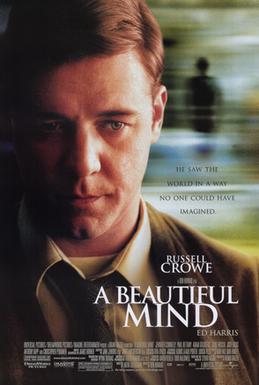
A Beautiful Mind-2001

A Beautiful Mind-2001

Director Ron Howard

Starring Russell Crowe, Jennifer Connelly

Scott’s Review #1,003

Reviewed March 25, 2020

Grade: A-

A Beautiful Mind (2001) is a superior-made film based on the life and times of American mathematician John Nash, a Nobel Laureate in Economics and Abel Prize winner.

The biography explores Nash’s battles with schizophrenia and the delusions he suffered, causing tremendous stress on friends and family.

The film is well-written and brilliantly acted, but deserves a demerit for factual inaccuracies, especially related to Nash’s complex sexuality and family life.

This leaves a gnawing paint-by-the-numbers approach for mass appeal only.

The film was an enormous success, winning four Academy Awards, for Best Picture, Best Director, Best Adapted Screenplay, and Best Supporting Actress. It was also nominated for Best Actor, Best Film Editing, Best Makeup, and Best Original Score.

Arguably one of the best films of 2001, it cemented director Ron Howard’s reputation as a mainstream force to be reckoned with in the Hollywood world.

The project was inspired by the Pulitzer Prize-nominated book of the same name.

Starting in 1947, we meet Nash (Russell Crowe) as a virginal and socially awkward college scholar, studying at Princeton University. He is a whiz at science and mathematics, coming up with unique and dynamic ideas for problem-solving.

Rising the ranks in respectability, he is given an important job with the United States Department of Defense, tasked with thwarting Soviet plots. He becomes increasingly obsessive about searching for hidden patterns and believes he is being followed, sinking further into depression and secrecy.

A Beautiful Mind is an important film because it brings to light the overwhelming issue of mental health and the struggles one suffering from it is forced to endure. Nash largely lives in a fantasy world and has imaginary friends who have followed him for decades by the time the film ends.

Nash conquers his demons with little aid of medication causing a controversial viewpoint. Amazing that the man was able to rise above, but is this a realistic message for those suffering from hallucinations?

Russell Crowe carries the film, fresh off his Oscar win the year before for his stunning turn in Gladiator (2000). He would have won for portraying Nash had he not recently received the coveted prize.

Crowe, hunky at this point in his life, convincingly brings the brainy and nerdy character, rather than the stud, to life, adding layers of empathy and warmth to the role.

We root for the man because he is as much sensitive as he is a genius.

Jennifer Connelly, in what is disparagingly usually described as the wife or the girlfriend role, does her best with the material given. My hunch is her Oscar nomination and surprising win have more to do with piggybacking off the slew of other nominations the film received.

She is competent as the supportive yet strong Alicia, the wife of Nash. In her best scene, she flees the house after a confused Nash leaves their infant daughter near a full bathtub, putting her life in danger.

The most heartfelt scene occurs during the conclusion. After many years of struggle, Nash eventually triumphs over this tragedy, and finally, late in life, receives the Nobel Prize. This is a grand culmination of the man’s achievements and a sentimental send-off for the film.

The aging makeup of all principal characters, specifically Nash and Alicia is brilliantly done.

Despite the heaps of accolades reaped on A Beautiful Mind, several factual points are reduced to non-existence. Questionable is why Howard chose not to explore Nash’s rumored bisexuality, instead of passing him off as straight.

Admittedly, the film is not about sexuality, but isn’t this a misrepresentation of truth? Nash had a second family, which is also never mentioned.

These tidbits eliminated from the film leave a glossy feel like Howard picked and chose what to tell and not to tell for the sake of the mainstream audience.

Bringing needed attention to a problem of epic proportions, A Beautiful Mind (2001) recognizes the issue of mental health in the United States.

The methods may be questionable, and the film has an overall safe “Hollywood” vibe but must be credited for a job well done in a film that is not only important but displays a good biography for viewers eager to learn about a genius who faced unrelenting issues.

Oscar Nominations: 4 wins-Best Picture (won), Best Director-Ron Howard (won), Best Actor-Russell Crowe, Best Supporting Actress-Jennifer Connelly (won), Best Screenplay Based on Material Previously Produced or Published/Adapted Screenplay (won), Best Original Score, Best Makeup, Best Film Editing

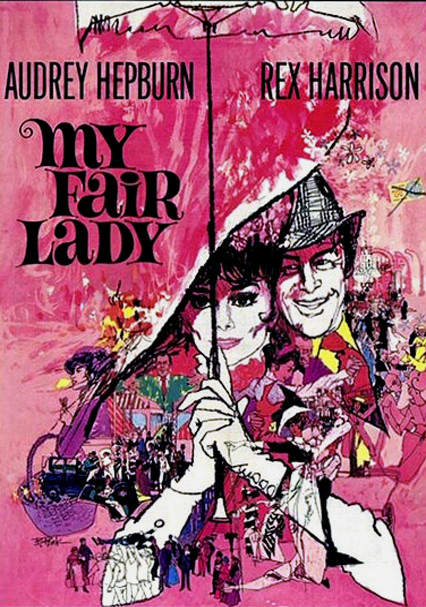
My Fair Lady-1964

My Fair Lady-1964

Director George Cukor

Starring Audrey Hepburn, Rex Harrison

Scott’s Review #938

Reviewed September 6, 2019

Grade: A-

Winner of the Best Picture Academy Award (it would not have been my choice), My Fair Lady (1964) is a good product that is based on the stage version, in turn, based on the famous 1913 stage play Pygmalion by George Bernard Shaw.

The musical’s central negative aspect is its casting choices. Hepburn and Harrison have only mediocre chemistry, and Hepburn does not sing. However, the film is enchanting and filled with lavish sets, colorful costumes, and earnest songs, making it entertaining for the whole family.

The iconic Eliza Doolittle (Hepburn) and Henry Higgins (Harrison) are household names to every fan of the musical genre.

Set in London, sophisticated and arrogant Professor Higgins, a scholar of phonetics, is intent on proving that the tone and accent of one’s voice determine one’s lot in society.

As an experiment, he chooses flower saleswoman Eliza, with her horrid Cockney accent, and is determined to crown her duchess of a ball.

Unaware of his scheme but soon to find out she has been had, romance eventually blooms as the song “I’ve Grown Accustomed to Her Face” becomes essential.

My Fair Lady is quite the epic, with a runtime of two hours and fifty-two minutes, which is lofty for a film.

The misty London setting adds layers of mystique and atmosphere, and the cinematography drizzles with color and pizzazz, making the overall content look fantastic.

Because of the length of the film and the magnificent trimmings, the production looks like a spectacle, reminiscent of the elegant extravagance of the 1950s and 1960s, when musicals made into films were grand and robust.

It’s no wonder this helped it win Best Picture, Best Director, and many other awards. Hollywood loves this film.

When dissected and analyzed, social and class systems are a large part of the film amid the cheery singing, dancing, and big-screen bombast. Social status and hints of socialism pepper the production, rising way above the fluff it could have been if just a “boy from the good side of the tracks meets girls from the wrong side.”

Eliza’s father, Alfred (Stanley Holloway), a waste collector, is also an opportunist. He sings his story during “With a Little Bit of Luck.” The differences between the “haves” and the “have nots” are evident.

Since the chemistry is limited, I never bought Harrison and Hepburn as a romantic duo. The teacher/student angle somewhat works, though always bothersome, but Henry’s self-assured behavior and superior attitude make him tough to root for.

The controversy surrounding the film includes the decision to dub nearly all of Hepburn’s singing with another singer’s voice. This devastated the actress and cost her an Academy Award nomination. Her snub is especially jarring, given the dozen other nominations it received.

The story is heartwarming and follows the like-minded theme of a hero rescuing a damsel in distress. Hints of Cinderella (1950) and even Pretty Woman (1990) glisten, with only a hint of male chauvinism that does not ruin the experience or reduce the film to a dated guy film, as with Pretty Woman.

“I’m an Ordinary Man” describes how women ruin men’s lives and are not the most progressive or female-friendly of all the numbers.

My Fair Lady (1964) is a film from the past that begs to be viewed on the big screen so that all its qualities can be enjoyed. Like Lawrence of Arabia (1963), it is best viewed in a wide-angle, enormous theater setting to ensure that all its aspects are noticed and enjoyed.

It’s a Hollywood film done tremendously well. Young viewers would be wise to be exposed to this film to delight in the cinematic treats.

Oscar Nominations: 8 wins-Best Picture (won), Best Director-George Cukor (won), Best Actor-Rex Harrison (won), Best Supporting Actor-Stanley Holloway, Best Supporting Actress-Gladys Cooper, Best Screenplay Based on Material from Another Medium, Best Scoring of Music-Adaptation or Treatment (won), Best Sound (won), Best Art Direction, Color (won), Best Cinematography, Color (won), Best Costume Design, Color (won), Best Film Editing

The Bridge on the River Kwai- 1957

The Bridge on the River Kwai- 1957

Director David Lean

Starring William Holden, Alec Guinness 

Scott’s Review #908

Reviewed June 11, 2019

Grade: A

The Bridge on the River Kwai (1957) is a war film that is an example of character-driven storytelling from each person’s perspective.

Films of this genre frequently do not steer too far from the straight and narrow, showcasing the war event perspective. This often becomes larger than the humanity piece. A key point is the American, British, and Japanese points of view, which turn the grand epic experience into a more personal one.

The film was awarded numerous Oscar nominations, culminating with the Best Picture of the Year victory.

The time is early 1943 amid the powerful and destructive World War II when a group of British prisoners of war (POW) arrives at a Japanese camp. Colonel Saito (Sessue Hayakawa) commands all prisoners, regardless of rank, to begin work on a railway bridge that will connect Bangkok with Rangoon.

Lieutenant Colonel Nicholson (Alec Guinness), the British commanding officer, refuses manual labor, and a battle of wills erupts between the two men. Meanwhile, Commander Shears (William Holden), an American also being held at the same camp, vows to destroy the bridge to avoid a court martial.

The complexities of the relationships between the men are the main draw and an aspect that can be discussed at length. Each possesses a firm motivation, but the emotions teeter back and forth as they face various conflicts.

Each of the three principles is an analytical juggernaut in the human spirit, ranging from courageous, cowardly, and even evil. We are supposed to root for Shears and supposed to not root for Saito, but why is that not so cut and dry?

Is Shears too revenge-minded? We cheer Nicholson’s resilience, but is he too stubborn for his own good?

The film’s whistling work theme nearly became famous when the film was initially released in 1957. Ominous and peppered with a macabre depression, the prisoners go about their work in a near ode to Snow White and the Seven Dwarfs’ cheerier “Whistle While You Work” anthem.

As they continue to build the bridge dutifully, the audience feels a sense of dread and a foreboding atmosphere. What will ultimately happen? When two prisoners are shot dead while attempting to escape, the film takes a different turn.

Given that David Lean, responsible for such epic masterpieces as Lawrence of Arabia (1962) and A Passage to India (1984), directs The Bridge on the River Kwai, should be telling as far as the sweeping exterior landscape treats in store for the viewer.

The lavish Asian landscape, so picturesque and beautiful, is peaceful amid the chaos and vile treatment of the prisoners. This imbalance is wonderfully rich and poignant against the robust storytelling.

The climax is bombastic (literally!) and a nail-biting experience resulting in a stabbing, an explosion, and a heap of tension. A train carrying important dignitaries and soldiers is racing towards the newly constructed bridge as one man is intent on detonating a bomb and destroying another race against time to prevent the bloodbath.

The suspense, action, and cinematic skill are front and center during the final act.

Deserving of each one of the accolades reaped on The Bridge on the River Kwai (1957), the film is the thinking man’s war film.

Layered with an underlying humanistic approach and little violence given the subject matter, one can sink into empathy for each point of view presented instead of being force-fed a one-dimensional message film.

Fine acting and gorgeous cinematography make this film one to be forever remembered.

Oscar Nominations: 7 wins-Best Motion Picture (won), Best Director-David Lean (won), Best Actor-Alec Guinness (won), Best Supporting Actor-Sessue Hayakawa, Best Screenplay Based on Material from Another Medium (won), Best Scoring (won), Best Cinematography (won), Best Film Editing (won)

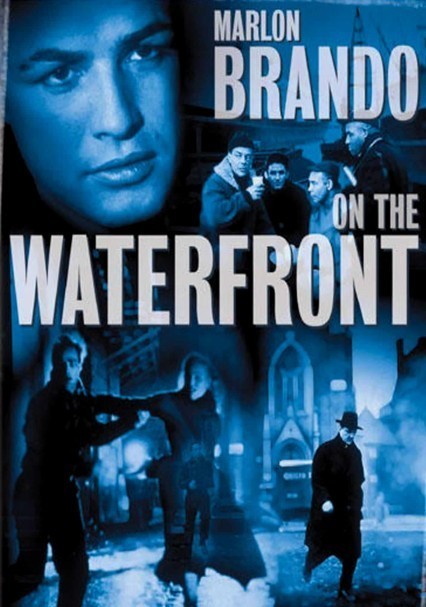
On the Waterfront-1954

On the Waterfront-1954

Director Elia Kazan

Starring Marlon Brando, Eva Marie Saint

Scott’s Review #876

Reviewed March 9, 2019

Grade: A

Led by one of the best acting performances of all time, On the Waterfront (1954) was an essential and relevant film when made and is still influential in the modern era.

Director Elia Kazan and newly minted Hollywood star Marlon Brando collaborate on a film spectacle as much a character study as a tale of morality and social injustice.

The musical soundtrack score composed by Leonard Bernstein only enhances an already astounding picture that is deservedly referenced as a masterpiece.

Terry Malloy (Brando) is a washed-up former local boxer who now spends his days slaving away as a dockworker on the dingy waterfronts of Hoboken, New Jersey. Terry’s brother Charley (Rod Steiger) works for a vicious mob boss, Johnny Friendly (Lee J. Cobb), who controls the area.

The police are aware of the ongoing corruption but are limited by the lack of evidence and witnesses to regular crimes. When a fellow dockworker is killed, Terry falls for the victim’s sister, Edie (Eva Marie Saint), leading him to rethink his priorities.

The positive aspects of On the Waterfront are enumerable. Meritful cinematography and location sequences, enshrined in the rich story and flawless acting, give the film authenticity. The film was shot almost entirely on location in New York and New Jersey, using actual docks and outdoor sequences.

The dingy, water-soaked locales are riddled with secrets and dark violence, brought to new levels through realism and grittiness.

Never looking more masculine or more handsome, though his portrayal of Stanley in A Streetcar Named Desire (1951) is a close second, Marlon Brando achieves riches in the world of stellar acting.

He is rugged yet compassionate, macho yet tender, and pours his heart into the role of Terry. One cannot help wondering if the self-professed method actor became Terry during filming.

With both vulnerability and strength, Brando embodies the character so well that he has become my favorite of all the film roles he has undertaken.

The supporting players dutifully flesh out the resounding cast with gusto. Special mentions go to Karl Malden as Father Barry and Steiger as Charley. Like Barry, Malden brings warmth, patience, and benevolence in a world of crime and deceit. He attempts to console and mentor the folks in his world and is eventually beaten for his honesty and earnestness.

Charley is a different story, selling his soul to the devil and accepting the cards he has been handed, choosing to join with Friendly. At a crucial moment, he makes another devastating choice that changes his life forever.

Few films can proudly boast a scene or dialogue that remains timeless and imprinted on cinematic history, but On the Waterfront contains a scene of this caliber.

During a tremendously important moment in the film, Terry has a conversation with Charley and makes an impassioned statement-“I coulda’ been somebody. I coulda been a contender”, laments Terry to his brother, “Instead of a bum, which is what I am – let’s face it.”

This line is a historic piece of writing and is true to the character.

The film is more powerful and truthful because it represents Elia Kazan’s real-life plight. In the early 1950s, the director famously informed a government committee about suspected Communists, while many of his colleagues chose to go to prison rather than name names.

Many Hollywood actors, directors, and screenwriters were blacklisted for decades to come. On the Waterfront is frequently deemed an allegory to the director’s plight and is a personal story.

On the Waterfront (1954) is sometimes violent and all-times realistic, painting a portrait of one man’s struggle to overcome the lousy life given to him to do the right thing.

Thanks to gorgeous direction, an explosive lead performance by Brando, and all the pieces fitting perfectly in unison, the film is one of the greats and will remain one that generations will discover.

Oscar Nominations: 8 wins-Best Motion Picture (won), Best Director-Elia Kazan (won), Best Actor-Marlon Brando (won), Best Supporting Actor-Lee J. Cobb, Karl Malden, Rod Steiger, Best Supporting Actress-Eva Marie Saint (won), Best Story and Screenplay (won), Best Music Score of a Dramatic or Comedy Picture, Best Art Direction, Black-and-White (won), Best Cinematography, Black-and-White (won), Best Film Editing (won)

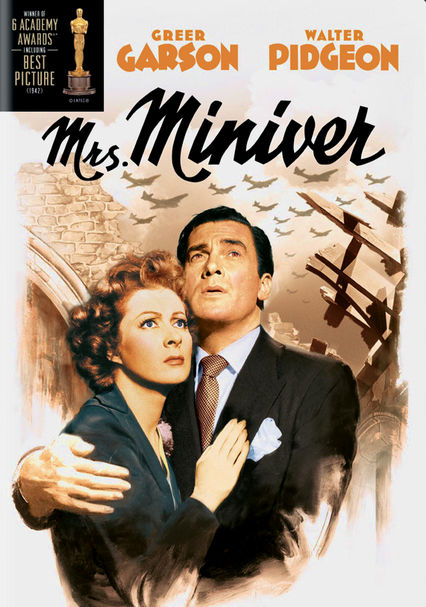
Mrs. Miniver-1942

Mrs. Miniver-1942

Director William Wyler

Starring Greer Garson, Walter Pidgeon

Scott’s Review #841

Reviewed December 13, 2018

Grade: A-

Released in 1942 amid the horrific World War II, Mrs. Miniver (1942) was a smash hit, winning over audiences concerned with the troubled and uncertain times.

Decades later, the film does not age as well as other similarly themed films, but still entertains and tells a good story with an important theme.

The film is nestled in the war drama genre with romance. The film won numerous Oscars the year of its release, including Best Picture and star Greer Garson won for Best Actress.

The story is told from the perspective of an affluent British family and the struggles they face to keep things together during growing peril. The focus primarily remains on an unassuming housewife, Kay Miniver (Garson).

The supporting players do much to flesh out the film with fantastic performances by Walter Pidgeon, Teresa Wright, and Henry Travers as Clem Miniver, Carol Beldon, and Mr. Ballard, respectively.

The direction by William Wyler is astounding and adds to the perfectly crafted ambiance and homey details.

The family lives a comfortable life in a whimsical village outside of London. Quite idealized, they own a large garden and a motorboat on the River Thames.

Along with Kay and Clem, their three children of varying ages and their housekeeper and cook reside with them. Besides the parents, the central couple is son Vin (Richard Ney) and the prominent Carol (Wright); the pair initially disagree on politics but finally fall madly in love.

As the soap opera-style family situations continue, the war grows closer and closer to their house.

As Mrs. Miniver progresses, Vin enlists in the army to assist with war efforts, a German Nazi breaks into the Miniver house, a central character dies, and bombs and planes crash.

Through it all, Kay remains stoic and takes the family through challenging situations, adding melodrama to the film. The woman’s journey and resolve to keep everything and everyone intact is at the core.

The film is mainly a family drama with the Minivers and the townspeople experiencing trials and tribulations. In this way, Mrs. Miniver risks being a one-trick pony, albeit an emotional and teary-eyed one.

The film’s rich characteristics and polished nature make it more than it ought to be, and the superlative cast, production values, and timely release undoubtedly made it what it was in 1942.

In present times, however, Mrs. Miniver seems diminished in importance and relevance with a sappy and overly sentimental feel, World War II in the distant past, and several other wars come and gone.

Wyler carefully packaged the film to hit every emotion, from the bombastic musical score to the proper English characters to the comic relief housekeeper.

The film is a giant Hollywood production, but perhaps a bit too perfect to age with any zest or reason to watch more than once.

The film might be better remembered for its strong female lead. Told from Kay’s perspective, it was unusual in 1942 for a movie (especially with a war theme) not to have the story from the male point of view. Still refreshing in 2018, this quality was downright groundbreaking at the time.

Kay stays strong and proud through the ravages of war that are closing in on her family with unbridled boldness and nary a simpering quality. Wright’s Carol is an early champion for strong, female-driven characters, and, in a more minor way, she is also a muscled female role model.

Mrs. Miniver (1942) is a well-crafted film of its time that displays lavish production values and strong characters worthy of admiration.

The film is a significant win for a glimpse of the 1940s, especially for fans of good, solid drama. There are no significant flaws to harp on, but the overall piece has not aged exceptionally well, and other similar films (Casablanca, 1942) are more memorable.

Oscar Nominations: 6 wins-Outstanding Motion Picture (won), Best Director-William Wyler (won), Best Actor-Walter Pidgeon, Best Actress-Greer Garson (won), Best Supporting Actor-Henry Travers, Best Supporting Actress-Teresa Wright (won), Dame May Whitty, Best Screenplay (won), Best Sound Recording, Best Cinematography, Black-and-White (won), Best Film Editing, Best Special Effects

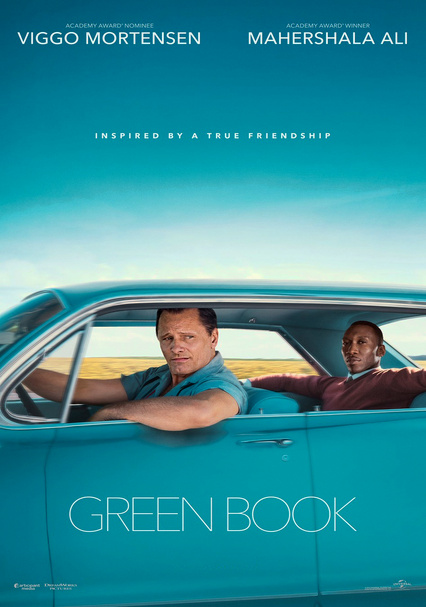
Green Book-2018

Green Book-2018

Director Peter Farrelly

Starring Viggo Mortensen, Mahershala Ali

Scott’s Review #839

Reviewed December 10, 2018

Grade: A

To be candid, it was not originally on my radar to see Green Book (2018) despite the high regard and the bevy of award nominations reaped upon the film.

From the trailers, and admittedly my assumptions, the production looked somewhat like a Driving Miss Daisy (1989) role reversal with the standard over-saturation and glossy view of racism.

I confess to being wrong in my initial assessment. Green Book is a wonderful film with a multitude of worthy efforts. It successfully crosses the drama and comedy barriers and delivers an astounding message of compassion and benevolence.

Viggo Mortensen and Mahershala Ali exhibit tremendous flair and fine chemistry as an Italian blue-collar driver and an astute African-American classical pianist.

The men travel together in the Deep South circa 1962 on a concert tour requested by the renowned musician despite the dangers of southern racism and prejudice.

Mortensen’s Tony Lip is a struggling New York City bouncer who needs any gig for two months while the club he works for is closed for renovations. Ali plays a sophisticated musician who needs a driver with a measure of toughness, and Tony comes highly recommended.

The two men initially are strangers but form a close-knit bond and a deep understanding of each other as they become better acquainted during their journey.

The first half of the film focuses on Tony.

As viewers, we experience his Italian lifestyle. He possesses a strong family unit and a dedicated wife, Dolores (Linda Cardellini). He loves to eat and won a hot dog eating contest for $50 to pay the rent. He thinks nothing of beating an unsavory character to a bloody pulp if they are out of line and have more than one link to the mafia.

Still, he is a decent man, with a salt-of-the-earth mentality, and loves his family.

“Doc” Don Shirley (Ali) is the opposite of Tony. Raised as a highly gifted musical prodigy, he surrounds himself with high culture, is well-versed in many languages, and is of affluent means. Nonetheless, he is a wounded soul and drinks himself into oblivion each night, frequently deep in thought, pondering life and its problems.

Despite being black, he knows nothing about black culture.

Don is highly uncomfortable in his skin, while Tony is happy with who he is, a significant point that the film hits home on as the men have conflict. Don feels Tony can do much better to educate himself, while Tony sees nothing wrong with being who he is. The men forge a middle ground as they come to respect each other.

Ferrelli does a fantastic job in showing Tony as Don’s protector as he is accosted by rednecks or is caught with another man at the YMCA.

In turn, Don helps Tony write warm love letters to Dolores.

Green Book is a film about friendship and how different backgrounds can result in closeness and respect.

The film is humanistic in its approach to an overall message and is the feel-good film of 2018 without the slightest thread of sappiness or contrived situations. It is best about two real-life men who remained friends until their deaths.

Director Peter Farrelly, known chiefly for silly films such as Dumb and Dumber (1994), finds breakthrough success with Green Book.

The film is mainstream material, but of a sort that can be appreciated for the good it exudes. Don exhibits racism on more than one occasion- Birmingham and Mississippi specifically- but also experiences kindness from other folks.

Worth noting is that Don experiences discrimination and abuse not only from whites but also from blacks. Farrelly avoids the usual stereotypes or elicits humor from them as in the scene where Tony teaches Don to enjoy fried chicken, a foreign food to Don.

A key point of the film occurs early on when Dolores graciously invites two black workers to repair, thinking nothing of treating the men to a refreshing lemonade.

Seeing the empty glasses in the sink, Tony throws them in the trash, not wanting to drink from the same glasses. Is Tony, along with his family, racist or uncomfortable with blacks? Regardless of the answer, they think very differently after the film, which is monumental.

The final sequence of Green Book is teary, heartfelt, and provides a feeling of incredible warmth.

In the tumultuous times of current American history, Green Book (2018) is sentimental and inspirational in a day when racism once again reared its ugly head, thanks to the chaotic political environment.

The film is a lesson in how far we have come as a society, but also in how things have not changed so much and how much further we need to go to create equality for all.

Farrelly creates a timely and wonderful film that everyone can appreciate.

Oscar Nominations: 3 wins- Best Picture (won), Best Actor- Viggo Mortensen, Best Supporting Actor- Mahershala Ali (won), Best Original Screenplay (won), Best Film Editing

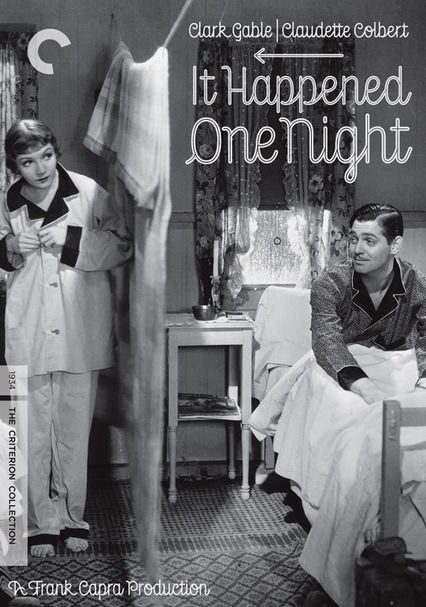
It Happened One Night-1934

It Happened One Night-1934

Director Frank Capra

Starring Clark Gable, Claudette Colbert

Scott’s Review #824

Reviewed October 25, 2018

Grade: A-

Perhaps the film that best defines the early cinematic romantic comedy and certainly the one most modern genre films can learn from, It Happened One Night (1934) is a lively, fun romp.

The film carted away the Best Picture, Best Director, Best Actor, and Best Actress Academy Awards, a rare feat, and defined what romantic tension and thoughtful dialogue should be in a quality picture. All the elements sparkle into an excellent classic film watch.

Ellie Andrews (Colbert) is a pampered socialite who recently disobeyed her overbearing and wealthy father by eloping with a blue-collar pilot who is feared to be after her money.

Determined, Ellie escapes her father’s clutches and hops on a Greyhound bus headed from Florida to New York, where her husband is. When she crosses paths with an out-of-work journalist, Peter Warne (Gable), they each find an opportunity to use the other to their advantage.

The pair’s adventures along the East Coast lead to antics and schemes as they fall madly in love with one another.

It Happened One Night successfully mixes a good romance with some screwball comedy without ever becoming silly or trite.

The film also serves as a good old-fashioned adventure story as Peter and Ellie face one hurdle after another on their trek north.

Pleasing is how the duo slowly finds romance but first begins as irritants towards each other. The chemistry between the actors is superb and never seems forced or contrived.

Frank Capra, a famous director with successes throughout the 1930s, culminating with the holiday favorite It’s a Wonderful Life (1946), had several Oscar-winning films during the decade.

It Happened One Night seems to have inspired most of them, and the acting, absurd situations, dialogue, and direction all successfully come together.

Shot in black and white and the Motion Picture Production Code, which heavily restricted details deemed too violent or sexual, It Happened One Night pushed the envelope quite a bit.

This is to the film’s credit- who can forget the adorable yet provocative scene in which Ellie shows her shapely legs to enable the duo to catch a ride? The lovable scene, non-risque in today’s modern world, was anything but in 1934.

An interesting, at that time unique, point is that supporting characters are more layered than is typical in romantic comedies. Danker, whom Peter and Ellie hitch a ride with, is seemingly a decent man but ultimately attempts to steal their luggage.

Later, Ellie’s preposterous father turns out to be a decent man, so the film also contains a few character surprises.

While not quite a pure masterpiece, It Happened One Night (1934) is nonetheless an inspired legendary film that can be viewed and enjoyed for the period in which it was made.

The film stands out among the similarly themed romantic comedies of the 1930s and 1940s and is a teachable moment for all filmmakers who explore the same genre territory.

Oscar Nominations: 5 wins– Outstanding Production (won), Best Director (won), Best Actor-Clark Gable (won), Best Actress-Claudette Colbert (won), Best Adaptation (won)

Crash-2005

Crash-2005

Director Paul Haggis

Starring Matt Dillon, Thandie Newton, Don Cheadle

Scott’s Review #799

Reviewed August 3, 2018

Grade: A-

A superior film that has unfortunately suffered greatly after controversy, Crash (2005) is a story of intersecting vignettes all interrelated.

The controversy stems from the film’s very surprising Oscar win over the heavily favored Brokeback Mountain. Many thought the latter was a shoo-in, poised to set the LGBT genre ahead of the game.

Sadly, now when Crash is discussed by film lovers, it’s usually in tandem with Brokeback, and usually on the heels of its having stolen the Oscar crown.

On its own merits, the film excels as a social story exploring the many facets of race, racism, and bigotry.

The events in Crash take place within one thirty-six-hour day in metropolitan Los Angeles. Featuring a slew of characters that would even impress Robert Altman, the audience witnesses situations involving many races and backgrounds.

We meet Rick and Jean Cabot (Brendan Fraser and Sandra Bullock), a white affluent couple who are carjacked when driving home from dinner. The black men who carjack the couple then strike a Korean man and bring him to the hospital.

A racist police officer, John Ryan (Matt Dillon), cares for his troubled father who cannot afford insurance. A Persian father and daughter wish to buy a gun for protection, and a Hispanic father (Michael Pena) worries about a rash of drive-by shootings.

The stories go on and on as a myriad of the characters come into situations involving other characters.

The interconnecting stories all cascade into overlapping situations of interest. The point of Haggis’s film is racism but with a creative twist.

The director points out and shows that those who are racist have good qualities too and those who are discriminated against in turn discriminate against others themselves.

The most interesting character is Dillon’s, John Ryan. On the surface a racist, wise-ass, who in one scene embarrasses an affluent light-skinned black woman (Thandie Newton), simply because he carries a gun, then ends up saving her life in a horrific car accident.

But is he redeemed? Does he see the world as black people getting ahead and he is left behind? What about the Persian man, discriminated against, but then vowing revenge on a Hispanic man after a misunderstanding?

The black men who carjack the white couple then release a group of immigrants who will surely be sold, perhaps even for sex trafficking. Does this act make the men good?

The point that Haggis makes is that each character is neither all good nor all bad, but rather complicated and nuanced with emotions based on past experiences and discrimination themselves.

Crash is highly similar to Traffic (2000) and Babel (2006) in terms of pace, style, and the way the stories align. The film is different, however, in that the location is strictly confined to Los Angeles, making the setting of monumental importance.

How would events be different in a setting like Middle America? Or in a different country? These possibilities are worth contemplating based on the perception that Los Angeles is one of the most diverse cities in the United States. If racism occurs there it can occur anywhere.

Now more about that pesky Oscar controversy! In later years critics would largely agree that the inferior film had won that year and Brokeback Mountain lost due to a level of homophobia on the part of the voting academy.

Since the academy is filled with Hollywood liberals, albeit of an older generation, an alternative way of thinking is that perhaps Crash won because it was the “safer” film.

Everyone seems to have forgotten the other three nominated films that year. Alas, Crash is permanently marred for winning Best Picture. It would undoubtedly have more supporters had it lost.

Ranked as one of the lowest-scoring Best Picture winners, I still believe Crash has some worth- though I agree that it should not have won over Brokeback Mountain.

Taken on its own merits the film is quite good. A message film with great atmosphere, it succeeds in making the viewer think and ponder perhaps their discrimination, whether conscious or subconscious.

The ensemble acting and character representations are all very good and worthy of a second watch.

Oscar Nominations: 3 wins-Best Picture (won), Best Director-Paul Haggis, Best Supporting Actor-Matt Dillon, Best Original Screenplay (won), Best Original Song-“In the Deep”, Best Film Editing (won)

Independent Spirit Award Nominations: 2 wins-Best Supporting Male-Matt Dillon (won), Best First Feature (won)

Million Dollar Baby-2004

Million Dollar Baby-2004

Director Clint Eastwood

Starring Clint Eastwood, Hilary Swank, Morgan Freeman

Scott’s Review #798

Reviewed August 2, 2018

Grade: A

Million Dollar Baby (2004) is arguably Clint Eastwood’s best-directed film of his career.

Rivaling Mystic River (2003) by a hair, the film has a raw emotional appeal, empathetic and richly carved characters and mainstream sensibility.

These combined elements resulted in huge box office success and Oscar wins for Picture, Director, Actress, and Supporting Actor in the year of its release.

Frankie Dunn (Clint Eastwood) is a hardened boxing coach who owns a run-down Los Angeles gym. He works with his best friend and assistant, Eddie (Morgan Freeman). When an aspiring female boxer, Maggie (Hilary Swank), arrives and begs Frankie to train her, he initially declines, but at Eddie’s urging, eventually relents and leads her to great success as a top female boxer.

Frankie and Maggie forge a close-knit, father/daughter relationship, a substitute for the damaged one he has with his daughter.

The final portion of Million Dollar Baby takes a very dark turn, as Maggie is illegally punched during a fight by a fellow boxer, causing her to become a quadriplegic. These events are what change the tone of the film from a very good sports drama to a great tale of morality.

Many emotions and debates transpired after this film was released and the common question of, “What would you have done?” engulfed viewers for months, all through awards season.

The heartbreaking effects of the story events raise the film head and shoulders above most typical sports films.

Too often Eastwood creates films that are palpable, but in a way generic, and very Hollywood. Grand Torino (2008) and Invictus (2009) are good examples of this- especially Invictus given the sports drama element.

Some assumed that Million Dollar Baby was to be a female Rocky (1976) and the film was indeed marketed as such. For this reason, some felt robbed or duped, but I celebrate this film as leaning a firm left of center with a refreshing, progressive approach.

The performances are amazing all around, even by Eastwood- never known for his acting talent. The characters are written as character-driven, but not caricatures. Wounded, grizzled, and flawed, in his senior years, Frankie sees his life has passed him by, having achieved nothing.

Never has Eastwood portrayed a character as complex and reserved as Frankie.

Swank deserved her second Oscar (1999’s Boys Don’t Cry was her first) for simply becoming a boxer- her pre-filming prep schedule reportedly was insane. More than the muscle and toning she achieved, are the raw acting talent and wounded emotions she possesses.

The character is written as pained and vulnerable, but also very strong. She has achieved little in her life- working as a waitress in Missouri and stealing scraps of leftovers to survive. Her family is trash through and through, only wanting her eventual riches for themselves.

The character is inevitably championed as we empathize with her plight emotionally.

Finally, Freeman deserves recognition for being the ultimate supporting actor. Eddie Dupris, a former fighter blind in one eye, is the center point of the story and frequently narrates the actions of others, oftentimes offering a glimpse into the psyche of individuals.

The voice of reason, he is observant and analytical, almost knowing Freddie better than Freddie knows himself. They quarrel and disagree, but are forever friends and loyal to a fault. Freeman possesses quite a reserve as the audience becomes curious about his past life.

Million Dollar Baby (2004) is Eastwood’s best film- Mystic River comes a close second, however. A seemingly formulaic story and genre are weaved into a web of humanism, emotions, and power.

The film is about the characters, which makes it succeed.

Eastwood has not been able to quite surpass this beautiful story, but thankfully received dripping praise and accolades for a film not soon forgotten.

Oscar Nominations: 4 wins-Best Picture (won), Best Director-Clint Eastwood (won), Best Actor-Clint Eastwood, Best Actress-Hilary Swank (won), Best Supporting Actor-Morgan Freeman (won), Best Adapted Screenplay, Best Film Editing

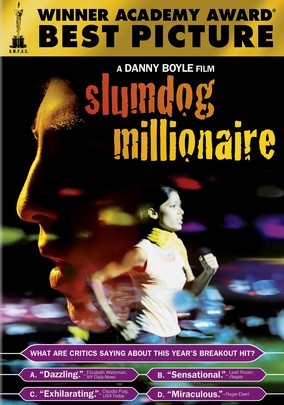
Slumdog Millionaire-2008

Slumdog Millionaire-2008

Director Danny Boyle

Starring Dev Patel, Freida Pinto

Scott’s Review #786

Reviewed July 11, 2018

Grade: A-

Winner of the 2008 Best Picture Oscar (as well as seven other Academy Awards), Slumdog Millionaire (2008) arguably was the “feel good” film of the year.

While I am not sure if all of those awards are ultimately deserved, the film is nonetheless very good, offering a mixture of good culture, a young man overcoming enormous odds, and a love story.

Fans of the universal game show hit, Who Wants to Be a Millionaire, will be pleased.

Young Dev Patel (critically acclaimed for 2016’s Lion) stars as a poor young Indian man, Jamal Malik. He is detained after being a contestant on Who Wants to Be a Millionaire after he comes one question away from winning a million dollars.

The producers go on a commercial break and Jamal is whisked away to custody as suspicions are aroused and the young man is accused of cheating. Since he is a “slumdog” and poorly educated, it is assumed there is no way possible he could know all the answers.

Jamal recounts, via flashbacks, through experience, how he came to know all of the correct answers.

Director, Danny Boyle does a fantastic job directing the film. Slumdog Millionaire is edited in a fast-paced fashion and the camera angles are quick and stylized, making for an excellent flow.

The soundtrack to the film is very effective and enhances the plot. For example, the music is extremely diverse and features genres such as traditional Indian classical music, European house music, and American-style hip hop.

This is an ingenious way for Boyle to incorporate multiple cultures and he, therefore, creates a rousing crowd-pleasing experience.

Another successful aspect of the film is its use of knowledge and intelligence to tell a story. As we experience Jamal’s difficult life beginning as a five-year-old orphan, the unlikely success story and his adventures on the streets are engulfed in both life lessons and education.

The audience is learning important details about the world while Jamal simultaneously is.

The romantic, love-story featured in Slumdog Millionaire is also a highlight and extremely well-crafted. Heartbreakingly, Jamal, his older brother Salim, and the lovely Latika (later played by the gorgeous Freida Pinto) are on the run when Latika vanishes.

Her disappearance and later reappearance are vital aspects to the heart of the film and Patel and Pinto make a handsome and highly likable couple. Their reconciliation is heartfelt and beautiful and gives the film a nice emotional investment.

The incorporation of a relevant and acclaimed game show into the story is wonderful, though hopefully as the years go by, the film does not suffer from a dated feel if and when Who Wants to Be a Millionaire is long forgotten, but alas this is a risk and only time will tell.

The glossy set and for American audiences, the Indian-style version of the game show is great fun as are the Indian locales, which visually dazzle.

A slight detraction of Slumdog Millionaire is the film is unquestionably uplifting and light feeling. Even though the characters face peril and dangerous experiences, the film just “feels” safe.

So much so that qualities such as slick and mainstream resound.

Don’t get me wrong, the film is genuine and has heart and soul, but just slightly too cheery. Of course, since the film is made well and the story and the acting great, this can easily be overlooked.

Slumdog Millionaire (2008) is a wonderful piece of work and is quite simply a film that lots of people will champion.  All of the elements are perfectly in place, which is a main selling point and a prime reason for the film’s many accolades.

The romance and adventure pieces are the best parts- with a quick flow and lots of fun, educational tools utilized.

The film is a nice pleasure to experience.

Oscar Nominations: 7 wins-Best Picture (won), Best Director-Danny Boyle (won), Best Adapted Screenplay (won), Best Original Score (won), Best Original Song-“Jai Ho”, “O Saya”, Best Sound Editing, Best Sound Mixing (won), Best Cinematography (won), Best Film Editing (won)

No Country for Old Men-2007

No Country for Old Men-2007

Director Ethan Coen, Joel Coen

Starring Tommy Lee Jones, Javier Bardem, Josh Brolin

Scott’s Review #745

Reviewed April 19, 2018

Grade: A

No Country for Old Men, made in 2007,  is arguably Joel and Ethan Coen’s greatest work save for the amazing Fargo (1996).

Achieving the Best Picture Academy Award and appearing on numerous Top Ten lists for its year of release, the film is one of their most celebrated.

Containing dark humor, offbeat characters, and fantastic storytelling, adding in some of the most gorgeous cinematography in film history, No Country for Old Men is one of the decade’s great films.

The time is 1980 and set in western Texas as we follow dangerous hitman, Anton Chigurh, played wonderfully by Javier Bardem.

He escapes jail by strangling a deputy and is subsequently hired to find Llewelyn Moss (Josh Brolin), a hunter who has accidentally stumbled onto two million dollars in a suitcase that Mexican smugglers are desperate to find.

In the mix is Sheriff Tom Bell (Tommy Lee Jones), who is pursuing both men. Moss’s wife, Carla Jean (Kelly Macdonald) in turn becomes an important character as she is instrumental in the web of deceit the chain of events creates.

The film subsequently turns into an exciting cat-and-mouse chase with a dramatic climax.

The crux of the story and its plethora of possibilities is what makes the events so exciting to watch. As characters are in constant pursuit of each other the viewer wonders who will catch up to whom and when.

One quality that makes the film unique with an identity all its own is that the three principal characters (Moss, Bell, and Chigurh) seldom appear in the same scene adding a layer of mystery and intrigue.

The hero and most well-liked of all the characters is, of course, Sheriff Bell- a proponent of honesty and truth while the other two characters are less than savory types, especially the despicable Chigurh.

My favorite character in the story is Chigurh as he is the most interesting and Bardem plays him to the hilt with a calm malevolence- anger just bubbling under the surface.

One wonders when he will strike next or if he will spare a life- as he intimidates his prey by offering to play a game of chance- the toss of a coin to determine life or death- he is one of cinema’s most vicious villains. With his bob-cut hairstyle and his sunken brown eyes, he is a force to be reckoned with by looks alone.

True to many other Ethan and Joel Coen films the supporting or even the glorified extras are perfectly cast and filled with interesting quirkiness.

Examples of this are the kindly gas station owner who successfully guesses a coin toss correctly and is spared his life. My favorite is the matter-of-fact woman at the hotel front desk, with her permed hair, she gives as good as she gets, and her monotone voice is great.

It is these smaller intricacies that truly make No Country for Old Men shine and are a staple of Coen Brother films in general.

Many similarities abound between Fargo and No Country for Old Men, not the least of which is the main protagonist being an older and wiser police chief (Marge Gunderson and Tom Bell, respectively).

Add to this a series of brutal murders and the protagonist being from elsewhere and stumbling upon a small, bleak town. Of course, the extreme violence depicted in both must be mentioned as comparable.

Having shamefully only seen this epic thriller two times, No Country for Old Men (2007) is a dynamic film, reminiscent of the best of Sam Peckinpah classics such as The Getaway (1972) or The Wild Bunch (1967).

The Coen brothers cross film genres to include thriller, western, and suspense that would rival the greatest in Hitchcock films.

I cannot wait to see it again.

Oscar Nominations: 4 wins-Best Picture (won), Best Director-Joel and Ethan Coen (won), Best Supporting Actor-Javier Bardem (won), Best Adapted Screenplay (won), Best Sound Editing, Best Sound Mixing, Best Cinematography, Best Film Editing

The Shape of Water-2017

The Shape of Water-2017

Director Guillermo del Toro

Starring Sally Hawkins, Richard Jenkins, Michael Shannon

Scott’s Review #705

Reviewed December 16, 2017

Grade: A

Director Guillermo del Toro created a lovely Beauty and the Beast-style film, The Shape of Water (2017). It is gorgeous to look at, and the story is intelligent and sweet to experience.

Thanks to a talented cast led by Sally Hawkins, the film is part drama, part science fiction, even part thriller, but touching to one’s heart and a lesson in true love regardless of outward appearances.

Vanessa Taylor co-wrote the story, giving it a needed female perspective to perfectly balance the traditional male machinations.

The setting is Baltimore, Maryland, in the early 1960s. The Cold War is ongoing, pitting the United States and the Soviet Union against each other.

Both sides are mistrustful of the other.

Kindly and mute, Elisa Esposito (Hawkins) is a curious and whimsical young woman who works as a cleaning lady at an Aerospace Research Center.

When she stumbles upon a mysterious “shape” being held prisoner for experimentation, she slowly communicates with and befriends the creature, eventually falling madly in love with him.

The “asset,” as the scientists like to call him, is an amphibian/humanoid that needs saltwater to survive. Elisa sees an opportunity to help her love escape captivity, and off she goes.

Hawkins exudes warmth and fills Elisa with courage and astounding determination. Not uttering a word is a tricky feat for an actor to challenge, but instead of words, Hawkins successfully provides a vast array of emotions to reveal how Elisa feels.

Despite her “handicap,” she is a strong woman who speaks her mind on more than one occasion, using sign language to express her frustration. Hawkins gives a fantastic and believable performance.

In excellent and vital supporting roles are Richard Jenkins as Elisa’s friend and neighbor, Giles, a closeted gay man who works as a commercial artist. Jenkins fills this character with intelligence, heart, and empathy as he struggles with his issues of alcoholism and loneliness- unable to be accepted for who he is.

Octavia Spencer shines as witty and stubborn Zelda Fuller, Elisa’s best friend and co-worker. Zelda has her domestic problems but is forever there for her friend, and Spencer gives her character zest, humor, and energy.

Finally, Michael Shannon plays the dastardly and menacing Colonel Richard Strickland, the man who found the “asset” in the rivers of South America and has a lovely family.

Each character is written exceptionally well and has a storyline rather than simply supporting Hawkins’s character.

The audience becomes involved in Giles, Zelda, and Strickland’s private lives, and we get to know and care for them—or hate them, as the case may be.

Giles, harboring a crush on a handsome pie shop owner, is afraid to reveal his feelings. Zelda, with a lazy husband, dutifully takes care of her man, though she is as sassy as they come. And Strickland lives in an all-American family with a pretty wife and two kids, unaware of his shenanigans.

The film is a gorgeous and lovely experience with a magical element. The opening and closing sequences, shot underwater, resound in beauty as objects float along in a dreamy way.

The narrator (Jenkins) takes us on a journey to explain the events of the story.

At its core, The Shape of Water is a romantic love story, and my favorite scenes—those of Hawkins and the “asset”—are to be treasured. Yes, the two do make love, which may be too much for some, but the scenes are tasteful and important, showing the depth of the characters’ love for one another.

Cherishing is how Elisa uses music and hard-boiled eggs to communicate with the “asset.” When Elisa imagines the two characters dancing, the sequence is an enchanting experience reminiscent of Beauty and the Beast.

Other underwater scenes involving Elisa and the “asset” are tender, graceful, and filled with loveliness.

A key part of the film involves a story of intrigue between the Americans and the Soviets. While both are portrayed negatively, the Americans are arguably written as more unsympathetic than the Soviets.

Thanks to Strickland—abusive and vicious—and his uncaring superior, General Holt, we do not root for the government officials at all but rather for ordinary folks like Elisa, Zelda, and Giles, who are outcasts.

Interestingly, Dmitri (Michael Stuhlbarg), a Soviet spy scientist, is the only character working at the center who wants to keep the “asset” alive and is written sympathetically.

My overall assessment of The Shape of Water is that it is a film to be enjoyed on many levels and by particular varied tastes- the film will cater to those seeking an old-style romance, complete with some tasty French music.

Then again, the film can be considered a political espionage thriller, with a cat-and-mouse chase and other nail-biting elements.

Overall, the film has heart and truth and will appeal to vast audiences seeking an excellent movie.

Oscar Nominations: 4 wins-Best Picture (won), Best Director-Guillermo del Toro (won), Best Actress-Sally Hawkins, Best Supporting Actor-Richard Jenkins, Best Supporting Actress-Octavia Spencer, Best Original Screenplay, Best Original Score (won), Best Sound Editing, Best Sound Mixing, Best Production Design (won), Best Cinematography, Best Costume Design, Best Film Editing

Unforgiven-1992

Unforgiven-1992

Director Clint Eastwood

Starring Clint Eastwood, Gene Hackman

Scott’s Review #596

Reviewed January 9, 2017

Grade: A-

Winning the 1992 Best Picture Academy Award, Unforgiven is a beautifully shot, well-crafted Western film, directed by and starring Clint Eastwood.

The film differs from that of classic Westerns in that it questions the meaning of violence and is of moral fiber. Director Sergio Leone influenced Eastwood.

Eastwood also stars in the film as William Munny, a former cold-blooded murderer, who is now retired and living as a farmer, a widower due to violence against his deceased wife.

He is talked out of retirement to help kill some shady cowboys.

Unforgiven is a dark film and definitely, character-driven- centering mostly on Eastwood’s character. Why does Munny come out of retirement? Is he lusting after blood or enjoying the satisfaction of revenge?

The cinematography is second to none with gorgeous western United States locales and beautiful landscapes.

The film admittedly drags a bit at times but is rich in character development and questions the motives of its central characters, which is much deeper than most Western, shooting them up the style of films.

Oscar Nominations: 4 wins-Best Picture (won), Best Director-Clint Eastwood (won), Best Actor-Clint Eastwood, Best Supporting Actor-Gene Hackman (won), Best Screenplay Written Directly for the Screen, Best Sound, Best Art Direction, Best Cinematography, Best Film Editing (won)

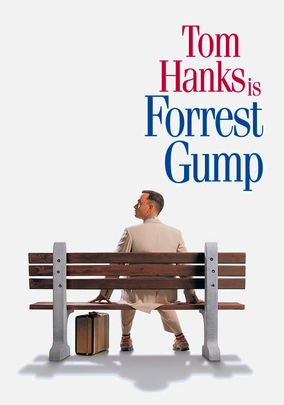
Forrest Gump-1994

Forrest Gump-1994

Director Robert Zemeckis

Starring Tom Hanks, Robin Wright, Gary Sinise

Scott’s Review #362

60000724

Reviewed January 9, 2016

Grade: A

Awarded a bevy of Academy Awards in the year 1994, Forrest Gump is a film that is engrained in many people’s memories since the film was a monster hit in the mid-1990s.

Some complained that the unrealistic nature of the film was silly, and the story too saccharine, but the film is an innocent, sweet piece about a simple-minded man’s journey through life and the insurmountable success that he achieves.

I adore the film largely from a sentimental standpoint and the memories that watching the film years later conjures up.

I find the film to be a comfort.

Zemeckis, a feel-good film director (Back to the Future-1985, Who Framed Roger Rabbit? -1988), carves a whimsical tale of a fellow, Forrest Gump (played brilliantly by Tom Hanks), a slow-witted, but gentle soul, from Alabama, and his decades-long journey through life.

His lifelong love is Jenny (played by Robin Wright), who is a troubled girl and relies on Forrest over their friendship spanning decades.

Forrest is always in the right place at the right time and influences the events of history in his innocent way.

Forrest Gump is unique in its clever use of editing to incorporate Forrest into real-life historical events, which is a big part of the appeal of the film.

In one instance, Forrest meets with Richard Nixon and reveals the Watergate scandal. He also met President John F. Kennedy after winning a football scholarship.

And who can ever forget the numerous lines made famous from the film- “Stupid is as stupid does”, and “Life is like a box of chocolates. You never know what you are going to get.”, to name just two.

What I love most about the film is that it has heart and the relationships that Forrest shares with the central characters in his life are rich. Forrest’s haggard, but kind mother (Sally Field) loves her son and they share a tender, emotional relationship.

When Forrest enlists in the Army during the Vietnam War, his grizzled commanding officer, Lt. Dan Taylor (an Oscar-nominated performance by Gary Sinise), surprisingly becomes one of Forrest’s closest friends.

The film takes a darker turn when we begin to see a more human side to Taylor after a horrible accident, which leaves him without legs. To counterbalance this tragedy, Forrest is comically wounded in the buttocks.

I am not sure if I love or loathe the character of Jenny. Wright is perfect at giving her some vulnerability and her terrible upbringing can excuse some of her actions and take advantage of Forrest for arguably her gain.

Still, she has Forrest’s heart so she cannot be all that bad.

A favorite scene occurs in Washington as Forrest speaks at an anti-war rally. Jenny, in the crowd, recognizes Forrest and their reunion is sweet. Jenny, now a hippie and expelled from school, returns to Forrest’s life.

The fate of both Jenny and Mrs. Gump are scenes that will undoubtedly require tissues to get through as they are tender and emotional as can be.

Zemeckis’s Forrest Gump (1994) has emotion, sweetness, and heart, and those are nice qualities for a film to have.

It is not too sappy overwrought or manipulative, instead provides an honest story.

Oscar Nominations: 6 wins-Best Picture (won), Best Director-Robert Zemeckis (won), Best Actor-Tom Hanks (won), Best Supporting Actor-Gary Sinise, Best Screenplay Based on Material Previously Produced or Published (won), Best Original Score, Best Sound Effects Editing, Best Sound, Best Art Direction, Best Cinematography, Best Makeup, Best Film Editing (won), Best Visual Effects (won)

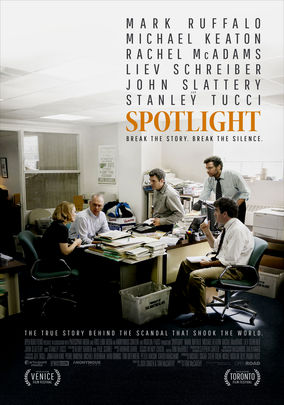
Spotlight-2015

Spotlight-2015

Director Thomas McCarthy

Starring Michael Keaton, Mark Ruffalo, Rachel McAdams

Scott’s Review #294

80061341

Reviewed December 9, 2015

Grade: B+

Spotlight (2015) is a film with an important story to tell.

A telling of true events that occurred within the Catholic Archdiocese for ages, Spotlight’s focus is specifically on the Boston scandals, as a team of reporters working for the Boston Globe uncovered and exposed a multitude of child molestation cases committed by priests.

They were subsequently covered up, leaving victims paid off to keep quiet. The number of proven cases in Boston alone is staggering.

Starring are a plethora of talents including Michael Keaton, Mark Ruffalo, and Rachel McAdams, who lead the pack.

They make up the “Spotlight” team at the newspaper,  an investigative unit that works on special stories as they arise.

Their new boss, Marty Baron (ironically a Jewish man), played compellingly by Liev Schrieber, takes over as head of the department. He quizzically asks why the story is not already a priority. Suddenly it is a hot-burner issue and the film delves into an investigation to uncover the facts.

Spotlight is a minimalist film. There is nothing cinematically unique or razzle-dazzle about it, but somehow that is okay.

In some aspects, the film reminds me of the 1975 thriller All The Presidents Men, starring Dustin Hoffman.

For instance, the bleak, bare news rooms-sterile in their look, are similar- cubicle after cubicle,  harsh lighting, and generic conference rooms.

This is the filmmaker’s intent.

Also, the fast, energetic pacing, successfully emitting the tight deadlines newspaper folks face, transfers perfectly on film.

The sexual abuse scandal is a cold, harsh reality and the film introduces several victims, who, now as adults, are forever scarred. Some attend support groups, some take drugs, one is sadly not “all there”. Another, now a gay man, was singled out by a priest during a vulnerable period in the then-young boy’s, life.

It is a heartbreaking reality that many victims in the film are based on real cases.

Let’s focus on Schrieber’s character for a minute.  He gives such an understated yet compelling performance there is a risk it will wind up being overlooked. He calmly, yet passionately initiates the case. It is not a showy performance and subdued but a compelling one if enough attention is paid to it. He is a standout.

Unfortunately, the film does not delve much into the defense (if any) of the Catholic church. Did they do anything but deny the allegations? Why were the victims paid off? Not much is noted from the church’s point of view.

In real life, the Catholic church did hide the abuse that transpired for decades.

A slight negative is that the film does not delve into the characters’ personal lives.

Michael Keaton’s character, Robby Robinson, is arguably the lead character, spearheading the case,  though very little is known about him.

Is he married? happily? Yes, he is a workaholic, but what else?

Ruffalo’s Michael Rezendes is separated from his wife, but little is known to the reasons.

Finally, McAdam’s Sacha is probably the most fleshed-out. She is happily married, close with her religious grandmother, and hurt by the scandal. But we do not know her in-depth either.

I found myself wanting to know more about these people.

All in all, Spotlight (2015) is a superior film deserving of the recognition it is receiving. Intense, gritty, and filled with honesty, it is a story that needed to be told and has been told well.

Oscar Nominations: 2 wins-Best Picture (won), Best Director-Tom McCarthy, Best Supporting Actor-Mark Ruffalo, Best Supporting Actress-Rachel McAdams, Best Original Screenplay (won), Best Film Editing

Independent Spirit Award Nominations: 5 wins-Best Feature (won), Best Director-Tom McCarthy (won), Best Screenplay (won), Best Editing (won), Robert Altman Award (won)

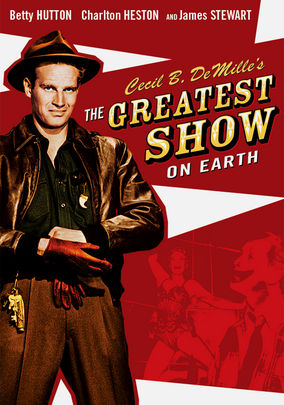
The Greatest Show on Earth-1952

The Greatest Show on Earth-1952

Director Cecil B. DeMille

Starring Charlton Heston, Betty Hutton, James Stewart

Scott’s Review #204

60034703

Reviewed December 14, 2014

Grade: B+

Considered by some critics to be one of the worst Best Picture winners of all time, The Greatest Show on Earth (1952) is quite an impressive Hollywood spectacle and tells the story of the world’s largest railroad circus as they launch a tour and travel throughout the United States, with plenty of drama to experience throughout the film.

The film stars Charlton Heston, Betty Hutton, and James Stewart as the general manager, acrobat, and clown of the show, respectively.

The film used over 1,400 real Ringling Bros. and Barnum & Bailey employees and hundreds of animals in its production, giving it an authentic circus feel.

Unfortunately, the film also has a schmaltzy quality and lacks the best acting, which surprisingly does not bother me and, strangely enough, works in a way.

Various characters have affairs with each other or fall in and out of love rather quickly- it makes for good drama, anyway.

Of course, the main appeal is the extravagant show. While the drama sometimes takes center stage, the lavish production and actual circus events shine through.

My favorite character, and arguably the only interesting character with any depth, in The Greatest Show on Earth is Buttons the Clown, played by James Stewart.

Buttons wears his clown costume, complete with full makeup, at all times. He is kind and mysterious. We learn that he “mercy killed” his dying wife and has joined the circus for protection from the police.

A wonderful human being, he was once a Doctor and tends to anyone in the circus troupe who needs assistance. Later in the film, he plays a vital role after a tragic accident.

His heartbreaking, tender conversation with his elderly mother, whom he only sees secretly once a year for seconds as she tearfully and discreetly visits him in the audience, is painfully sad to watch and is such a sweet scene.

The Greatest Show on Earth’s best scene by far still impresses today is the massive train wreck close to the conclusion.

Made in 1952, the special effects and direction of Cecil B. DeMille are brilliant. The train derails one night in a perfect way—it crashes into an approaching train and derails, highly effective in its enormity.

The scene does not look silly.

The way that all of the drama comes together in this scene—Harry, the crooked midway concessionaire and vicious elephant trainer, Klaus, who is responsible for the accident, Button’s true identity being revealed, and a significant character in peril—makes this scene top-notch and a satisfying conclusion to the film.

The stories involving Brad, Holly, Sebastian, and Angel are soapy and melodramatic and are the film’s weakest point. As a viewer, I couldn’t care less which character lusted after which or who wound up in bed together, but the movie itself is a spectacle, which is my main enjoyment.

The brightness, the revelry, and the circus performances are all wonderful.

Oscar Nominations: 2 wins-Best Motion Picture (won), Best Director-Cecil B. DeMille, Best Story (won), Best Costume Design, Color, Best Film Editing

Birdman-2014

Birdman-2014

Director Alejandro G. Iñárritu

Starring Michael Keaton, Edward Norton, Emma Stone

Scott’s Review #190

80000643

Reviewed November 6, 2014

Grade: A

Birdman (2014) is a unique art film that, happily, has garnered major exposure and publicity because a movie like this runs the risk of receiving praise and notice only from the art-house crowd itself.

The film’s star, Michael Keaton, portrays Riggan Thomson, a former action hero superstar from the 1990s, who was made famous for the “Birdman” character he created.

Having made sequels to the film, his career has since dried up and he hopes to establish credibility and prove himself a real actor by writing, directing, and starring in his play.

The film is set in and around the Broadway theater in New York City.

As opening night approaches, he struggles to pull everything together and emit a successful production while faced with an injured terrible actor, a difficult actor, his insecurities, and a miserable theatre critic destined to ruin his big chance.

To make matters worse, his daughter Sam, played by Emma Stone is a recovering drug addict who hangs around the theatre distracting actors with her charm and good looks.

Naomi Watts and Edward Norton play Leslie and Mike, other cast members in the production. Watts is sympathetic as the emotional actress with a heart of gold who finally has her dream of performing on Broadway realized.

Norton, outstanding as Mike, is blunt yet socially awkward and can only perform truthfully on stage.

Keaton is simply a marvel as he plays a dark and vulnerable man. He hates and wishes to shed his ridiculous movie persona of yesteryear and secretly cringes when recognized by fans. He uses it with a voice inside his head when he played “Birdman” years earlier.

The uniqueness of the film is the use of what seems like one long take as the action rarely stops and is ongoing. The film belongs to Keaton, who wonderfully relays vulnerability, pain, and fear within with an outward persona of bravery and masculinity.

Throughout the film I wondered, is Riggan suicidal? What is real and what is imagined? Are certain scenes foreshadowing later events?

The film has much depth.

One marvels at how art imitates life, is Keaton portraying himself? He was the original Batman in the successful superhero franchise beginning in 1989 and his career tanked shortly after.

Birdman is a comeback film for him and he is devastatingly good.

Norton’s character Mike impressed me. He is blunt flawed, scared, and addicted to the stage.

Stone has one particularly brilliant scene as she lambasts her father and with regret, later on, tells him that the world has moved on without him and that he is irrelevant just like everyone else. It is a powerful scene.

In another, Riggan is locked outside the theater during the performance, clad only in his underwear. How on earth will he return to the stage and complete the show? The quick slights at current Hollywood superstars playing superheroes, specifically Robert Downey Jr. are deliciously naughty.

It is impossible to predict what will come next and the film is very New York theater style. Keaton’s run-in with a theater critic in a cocktail bar is the best scene in the film as the critic’s vicious critique of “You’re a celebrity, not an actor” resonates with both pain and tremendous anger for Riggan.

Riggan is a sensitive, struggling man and Keaton so wonderfully shows his vulnerability in every scene.

Oscar Nominations: 4 wins-Best Picture (won), Best Director-Alejandro G. Iñárritu (won), Best Actor-Michael Keaton, Best Supporting Actor-Edward Norton, Best Supporting Actress-Emma Stone, Best Original Screenplay (won), Best Sound Editing, Best Sound Mixing, Best Cinematography (won)

Independent Spirit Award Nominations: 3 wins-Best Feature (won), Best Director-Alejandro G. Inarritu, Best Male Lead-Michael Keaton (won), Best Supporting Male-Edward Norton, Best Supporting Female-Emma Stone, Best Cinematography (won)

12 Years a Slave-2013

12 Years a Slave-2013

Director Steve McQueen

Starring Chiwetel Ejiofor, Lupita Nyong’o, Michael Fassbender

Scott’s Review #62

70284282

Reviewed June 24, 2014

Grade: A

At the time of 12 Years a Slave’s (2013) release, a ton of buzz began circulating. Was it that good?

Considered the front-runner to win the Best Picture statue, it did go on to win the top honor.

The film is not easy to watch. It is brutal and heart-wrenching at times. I will spare the details, but the most intense scene involves a whip.

There are scenes of torture, degradation, and cruelty against the slaves by the slave owners.

While tough to watch, I applaud the film for not glossing over the atrocities of slavery. Some have criticized it for being a retread of similar films, but I disagree. It is worlds more intense than watered-down versions.

However, the film is not a downer.

Yes, a class of people is beaten down and victimized, but they also rise above and never give up hope. The fact that it’s a true story and a book was written on the subject by the real Solomon Northup makes it all the more powerful.

The performances are outstanding (Ejiofor, Fassbender, Paulson, and Nyong’o).

The look and cinematography are sharp and I love the distinctiveness of the north and south scenes. The setting is stifling hot and dreary.

There are at least two scenes where the camera pans on a shot and holds it for seemingly an eternity until an action occurs, which makes the scenes effective.

While difficult to watch, 12 Years a Slave (2013) should be viewed by everyone to see how far society has come, not forgetting how far we still need to go to eliminate discrimination and victimization.

Oscar Nominations: 3 wins-Best Picture (won), Best Director-Steve McQueen, Best Actor-Chiwetel Ejiofor, Best Supporting Actor-Michael Fassbender, Best Supporting Actress-Lupita Nyong’o (won), Best Adapted Screenplay (won), Best Production Design, Best Costume Design, Best Film Editing

Independent Spirit Award Nominations: 5 wins-Best Feature (won), Best Director-Steve McQueen (won), Best Male Lead-Chiwetel Ejiofor, Best Supporting Male-Michael Fassbender, Best Supporting Female-Lupita Nyong’o (won), Best Screenplay (won), Best Cinematography (won)

Annie Hall-1977

Annie Hall-1977

Director Woody Allen

Starring Woody Allen, Diane Keaton

Scott’s Review #48

261909

Reviewed June 19, 2014

Grade: A

Annie Hall (1978) is one of Woody Allen’s finest works and that says something as his list of wonderful films goes on and on (Manhattan, Blue Jasmine, and Interiors) are gems.

Annie Hall is a witty, intelligent, great comedy. It is sharply written, quirky, and neurotic all rolled into one.

Comedy is a tough genre. Romantic comedies are even tougher to get right.

My favorite part of the film is Woody Allen himself. Some might say he plays himself, but he is engagingly hysterical as the neurotic, skeptical, Jewish, cynical New York man named Alvy.

He meets and falls in love with equally neurotic Annie Hall, played by Diane Keaton.

They quarrel, love, and traverse from New York to California and back.

There are some very funny scenes (lobster, movie theater line, and the drive-through Manhattan), and the intelligent, crisp dialogue makes this a top-notch comedy.

Oscar Nominations: 4 wins-Best Picture (won), Best Director-Woody Allen (won), Best Actor-Woody Allen, Best Actress-Diane Keaton (won), Best Screenplay Written Directly for the Screen Based on Factual Material or Story Material Not Previously Published or Produced (won)

The Apartment-1960

The Apartment-1960

Director Billy Wilder

Starring Jack Lemmon, Shirley MacLaine

Scott’s Review #7

60011007

Reviewed June 17, 2014

Grade: A-

The Apartment (1960) is another gem by Billy Wilder (Sunset Boulevard, The Lost Weekend). This one is set in 1959 New York City, a setting and period I adore.

The black-and-white images effectively portray the loneliness and bleakness of the characters, who are all friendless, sad, and starved for love.

It questions social morality and getting ahead in the corporate world but goes from drama to romantic comedy with no sappiness.

Quite the contrary, as the film has dark moments of despair and angst.

The film influenced the television series “Mad Men”. As with most Billy Wilder films, there is a darkness of humanity, which is fascinating to watch.

Jack Lemmon and Shirley MacLaine are terrific, but their chemistry is lacking. Despite this, the film is still excellent.

The Apartment (1960) won the Best Picture Oscar.

Oscar Nominations: 5 wins-Best Motion Picture (won), Best Director-Billy Wilder (won), Best Actor-Jack Lemmon, Best Actress-Shirley MacLaine, Best Supporting Actor-Jack Kruschen, Best Story and Screenplay Written Directly for the Screen (won), Best Sound, Best Art Direction, Black-and-White (won), Best Cinematography, Black-and-White, Best Film Editing (won)