Tag Archives: Richard Haydn

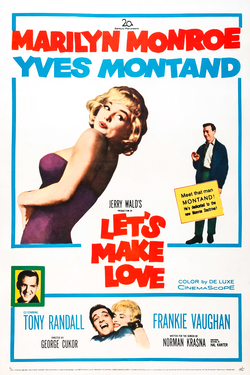
Let’s Make Love-1960

Let’s Make Love-1960

Director George Cukor

Starring Marilyn Monroe, Yves Montand, Frankie Vaughn

Scott’s Review #1,520

Reviewed February 22, 2026

Grade: C+

Let’s Make Love (1960) is a mediocre musical comedy starring Marilyn Monroe in one of her last film roles.  It would be her final musical film performance before she died in 1962.

Ironically, the iconic star plays a strong character, too frequently known for playing dimwits or money-hungry women. While refreshing, her role is almost a supporting turn for the star, playing a love interest to an uninteresting character portrayed by Yves Montand.

A very wealthy businessman, Jean-Marc Clement (Montand), has all the material possessions money can buy, but he has no love life. He seeks someone who loves him for who he is, not for his fortune.

One day, Clement learns that he is the subject of a satirical theater production and visits the set during a rehearsal. Unrecognized, the show’s unwitting producers offer him the part as himself, and he takes the gig to be close to the gorgeous yet down-to-earth actress Amanda Dell (Monroe).

This leads to a series of hijinks, misunderstandings, and, finally, an unfulfilling, predictable conclusion.

Monroe is terrific, of course, playing a character rich with honesty, integrity, and support for her theatre company. Amanda is not looking for a sugar daddy or a meal ticket and is content to while away the days doing what she loves on stage.

The film’s highlights occur when Monroe performs in showy outfits sparkling with glitter and color, oozing with sex appeal. Visually, she does not look as good as she did five years prior, appearing washed out and tired, but this can be attributed to knowing the personal turmoil she was in.

Numbers like the Cole Porter song “My Heart Belongs to Daddy,” and the title track, “Let’s Make Love,” are moderately memorable and, because Monroe performs them, are worth hearing.

It’s also cool to see exterior shots of New York City in the early 1960s grace the screen, and the backdrop of a low-key theatre is appealing.

I couldn’t help but find Clement’s character harshly unlikable and incapable of sympathy. We are asked to root for a rich man who wants a loving woman but doesn’t treat others very well.

When female staff who take dictation are called into his office, he isn’t particularly warm to them. His assistant, Alexander Kaufman, played by Tony Randall in a tepid performance, caters to Clement’s every whim but isn’t treated kindly in return.

In fact, the irritation is increased because the character of Tony Danton, Amanda’s boozy co-star, is very likable and a perfect match for Amanda.

Why the writers decided Clement and Amanda were better suited for each other is a mystery we’ll probably never figure out.

The biggest mistake is the lack of chemistry between Clement and Amanda, who have none. On the other hand, in the few scenes they share, Tony and Amanda have a tremendous connection.

What a missed opportunity.

Besides the main storyline, there is a silly side story about financing the production and a pissing match over who controls the theatre and its show. This was terribly unnecessary and would have been better if Amanda had been given her own side story, or better yet, a triangle between Amanda/Clement/Tony.

Troubles surrounded the production with various starts and stops, restarts, and proposed reshoots. This affects the film’s look and feel, and it’s apparent that the pacing is terribly uneven.

Even the incorporation of big stars like Milton Berle and cameos by Gene Kelly and Bing Crosby does nothing for the film.

It’s hard to believe that, aside from the outfits and musical numbers, George Cukor directed the film, since he would direct the sensational My Fair Lady in 1964.

Since I adore Marilyn Monroe, I desperately wanted to like Let’s Make Love (1960), but didn’t. The misplaced characters, the lukewarm pacing, and missed opportunities for a better story led to boredom and disappointment.

Oscar Nominations: Best Original Score

The Sound of Music-1965

The Sound of Music-1965

Director Robert Wise

Starring Julie Andrews, Christopher Plummer

Top 250 Films #18

Scott’s Review #49

60001917

Reviewed June 20, 2014

Grade: A

The Sound of Music (1965) is a film that almost everyone has seen multiple times. It is undoubtedly ingrained in most people’s childhood memories, especially around the holiday season, and is a treasure to watch.

It is tough to be objective, as I’ve probably seen the film dozens of times and continue to appreciate and love it with each repeated viewing.

Maria (Julie Andrews) is a pretty, young, free-spirited woman living in the gorgeous hills of Austria. We first meet her on a lush hilltop where she sings with the birds and enjoys life.

While very popular with other nuns, she does not quite fit in at the Nonnberg Abbey, where she studies to become a nun. She is sent to discover herself as the governess of seven nearby children. They are the children of well-known and now-retired Georg von Trapp (played by Christopher Plummer).

Since his wife died, no life or music exists inside the house. Maria brings life and music to all, transforming everyone’s existence into a happier one. The threat of the powerful Nazis wishing to recruit a disapproving von Trapp adds tension.

Maria and the von Trapp family fall madly in love.

As a musical, it is top-notch and is the hallmark of all musicals. The songs are challenging to get out of one’s head (“The Sound of Music,” “Climb Ev’ry Mountain,” and “My Favorite Things” are personal favorites), but the list of gems goes on and on.

The political/Nazi story was lost on me as a child, but now I see the film does have a darker tone in the second half and becomes quite severe. Indeed, since it is a family film, the details are glossed over a bit, but so what? It is the wonderful music that makes The Sound of Music great and memorable.

The first half is wholesomely sugary, sweet, and safe, and, from what I’ve read, exceptionally loosely based on the real von Trapp family. However, this hardly matters, as escapism is sometimes needed.

I hate to dissect and overanalyze a film like this, a fantasy/musical extravaganza meant to be enjoyed—lighthearted and fun for everyone.

Oscar Nominations: 5 wins-Best Picture (won), Best Director-Robert Wise (won), Best Actress-Julie Andrews, Best Supporting Actress-Peggy Wood, Best Scoring of Music-Adaptation or Treatment (won), Best Sound (won), Best Art Direction, Color, Best Cinematography, Color, Best Costume Design, Color, Best Film Editing (won)

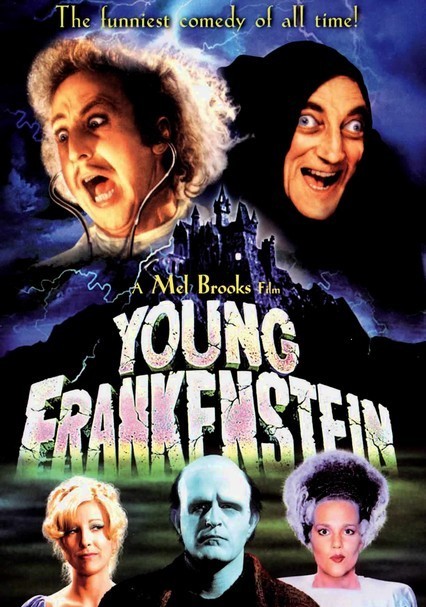
Young Frankenstein-1974

Young Frankenstein-1974

Director Mel Brooks

Starring Gene Wilder, Peter Boyle, Teri Garr

Scott’s Review #1,347

Reviewed February 27, 2023

Grade: A

Young Frankenstein (1974) is one of the funniest, most authentic examples of slapstick comedy done right. The physical timing, facial expressions, and dialogue delivery are sheer perfection from the well-known cast.

Many of whom are stars of the comedy genre.

The fact that director Mel Brooks took a classic horror film as distinguished as Frankenstein (1931), and made a cross-genre sequel, is pure brilliance.

Even better is the incorporation of black-and-white filmmaking resembling the 1930s masterpiece so the setting feels similar. This is aided by the recreation of the original set designer Kenneth Strickfaden’s lab equipment from the 1931 film. 

Brooks co-wrote the screenplay with star Gene Wilder, a comic legend, and the writing is brilliant crackling with wit and energy.

The 1970s film watched decades later has lost none of its original appeal holding up astoundingly well after most of the cast and director have left this world. It can be watched over the Halloween season for the proper atmosphere or at any time.

Ideally, recommended is to watch Frankenstein either before or after seeing Young Frankenstein for ideal pleasure.

Respected medical lecturer Dr. Frederick Frankenstein (Wilder) learns, much to his chagrin, that he has inherited his infamous grandfather’s estate in Transylvania, Romania.

The original Frankenstein’s reputation is so tarnished that Frederick wants nothing to do with the name even going so far as changing the pronunciation of his surname to “Fronkensteen”.

Begrudgingly arriving at the castle, Dr. Frankenstein soon begins to recreate his grandfather’s experiments with the help of servants Igor (Marty Feldman), Inga (Teri Garr), and the rigid Frau Blücher (Cloris Leachman).

After he creates his monster (Peter Boyle), a new set of complications ensue with the arrival of the doctor’s fiancée, Elizabeth (Madeline Kahn), and the unleashing of the frightening beast on the small town.

Comedy and horror are worlds apart but Brooks and Wilder pay respect and tribute to the classic horror film by not mocking it but instead embracing it and enhancing the story with Young Frankenstein.

You could say it’s a sequel in addition to a spoof made over forty years later.

The characters are the best part and each one is enveloped by its actor in fine form. Led by Wilder as the mad scientist, bug-eyed Igor (pronounced ‘Eyegor’ naturally) explained to be the grandson of Igor in Frankenstein, is a personal favorite of mine followed by Garr as the secret romantic interest for Wilder.

My favorite scenes are when Igor reveals that he took the wrong brain for Frankenstein’s experiment belonging to ‘Abby Normal’ instead of ‘Abnormal’ as the label read.

Inga and Frederick have instant chemistry leaving Kahn’s Elizabeth in the dust as far as a romantic triangle. Hilarity between the pair occurs in the final sequence when, after a lobotomy, she is delighted to realize that Frederick has received the monster’s “enormous Schwanzstucker”.

This is not to diminish Boyle, Leachman, or Kahn who each do their part to make Young Frankenstein an ensemble. Apt viewers will spot Gene Hackman in the role of Harold, the blind man.

As an aside, Brooks brilliantly pays tribute to Bride of Frankenstein (1934) by giving Elizabeth the same hairstyle.

The double entendre is fast and furious from knockers to the male anatomy.

The only scene that didn’t wow me was the sequence where Frankenstein and his creation perform “Puttin’ on the Ritz”. The monster singing and dancing was too amateurish for me but for some, it’s a favorite scene.

A parody that works on nearly every level and is the best of all the Brooks films (even barely usurping my forever fondness for 1977’s High Anxiety), Young Frankenstein (1974) is a treasure.

Silly, devoted, and creative, it revives a classic in only the best of ways and is filmmaking 101 in how to create a proper spoof.

Oscar Nominations:  Best Adapted Screenplay, Best Sound

And Then There Were None-1945

And Then There Were None-1945

Director René Clair

Starring Barry Fitzgerald, Judith Anderson

Scott’s Review #66

255772

Reviewed June 24, 2014

Grade: C+

And Then There Were None (1945) is adapted from a famous Agatha Christie novel of the same name from the 1930s, the first of 3 film adaptations over the years.

A group of 10 individuals from all walks of life is summoned for a weekend of merriment at a secluded mansion on a lonely island.

The premise is perfectly set up for a fascinating whodunit as the characters are knocked off one by one in sometimes bizarre fashion- the bee sting death is great.

There is a wide range of characters- the rich movie star, the spinster, the doctor, the house servant, and his wife). I was very disappointed with the DVD quality (no Blu-Ray is available for this film).

The picture and sound are abhorrent. The quality is quite grainy and faded making watching an unpleasant experience. However, a great film might withstand those issues.

The film has some appeal that the novel had- an interesting whodunit. The character histories are similar to the ones in the book and, to be fair, the film is well-acted, and the wonderful Judith Anderson (Rebecca) is always a treat to watch.

But the most disappointing aspect is the blatantly changed and completely upbeat, romantic comedy ending, vastly different from the dark novel ending, and lost major points with me for the adjustment.