Tag Archives: Independent Drama

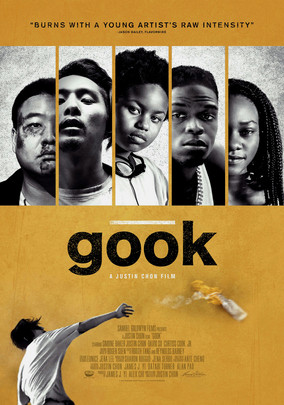
Gook-2017

Gook-2017

Director Justin Chon

Starring Justin Chon, Simone Baker

Scott’s Review #771

Reviewed June 11, 2018

Grade: B+

Gook (2017) is an independent film drama starring and directed by the rising talent Justin Chon.

Although the film is made on a very limited budget, it delivers a powerful story with a particularly jaw-dropping final sequence that I did not see coming.

If I am being an honest critic, the film drags at times and is not wholly attention-grabbing, but the wrap-up is exceptionally done.

The film’s use of black-and-white filming and a poor, ethnic Los Angeles set is winning, and it is proof that Chon is becoming someone to watch in the years to come.

The time is 1992 amid the soon-to-be-ending Rodney King police brutality trial- news stations and radio programs are abuzz with developments.

The intensity and racial strife are in the air as the trial is reaching its controversial conclusion, resulting in tumultuous riots across Los Angeles.

Two Korean American brothers, Eli (Chon) and Daniel (David So), attempt to keep their deceased father’s shoe store alive in a predominantly African American neighborhood.

The twenty-something men bond uniquely with eleven-year-old Kamilla (Simone Baker), the younger sister of their nemesis, Keith (Curtiss Cook Jr).

I was immediately struck (and impressed!) by the clever use of black-and-white cinematography, which I was not expecting from a film with such a small budget. This technique added grittiness and texture to the spread-out city and enhanced the film’s beauty.

There is something so lovely and peaceful about the juxtaposition of the shoe store’s location in a rather remote area with the looming violence and brutality of some of the film’s roughest scenes.

The harshness of the apparent racial slur title that Chon chooses, Gook, is both shocking and brave, immediately grabbing one’s interest and piquing curiosity.

This wisely sets the tone for the entire film, and viewers will certainly not mistake it for a feel-good affair. Sure, there are some light moments of banter between Kamilla and the brothers, but the conclusion of the film brings a painful reminder of how precious life really is.

Yes, the film is uneven, but that should not be a surprise with a movie that teeters around student filmmaking territory. This is hardly a slight, but merely a mention since Chon is so new at his craft.

For example, the pacing is very bizarre. While most of the film moves at a sleepy, whimsical pace, the aforementioned final sequence moves in breakneck fashion. When a terrible, accidentally self-inflicted gunshot wound sends one character to the emergency room, the speed at which the scene occurs is strange in comparison to the rest of the film.

The highlight of Gook is a tremendous, humanistic element.

The earnest and endearing relationship between Eli and Kamilla really shines through the ugliness of other components. Since the young girl comes from a broken home led by her tyrannical older brother, Keith, she has no father figure to speak of.

To compensate for what she lacks, she spends a great deal of time with the brothers helping out at the store.

Naturally, she bonds closely with Eli, whose father (presumably murdered) is not on the scene either, so they really embrace each other. Eli serves as Kamilla’s big brother, and their scenes are crisp with good dialogue and emotional pizzazz.

Another nice touch that Chon provides with his creation is an instance where the first scene is the same as the last scene- Kamilla doing a ceremonial dance amid the burning storefront.

The final scene is more meaningful and powerful than the opening scene since, by this time, the audience knows Kamilla’s fate.

It is another shining example of Chon’s artistic talent.

Props must be given to a talented up-and-comer in the cinematic scene. Justin Chon is an actor, director, creator, and all-around talented performer.

Gook (2017) is far from perfect and suffers from choppy story-telling and erratic elements, but is impressive in the good qualities it brings to the big screen.

Celebrating young filmmakers is fun, encouraging, and necessary to ensure that ambitious ideas are embraced.

Independent Spirit Award Nominations: 1 win-Kiehl’s Someone to Watch (won)

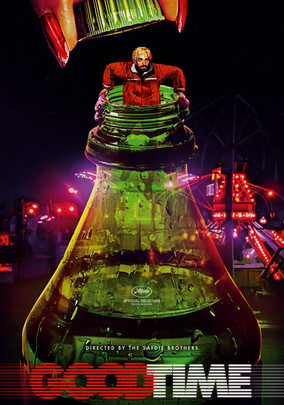
Good Time-2017

Good Time-2017

Director Ben Safdie, Joshua Safdie

Starring Robert Pattinson, Ben Safdie

Scott’s Review #767

Reviewed June 5, 2018

Grade: B+

Every so often, an actor who is known for either making mainstream films or portraying a mediocre character risks being typecast.

Fortunately, actor Robert Pattinson, known chiefly as the heartthrob from the trite Twilight films, has been given the best career role. The actor hits the jackpot with a challenging and edgy performance in the fast-paced, independent crime drama Good Time (2017).

The film is a perfect ride, and directors Ben and Joshua Safdie successfully provide excellent tension and compelling action scenes (Ben even gives a worthy supporting performance as a mentally challenged character).

The overall tone of the film is that of an edge-of-your-seat experience.

As enjoyable and taut as the film is, a few minor criticisms must be mentioned below.

Good Time begins with Nick Nikas (Ben Safdie) being quizzed by a therapist. They are quickly interrupted by Nick’s brother Connie (Pattinson), who removes him from the facility so that he can assist with a bank heist.

When the attempt goes awry and Nick is arrested, Connie does his best to spring his brother from jail and then from the hospital following an altercation with another inmate. All the while, Connie must also evade the police as he forms a strange connection with a sixteen-year-old girl, Crystal (Taliah Webster).

The fun part of Good Time is that the film is fast-paced and filled with twists and turns. Taking place largely over the course of one night, we are compelled by Connie’s journey and wonder if he will outrun the cops.

Although it is a standard thriller, Good Time rises slightly above this ranking due to its wonderful New York City setting and numerous exterior scenes—this is a major plus.

The film’s look also garners props. With a slick yet gritty and grainy feel, the camera angles are quick and plentiful. This is a great tool to keep the action going at lightning speed, and the editing deserves kudos, too.

The intensity and tension run rampant throughout.

A good example is the bank robbery scene—as the teller disappears into the vault to get the requested amount of money, she takes what seems like an eternity to return, leaving the audience (and Connie) wondering if she has alerted the authorities.

Otherwise, the film is helped immensely by the acting performance of Pattinson, who owns the film. Having not seen him in anything before, I was surprised at how good he was.

I thought of him as more of a matinee idol than a serious actor, but I was proven wrong. Grizzled and temperamental but a decent guy at times, Pattinson’s Connie is loyal to a fault, putting his brother first and foremost.

Fans of Captain Phillips (2013) will be delighted to see Barkhad Abdi cast in the small yet pivotal role of an amusement park security guard.

Nominated for the Best Supporting Actor award for Captain Phillips, the Somali-American actor has found steady work in film since his acclaimed debut performance. In his role in Good Time, the character is instrumental in kicking off the final act that leads to the downfall of at least one other character.

A few minor but notable flaws (somewhat unnecessary) that Good Time contains are worth mentioning.

Perplexing to me is the casting of Jennifer Jason Leigh as Connie’s girlfriend, Corey. Decades older than Connie, Corey is written pretty much as a nitwit attempting to use her mother’s credit card to bail out Nick.

The film does not mention the age difference or provide much meat to the role—Jason Leigh deserves better than a throwaway role like this.

Otherwise, none of the female characters are treated exceptionally well. Connie frequently directs or shouts at either Corey or even Crystal, eliciting a slightly off-putting “man in charge” vibe.

Also, a gay slur uttered by Connie is thrown into a scene for seemingly no reason, which surprises me in 2017. Still, something makes the audience root for Connie while we still want him to get his punishment.

Good Time (2017) provides quality entertainment in a specified genre with good acting.

With a weird Ocean’s Eleven style (only with one prominent character), the bank robbery theme will satisfy those in the mood for a good heist film.

The film’s title is a mystery (is it irony?), and I’m not sure it works, but overall, it is a perfect watch.

Independent Spirit Award Nominations: Best Director-Safdie Brothers, Best Male Lead-Robert Pattinson, Best Supporting Male-Benny Safdie, Best Supporting Female-Taliah Lennie Webster, Best Editing

A Ghost Story-2017

A Ghost Story-2017

Director David Lowery

Starring Casey Affleck, Rooney Mara

Scott’s Review #764

Reviewed May 27, 2018

Grade: A-

It’s marvelous to support independent film. I get most of my selections via the annual Independent Spirit Award nominations, which are announced every November.

Rich, creative films that ordinarily would be overlooked are recognized and sometimes treasured instead of forgotten entirely.

A Ghost Story (2017) is a small film fortunate to land big-name stars, undoubtedly increasing its audience—I am unsure if this film ever played in theaters anywhere.

Nonetheless, the film is a thought-provoking experience that left me perplexed and fascinated but with the knowledge that I had seen something worthwhile. I may not have completely understood it, but I also adored it.

Writer and director David Lowery must be good with Hollywood A-listers Casey Affleck and Rooney Mara, who star in A Ghost Story. The pair also appeared in Lowery’s first film, Ain’t Them Bodies Saints (2013), which received critical acclaim.

Somewhere outside of Dallas, Texas, a young married couple known as “C” (Affleck) and “M” (Mara) moves into a small house. “C” is a musician with an unusual fondness for the tiny house the couple rents.

While “M” desires to leave the house, “C” wishes to stay, somehow drawn to it. After “C” is tragically killed in a car accident, his spirit returns, unable to let go of either his wife or his home, eventually stuck in time to watch generations come and go.

A Ghost Story is a cerebral experience as we watch the events from the perspective of “C.” Adding an eerie quality is that “C” is a ghost- shrouded in a plain white bed sheet with dark circles for the eyes. While “C” does not speak, we experience his perceptions and feelings through what he sees.

At first, following “M” around as she mourns his loss, eventually, she moves on and “C” is forced to watch others live in the house. Pitifully, he awaits the return of “M” as hundreds of years go by.

Lowery is good at creating an ominous and haunting tone, mainly through his classical musical score. The film is wonderfully original.

The audience feels the loss and loneliness of both “C” and “M,” but there is a scary quality, too—not in the horror genre way, but rather, we do not know what will happen next. When “M” brings a man home, “C” is furious, knocking books to the ground and turning the lights on and off.

Later, a new family is terrorized when an unhappy “C” breaks all their dishes in a rage.

A scene that gave me the creeps is when “C,” in spirit form, gazes out the window of his house and notices another ghost looking out the window next door. This ghost looks exactly like him, except it is female- we know this because her sheet has a flower pattern.

They can communicate without speaking, and “C” learns that she has been waiting for someone to come home to her, but it’s been so long that she can’t remember who it is. This scene is sad and filled with despondency.

A forewarning is that the pacing of the film is very slow—perhaps too slow for most. After “M’s” landlord brings her a pie, we watch her devour it in a very long five-minute scene, after which she vomits the contents up.

Despite its length, this scene is powerful and important, as the entire time, we view her depression and longing for “C” to return, absorbing some little comfort from the pie.

A Ghost Story reaches its creative climax towards the end as the film comes full circle, and we begin to understand the circumstances. A dynamic sequence of the passage of time occurs, showing the demolition of the house and the development of a thriving city over time. Depressed and desolate, “C” jumps off of a high rise.

However, the final scene mystified me, and I was unable to completely make A Ghost Story (2017) add up (was there a second ghost or a rebirth of “C”?), but that is also part of the film’s intrigue.

Regardless, the film is a worthy watch if only for a cerebral story that makes one think. Its central themes of loneliness and loss are depressing but also fascinating concerning the good story that Lowery creates.

Independent Spirit Award Nominations: John Cassavetes Award

Shelter-2007

Shelter-2007

Director Jonah Markowitz

Starring Trevor Wright, Brad Rowe

Scott’s Review #758

Reviewed May 16, 2018

Grade: B+

By the mid-2000s independent LGBT films were coming fast and furious as the genre was still relatively new and ripe for the picking with good ideas.

With Shelter (2007) we have a sweet film that focuses on the new romance between two young men, one of whom is coming to terms with his sexuality.

The lead characters are not gay stereotypes and could easily pass for straight men, a characteristic impressive in LGBT film- and other mainstream films for that matter.

Rather than focusing on discrimination, the characters may face, or any obstacles from other characters (family and friends), the film wisely makes the story a character study and the demons one man wrestles with while “coming out”.

The small film is written intelligently save for one supporting character’s plot-driven decision. Also, in the modern age, we are beginning to see a bevy of similarly themed films emerge from the LGBT community, and Shelter offers nothing we have not seen before.

Set in sunny southern California, our main protagonist is Zach (Trevor Wright), an aspiring artist in his early twenties. The ultimate “good guy” he is popular with friends and girls and frequently babysits his five-year-old nephew Cody while his sister parties and has one-night stands.

When Zach meets his best friend’s older brother Shaun (Brad Rowe), the pair fall in love as Zach wrestles with his sexuality and conflicts with his plans. The sexual and family struggles of Zach are the main themes of the film.

Shelter (not sure I get the title’s meaning) is a solid slice-of-life story.

Zach initially dates a pretty girl, Tori, who is blonde, wholesome, and a girl-next-door type. This is done intentionally to show that Tori is a girl any young straight man would have an interest in.

We never see Zach show interest in any other men besides Shaun so the film leans towards a solid romantic drama once the fellas get together. Still, we see Zach’s internal struggles and accepting himself for who he is played out.

Actor Wright and director Jonah Markowitz, capture this successfully.

Shaun, arguably second fiddle to Zach, is a character that I feel is very well written. Avoiding negative stereotypes, Shaun is handsome, masculine, and charismatic. Completely confident and exuding great poise, he is a character that any gay male should look up to.

He is openly gay yet “one of the guys” as he should be. He immediately connects with Cody becoming a father or cool surrogate uncle figure for the lad. A quick concern of Zach’s sister Jeanne’s of having the boy around a gay man is trivialized in a quick form.

Another positive to the film is the multiple scenes showing Zach, Shaun, and Cody as a happy family and how normal this is. Examples of this are frolicking around the beach playing football or horseplay.

A quiet dinner of barbeque steaks and red wine for the men and macaroni and cheese for Cody elicit images of a connected family unit despite some in society still poo-pooing this idea.

The film presents the connectivity as normal.

A tiny flaw in the character of Jeanne shows her willingness (almost eagerness) to leave Cody (and her ailing father) behind when she decides to take off to Oregon with her brand new boyfriend. This point seems rushed and out of character.

While a party girl with a crappy job in a grocery store Jeanne did exhibit heart and was written as sympathetic and caring throughout the film. Surprising and unrealistic to me is that she would up and leave her life.

A paltry excuse of “Oregon not allowing kids” was left unclear and unexplained.

A part coming-of-age story, part coming out story, Shelter (2007) is an example of a little film that could with an appreciation of independent cinema.

The film tells a nice story of one man’s journey to self-discovery and the individuals he surrounds himself with.  With impressive California oceanfront and working-class principles as a backdrop, the film has a calming texture and weaves a solid experience for viewers to enjoy.

Lean on Pete-2018

Lean on Pete-2018

Director Andrew Haigh

Starring Charlie Plummer, Steve Buscemi

Scott’s Review #747

Reviewed April 24, 2018

Grade: B+

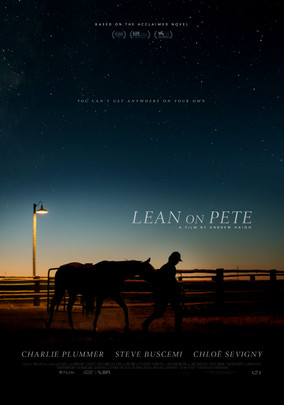
Lean on Pete (2018) is a heartbreaking and emotional slice-of-life film written and directed by British director Andrew Haigh.

The film centers on the relationship between a boy and a horse, so the heartstrings will be tugged a lot as the viewer is taken on a journey as the protagonist struggles through both pain and triumph.

While slow-moving and matter-of-fact, the film celebrates excellent writing and good story chapters, perfectly nestled into the independent drama genre.

Based upon the novel of the same name—reportedly a much darker experience—actor Charlie Plummer portrays Charley Thompson, a fifteen-year-old boy living outside of Portland, Oregon, with his troubled father.

His mother has taken off for parts unknown.

As his already complicated life turns upside down after a violent attack, Charley becomes increasingly attracted to the world of local horse racing and becomes involved with a shady horse trainer, Del Montgomery (Steve Buscemi).

There, he befriends and falls in love with an aging horse named Lean on Pete, who sadly is destined for the slaughterhouse in Mexico.

The film is about Charley’s journey and determination to survive while facing seemingly insurmountable odds and obstacles. The intriguing aspect of Lean on Pete is watching what Charley experiences and hoping against hope that he will come out unscathed and undamaged.

The youngster aspires to reach his estranged aunt, whom he knows only to have been living in Wyoming as a waitress. How on earth will he be able to find her? If he does reach her, will she welcome him with open arms, as he hopes, or will he suffer more defeat?

Several key aspects struck me as I watched this film. Charley embarks on his travels to find his beloved aunt, with Lean on Pete in tow, and encounters many individuals who either aid or hinder his intentions.

However, the common theme of waitresses continues to be portrayed—for starters, his aunt is referenced as working as a waitress at a bar. When Del gives Charley some fatherly advice, he implores him that the best women have always worked as waitresses.

On the road, he is treated kindly by two different waitresses—one of whom gives him free dessert, the other gives him a major break. I am not sure why Haigh chose to add this to the film, but it is a nice touch and effectively gives the story a warm, blue-collar sensibility.

Another intelligent decision Haigh makes is to keep the focus on Plummer and Charley’s facial expressions and reactions during pivotal scenes- for example, a scene where Charley is painting a house for extra money is essential.

As he hears a jovial father and son playing outside, Haigh shoots Charley’s reactions to this poignant scene rather than deciding to show the father and son. Hearing their pleasure is enough to elicit a look of pain on Charley’s face, rather than a blatant scene of said father and son shoved down the viewer’s throat.

Enough praise cannot be given to young talent Plummer, who gives a layered performance that will surely make him a star in future years.

The actor possesses an earnest, trustworthy sensibility, making him a likely hero in any film he appears in. Furthermore, he quietly gives Charley depth with various emotions, including disappointment, fear, and anger at his predicament.

The supporting cast members give well-acted performances that add to the overall meat of the story. As grizzled, yet responsible Del, Buscemi sinks his teeth into a role that allows his sarcastic humor and wit to take center stage, and he is perfect.

Chloë Sevigny, like Bonnie, a female jockey who befriends Charley, yet also gives it to him straight with lessons on life’s hard knocks, offers a satisfactory performance.

Lean on Pete (2018) is a quiet film that elicits an emotional response from its intended audience by giving firm texture to the story and fantastic cinematography of the western United States landscape.

Viewing a likable young adult in constant turmoil seems to be a complex subject, but instead, it is rather beautiful and inspiring, as captured by Haigh’s piece, instead of a complete downer as it might have been.

The film is a tale of a journey and struggle that accomplishes what it sets out to achieve.

Do the Right Thing-1989

Do the Right Thing-1989

Director Spike Lee

Starring Danny Aiello, Spike Lee

Scott’s Review #746

Reviewed April 21, 2018

Grade: A

Do the Right Thing is one of the few great films to come out of 1989, not remembered as a fantastic year in cinema when most mainstream films were as glossy as tin foil- and barren of quality substance.

Here we have a small, independent gem that made people have discussions about current race relations in the United States and also became a monumental, influential film.

Filmmaker (and star) Spike Lee carves a controversial story of racial tensions in a Brooklyn neighborhood one hot summer day.

Beginning rather light and comedic, then turning violent and dark, the action is set in a largely black neighborhood, Bedford-Stuyvesant, Brooklyn, where twenty-five year old, Mookie (Spike Lee) works delivering pizzas at an Italian pizzeria owned by Sal (Danny Aiello).

With a toddler at home and a nagging girlfriend Tina (Rosie Perez) always in his face, Mookie is unmotivated yet still a decent guy and loyal friend.

Sal has two sons who work at the pizza place- Pino (John Turturro), who is angry and racist, and nice guy Vito, who is a friend of Mookie’s.

When conflicts erupt over whether Sal’s restaurant should celebrate black celebrities and white on a wall in the dining room, tensions reach their breaking point as the intense heatwave makes matters much worse.

What makes Do the Right Thing a marvel is both the overall tone of the film and the atmosphere relayed by Spike Lee, who does an incredible job of writing, producing, and starring in the film.

The elements having little to do with the actual story immediately impress as big, bright colors, in comic book style scream at the big screen in bold fashion, eliciting both a warm, inviting feeling and an angry, contemptuous vibe.

The loud rap and hip-hop beats are exceptionally instrumental in portraying a certain feeling and emotion in the film. Made independently, with little budget, the film feels raw and intense from the get-go.

Brooklyn, and New York City, in particular, are the perfect settings as Sal and his family are white folks living in a predominantly black neighborhood, so, in turn, are the minorities in the story.

Additionally, the viewer sees the friendly neighborhood and feels a sense of belonging regardless of race- the humorous drunk, the kindly, grandmotherly type people-watching from her stoop, and the boombox music kid all form a sense of community and togetherness.

This point is tremendously important to the overall plot of the film.

The relationship between Mookie and Sal and his sons is very important and the centerpiece of the entire film, which I found quite interesting as a character study.

Open-minded, Sal is a decent man and fine with the diversity in his neighborhood- yet still true to his Italian roots. Aiello does a fantastic job of portraying this complex, conflicted character.

His two sons could not be more different from each other- Vito, who is a close friend of Mookie’s, is sympathetic and sweet- with nary a racist bone in his body.

Pino, on the other hand, is angry and resentful of the black community taking over what he feels is his territory. Finally, while lazy, Mookie is also a sympathetic character as he is conflicted once tension reaches its boiling point.

These diverse characters make the film so dynamic.

Revered director Spike Lee carves out a story and brings it to the big screen telling an important topic that is as vital in modern times as it was when Do the Right Thing was released in 1989.

The film is intelligent and timely without being condescending to either black or white races, nor preachy- instead of telling a poignant story that is angry and sometimes painful to watch, but more importantly, is empathetic and real.

Oscar Nominations: Best Supporting Actor-Danny Aiello, Best Screenplay Written Directly for the Screen
The Florida Project-2017

The Florida Project-2017

Director Sean Baker

Starring Willem Dafoe, Brooklynn Prince

Scott’s Review #730

Reviewed February 28, 2017

Grade: A

Incorporating a realism and authenticity rarely found in mainstream films, the 2017 independent drama film The Florida Project offers the viewer a glimpse into the underbelly of society, largely from a child’s perspective.

We meet a group of poverty-stricken folks residing in a crummy hotel outside of Disney World.

Shot almost entirely on location, the film is humorous, dramatic, pathetic, and compelling—a must-see. The balance between a child’s carefree outlook and the real-life adult reality is key.

Director Sean Baker, famous for the ground-breaking and brilliant transgender-themed indie from 2015, does it again with a gritty flavored location shot feast of a story involving the welfare-stricken, prostitute-laden Floridians holing up at a cheap motel.

The plot follows six-year-old Moonee, played by Brooklynn Prince, as she and her problem-prone mother, Halley (Bria Vinaite), attempt to avoid trouble and the police.

They while away the hot summer months, pandering and stealing from tourists as Halley dabbles in prostitution after failing to get a job at a nearby Waffle House.

In addition to Moonee and Halley, other prominent characters rounding out the hotel community are Bobby Hicks (Willem Dafoe), who manages the Magic Castle Motel, and is the father figure and voice of reason to the others, Ashley, Halley’s friend, Jancey, and Scooty, friends of Moonee’s.

The group holds a special bond since they are all barely existing on limited funds in a world laden with drugs, violence, and various unsavory characters.

With initial thoughts of an R-rated Little Rascals, the early scenes involve only the children as they create juvenile pranks including car spitting, bed jumping, and more serious mischief like setting fire to abandoned condos.

All non-actors, the child scenes are genuinely brilliant, and enough praise cannot go to little Brooklynn Prince, the sweet yet precocious six-year-old central child character.

The film’s final scene involving this treasured little girl is heart-wrenching and poignant, as the scene is fraught with raw emotion on the part of Prince.

Dafoe is brilliant in the role of Bobby and the actor chooses a character he does not often play. Frequently playing villains, he shines as a good man attempting to keep things together in an evil world.

On the lookout for child predators and the police, he watches out for the kids, as he sadly knows their lives will only get worse as they grow into teenagers and adults, sure to experience misery or tragic lives.

The most successful and riveting component of The Florida Project is the honest portrayal of the characters and the gritty, realism the viewer experiences.

The fact that Baker shot the film entirely on location is immeasurable and key to the story.

In a slice-of-life way, we are brought into this world for the duration of the film and learn the inner workings of the hotel, the streets, and the hotel parking lots. We live the characters’ lives and feel their struggles and small triumphs.

Most importantly, we empathize with their hopelessness—they are basically stuck, with little hope of finding a better life.

To avoid a complete downer of a film, Baker incorporates a few humorous moments, mainly the light and fun scenes between Halley and Moonee. As they dance around in their hotel room or outside on the hotel lawn as an unexpected downpour erupts, the close bond between mother and child is apparent.

The boisterous trio of kids also breaks up the monotonous adult tension of the other characters as they frolic and play without a care in the world.

The adults versus kids outlook is apparent.

Surely one of the best films of 2017, The Florida Project examines a forgotten and depressing segment of the American population and provides a sobering reality of the world in modern times.

With the Trump era in full swing, this film’s release is timely in American history and gives a sobering look at the United States in general.

Oscar Nominations: Best Supporting Actor-Willem Dafoe

Independent Spirit Award Nominations: Best Feature, Best Director-Sean Baker

A Fantastic Woman-2017

A Fantastic Woman-2017

Director Sebastian Lelio

Starring Daniela Vega, Francisco Reyes

Scott’s Review #729

Reviewed February 27, 2018

Grade: A

A Fantastic Woman is a 2017 Chilean film that is groundbreaking in subject matter and has received many accolades, including an Oscar nomination for Best Foreign Language Film.

Especially worthy of mention is the film’s lead actress, Daniela Vega, the first transgender woman to present an award at the Oscars and a dynamo performance in her represented film.

Besides the cultural achievements, the film succeeds in its own right as a compelling drama.

The film gets off to a sweet and romantic start as we meet Marina (Vega), a young waitress and aspiring singer, and Orlando (Francisco Reyes), a mature, affluent man thirty years her senior.

After surprising her with a lovely birthday cake, the pair begin to embark on a serious relationship, as Marina has recently moved in with Orlando.

When tragedy strikes and Orlando is rushed to the hospital after collapsing, Marina must face the harsh reality of her partner’s narrow-minded family and suspicions from law enforcement.

What a wonderful starring vehicle for this astounding young talent, Vega. The film shares a story that has never been told before, though the transgender genre is slowly coming into its own—like 2015’s brilliant Tangerine.

With A Fantastic Woman, though, the storytelling is more intimate, personal, and explicit from Marina’s point of view. Faced with financial issues and losing her love, she is forced to hurdle obstacles centered around her lifestyle that she had thought had been conquered through her open life with Orlando, who loved her for who she is.

Vega expresses so much with her wide-eyed stares and introspective glazed looks. A remarkably subdued performance, she does not have a traditional blowup or dramatic, emotional scene. Instead, she calmly goes from scene to scene, her anger and heartbreak brimming under the surface.

As she is verbally insulted and degraded by Orlando’s bitter ex-wife, Marina stands her ground and calmly accepts the verbal attack. Even when Orlando’s thuggish relatives physically assault her with tape, she is calm in her reaction.

This is a testament to Vega’s talents.

Perhaps the most touching subplot involves Marina’s struggle to retain the dog that Orlando kindly gave her. When Orlando’s son refuses to let her keep the dog, Marina reaches her breaking point and begins to fight dirty, refusing to hand over the keys to Orlando’s flat until she gets her way.

The tender affection she has for the animal is wonderful. Despite having a few people in her corner, the dog is her pride and joy and best friend.

As stellar as Vega is, and the film belongs to her, credit and mention must be given to the supporting players, mainly unknown actors to me.

Though we feel no sympathy for Orlando’s ex-wife or his relatives, they are competently portrayed and we do feel their anger and spite.

We do not know much about the back-story, but we do know that Orlando has revealed his involvement with a trans woman and he is proud of Marina.

Actor Reyes is a dream as Orlando and we wistfully imagine a different film centered solely on his romance with Marina. In their short time together, the audience falls madly in love with the duo.

A Fantastic Woman (2017) succeeds as a nuanced, level-headed drama with a powerful message and a timely approach. Never veering over the top or being too preachy, the film is an excellent telling of a topical subject matter.

I only hope that more stories about this genre are told in the future. It is a goldmine of uncharted story-telling with so much potential.

Oscar Nominations: 1 win-Best Foreign Language Film (won)

Independent Spirit Award Nominations: 1 win-Best International Film (won)

The Big Sick-2017

The Big Sick-2017

Director Michael Showalter

Starring Kumail Nanjiani, Zoe Kazan

Scott’s Review #720

Reviewed January 29, 2018

Grade: B+

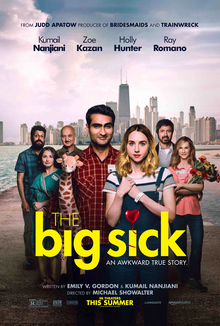
The Big Sick, a 2017 independent “dramedy” film, takes what could be a standard premise and turns it upside down, offering a fresh perspective on a familiar tale about a prospering relationship.

The screenplay is the standout as the writing is intelligent and crisp. Thanks to exceptional acting by all four principal characters, The Big Sick is a success and worth watching.

The story follows an interracial couple, Emily and Kumail, played by Zoe Kazan and Kumail Nanjiani, who have recently started casually dating. Kumail is a standup comic living in Chicago who meets the flirtatious Emily after a club performance one night.

They share a one-night stand and agree never to see one another again.

As the smitten pair break their promise and form a romance, a tragedy occurs, landing Emily in a coma.

Kumail must handle Emily’s parents, Beth (Holly Hunter) and Terry (Ray Romano), who are angry with Kumail for misleading Emily and not telling her about his strict Muslim parent’s intentions of marrying him off by arranged marriage.

The screenplay (nominated for a 2017 Oscar nomination) is loosely based on the relationship between actor/writer Nanjiani (who stars), and Emily Gordon (who co-wrote the screenplay).

Especially since Nanjiani stars, the film is sincere and authentic, as if Nanjiani is living the role.

The chemistry between Nanjiani and Kazan during their many scenes at the start is a significant plus to the film. Before the drama takes off, the audience will become fully invested in the pair as a couple.

Whether the couple flirts as Kumail drives Emily home or fights when Emily learns about his Muslim culture’s belief in arranged marriage, the couple has a tremendous connection, and it shows.

The story fabric takes an interesting turn about midway through when Emily is stricken with a debilitating illness.

A medically induced coma is needed, as Kumail is forced to pretend to be her husband, this opens up many moral and legal ramifications that the film chooses essentially to ignore, instead of dealing with the relationships between Kumail and Emily’s distraught parents.

Hunter and Romano are excellent in the parent roles. Hunter is the more showy of the two and has more meat, while Romano holds his own and powers a vital comedy club scene in which he defends his wife from a callous heckler.

Admittedly, the film decides to go the “happily ever after” route, this is hardly a surprise given that Judd Apatow is the producer.

Remember, this is the same guy who produced safe films such as Superbad (2007) and Anchorman 2 (2013). Still, the story within The Big Sick is an enjoyable, character-driven ride, if not unpredictable.

A darker-tinged affair might have set this film over the top as it contains many other credible film qualities.

The addition of comic talent in the supporting roles of Kumail’s comedy club buddies adds a good balance and nicely counterbalances the drama so that it does not become too dour.

Much of the film involves Emily in a coma, so comic talent such as SNL’s Aidy Bryant and Comedy Central’s Kurt Braunohler are suitable ads.

I enjoyed the inclusion of the traditional Pakistani custom of arranged marriages, but at times this seems played for laughs rather than being a significant obstacle to the couple.

Kumail’s controlling mother parades one young Pakistani girl after another in front of her son as a way of encouraging him to select one of them. Kumail’s traditional family is played as stereotypes and the lighthearted foils of the film.

The Big Sick (2017) succeeds with crisp, witty dialogue and a solid story that nicely complements the intended comedy.

A few too many stereotypes and goofiness keep the action light even when compared to the more serious parts—great acting all around.

Oscar Nominations: Best Original Screenplay

Independent Spirit Award Nominations: 1 win-Best Supporting Female-Holly Hunter, Best First Screenplay (won)

Beach Rats-2017

Beach Rats-2017

Director Eliza Hittman

Starring Harris Dickinson

Scott’s Review #719

Reviewed January 26, 2018

Grade: A-

Beach Rats is a 2017 coming of age film penned and directed by Eliza Hittman, a young female director from Brooklyn, New York, who incorporates her familiar geographical settings into only her second feature film.

2013’s It Felt Like Love received two Independent Film nominations, and Beach Rats has followed suit, garnering a Best Actor nomination and a Best Cinematography mention.

The film is a terrific story of conflict that its target audience will surely relate to.

The film is very low-budget but a successful character study of a young man named Frankie, played by newcomer Harris Dickinson, who wrestles with family issues and his sexuality while hanging out with his troubled friends and dating his sometime girlfriend.

Beach Rats is not a downer but rather an interesting glimpse into a teenager’s life and struggle with self-identity.

Mirroring It Felt Like Love, Hittman uses plenty of locales unique to Brooklyn, the most identifiable being the borough’s watery, nighttime beaches, which gives the film an authentic feel.

Many scenes are shot outdoors, which is a strong point of the film. Like many independent films, Beach Rats uses several “non-actors” in small roles, adding depth to the blue-collar, sometimes harsh, Brooklyn feels.

With only two features to her credit, Hittman is successful at having her hand-print on her films, making them identifiable as her own.

It is interesting how the director chooses a male character to write for. Similar to the female Liza in It Felt Like Love, both she and Frankie are vulnerable and coming to terms with their sexual feelings and desires.

The fact that Liza is straight and Frankie, at most, bisexual, is the only strength of the complex writer/director.

Dickinson is perfectly cast as Frankie. Good-looking, with chiseled features and a lithe, toned body, his bright blue eyes are expressive, as the audience empathizes with his many dilemmas.

Beach Rats is much more than a traditional “gay film”, which is admirable, it is more complex than that.

By 2017, the common theme of coming to terms with one’s sexuality has been explored.

According to Frankie, he “just has sex with men” and refuses to identify as either gay or bisexual. It is implied that because of his group of trouble-making friends, who only want to get high, he might be faced with resistance if he ever came out to them.

The supporting cast is well represented, Frankie’s mother, Donna (Kate Hodge), is faced with a tricky predicament as her husband, Frankie’s father, has just died of cancer, ripping the family apart.

She knows that Frankie keeps things from her, is she figuring out Frankie’s sexual secrets?

Donna implies that it is okay for Frankie to tell her anything, admirable, combined with her problems. Frankie’s girlfriend, Simone, is coming into her own as Frankie is, and even though the duo shares a sweet relationship, it appears doomed for failure.

The most interesting scenes in Beach Rats occur between Frankie and the mostly older men he meets virtually or in person. Though Frankie is quite nervous, Dickinson always makes the character appear confident and well beyond his years.

Being street-smart, he is never taken advantage of, as he is familiar with young men and older men. Why he mostly prefers older men is never explained, but it might have anything to do with seeking to fill the void left by his deceased father.

Or is it simply to reduce the risk of running into anyone he might know within his age group?

Hittman is not shy about featuring nudity, yet each scene is tastefully done and never seems to be for either shock value or to elicit a gasp. Full frontal nudity is featured, as well as scenes of Frankie engaging in sexual acts with both the men and his girlfriend.

Sure, Dickinson has a perfect body, but his assets are not on display unnecessarily.

More often than many “box office” films, independent films are given much creative freedom to tell a good story. Thankfully, in the case of Beach Rats, the audience is lucky enough to view a quiet, introspective tale of a conflicted adolescent and how he deals with demons and complex feelings.

Particularly for the predominantly LGBT audience who will see the film, Beach Rats (2017) will have much to offer.

Independent Spirit Award Nominations: Best Male Lead-Harris Dickinson, Best Cinematography

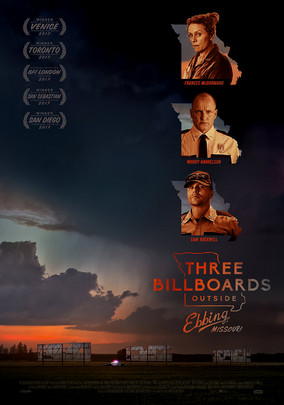
Three Billboards Outside Ebbing, Missouri-2017

Three Billboards Outside Ebbing, Missouri-2017

Director Martin McDonagh

Starring Frances McDormand, Woody Harrelson, Sam Rockwell

Scott’s Review #703

Reviewed December 4, 2017

Grade: A

Frances McDormand takes control of Three Billboards Outside Ebbing, Missouri, and never lets go. In the Martin McDonagh-directed 2017 vehicle, she rivetingly portrays an angry Midwestern woman seeking justice.

The up-and-coming director has also created such films as  2008’s In Bruges and 2012’s Seven Psychopaths.

Similar to these films, Three Billboards Outside Ebbing, Missouri, is peppered with dark comedic moments and vile, bitter characters. The film is a measured success because it is not your standard Hollywood production and is quite left-of-center.

The action begins as we meet McDormand’s Mildred Hayes, sitting alone in her beat-up station wagon, brooding by the side of the road, gazing at three tattered billboards.

She is both pissed off and thoughtful as she formulates a plan to purchase a year’s worth of billboards, questioning the local police’s ineptitude in finding her daughter’s rapist and killer.

Woody Harrelson portrays the Ebbing police chief, Sheriff Bill Willoughby, and Sam Rockwell plays the racist and dim-whited officer Jason Dixon, both displeased with Mildred’s activities.

Other casting decisions in small yet essential roles are Lucas Hedges as Mildred’s adolescent and depressed son, Robbie, and John Hawke as her ex-husband, Charlie, who is dating an eighteen-year-old ditz.

Peter Dinklage is well-cast as James, a local car salesman who is an earnest dwarf with a crush on Mildred.

Supporting roles are prevalent throughout the film, and small-town locales like Jason’s mother and Red, the owner of the advertising agency who rents the billboards to Mildred, shape the experience.

The casting in Three Billboards Outside of Ebbing, Missouri, is a strong point of the film.

The town of Ebbing is portrayed as dreary, blue-collar, and racist, which is just perfect for setting the tone of the film.

I suspect residents of the Midwest or the southern United States of America may have some issues with character representations. Jason is written as both racist and not too smart, and he encompasses numerous characters in the film.

Enough cannot be said for Rockwell’s performance, transforming from a hated character during the film’s first two-thirds to suddenly almost becoming the hero towards the end.

Props are also deserved by Harrelson’s Chief Willoughby- bordering on hick and racist, he also has a heart and cares about Mildred’s predicament- when a shocking event occurs, he becomes an even richer character.

It is worth pointing out and impressive to me as a viewer that the three prominent black characters—Willoughby’s replacement, Abercrombie, Mildred’s best friend and co-worker, Denise, and a kindly billboard painter—are each written as intelligent and sensitive, a fact I found to perfectly balance the other less sympathetic characters.

In this way, a nasty film becomes more satisfying.

Three Billboards Outside of Ebbing, Missouri, though, belongs to McDormand. She is successful at portraying a myriad of different emotions. From her sly eye-winking as she crafts a good verbal assault on whoever crosses her path, to an emotional breakdown scene towards the end of the film, McDormand embodies the character with depth.

In a gorgeous scene, she has a sweet conversation with a peaceful deer grazing nearby, and for a second, she imagines it could be her dead daughter reincarnated. The scene richly counterbalances other violent and brutal scenes.

McDormand manages to look downright homely in some scenes and beautiful in others.

A film will indeed divide viewers. Some will champion the film’s crisp writing and witty dialogue. Still, others will undoubtedly be turned off by some of the character’s foul language and nasty nature.

I found Three Billboards Outside Ebbing, Missouri (2017), sarcastic, gritty, and well-told. It is a versatile affair rich with layers and brimming with enjoyment.

Oscar Nominations: 2 wins-Best Picture, Best Actress-Frances McDormand (won), Best Supporting Actor-Sam Rockwell (won), Woody Harrelson, Best Original Screenplay, Best Original Score, Best Film Editing

Independent Spirit Award Nominations: 2 wins-Best Female Lead-Frances McDormand (won), Best Supporting Make-Sam Rockwell (won), Best Screenplay
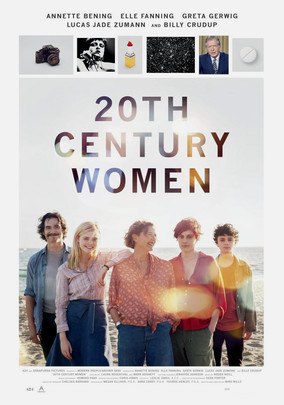
Lady Bird-2017

Lady Bird-2017

Director Greta Gerwig

Starring Saoirse Ronan, Laurie Metcalf

Scott’s Review #700

Reviewed November 28, 2017

Grade: A

Lady Bird is a 2017 independent film released by actor-turned-writer/director Greta Gerwig. It is a tremendous effort in her solo directorial debut.

No stranger to the indie syndicate herself, Gerwig puts her unique stamp on the film with a rich, female-centered perspective that works quite well and seeps with charm and wit.

It is worth noting that the story is semi-autobiographical, based on Gerwig’s life and her stormy dealings with her mother. The story is well-written, well-paced, and empathetic as the audience views a slice of life through the eyes of a restless yet kindly teenager on the cusp of womanhood.

Saoirse Ronan gives a bravura performance in the title role. Her given birth name is Christine, but she defiantly changes it to Lady Bird in a show of adolescent independence, and much to her parents, Marion and Larry’s (Laurie Metcalf and Tracy Letts ) chagrin.

Christine lives in suburban Sacramento, California, and yearns for a more exciting life in New York City, far from what she considers Dullsville, USA. Now, in her senior year, she is attending a Catholic high school.

Christine applies to college after college, hoping to escape her daily dilemmas. Christine’s best friend Julie and somewhat boyfriend Danny (Lucas Hedges) are along for the ride.

The period is 2002- shortly after 9/11.

The brightest moments in Lady Bird are the plentiful scenes between Christine and her mother. The chemistry between Ronan and Metcalf is terrific, and I genuinely buy them as a real mother/daughter duo, warts and all. They fight makeup, get on each other’s nerves, fight, cry, do makeup, etc.

I especially love their knock-down drag-outs, as each actress stands her ground while allowing the other room to shine—feeding off of each other.

My favorite Metcalf scene occurs while she is alone. Having gotten into a tiff with Christine and giving her the silent treatment while Christine flies to New York, Marion reconsiders as she melts into tears. At the same time, she drives away, regretting her decision and missing her daughter already.

Metcalf fills the scene with emotional layers as she does not speak- we watch in awe as her facial expressions tell everything.

Comparably, Ronan—likely to receive her third Oscar nomination at the ripe old age of twenty-three (Atonement, 1997, and Brooklyn, 2015, are the other nods)—successfully gives a layered performance as a teenage girl struggling with her identity and restless to see different worlds and get out of what she sees as a bland city.

Of Irish descent, Ronan is remarkable in her portrayal of a California girl- sometimes selfish, sometimes sarcastic, but always likable and empathetic.

The casting from top to bottom is terrific, as the supporting players lend added meat to the story. Christine’s best friend, Julie, played by young upstart Beanie Feldstein (Jonah Hill’s sister), is compelling as the lovable, chubby, and nerdy theater geek.

Letts is perfect as Christine’s father, depressed at losing his job in the tough economy and having to compete with young talent as he sees his career slip away.

Legendary actress Lois Smith adds heart to Sister Sarah Joan’s role- a by-the-book nun who is an incredible old chick.

Finally, Hedges, seemingly in every film from 2016 to 2017, is emotionally resounding as Danny, Christine’s troubled boyfriend, struggles with his sexuality.

Gerwig does it all with this film—she directs and writes, scripting laugh-out-loud moments and eliciting heartfelt emotion from her enchanted audience.

A hilarious scene occurs as Christine attends a dreary class assembly- an anti-abortion-themed one- by a woman who almost did not exist but for her mother’s decision not to have an abortion.

When a bored Christine icily points out that had the woman’s mother had the abortion, she would not be forced to sit through the assembly, it is a laugh-out-loud moment.

Lady Bird (2017), thanks to a fantastic writer and director and superlative casting, is a film that has its all heart, emotion, humor, and great acting.

The film is intelligently written and forces the audience to embrace its characters quite willingly. Gerwig carves a story, perhaps done many times before in film, but with a fresh and energetic feel.

Oscar Nominations: Best Picture, Best Director-Greta Gerwig, Best Actress-Saoirse Ronan, Best Supporting Actress-Laurie Metcalf, Best Original Screenplay

Independent Spirit Award Nominations: 1 win-Best Feature, Best Female Lead-Saoirse Ronan, Best Supporting Female-Laurie Metcalf, Best Screenplay (won)

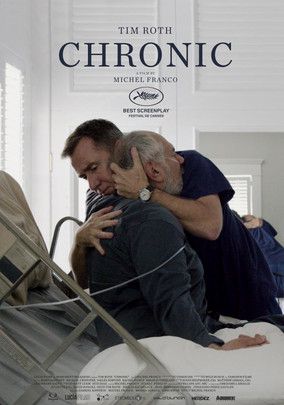
Chronic-2015

Chronic-2015

Director Michel Franco

Starring Tim Roth, Robin Bartlett

Scott’s Review #682

Reviewed September 18, 2017

Grade: A-

Chronic (2015) is a brave film, a character study, that offers an in-depth look at the life of a male nurse. He has rich relationships with his patients.

What the film also does quite soundly is reflect on not just the obvious physical needs of the patients, but the deep effects that the main character’s dying patients have on himself as well.

The film is quite bleak with a quiet element and very long scenes containing little dialogue but a treasure in bold storytelling and brazen reflection.

The film is a subdued work requiring attention and focus.

Yes, some would deem Chronic to be slow, and most would describe it as “a downer”, but dismissing the film is a mistake as it offers rich writing and an in-depth look at a vocation and lifestyle misunderstood or confusing to most people.

Tim Roth, famous for his bad boy roles, especially in Quentin Tarantino films, does an about-face, delivering a superb, subdued performance as David Wilson, a lonely and depressed nurse in the Los Angeles area.

He is a quiet, kindly man whose internal pain registers on his face as he dutifully treats his mostly close-to-death patients, sometimes attending their funerals after they have expired.

Initially, we meet David as he treats a sickly young woman. Once beautiful, she is now haggard and I cringed when the woman’s nude, skeleton-like body, is on display as David washes her with a washcloth.

The filmmakers do not gloss over his tender attention to her private areas, shot gracefully and not done garishly. Still, the long scene is frightening in its realism.

When the woman succumbs to AIDS, David reluctantly becomes involved in a celebratory drink with a newly engaged young couple after he goes to a bar to unwind.

When he pretends the deceased woman is his wife, he receives sympathy, but the couple quickly becomes aloof when he reveals what she died of.

Does he do this purposely to push the couple away? Throughout the film, we realize that David thrives on being with his patients, and can do no other work.

In contrast, he has difficulty with relations with “normal” people.

Perplexities abound in this film, which makes the viewer think and ponder throughout, and after the story ends.

For example, David searches through a young girl’s Facebook account looking at her photos- he later finds the girl, revealed to be studying medicine, and they happily reunite.

Is she his daughter or the daughter of a deceased patient?

Later, David is sued by an affluent family and subsequently fired, after he watches porn with an elderly man to lift his spirits. There is a glimmer of uncertainty where we are not sure what David’s sexual orientation is.

In the most heartbreaking sequence of all, David begins caring for a middle-aged woman with progressive cancer. Martha (Robin Bartlett) is strong-willed and no-nonsense and makes the painful decision not to continue with chemotherapy after suffering chronic nausea and later soiling herself.

It is apparent that her family only visits her out of obligation as she lies to them that her cancer is gone and she is in the clear. She then pleads with David to end her life with dignity using a heavy dose of morphine- the sequence is heartbreaking.

The final scene will blow one away and I did not see this conclusion coming. The event left me questioning the entire film, wondering how all the pieces fit together.

Surely, being overlooked for an Oscar nomination, Tim Roth proves he is a layered, complex, full-fledged actor, in a painful, yet necessary story called Chronic (2015).

Independent Spirit Award Nominations: Best Feature, Best Male Lead-Tim Roth

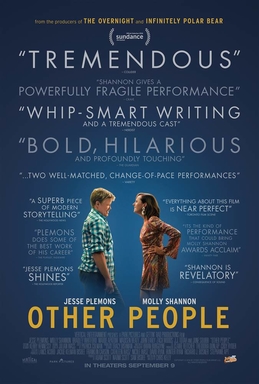
Other People-2016

Other People-2016

Director Chris Kelly

Starring Jesse Plemons, Molly Shannon

Scott’s Review #676

Reviewed August 24, 2017

Grade: B+

2016’s recipient of numerous Independent Film award nominations is equal parts a touching drama and equal parts witty comedy, providing a film experience that crosses more than one genre.

Is it a heavy drama, or is it a comedic achievement?

Without being sappy or overindulgent, Other People is a film that will elicit laughs and tears from viewers fortunate enough to see it. The subject is a tough one- a woman dying of cancer.

The title, in which one character states he always thought cancer was something that happened to “other people,” is poignant.

Jesse Plemons and Molly Shannon play son and mother. The film is both written and directed by Chris Kelly.

The very first scene is a confusing one and caught me off guard. We see the entire Mulcahey clan- father Norman (Bradley Whitford), three kids, David (Plemons), Alex, and Rebeccah, along with their dead mother Joanne (Shannon), all lying in the same bed, sobbing and clutching hands.

Joanne has just succumbed to her battle with cancer. This powerful opening scene, also the final scene, sets the tone as Kelly works his way back, beginning a year before the critical “death scene.”

Cancer is a challenging subject to cover in film, especially going the comedy/drama route.

The sensitive filmmaker must be careful not to trivialize the subject matter with too many comedic elements or heavy drama. Kelly successfully mixes humor and drama well, making it a cross-genre film.

He achieves this with capable talents like Plemons and Shannon. They share tremendous chemistry in every scene they appear in together.

Scenes that show David and Joanne crying in each other’s arms work well, as do others, such as when David takes a giddy Joanne to meet his comedy friends.

Most impressive is that the story in Other People is mainly autobiographical. Kelly, a gay man like the character of David, moved from New York City to Sacramento, California, to tend to his ailing mother, who had also died from cancer.

Actress Shannon reminded him so much of her that he had the fortune of casting the talented lady in his film- the part slated initially to go to Sissy Spacek instead.

Along with Joanne’s battle with cancer, a lovely story about David is included. A gay man, David has broken up with his boyfriend Paul, who previously lived together on the East Coast (though he still pretends to spare Joanne worry), and is returning to the West Coast.

Over the next year, we see Joanne and Norman slowly come to terms with David’s sexuality. The turbulent father/son relationship is explored during the film as Norman, initially hesitant to meet David’s boyfriend, Paul, pays for his airline ticket to attend Joanne’s funeral.

A slight miss with the film is the Norman/David dynamic.

Other than a few hints of Norman encouraging David’s struggling writing career and his obsession with David joining the gym and boxing, it is not clear what issue he takes with his son being gay or why he is uncomfortable with it. Besides the family being rather conservative, no other reason is given.

David’s sisters and grandparents do not seem to take issue with David’s sexuality, though it is not made sure if the grandparents are even aware of it. Is it a machismo thing with Norman?

This part of the story is unclear.

Still, Other People (2016) is a good, small indie film. It is rich with crisp, sharp writing and a tragic “year in the life of a cancer patient. ” The film also features good family drama and the relationships that abound when a family comes together and unites because of a health threat.

The film is nothing that has not been done before, but thanks to good direction, a thoughtful, nuanced approach, and one character’s sexuality mixed in, the film feels relatively fresh.

Independent Spirit Award Nominations: 1 win-Best Male Lead-Jesse Plemons, Best Supporting Female-Molly Shannon (won), Best First Screenplay, Best First Feature

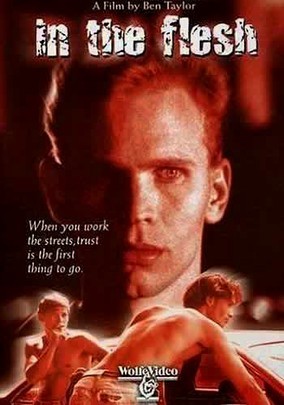
In the Flesh-1998

In the Flesh-1998

Director Ben Taylor

Starring Dane Ritter, Ed Corbin

Scott’s Review #663

Reviewed July 10, 2017

Grade: B

In the Flesh is a steamy, pre-Brokeback Mountain, LGBT film from 1998. The budget for this film is very small and the acting is quite wooden.

My initial reaction was that In the Flesh is a terrible film, yet something sucked me in as a fan, whether the crime theme or the romance (or both).

The atmosphere is quite dreamlike and moody, which I find appealing and the addition of a whodunit murder mystery amid the romantic drama is highly appealing- therefore I hesitantly recommend this film for perhaps a late-night adult viewing.

But be prepared for endless plot holes and unnecessary subplots.

Oliver Beck (Dane Ritter) is a handsome college student who works as a hustler in a dive bar named The Blue Boy in Atlanta, Georgia. He has his share of loyal, older men who use his services and adore him, especially a lonely man named Mac- a barfly at the watering hole.

When closeted Detective Philip Kursch (Ed Corbin) begins an undercover assignment to bust a drug ring at The Blue Boy, their lives intersect, as Philip falls in love with Oliver and investigates his past.

As the drug investigation seems to be quickly forgotten, a murder mystery develops when Mac is murdered at the ATM- Oliver looks on, panics,  and speeds away. When Philip covers Oliver as an alibi, the plot thickens.

Other side stories like a flashback sequence involving Oliver’s past- while driving drunk he killed his best childhood friend, the introduction of his sometime boss and girlfriend, Chloe, and his caring for Lisa, his sister, addicted to heroin- are brought to the table, but really have little to do with the main story and only confuse the plot.

The most compelling element is the relationship between Oliver and Philip and their dysfunctional love story, but many questions abound. Is Philip secretly married or dating a female? We know nothing about his personal life.

Oliver, hustling and hating every minute of it, merely as a way to support Lisa’s habit is ridiculous- why not get her help?

Neither actor Ed Corbin nor Dane Ritter will ever be accused of being the world’s greatest actor, and can hardly act their way out of a paper bag. Both actor’s performances are wooden and unemotional, even when emotion is required in the scene.

Still, oddly this somewhat works in the film.

Regardless of In the Flesh being riddled with plot holes and sub-par acting, the film has some charm.

The moody Atlanta nights, rife with sex and secrets, are quite appealing. A murderer on the loose and disguised save for a green watch is intriguing.

The film also has a mysterious, almost haunting nature, and the muted camera work, whether intentional or the result of a poor DVD copy, works very well.

Since the time is 1998, a time when more and more LGBT films were beginning to be made, but not overly so, In the Flesh and its director, Ben Taylor, deserve credit for even being able to get this film produced and made.

The mainstream success of the LGBT juggernaut, Brokeback Mountain (2006), undoubtedly helped, albeit in a small way, by this film.

Though, strangely, I never noticed the two main characters ever kiss- too soon for 1998?

Not the finest acting nor the best-written screenplay, In the Flesh (1998), is a bare-bones film that will be enjoyed largely by an LGBT audience seeking a peek into a time when these types of films were not running aplenty and typically made in the independent film venue.

I Smile Back-2015

I Smile Back-2015

Director Adam Salky

Starring Sarah Silverman

Scott’s Review #654

Reviewed June 13, 2017

Grade: B+

As a fan of Sarah Silverman, the comedienne, I was anxious to see the 2015 film, I Smile Back, which garnered her a Screen Actors Guild Award nomination.

Silverman tackles a heavily dramatic role in a film that teeters on being a pure “downer”. Many fans expecting the actress’s comic wit to be featured need not see it.

Rather, I embraced the performance and found the film to be an independent film treat, thanks to Silverman’s powerful performance. She nails the part and carries it to success.

I Smile Back is a small film that I wish had garnered more viewers.

Laney Brooks (Silverman) appears to have it all. She lives an affluent existence in Westchester County, New York with her handsome husband, Bruce (Josh Charles), and their two young children.

With a gorgeous house, dinner parties, and friends, who could ask for anything more?

Bored and troubled by a tough childhood and “daddy issues”, Laney tends to drink too much, abuse drugs and prescription pills, and carry on an affair with her best friend’s husband, all while managing to run a household.

As she gradually spirals down a darker path, Laney sees her perfect world slowly crumble around her.

Throughout the film, I asked, “Are we supposed to root for Laney or dislike her?”

Director Adam Salky does not make it easy to like her.

In addition to her substance abuse use (or over-use), Laney is rather selfish. From the small scenes when Laney drops off her kids from school and is annoyed when the crossing guard and a teacher refuse to give her special treatment, she mutters insults under her breathe as she grabs a cigarette and heads for her scandalous rendezvous.

But when she is put in great peril later in the film, following one of her benders, I could not help but feel deep sympathy for her.

It is a bit unclear what the audience should feel.

This leads me to conclude that the film belongs to Silverman.

What impresses me most is how believable she is in most scenes. She packs creative lunches for her kids and plays fun birthday cake decorating games with them, but in the next breathe snorts cocaine and rails at a neighbor lady for not celebrating Thanksgiving.

Thanks to Silverman, she plays these scenes with gusto.

Some critics have complained about the script, but I find no real fault. While not the strongest element, it is fine, nonetheless.

I Smile Back is a low-budget indie drama that serves its purpose- it does not delve too deeply into the how’s and why’s of her addiction, and a nice scene with Laney’s father (Chris Sarandon) offers no concrete evidence of why this man drove her to drugs by his abandonment.

The film seems to be more about proving a good performance by Silverman than anything else.

Sarah Silverman commands great respect for her dark portrayal in I Smile Back.

This role, combined with her recent turn in Showtime’s Masters of Sex television series, portraying a pregnant lesbian in the 1960s, proves that she has what it takes to compete with the great dramatic actresses of today.

She is much more than a stand-up comic. Here’s to hoping for more drama from this talented lady in the years ahead.

Spa Night-2016

Spa Night-2016

Director Andrew Ahn

Starring Joe Seo

Scott’s Review #645

Reviewed May 19, 2017

Grade: B+

On the surface, Spa Night (2016) may seem like a straight-ahead independent LGBTQ-themed film (of which, in recent years, there has been no shortage), but the film’s plot is twofold.

Sure, it tells the coming-of-age story of a young man’s sexuality. Still, Spa Night is also a story of the boy’s Korean parent’s financial struggles and their desire to raise a son into a successful young man, sacrificing their happiness.

The film’s tone is very subtle, and the action moves slowly, but it is a sweet and relevant story.

David Cho is a shy Korean-American high school student on the cusp of going to college. His parents (who only speak Korean) have sadly recently lost their take-out restaurant in Los Angeles. The parents struggle to make ends meet (she by waitressing, he by doing odd moving jobs), while David takes SAT classes to ensure he gets into a great college.

David is also struggling with his sexuality and one-night visits a local male spa with drunken friends. He gets a job there and begins to experience male-on-male shenanigans taking place on the sly in the spa, all the while developing his blossoming sexual feelings.

David’s development in the story is key- he is resistant to coming out as gay because his parents are traditionally Korean, constantly mentioning David finding a girlfriend and succeeding in school, becoming what they have failed to achieve.

When, at one point, he fools around with another male in the spa, David insists on a no-kissing policy. This reveals to the audience that he has issues with intimacy with another male, and in one compelling scene, some self-loathing occurs.

When he stares too long at a buddy in the bathroom, while both are inebriated, this clues in the friend, who is then distant towards David.

The film is enjoyable because it tells two stories rather than one, which helps it succeed. We also care greatly about David’s parents, who are compassionately portrayed rather than the stereotypical “tiger mom” and rigid father.

Wanting only the best for him and having no clue about his sexuality struggles, they trudge along with their issues. The father drinks too much, and the parents frequently squabble.

This is a clue to the film because it explains why David hesitates to mention anything to them, even though he is close to his parents.

I also enjoyed the slice-of-life and coming-of-age appeal that the film possesses.

Several shots of day-to-day life in Los Angeles are shown, mainly as characters go about their daily routines.

The budget allotted for Spa Night must have certainly been minimal. Still, the lesson learned is that some fantastic films are made for minuscule money, but as long as the characters are rich and the story humanistic, the film succeeds- this is the case in Spa Night.

Almost every character is of Asian descent- I am guessing all Korean actors. This is another positive I give to Spa Night.

In the cinematic world, where other cultures and races are woefully underutilized or still stereotypically portrayed, how refreshing is it that Spa Night breaks some new ground with an LGBTQ-centered film with Korean characters?

Spa Night has deservedly crowned the coveted John Cassavetes Award at the 2016 Independent Spirit Awards (for films made for under $500,000), and director Andrew Ahn is undoubtedly a talented novice director to be on the watch for.

He seems destined to tell good, interesting stories about people.

Independent Spirit Award Nominations: 1 win-John Cassavetes Award (won), Acura Someone to Watch Award

99 Homes-2015

99 Homes-2015

Director Ramin Bahrani

Starring Andrew Garfield, Michael Shannon

Scott’s Review #633

Reviewed April 13, 2017

Grade: B+

99 Homes is a 2015 independent film containing an underlying theme of morality as its central message, bubbling to the surface throughout the run.

Our main hero is faced with a major dilemma.

Set in 2010 amid the dark economic housing crisis where thousands of families lost their homes to foreclosure, the film is depressing but turns uplifting towards the end.

Reminiscent of The Big Short (2015) and Inside Job (2010) in subject matter, we witness a wonderful performance by Andrew Garfield in the lead role, with a worthy supporting turn by Michael Shannon as an opportunist.

Director Ramin Bahrani immediately creates tension with a taut musical score that bombards the screen. We see a poor victim of foreclosure, having shot himself to avoid the humiliation of being evicted from his home, followed by the introduction of a powerful real-estate mogul, Rick Carver.

Carver has wisely capitalized on the slew of Florida working-class families, living well beyond their means and novice homeowners, booted from their homes thanks to adjustable mortgages that they cannot afford to pay.

Andrew Garfield plays Dennis Nash, a struggling construction worker, raising his young son and presumably supporting his mother (Laura Dern).

They are fated to be evicted even though they have tried to win an extension with the court- months behind in their mortgage payments. They feel victimized and are forced to move to a seedy motel that houses many others in the same circumstances.

Desperate for work, Dennis ironically ends up working for Rick and becomes encased in the dishonest world of real estate scheming- manipulating banking and government rules at the expense of homeowners down on their luck.

The main point is the exploitation of the “working man” at the expense of “the man” and Rick is an example of this beast. Dennis represents the goodness of humanity as he wrestles with the moral repercussions of evicting families since he has met with similar circumstances.

Is the money worth the pain and the hardship he causes people? How is it Rick has no morals, but Dennis does? Will Dennis choose money and lose himself in the process? What would the viewer do?

Despite the morality questions, the film does play like a slick thriller, with a few slight contrivances and the “wrapped up in a neat bow” style ending.

This slightly makes the film lose its luster at times. It is implied that it ends happily for Dennis and that Rick gets his “just desserts”, but what about the characters kicked out of their homes?

Sadly, as in real life, they are largely forgotten by the end and play as footnotes in a larger story. Some follow-up as to what happens to them might have been nice.

99 Homes is a thinking man’s film and will undoubtedly leave the viewer asking what he or she would do in many situations that Dennis faces.

The emotions ooze from the face of Andrew Garfield as Bahrani uses many close-ups and enough cannot be said for Garfield’s bravura performance.

In one heart-wrenching scene, he is forced to evict a man and his wife and children from their home, the man is reduced to tears, comforted by his wife-Dennis is pained.

In another, an elderly man with nowhere to go is evicted, and defeated by the side of the road.

These scenes may have played as overwrought, but Garfield convincingly brings honesty and raw emotion to the work.

Laura Dern is good in her role as a young mother, Lynn,  to Garfield’s Dennis and I am perplexed why she was cast- she barely seems old enough to play convincingly as his Mom, but she does pull it off.

However, I could not help but desire more meat from this Oscar-nominated Actress- sure there is one great scene when Lynn realizes the extent of Dennis’s involvement with Rick, but I wanted more.

Still, the acting all around in this film is superb.

What left me so bothered by 99 Homes (2015) is that situations just like the ones that played out in the film are examples of countless real-life occurrences people experienced due to greed, dishonesty, and uncaring fellow human beings and that is a sad realization.

Director, Bharani, surrounded by a stellar cast, brings this realism to the big screen in raw, honest, storytelling.

Independent Spirit Award Nominations: Best Supporting Male-Michael Shannon

American Honey-2016

American Honey-2016

Director Andrea Arnold

Starring Sasha Lane, Shia LaBeouf

Scott’s Review #622

Reviewed March 6, 2017

Grade: A-

American Honey (2016) is an unconventional coming-of-age drama that deserves kudos for being shot on a shoestring budget and having something of substance to tell.

The film is mainly shot outdoors in heat-drenched Oklahoma, Nebraska, and Kansas during the summer. It follows a group of rebellious, lonely teenagers who attempt to sell magazines as part of a shady con organization.

Their female leader uses cult-like rallying techniques to achieve loyalty.

The film is shot mainly with hand-held cameras and uses only natural light, which is an admirable feat in filmmaking.

The film’s central character is an eighteen-year-old girl named Star, played by novice actress Sasha Lane.

Saddled with a deadbeat boyfriend with two young kids that she is forced to care for, she takes food from dumpsters to survive.

One day, she is approached by a charismatic, handsome bad boy, Jake (Shia LaBeouf). Jake and a group of teenagers offer her a job in Kansas.

Hesitant but realizing her dead-end existence, she accepts the mysterious job and travels with other unsavory characters across the states, where they prey on wealthy, religious types willing to lend a hand under the guise of selling them magazines.

The central story envelopes Star, her romantic feelings for Jake, and the quandaries she faces on the road. She drinks, smokes, curses, and is sexually active, yet also savvy and wise beyond her years.

The audience wonders if she will continue this lifestyle and worries when she meets older men—all rather well-mannered and affluent.

Will they pay her for her magazines or some other form of entertainment? How will Star handle propositions and scrapes in and out of precarious situations? Throughout the film, Star grows up and becomes kind and confident.

American Honey is extremely lengthy at two hours and forty-three minutes long, especially given that the film is an independent feature and does not seem to contain many concrete plot points or much of a conclusion.

It seems to go on and on and on.

Despite this, the film never bored me. I was pretty enraptured by the antics of the story’s characters, and I found myself quite fond of the surprising love story shrouded in the hip-hop and rap soundtrack.

Star and Jake (thanks mainly to the talents of Lane and LaBeouf) have genuine chemistry and likability as a couple.

The mystery surrounding Star is we know nothing about her parents or family or how she came to this existence at such a young age. At one point, she does mention her mother dying of a meth overdose, but it is unclear whether she makes this story up for the benefit of a magazine sale or if it is the truth.

Star is rebellious but brilliant and capable, all the while exhibiting kindness to strange children and her “colleagues.”

Two key aspects of American Honey are interesting to note: the film uses almost all non-actors. Director Andrea Arnold scouted and offered roles to most of the kids at local malls or various hangouts, so the film has a powerful rawness and energy, given that it is largely improvised.

Also, the film is almost entirely shot using a hand-held camera or cellphone, which creates a shaky, documentary-style feel. However, these characteristics do not give American Honey an amateurish feel; instead, they give the film an authentic quality.

The left-of-the-center approach of featuring male frontal nudity and same-sex relations gives the film much credo as an alternative film- the teens also swear and use drugs quite a bit, which could turn some off.

Receiving a heap of 2016 Independent Film award nominations (but winning none), my reason for watching American Honey (2016) breathes some fresh air into the world of independent cinema, where sometimes too many big-name stars appear in the indies to garner some credibility.

Watching a film of novices or individuals with no acting aspirations creates a good story that is worth something. And kudos to Arnold for spinning such a fresh tale.

Independent Spirit Award Nominations: Best Feature, Best Director-Andrea Arnold, Best Female Lead-Sasha Lane, Best Supporting Male-Shia LaBeouf, Best Supporting Female-Riley Keough, Best Cinematography

Captain Fantastic-2016

Captain Fantastic-2016

Director Matt Ross

Starring Viggo Mortensen

Scott’s Review #616

Reviewed February 10, 2017

Grade: B+

A thought-provoking story that raises a question of home-schooled, non-traditional book intelligence versus the lack of social norms and interactions and debates about which upbringings are more relevant, Captain Fantastic (2016) is a terrific film with a moral center.

The film, which stars Viggo Mortensen, is a family drama with a unique spin and edgy subject matter. Mortensen is not afraid to tackle complex and thoughtful roles.

Although it is perhaps not as gritty as it could have been and feels a bit safe, it still entertains and elicits thought, a critical aspect of film often lacking in modern cinema.

Director Matt Ross immediately treats us to aerial views of the green and mountainous Pacific Northwest, where a family of seven- one father and six children aged five to seventeen, silently prey on and kill a deer grazing in the forest. This is their dinner.

The family is unorthodox, to say the least.

Led by Ben Cash (Mortensen), he teaches the children how to fight, how to survive, and how to be ready for any situation. They are brilliant kids who can recite the Bill of Rights and the most complex literature.

Soon, it is revealed that their mother, Leslie, has committed suicide, and a battle ensues between her parents (Frank Langella and Ann Dowd), who is determined to bury her “properly” with a Christian funeral, and Ben and his children, who are determined to honor her last wishes for cremation.

Ben and the gang travel via their run-down school bus to New Mexico, meeting local townspeople as a battle of cultures occurs.

I commend Ross for creating a story that challenges the viewer to think, depending on the viewer’s religious or political views. There is a risk of people either loving or hating the film.

The film is skewed toward the left, as in the dinner and sleepover scenes with Ben’s sister. Her “Americanized” family is awkward, and the families have entirely different styles.

Ross makes it clear that Ben and his family are the intelligent ones, and his sister’s kids are pretty dumb, not even knowing what the Bill of Rights is and mindlessly playing violent video games.

The fact that they are a “typical American family” is sad and quite telling of wRoss’s perspective

Captain Fantastic wisely shows that either side is not perfect. His oldest son, Bodevan, blooming sexually, has an awkward encounter with a pretty girl, proposing marriage to her with her mother present because he knows no social norms.

A younger son is attracted to a “normal” life with his grandparents, who are a wealthy couple. The grandparents are not presented as bad people; instead, they want the best for their grandchildren and fear how their lives will turn out without better structure or what they perceive as a better upbringing.

Some of the kids blame Ben for their lack of social skills and being what they perceive as “freaks.”

The film does end safely as a happy medium is ultimately reached, but I never felt cheapened by this result. I found Captain Fantastic rich in intelligent writing and a challenging tale.

Many moments of “what would you do?” were brought to the forefront. Mortensen portrays Ben Cash flawlessly, mixing just the right vulnerability with the stubbornness of the character, and it is an excellent film for anyone fearing being intelligent is not cool because it is.

Oscar Nominations: Best Actor-Viggo Mortensen

Independent Spirit Award Nominations: Best Male Lead-Viggo Mortensen

The Diary of a Teenage Girl-2015

The Diary of a Teenage Girl-2015

Director Marielle Heller

Starring Bel Powley, Alexander Skarsgard, Kristen Wiig

Scott’s Review #614

Reviewed February 2, 2017

Grade: A-

I was not sure what I expected from the Independent Spirit award-winning film, Diary of a Teenage Girl (2015).

I surmised that I would be treated to a light-hearted, yet well-written coming-of-age story, but the film is much darker than I would have thought, and this is a plus.

The film is edgy.

There is so much depth to the central characters and an incredibly complex performance by newcomer, Bel Powley in the title role.

Stars Kristen Wiig and Alexander Skarsgard also give tremendous performances.

The film is based on the graphic novel The Diary of a Teenage Girl: An Account in Words and Pictures by Phoebe Gloeckner.

Set in 1976 in San Francisco, a time filled with hippies, drugs, music, and life, fifteen-year-old Minnie, an aspiring comic book writer, is as insecure as any typical fifteen-year-old is.

With wide eyes and stringy hair, she is cute, but rather quirky looking, not the prettiest girl in her class, and records her deepest thoughts into a cassette recorder. Minnie is intelligent and worldly, accepting of alternative lifestyles and drugs.

She is wise well beyond her years.

Minnie’s mother Charlotte (Wiig), lives a bohemian lifestyle, constantly partying and losing jobs, and is divorced from Minnie’s and sister Gretel’s affluent, but mostly absent father, Pascal (Christopher Meloni).

The girls refer to him as “Pascal” instead of “Dad”, which he hates. Determined to lose her virginity, Minnie is man crazy and develops a sweet relationship with her mother’s boyfriend, Monroe (Skarsgard).

Things begin slowly but develop into a full-blown sexual relationship. A controversial piece to the story is that Monroe is thirty-five years old- Minnie is only fifteen. Both Monroe’s and Minnie’s feelings are challenged due to circumstances and Minnie’s emotions spiral out of control.

The subject matter of The Diary of a Teenage Girl will undoubtedly be off-putting for many folks as the actions are technically statutory rape.

The film never goes in that direction.

Rather, director Marielle Heller crafts a tender story of young love, and when there is too much drama comic relief is added.

Monroe is never the aggressor and Minnie is. She is a young girl who knows what she wants.

Since the director is female there is no hint of Minnie being taken advantage of or regretting her affair- the film is not about this.

Rather, it is about a young girl with blooming sexuality and emotions finding herself in the world. I admire this left-of-center approach to the story immensely.

Other aspects of the film may be too much for some. Minnie and her best friend pretend to be prostitutes and orally service two young men in the men’s room on a lark.

Later, Charlotte uses filthy language to describe Monroe’s and Minnie’s relationship.

The film is not safe, but daring and honest. I admire its courage.

Enough cannot be said for the three principal actors in Diary of a Teenage Girl. Bel Powley is a find!

Nominated for an Independent Spirit award, this amazing young actress should have been recognized by the Academy Awards, but she no doubt has many years and films ahead of her.

She is a “regular girl” type and reminds me of actress Lena Dunham in her looks and her rich delivery.

Kristen Wiig is fantastic and is evolving into a great dramatic actress. As Charlotte, Wiig is wonderfully insecure and an offbeat mother. She does not discipline, but rather befriends her daughters, showering them with hugs and kisses and giving vulnerable neediness to the character.

Wiig, dynamite in the comedy/drama The Skeleton Twins (2014), has embraced small, but important indie films, and kudos to her for this.

Lastly, Skarsgard, mainly known as HBO’s villainous Eric on True Blood, is as inspiring as Monroe.

Providing his character with sympathy and humanity (tough when having an affair with a teenage girl who also happens to be your girlfriend’s daughter), Skarsgard evokes so much emotion into the role that you almost root for Monroe and Minnie before remembering that she is too emotionally fragile.

Skarsgard is brilliant in Monroe’s breakdown scene. I hope audiences see him in more of these complex roles as he is far more than a hunky actor.

Diary of a Teenage Girl (2015) intersperses graphic novel/animated elements into the story told from the perspective of Minnie and the character narrates parts of the film.

This authentic story is not only for teenagers but for smart thinkers and anyone who has ever been over their heads in the emotions of love.

Independent Spirit Award Nominations: 1 win-Best Female Lead-Bel Powley, Best First Screenplay, Best First Feature (won)

20th Century Women-2016

20th Century Women-2016

Director Mike Mills

Starring Annette Benning, Greta Gerwig, Elle Fanning

Scott’s Review #611

Reviewed January 22, 2017

Grade: A-

Annette Benning shines in her leading role in 20th Century Women (2016), a film directed by Mike Mills, a formidable independent filmmaker whose credits include 2010’s Beginners and 2005’s Thumbsucker.

In 20th Century Women, Mills serves as director and writer, so the film is his vision.

All five principal characters are quirky and well-written, though Benning’s is the most nuanced and fascinating.

The time is 1979, Santa Barbara. Despite the image of Santa Barbara as a wealthy, grand town dripping with the rich and powerful (perhaps due to the sweeping 1980s daytime soap opera of the same name), Mills does not present this film as such.

He presents Santa Barbara as a more artsy town, at least where his characters are concerned.

Benning plays Dorothea Fields, a fifty-five-year-old divorced mother of a fifteen-year-old boy, Jaimie. She is a free spirit who allows two runaways to live with her: Abbie (Greta Gerwig), a twenty-five-year-old aspiring photographer with fuchsia-colored hair recovering from cervical cancer, and William (Billy Crudup), a handyman.

They are joined by Jaimie’s good friend, Julie (Elle Fanning), a depressed neighbor.

The film nicely explores each character’s trials and tribulations and their interactions with each other in a highly quirky manner, and we fall in love with each of them.

Dorothea enlists Abbie and Julie’s help to have a positive influence after he nearly dies after a foolish teenage prank.

Mills successfully gives the period a slice-of-life feel, heavily referencing punk rock and the political climate in the film. Bands such as Talking Heads and Black Flag focus on Dorothea’s striving to learn what young people like, to remain youthful, and to stay in touch with her charges.

Dorothea is a chain smoker, and many scenes feature her pondering a situation while taking long drags. I love this aspect of the film as it showcases Benning’s cerebral performance. She is a thoughtful woman who wants her son to grow up sane and productive since his father is absent.

Sex and feminism are significant themes in the film. Abbie loans Jaimie two books by female feminist authors to help him better understand women.

When he begins to discuss orgasms and a strange conversation about sex and virginity ensues during a dinner party Dorothea is hosting, the graphic detail is a bit too much for Dorothea.

She is a conflicted character- open-minded and caring; when it comes to her son, she has a more conservative edge while trying to remain open to his new experiences as a teen.

20th Century Women is strictly a character-driven film with enormous strength. Each character is in a different place in their lives, and I adore how the film gives a conclusion to each of the characters’ lives in the years to come.

Indeed, the film follows the “happily ever after” formula, but this does not bother me. Instead, the film is so well composed that the characters’ lives enrapture me.

Admittedly, the film is slow-moving at times, but this is due to the richness of the dialogue—nothing is rushed.

Kudos to the cast. Gerwig and Fanning are incredibly excellent. Fanning’s Julie is a unique character- her mother is a psychiatrist who forces her to attend group sessions that she holds. Julie has a step-sister with cerebral palsy, so Julie frequently sleeps at Dorothea’s house as a way to escape her life.

Sexual active, Julie has a pregnancy scare during the story.

A coming of age type film set in an enjoyable time, 20th Century Women (2016) showcases the talents of a stellar cast led by Benning, takes its audience into a wonderful, character-themed world, and discusses the lives of its intriguing characters with a clear portrayal of life in the late 1970s.

Oscar Nominations: Best Original Screenplay

Independent Spirit Award Nominations: Best Female Lead-Annette Bening, Best Screenplay

Hell or High Water-2016

Hell or High Water-2016

Director David Mackenzie

Starring Jeff Bridges, Chris Pine, Ben Foster

Scott’s Review #609

Reviewed January 16, 2017

Grade: B+

Hell or High Water (2016), a splendid tale of bank robbers chased by law enforcement officers in rural western Texas, is reminiscent of the Coen Brothers’ No Country for Old Men (2007) or a classic Sam Peckinpah film from the 1970s.

The film provides a good story with a morality tale, so the viewer is unsure who to root for—the good gr tad guys. This gives the film substance compared to the typical action-guy film, which is done to death.

Odd, quirky, minor characters are interspersed throughout the film, which adds comedy and a unique feel.

David Mackenzie directed the film, but up until now, it has been unknown to me.

Chris Pine and Ben Foster play Toby and Tanner, two brothers who embark on small-town bank robberies to save their recently deceased mother’s ranch.

Tanner (Foster) is the more seasoned criminal, having spent time in jail and being more volatile than his brother. Toby (Pine) is a family man with two kids and is more intelligent and sensible than his brother.

Two Texas Rangers, Marcus Hamilton (Bridges), a grizzled man weeks away from retirement, and his partner, Alberto Parker (Gil Birmingham), pursue them.

What I enjoyed most about this film is the authenticity of the setting.

The film was shot in New Mexico but meant to be in West Texas. This is believable, and the cinematography is gorgeous. The vastness of the land and the sticky desert heat are filmed very well.

Small-town Texas is portrayed as tiny characters introduced as townspeople, giving much credo to the film.

My favorites are the diner waitress-smitten with the handsome Toby (and her $200 tip), and t-bone waitress- grizzled and rude after forty-four years in the same place. Their sassy and abrasive behavior works and adds much to the film.

Dale Dickey is a treat in any film, and her turn as a bank employee is a joy.

How nice to see Chris Pine in a challenging role. His character is conflicted morally. Not wanting to hurt anyone, he struggles with the robberies and wants to do right by his kids and mother.

He is a decent man caught in uncertain circumstances, and Pine does an excellent job of portraying him, proving that the actor is becoming more than just a pretty face.

Bridges plays anger quite well, and it is nice to see the actor succeeding career-wise in his golden years. His Texas Ranger character is determined to uphold the law. Still, below the surface, he is more than a bit worried about his upcoming retirement, closing a chapter in his life that is undoubtedly important to him.

His relationship with his partner is jovial and buddy-like, but is there an underlying physical attraction between the men?

The film does not go there, but perhaps on a subconscious level, it is hinted at.

A fantastic scene laced with tension occurs near the film’s end when two of the main characters are killed. It is a stand-off of sorts atop a desert mountain ridge. One of the characters loses it, which results in a shoot-out and a shocking loss of life.

The scene is excellent in that it is a good, old-fashioned shoot ’em up done well.

Hell or High Water (2016) is a gritty action film with excellent elements, nice characterization, and clean fun. It’s a throwback to a long-time crime western without the standard stock characters.

This film is more layered than the traditional and intelligently written, achieving something unique.

Oscar Nominations: Best Picture, Best Supporting Actor-Jeff Bridges, Best Original Screenplay, Best Film Editing

Independent Spirit Award Nominations: 1 win-Best Supporting Male-Ben Foster (won), Best Screenplay, Best Editing

Precious: Based on the Novel Push by Sapphire-2009

Precious: Based on the Novel Push by Sapphire-2009

Director Lee Daniels

Starring Gabourey Sidibe, Mo’Nique

Scott’s Review #581

Reviewed January 2, 2017

Grade: A

Precious is an amazing film and one of the best to come out of the year 2009. Due to the hype, I had high expectations entering the theater and I was not disappointed.

The film is an in-your-face slug-fest with some of the rawest acting performed in recent years.

The marvelous aspect is that the film takes the viewer into a world that is probably not one’s own experience and makes them empathize with the characters.

The film is very disturbing at times, raw, gritty, and violent, but also has some light, humorous moments and an oh-so-important film to see. There is a heartwarming charm that offsets the violence perfectly.

The story itself, and the direction are basic, but the wonderful acting is what sets this film on a high pedestal. Gabourey Sidibe, a relatively unknown and novice actress, gives an astounding turn as an unloved, overweight, pregnant teen mom.

She is abused by both of her parents in separate ways and seems to have a life of pain ahead of her.

Paula Patton, who has been in several fluff films, impresses as a teacher who takes a shine to Precious. Mariah Carey is simply unrecognizable as a plain-looking social worker, who is also a sympathetic character.

However, actress and comedienne, Mo’Nique plays an unfeeling, brutal, violent mother to the hilt and holds nothing back. Her Best Supporting Actress Oscar win was deserving.

Everyone should see this fantastic slice-of-life film.

Oscar Nominations: 2 wins-Best Picture, Best Director-Lee Daniels, Best Actress-Gabourey Sidibe, Best Supporting Actress-Mo’Nique (won), Best Adapted Screenplay (won), Best Film Editing

Independent Spirit Award Nominations: 5 wins-Best Feature (won), Best Director-Lee Daniels (won), Best Female Lead-Gabourey Sidibe (won), Best Supporting Female-Mo’Nique (won), Best First Screenplay (won)

A Single Man-2009

A Single Man-2009

Director Tom Ford

Starring Colin Firth, Julianne Moore

Scott’s Review #577

Reviewed January 1, 2017

Grade: B+

A Single Man (2009) is a dark film fraught with meaning and honesty-it is a very good movie. It is a melancholy film and a bit surreal, but worth seeing.

The acting, especially from star Colin Firth, is first-rate.

The subject matter involves being gay in the 1950s and 1960s and the ramifications of living a forbidden and secretive life.

The intelligent film is based on the novel of the same name, written by Christopher Isherwood.

The film is written as a sad tale of a day in the life of a gay man living in the 1960s.

Firth portrays George Falconer, a British college professor living in liberal-minded Los Angeles. When his much younger lover (presumably a student) dies, George plans to commit suicide.

Moore plays his best friend and confidante, Charley, who is dealing with her demons.

Through flashbacks, we learn about George and his lover Jim’s secret life together and the challenges that ensued. George also had a strange relationship with a male prostitute.

We learn the path of life George leads following Jim’s tragic death- we also see them happy at one time.

A Single Man (2009) is a bit of a downer containing a definite dream-like feel and is heavy on the flashbacks, but this is intriguing to the picture and not a complaint.

A very good, but not an uplifting film.

Oscar Nominations: Best Actor-Colin Firth

Independent Spirit Award Nominations: Best Male Lead-Colin Firth, Best First Screenplay, Best First Feature