Category Archives: Drama

Birth-2004

Birth-2004

Director Jonathan Glazer

Starring Nicole Kidman, Cameron Bright

Scott’s Review #1,124

Reviewed March 18, 2021

Grade: B+

Due to the difficult nature of the film’s storyline, Birth (2004) is a tough sell to most cinema lovers.

A grown woman embarking on any sort of romance with a ten-year-old boy will turn off viewers, though can you even imagine if the genders were reversed? I was fascinated by the premise and the endless possibilities of a conclusion.

I’m not quite sure what I expected to ultimately happen but I felt slightly underwhelmed by the ending.

All in all, it is a daring effort that I wish had more payoff.

The first hour or so is extremely provocative.

Nicole Kidman excels at making the unbelievable material as believable as she can and the film is directed very well by Jonathan Glazer who gives it a haunting and mysterious Stanley Kubrick vibe.

The director would come into name recognition following his 2013 masterpiece Under the Skin.

The film opens with a voiceover of an unknown man, a professor, lecturing about his disbelief in reincarnation. The audience then sees the man jogging through New York City’s Central Park where he collapses and dies.

It takes Anna (Kidman) ten years to recover from the death of her husband, Sean, (the professor) but now she’s on the verge of marrying her boyfriend, Joseph (Danny Huston), and finally moving on. We suspect she may not be completely keen on marrying Joseph but most of their relationship is unclear. We know that she aches for Sean.

On the night of their lavish engagement party, a young boy named Sean (Cameron Bright) turns up, saying he is her dead husband reincarnated. At first, she ignores the child, thinking it’s a joke, but his knowledge of her former husband’s life is uncanny, leading her to slowly realize that he could be telling the truth.

Anna is conflicted to say the very least and Kidman effortlessly makes the audience believe that what is considered ridiculous might be true.

Is there a supernatural element here?

Her family members, led by her mother Eleanor (Lauren Bacall) are disbelieving and antagonistic towards the boy for disrupting Anna’s life.

An issue is that other than one supporting character, Clara (Anne Heche), who has a great opening sequence burying mysterious letters, the others have next to nothing to contribute to the story except to brood and get angry.

Bacall, in particular, is completely wasted in a role that could have been played by any other older actress.

Parallels to Rosemary’s Baby (1968) are hard not to make. Anna dons a similar pixie hair as Rosemary. They both reside in swanky old-style New York City high-rises that have a ghostly, haunting feeling. The ambiance is positive.

My favorite camera shot that Glazer includes is a lengthy one of Kidman’s Anna. In a close-up, the character’s reactions are on full display for what feels like several minutes. Kidman gets to show her tremendous range- tears, shock, realization.

I’ve noticed a similar shot in a handful of modern films and it’s an actor’s delight- a viewer’s too!

The finale, without giving much away, is interesting to a point. The big reveal involving Clara is intriguing until the viewer backtracks and tries to add up all the events. The fact is they don’t add up and I longed for something more concrete or believable.

There is not a good payoff.

Birth (2004) doesn’t always add up to satisfaction but it’s edgy, gloomy, and unpredictable and I enjoyed those facets enough to recommend it. This is not a mainstream film like Ghost (1990) with a similar theme- it’s much more cerebral and thought-provoking.

Kidman’s performance is the main draw here but it’s tough to find a film the actress is not great in.

The Father-2020

The Father-2020

Director Florian Zeller

Starring Anthony Hopkins, Olivia Colman 

Scott’s Review #1,123

Reviewed March 17, 2021

Grade: A

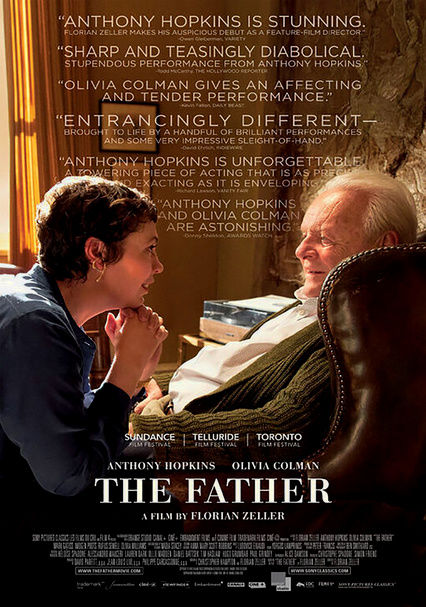
The Father is a heartbreaking 2020 drama film co-written and directed by Florian Zeller, based on his own 2012 play entitled Le Père. The piece is wonderfully written and superbly acted with incredible empathy for the characters involved.

Everyone should see this important film.

Anne (Olivia Colman) has always adored her intelligent and independent father, Anthony (Anthony Hopkins), who’s approaching the treacherous age of eighty. His mind is not what it used to be by any means, and is starting to fail. Stubborn, he rejects every caregiver she brings in to assist with his daily living.

Anne finds herself in anguish about how to solve this crisis while striving to live her own life.

Zeller spins a brilliant story from the very first scene because it’s told from Anthony’s perspective rather than solely from Anne’s.

Traditionally, in films centering around Alzheimer’s disease or dementia, the perspective is from the family member and how they cope and handle a life-altering and painful situation.

2014’s Still Alice, starring Julianne Moore, is an exception.

Immediately, the viewer is forced into the same world as Anthony and suffers as much confusion as he does. This is tremendously effective. When Anthony rummages in his kitchen in his London flat and hears a door close, he is startled.

Who can it be?

He wanders to the living room to discover a man sitting reading the newspaper, who claims to be Anne’s husband. Anthony has never laid eyes on the man before. Neither has the viewer.

Immediately, Anthony and the viewer are confused. Who is the man? Is he a burglar playing tricks on an older man, or is Anthony forgetting?

From this point in the film, it remains unclear what events are happening and what Anthony is forgetting or misunderstanding. Sometimes the characters are ambiguous.

Does Anthony think one person (Olivia Williams) is Anne, but is she his nurse? Is his caretaker his other daughter, Lucy? Is the man his daughter or Anne’s husband?

Confusion. Disorientation. Just like anyone with Alzheimer’s disease or dementia feels regularly.

Towards the finale, the most heartwrenching part of the film, Anthony weeps at his memory loss, yearning to be a child again and safe in his mother’s arms.

We feel his despair and desperation, and it’s gutwrenching to witness. Anyone who has had to care for an elder will understand. Anyone else should be empathetic.

We suffer alongside Anne, too. Help is becoming a necessity for her; she can’t make daily visits anymore, and Anthony’s grip on reality is unraveling. She wants to move to Paris, where her new boyfriend lives.

In a chilling scene, we watch Anthony sleeping peacefully while Anne gazes lovingly at him. She tucks him in and then begins to strangle him. We hope this is only a fleeting fantasy, toying with the idea of saving him from further suffering and giving her freedom back.

As we experience the changing tides of his memory, how much of his own identity and past can Anthony cling to? How does Anne cope as she grieves the loss of her father, while he still lives and breathes before her?

Hopkins and Colman are dynamic.

It’s hard to imagine Hopkins usurping his unforgettable role as Hannibal Lecter in The Silence of the Lambs (1991); he nearly does. His character is humorous, dignified, and lovable. He is also angry, feisty, and frustrated. Hopkins channels almost every emotion.

Colman is teary but strong. A woman sacrificing her own life and happiness for the burden of caring for her father. She is loyal and wouldn’t think twice about having it any other way.

The story is a downer, but one that must be witnessed.

The Father (2020) warmly embraces real life through loving reflection upon the simple human condition; heartbreaking and uncompromisingly poignant, the film tells a simple yet complex tale about life, death, and loss.

Oscar Nominations: 2 wins-Best Picture, Best Actor-Anthony Hopkins (won), Best Supporting Actress-Olivia Colman, Best Adapted Screenplay (won), Best Production Design, Best Film Editing

Luce-2019

Luce-2019

Director Julius Onah

Starring Naomi Watts, Octavia Spencer, Kelvin Harrison, Jr. 

Scott’s Review #1,122

Reviewed March 16, 2021

Grade: B+

Often unpleasant with shifting character allegiances, Luce (2019) is a painful look at race relations. The clever nuance is the relationships between people of the same race.

Superior acting elevates the film above just a nice idea, as heavyweights like Octavia Spencer and Naomi Watts lend credibility to a small indie film.

The result is sometimes muddied waters and an unclear direction, but the effort is exceptional and a worthy subject matter in modern times.

The film is down and dirty, and no apologies are given for what is dissected. The co-writer and director, Julius Onah, a Nigerian-American man, offers glimpses of grandeur, and it is impossible to guess how it will end.

We wonder if he bases the story on his own very real experiences, and I am eager to see what projects he comes up with in the future.

I found some aspects of the film implausible, if not logically impossible, and not every point adds up or is successfully outlined. But the effort and the balance of drama, thrills, and social issues are there for the taking.

I realized I was rooting for one character, and then suddenly, I was disappointed in their actions, and my allegiance shifted to another of the principal characters. This is key and a positive aspect of a good character-driven film.

At times, though, the characters’ actions are questionable, and more than one mighty shake of the head in disbelief will be experienced.

Liberal-minded parents Amy (Watts) and Peter Edgar (Eli Roth) have adopted Luce (Kelvin Harrison Jr.), a child of a refugee from a dangerous third-world country. It is referenced that they have spent years in therapy to repair the damage he has suffered as a child.

It is implied he learned to shoot and possibly kill at a young age. Now a teenager and Americanized, Luce is popular in high school and a star scholar and track star.

Life is good. Or is it?

The film, based on J.C. Lee’s play of the same name, is shot conventionally and does not look like a play.

Luce writes and submits an alarming essay that forces the Edgars to reconsider their marriage and their family after their teacher brings it to their attention.

He challenges and makes an enemy of this teacher, Harriet Wilson (Spencer), who is extremely tough on students of color, being black herself. She snoops through one student’s locker and finds drugs, ratting on him and blowing his chances for a scholarship.

When she finds fireworks in his locker, she is appalled and makes it her mission to entangle his parents, but could she have planted them herself?

Is she out to get Luce, jealous of his success when she has had to struggle for hers? Tensions mount between Harriet and Luce as the story unfolds.

The acting is powerful all around the canvas, but Harrison and Spencer deliver a standout performance that is nearly brilliant. Watts and Roth are good, too, but with more standard portrayals.

Excellent is how we get to know each of the four principles in detail. Harriet, at first, appears a demanding shrew, but her personal life makes her sympathetic. She attempts to care for her mentally ill sister herself, but after a humiliating scene at school, she is forced to return her to her home.

Suddenly, I was a fan of Harriet. Later, I was disappointed in Luce and Amy, whom I thought I was supposed to root for. The film is topsy-turvy, and I enjoyed this juicy infusion of not knowing what was to come next.

When Luce’s female classmate, who harbors an enormous secret, takes center stage, the roller-coaster ride becomes even bumpier.

I wish there were more films like Luce (2019) to hit mainstream theaters. It provokes thought and opinion while featuring social problems, preconceived notions, and trusting one’s merits.

I wish the puzzle had been solved more satisfactorily than it was.

Independent Spirit Award Nominations: Best Director-Julius Onah, Best Male Lead-Kelvin Harrison, Jr., Best Supporting Female-Octavia Spencer

Miss Juneteenth-2020

Miss Juneteenth-2020

Director Channing Godfrey Peoples

Starring Nicole Beharie, Alexis Chikaeze

Scott’s Review #1,119

Reviewed March 6, 2021

Grade: B+

I love it when a topic of relevance is explored in film or when an interesting class of people is represented or given a story worth sharing. It enriches everyone.

Black stories and actors are still woefully underutilized in cinema, and there is so much more uncharted territory to explore.

Unless it’s a story about racism, slavery, or blacks being saved by whites, it isn’t always a film that gets made.

Miss Juneteenth (2020) is a film about the black community and how they support and enrich each other, but it’s a story about them and how they strive to live the best lives they can.

Turquoise Jones (Nicole Beharie) is a single mom from the vicinity of Fort Worth, Texas, who leads a household, raises a blossoming teenager (Alexis Chikaeze), and works at a local watering hole.

She’s also a former local beauty queen who once reigned as a “Miss Juneteenth” pageant. The title is meant to celebrate Black culture and enrich the lives of the contestants, with the winner receiving a prestigious scholarship.

Life didn’t turn out as beautifully as the title promised since Turquoise had to drop out when she got pregnant, but she is determined that her daughter, Kai, will become the new Miss Juneteenth, even if Kai wants something else.

To complicate her life, Turquoise’s mother runs a local church and exudes grace and kindness on the surface, but secretly battles booze and judges others.

Turquoise is also embroiled in a love triangle with separated husband Ronnie (Kendrick Sampson) and local funeral home owner Bacon (Akron Watson). The girl has a lot going on!

I love the message that Miss Juneteenth sends, and I hope many within the black community (or any community) see the film. It encourages and inspires those who may not have much money or prospects to be their better selves.

When the pageant contestants are taught which cutlery to use while dining or the difference between a red wine glass and a white wine glass, I champion the teachers; these are life skills that teach sophistication, grace, and class, regardless of one’s financial status.

It’s an important scene to view.

It’s worth noting that Miss Juneteenth doesn’t always hit a home run. I wondered why Turquoise didn’t date Bacon, a man ideally suited for her. He adores her and is quite a catch.

I was frustrated that she kept giving what little money she had to Ronnie. I understand she felt passion for him, but after his many examples of unreliability, why didn’t she move on?

I wanted her to take more initiative, which she eventually did, but it wasn’t entirely satisfying.

Ideally, I wanted her to hit the road and run for Los Angeles or New York City. Beautiful, Torquoise could have made a better life for herself by leaving the town she had always known.

Directed by Channing Godfried Peoples, I wondered how much of the story was autobiographical and personal to her. I also wondered why Turquoise’s mother was written as she was.

Indeed, as a minor character, I would have appreciated more explanation and discussion of their mother-daughter relationship, not just Turquoise and Kai.

Turquoise does live in the past, and her desire to spend a fortune (which she didn’t have) on a pageant dress seemed superfluous and overbearing.

Understood is her determination, though I started to find this aspect slightly irritating after a while. Why didn’t she use the money and leave town?

A character study of one woman’s attempts and struggles to improve her life while residing in her past, Miss Juneteenth (2020) shows the challenges a mother faces when wanting the most for her child.

The story is a familiar one, but Peoples writes and directs with heart and charm, which supersedes the several questions and holes the film has.

The primary win is that it will enrich the lives of those who choose to see it.

Independent Spirit Award Nominations: Best First Feature, Best First Screenplay, Best Female Lead-Nicole Beharie, Best Supporting Female-Alexis Chikaeze

Saint Ralph-2004

Saint Ralph-2004

Director Michael McGowan

Starring Adam Butcher, Campbell Scott

Scott’s Review #1,118

Reviewed March 3, 2021

Grade: C

Saint Ralph (2004) is an indie drama that is overly sentimental with too many added standard plot points.  This makes the film ho-hum and extremely cliched. It feels like the attempt was to create a major studio film in independent clothes but without the grit afforded most indies.

There are plenty of ordinary setups and by the numbers, follow-through over anything different or fresh.

The film is too charming and safe for my tastes and is too feel-good. Maybe there are just too many similar types of movies made that it doesn’t stand out very well.

And since it’s an indie shouldn’t it strive for more edginess?

The message is meant to inspire and in a way it does but that only goes so far.

Saint Ralph is a story of a young man triumphing over insurmountable odds- wonderful but unrealistic. The religious elements of faith, miracles, and the Catholic high school are lost on me but some may champion those elements better.

I did enjoy the 1950s time-period and its share of decade trimmings and set pieces yet too often they feel stagey and any authenticity doesn’t feel fresh. Rather, like actors clad in period clothing.

The lead kid who plays Ralph (Adam Butcher) isn’t impressive enough though Campbell Scott who plays a priest with more wisdom than he probably should have is the best thing about Saint Ralph.

If I’m being harsh it’s unintentional but Saint Ralph is a film I’ve forgotten about a day or so after seeing it. I like a film that sticks with me and makes me think about and Saint Ralph just ain’t it.

It’s classified as a tear-jerker and I didn’t shed one.

Ralph is a troubled kid. His father has died in World War II and his mother lies ill in a coma. He smokes and masturbates resulting in adult intervention by way of strict Father Fitzpatrick (Gordon Pinsent) and kindly Father Hibbert (Campbell Scott).

He is encouraged to run in the upcoming Boston Marathon and he trains mightily with the right encouragement.

He feels if he trains hard and wins the marathon his mother will be granted a miracle by God, wake up from her coma, and live happily ever after. I won’t spoil the ending but the conclusion will satisfy pious audiences.

I embrace films that feature a character championing certain hardships and Saint Ralph does contain a youthful innocence and earnestness that holds some appeal. I felt myself rooting for him to overcome his problems. No kid deserves those hardships.

The weakness is that I felt manipulated. Since the intention was to root for Ralph it was clear what direction the film was going in and the predictability was at an all-time high.

The training sequences are reminiscent of any sports film. Think of a young Rocky Balboa training for an upcoming fight. And the saccharine ending is riddled with predictability.

Saint Ralph (2004) will ruffle no feathers and only appeal to mainstream audiences seeking safe cinema. Most people will not remember it very well.

Nomadland-2020

Nomadland-2020

Director Chloé Zhao

Starring Frances McDormand, David Strathairn, Swankie

Scott’s Review #1,116

Reviewed February 24, 2021

Grade: A

Frances McDormand, a fantastic actor in anything she is in, absolutely kills it in Nomadland (2020), an emotional film with startling realism and respect for strength and truth.

Mostly a documentary lookalike, the drama has heart while wisely incorporating real-life people versus actors in a story with enough weepy moments to go well with the dynamic cinematography.

It’s a character study in the highest regard and a lesson in what compassion is.

Chloé Zhao, who directs, also directed Songs My Brother Taught Me (2015) and was nominated for a couple of Independent Spirit Awards, which nobody saw.

Zhao has such zest and flavor for the Western American landscape, which can be both isolating and beautiful. She incorporates plenty of sunrises, sunsets, and wide shots that go well with the theme of the story she tells.

She’s well on her way to much-deserved stardom.

Following her husband’s death by cancer and her rural Nevada company town decimated, Fern (McDormand) packs up her van and starts driving, having no idea where she’s headed.

Becoming a modern-day nomad, she scrounges for work doing odd jobs and experiencing adventure along the way as she travels across the West. She meets interesting individuals, mostly nomads who try to survive, facing hardships.

McDormand may have delivered her best performance with Nomadland. Forever associated as Marge Gunderson in Fargo (1996), she is unafraid to get down and dirty in her role.

As for Fern, she has a nude scene and a scene sitting on the toilet. She also has various close-up scenes appearing tired, worried, or otherwise bleak. She wears no makeup. It’s a testament to McDormand’s craft and artistic ability to appear this way.

I admire her tremendously.

While McDormand carries the film, others must be mentioned for their terrific work. David Strathairn, who has been around forever, is one of those character actors who consistently deliver great work.

As a potential love interest for Fern, he is patient and admiring, even offering to have her move in with him and his family. A gorgeous house awaits her, but she prefers to be on the road and alone.

The non-actors make the film as rich and lovely as can be with their tales of truth, struggle, and desire. Swankie is a seventy-five-year-old woman dying of cancer.

She wants nothing to do with hospitals or treatment, but wants to live her remaining months in peace and tranquility among the wildlife in Alaska. She does just that, leaving the world on her terms.

When Fern learns that Swankie has died, she and the other nomads pay tribute to her life.

The greatness of Nomadland lies in its portrayal of a sense of community and family amongst a group of people who are otherwise dismissed or forgotten. It’s reminiscent of what the exceptional Boogie Nights (1997) did with the porn industry. It humanizes them when many dehumanize them, and it’s lovely to watch.

In a teary scene, Fern opens up to Bob, a nomad leader, about her loving relationship with her late husband, and Bob shares the story of his adult son’s recent suicide.

Bob espouses the view that goodbyes are not final in the nomad community, as its members always promise to see each other again down the road.

What a poignant statement.

Nomadland (2021) inspires those who want to do their own thing and be independent spirits. The film says that it’s okay to be your person, and I take that to heart. Be true to yourself, and good things will come. Well, at least you’ll have self-dignity and a soul.

The film contains exceptional acting, directing, editing, and cinematography. Some could perceive it as a downer, but I found it quite uplifting and inspirational.

I always say a great film will leave you thinking about it, and I’m still thinking about Nomadland.

Oscar Nominations: 4 wins-Best Picture (won), Best Director-Chloé Zhao (won), Best Actress-Frances McDormand (won), Best Adapted Screenplay, Best Cinematography (won), Best Film Editing

Independent Spirit Award Nominations: 4 wins-Best Feature (won), Best Director-Chloé Zhao (won), Best Female Lead-Frances McDormand, Best Cinematography (won), Best Editing (won)

Rabbit Hole-2010

Rabbit Hole-2010

Director John Cameron Mitchell

Starring Nicole Kidman, Aaron Eckhart

Scott’s Review #1,115

Reviewed February 23, 2021

Grade: A

Rabbit Hole (2010) is a raw and brutal film. I say that with major praise because it’s also a great film with much humanity and pathos. The dreariness of the film makes one relate to and empathize with the characters and perhaps recall a loved one who has died.

It’s truly brilliant if the viewer can withstand the sadness. I was able to tolerate the tone and immerse myself in it.

Thankfully, there are snippets of humor to offset the heavy drama.

Every film is not meant to be feel-good and enjoyable but they all should conjure emotions and Rabbit Hole succeeds in spades.

Yes, it’s a downer given the topic of the day is the loss of a four-year-old child but it’s a tragedy worth enduring to experience the powerful acting from its stars.

It’s a gem because it shows how people deal with and recover from loss if there is a way to cope with, live, and feel again without destroying oneself.

Eight months after the accidental death of their son, Howie (Aaron Eckhart) and Becca (Nicole Kidman) struggle to overcome their grief. He wants to hold on to everything that reminds him of Danny, while she would rather sell their home, relocate, and make a fresh start.

Trauma and conflict begin to appear in the relationship as Howie bonds with a member of his therapy group and Becca reaches out to a teenage boy with telling facial scars.

The drama is based on David Lindsay-Abaire’s Pulitzer Prize-winning play of the same name and the film version has the look and feel of a stage production.

Not much is shown before Danny’s death. I love this because it asks that I use imagination. The cleverness is that Danny was not killed by a drunk driver or a speeding car.

It was an accident and this point feels genuine.

The pain is watching a once-loving couple crumble from the weight of the devastation they have been dealt. Neither parent is to blame but do they blame each other? Do they resent each other because each reminds the other of Danny’s death?

A pivotal and necessary story point is watching Becca and Howie become drawn to other people, some of them surprising. Becca bonds with the teenage driver of the car that killed Danny. Howie nearly is drawn into a lurid affair with Gabby (Sandra Oh) whom he connects with at group therapy.

Is it healthier for Becca and Howie to go their separate ways? Do they stand a chance?

Most can ask themselves the same question as their partners if faced with devastating qualities. How does one pick up the pieces alone as part of a couple?

Kidman is breathtaking in her ability to generate the emotions she does. She was recognized with an Academy Award nomination. It’s terrific, but Aaron Eckhard, forever an underappreciated actor missed out on a nomination.

This is a shame because he is just as good as Kidman. Together, they are flawless, building and playing off the emotions and feelings of the other.

A film about grief, Rabbit Hole (2010) bravely tells the story of how an incident can ravage not only a relationship but our inner being turning us into someone we don’t know. This is a terrifying thought and the stellar acting and pacing only make us feel the pain others can suffer.

Oscar Nominations: Best Actress-Nicole Kidman

Portrait of a Lady on Fire-2019

Portrait of a Lady on Fire-2019

Director Céline Sciamma

Starring Noémie Merlant, Adèle Haenel

Scott’s Review #1,114

Reviewed February 19, 2021

Grade: A-

A film with tremendous artistry and a cool LGBTQ+ vibe, gay director Céline Sciamma delivers the goods with interesting finesse in Portrait of a Lady on Fire (2019).

She takes modern-looking actors and transplants them to the era of France during the late 18th century.

The film tells the story of a forbidden affair between an aristocrat and a painter commissioned to paint her portrait.

The viewer will ask themselves the following questions. What would become of two young gay women in this long-ago age? How many people repressed their true feelings and desires because of the times they lived in?

Would their different classes and backgrounds cause strife within their burgeoning relationship? I know I constantly asked myself these questions.

To those with limited cinematic patience, be forewarned. A Portrait of a Lady on Fire is plodding.

I didn’t mind this aspect, but some might. The payoff is not bombastic in an act of violence or an explosion sort of way, but it’s well worth the effort put in.

In a common approach in modern film that is feeling more standard than special, the first scene often precedes the events in the rest of the movie, so that we know how the events will turn out. But we do not know the hows and the whys.

It is immediately assumed that one character has suffered some loss or misfortune related to a painting.

Painter, Marianne (Noémie Merlant), is summoned to a remote island inhabited by very few people. She is commissioned to paint the wedding portrait of Héloïse (Adèle Haene), who is destined to be married to a nobleman in Milan, Italy.

Héloïse is depressed and despondent, wanting nothing to do with her intended, whom she has not met.

The portrait is a gift to the never-seen husband-to-be. It is revealed that Héloïse’s sister leaped to her death from the cliffs on the family estate, so it’s suggested throughout that she may suffer the same fate.

Needless to say, Marianne and Héloïse fall madly in love.

Their love is hardly ever a question, as the chemistry is immediately noticed. Sciamma, who wrote the screenplay, avoids stereotypes that would give away the sexuality of the main characters. They are not butch nor do they possess masculine qualities.

Do we wonder if they are bisexual? They never struggle with their sexuality, a dramatic cliche in other LGBTQ+ films.

I adore this because it makes the love story more powerful, rather than one character pursuing the conflicted other.

As brilliant and artistic as I found Portrait of a Lady on Fire to be, there are a couple of unexplained or unclear aspects. I am not even sure how they relate to the main story.

Waifish housemaid Sophie has an abortion with assistance from Marianne and Héloïse. Later, the three go to a bonfire gathering where women sing, during which Héloïse’s dress briefly catches fire (just as shown in the painting featured in the beginning).

When Sophie is having the abortion, there is an infant and a child nearby. Are they her children? Who are the women who sing?

I didn’t understand the point of these items.

Fortunately, these missteps can be forgiven for the grander piece is exceptional filmmaking. The final shot of Héloïse sitting in a theater is phenomenal and borrowed from Call Me By Your Name (2017), which featured an identical scene.

The camera focuses on the face of actress Haene as she conveys a range of emotions during the flawless scene. What a win for an actor!

Despite some side story flaws, I adored Portrait of a Lady on Fire (2019).

The film is exceptionally shot, and almost all shots could be portraits in their own right. Charming are the beach sequences, as when Marianne and Héloïse first ignite the flames of their passion.

My takeaway is that it tells the story of fate, but doesn’t feel like a downer. Instead, it feels like life.

Independent Spirit Award Nominations: Best International Film

Mank-2020

Mank-2020

Director David Fincher

Starring Gary Oldman, Amanda Seyfried, Tom Pelphrey

Scott’s Review #1,110

Reviewed February 9, 2021

Grade: A

Everyone knows that Citizen Kane (1941) is one of the greatest films ever made. Well, I hope so anyway. Almost always appearing at the top of ‘best of’ lists, its merits are justified, and its creativity astounding. In a word, it’s groundbreaking.

The visual beauty, tone, and lighting are exceptional, to say the least. But this review is not meant to kiss the ass of that treasured masterpiece.

Mank (2020) is a film that is a love letter to the Golden Age of Hollywood. For those unfamiliar with Citizen Kane, please see the movie immediately, or the beauty of Mank will be missed.

The film celebrates the brilliance of Citizen Kane by offering new fans a glimpse into the creation of the movie while breathing life into the 1930s and 1940s film for new and younger fans to experience.

It also gives classic film fans something to sink their teeth into and a reaffirmation of their passion for the cinema. Film lovers will adore Mank.

The project stems back to the 1990s when director David Fincher’s father, Jack, began work on the film. It never came to fruition, and Jack Fincher died in 2003.

Eventually, the project was officially announced, and filming took place around Los Angeles from November 2019 to February 2020.

The film is about Citizen Kane specifically, but is so much more than that.

It’s part biography about alcoholic screenwriter Herman J. Mankiewicz (Gary Oldman) as he scrambles to finish writing Citizen Kane, given a tight deadline while also trying to recover from a broken leg. He is hired by the famous Orson Welles (director and star of Citizen Kane) to pen the script without any credit.

As terrific as Oldman is, as he always is, Mank also explores and dissects the politics of California of that time, the impending Nazi regime that soon led to World War II, and the rich and powerful producers.

It harkens back to the 1930s so genuinely that I felt I was living this important decade through my cinematic eyes. How different Hollywood was then!

Oldman is the star of a large cast with many actors being given small yet important roles. Nearly unrecognizable with a bloated beer belly and stringy hair, Herman is a lifelong boozer.

Mank spans ten years, from 1930 to 1940, and goes back and forth between the years. Mankiewicz dictated dialogue to his secretary, Rita (Lily Collins), in one scene while visiting the set of films made in the early 1930s.

Fun fact- Collins is the daughter of British pop artist Phil Collins and is on the cusp of a big career.

With his wit and humor, never afraid to call a spade a spade, or insult billionaire American businessman William Randolph Hearst (Charles Dance), he offends glamorous starlets over an extravagant dinner, forcing them to depart one by one as he gets drunker and drunker.

Never a big fan of Amanda Seyfried, the actress impresses with a fabulous performance, the best of her career. Playing Marion Davies, the inspiration for a character in Citizen Kane, she befriends Mankiewicz platonically, and the pair become close.

Seyfried nails it with a giving performance.

Tom Pelphrey plays Herman’s handsome brother, Joseph, on the cusp of becoming a famous writer and director, and the actor is terrific.

The look of Mank is delicious. The black and white cinematography pays homage to Citizen Kane, employing a stark contrast of dark and light in a gorgeous form.

Two great scenes come to mind- In 1933, Herman and Marion go for a stroll in a lavish courtyard, where they bond over discussions on politics and the film industry. It’s a benevolent and sweet scene where many topics are explored and embraced, and it is a definite ode to Hollywood.

The other takes place within the Hearst Mansion, directly before the scene as mentioned above, where a drunken Herman lets loose on some of the Hollywood elite. He insults Louis B. Mayer, founder of the famous MGM studios, the most famous and influential of all studios.

A gem is the addition of so many historic Hollywood figures, a treasure chest for fans of old cinema. Joan Crawford, Great Garbo, and Bette Davis are featured, although if you blink, you’ll miss them.

A terrific suggestion is to work double-time and follow up a viewing of Mank with Citizen Kane (I did!) for further appreciation of the film. A gift is realizing how the characters who appear in the classic film are based on real-life characters in Mankiewicz’s world.

Mank (2020) should be appreciated and revered for its lovely hybrid of crisp dialogue and wry comedy based on a real-life Hollywood director, and its cinematography and visual appreciation of a long-ago era of cinema.

I hope this inspires some to appreciate and salivate over films created almost a hundred years ago.

Oscar Nominations: 2 wins-Best Picture, Best Director-David Fincher, Best Actor-Gary Oldman, Best Supporting Actress-Amanda Seyfried, Best Production Design (won), Best Cinematography (won), Best Costume Design, Best Makeup and Hairstyling, Best Original Score, Best Sound

Ma Rainey’s Black Bottom-2020

Ma Rainey’s Black Bottom-2020

Director George C. Wolfe

Starring Viola Davis, Chadwick Boseman

Scott’s Review #1,107

Reviewed February 3, 2021

Grade: A-

Viola Davis and the late Chadwick Boseman lead tremendous performances in Ma Rainey’s Black Bottom (2020), a film fueled by exceptional acting.

The production is shot like a play and is based on one written by August Wilson. He also wrote Fences, which was adapted into a film in 2017 and starred the terrific Davis.

As wonderful as Davis is amid a bruhaha of hype over how powerful her performance is, it’s an ensemble event that makes Ma Rainey’s Black Bottom a memorable experience.

Ruben Santiago-Hudson adapts a fast-paced screenplay with quick dialogue, extended scenes, and a startling turn of events. The action unfolds over one day, similar to other Wilson works, adding a robust and powerful strength as the situations unfold.

The time and the racial aspects are key to the crackling dialogue.

Most of the cast is black, and it’s 1927, so how can the work not be about race? In clever and heartbreaking form, much of the racism is internalized, pitting black versus black instead of the standard white versus black.

Despite the excellent singing and acting, this point hit home the most with me and was the most uniquely palpable. It’s bad enough when black people, or any other minority group, face hatred and resentment from other people, but when it’s one of your own, this is bitter and hard to watch.

The conflict and fury escalate to a vicious climax as one character lashes out in deadly form, ruining more than just their own life. It has a spiraling effect that utilizes the claustrophobic rehearsal hall where these scenes take place as a backdrop.

There are two different stories taking place here, and both are superb.

Ma Rainey (Davis) is a superstar, being female and black, her victory is achieving that success, to begin with, against insurmountable odds.

We only imagine this because the film doesn’t go into her backstory too much- they don’t need to. Her struggle is obvious, and we can only imagine how she managed to get so far in her career. Was she able to capitalize on her success with her voice alone?

Ma is immensely talented and angry. She is pouty and tough as nails with her white producers, who have invited her to Chicago to record an album. She knows they want one thing from her, and that’s money-making profits from her talent.

She demands a Coke before she will perform. She smirks as the producers scurry to fulfill her request, not daring to show too much irritation that will cause her to cancel the session and return to the South.

Is she a diva? Well, yes, but shouldn’t she be? If she were a gracious person, would people walk all over her?

We learn she would easily be arrested for causing a stir in the streets if not for her manager, Irvin (Jeremy Shamos), schooling the police on who she is.

Davis, who can play any role handed to her, is brilliant. Ma is brazen and brutal, yet she releases emotion when she belts out her tunes.

Though Davis is the star, Ma is almost a supporting player against the robust and juicy other plot occurring among the male cast, one floor below. Boseman is flawless as the trumpeter in her band, Levee Green.

His humor masks a wave of anger and cynicism lurking beneath that slowly builds as he feels jealous and cheated by the older members of Ma’s band.

Colman Domingo and Glynn Turmann are fantastic, adding stability and wisdom in supporting roles. Their characters try to teach the younger Levee that being a black man also represents stoicism, a calm demeanor, and wisdom.

From a diversity and inclusion perspective, the film features Ma’s bisexual girlfriend Dussie Mae (Taylour Paige) and nephew Sylvester (Dusan Brown), who stutters.

This offers LGBTQ+ and disability inclusion.

Ma Rainey’s Black Bottom (2020) is a film that celebrates fearlessness, determination, and the ugliness and frustration of inner turmoil within one’s race.

It also features gorgeous and emotional songs from the roaring 1920s and top-notch acting performances.

Oscar Nominations: 2 wins-Best Actor, Chadwick Boseman, Best Actress, Viola Davis, Best Production Design, Best Costume Design (won), Best Makeup and Hairstyling (won)

Independent Spirit Award Nominations: Best Feature, Best Female Lead-Viola Davis, Best Male Lead-Chadwick Boseman, Best Supporting Male-Colman Domingo, Glynn Turmann

Ma Mère-2005

Ma Mère-2005

Director Christophe Honoré

Starring Isabelle Huppert, Louis Garrel

Scott’s Review #1,103

Reviewed January 21, 2021

Grade: A

Brilliant French film actress, Isabelle Huppert, turns in another outstanding performance in Ma Mère (2005).

The film is a daring and sometimes shocking experience met with mostly derision from many fans and critics. The subject matter is hard for the weak of heart to take or understand, or maybe even put up with.

The taboo nature of incest is what the film is about but also the dark and far reaches of the human psyche and emotion. A heavy and ingenious film for where the filmmakers dare to go.

I found it brilliant.

Fun fact Ma Mère was rated NC-17 when it was released in the United States. The reason was “strong and aberrant sexual content”. Despite the sexual fetishism, there is NO drug use.

Huppert plays a recently widowed and sexually adventurous woman named Hélène. She is visited by her young and restless son, Pierre (Garrel) just before his father’s death when he plans to reside with his parents on their lavish island villa.

Instead of mourning the loss of her husband, Hélène boasts about her infidelities to Pierre as he copes by masturbating to and then urinating on his father’s pornographic magazines.

Ma Mère is not a happy film but quite intriguing. Of course, the film is French which automatically gives it a sense of style and sophistication which writer/director Christophe Honoré dazzles the audience with.

If the film were American it would not work at all. The characters need to be European.

An intense attraction develops between mother and son when Pierre struts around the villa naked and broods. Instead of acting on her impulses, Hélène encourages her uninhibited sex partner Réa (Joana Preiss) to have sex with Pierre.

They do so at a popular shopping and nightlife complex. Hélène looks on longingly as the partially clothed couple makes love with passersby raising no objections.

Hélène appears to be turned on.

Things get stranger when afterward, Hélène includes her son in an orgy with her friends. After the orgy, Hélène decides that she must leave her son to travel. While saying goodbye to Pierre, she implies that something taboo has happened between them and that she must leave to prevent it from happening again.

We are left unsure of what she means.

Hélène’s motivations are unclear or is she simply a good poker player? Does she feel bad about her attraction to her son or does she secretly revel in it?

There is a ton of masturbation and jealousy in this film. There is also a hefty dose of sadomasochism and such talk. It’s for the extremely adult viewer.

Ma Mere leaves the viewer to ponder many questions throughout the running time. Is Hélène a lesbian or just sexually promiscuous? What is the back story with her husband? Do they happily cheat on each other or what is their arrangement?

I completely get why people wouldn’t be enamored with Ma Mère. It’s a tough watch though I laughingly find myself wondering if those skeptics are mostly prudes.

I found myself absorbed by the machinations of the characters, especially Pierre and Hélène, and chomping at the bit to figure out what would eventually happen to the characters.

Spoiler alert- the film does not end happily.

A criticism hurled at Ma Mère is that why we should care about the characters. There is nobody to root for. While mother and child partake in orgies and other sexual dalliances, it’s not as if Hélène exactly takes advantage of the boy, nor is he especially likable.

I deem the film fascinating.

For a weird trip inside the minds of sexual deviants and those who love the joy of sex and sexuality, Ma Mère (2005) is a delightful experience.

It’s also creepy shit.

The ending is dire and dreary and will make the viewer think long after the film ends. And that is what provocative films do. And so do great films.

Anyone who thinks they have a mommy complex will soon be cured.

Isabelle Huppert does it again.

L.A. Confidential-1997

L.A. Confidential-1997

Director Curtis Hanson

Starring Kevin Spacey, Russell Crowe, Kim Basinger

Scott’s Review #1,102

Reviewed January 19, 2021

Grade: A

An enormous critical and commercial hit of 1997, L.A. Confidential spins a tale of intrigue and mystery during the 1950s with plenty of big-name stars to go around.

The film can be classified as a throwback, neo-noir escapade, but it’s quite stylistic and fleshed out. It’s well-made with slick elements and Hollywood looks and feels like the lavish production design and musical score, but it’s the seduction and bevy of secrets that will keep viewers glued to their seats, trying to guess what happens next.

As if it doesn’t have enough great elements a powerful whodunit is constructed leading viewers to question if the bad guys are good or the good guys bad.

Stalwarts like Kevin Spacey, Kim Basinger, and Danny DeVito bring star power, while unknowns at the time, Russell Crowe and Guy Pearce are the real reasons to tune in.

L.A. Confidential has a seemingly endless tangled web to absorb and unravel, but the film is paced well and never overcomplicates itself. The strong art direction and musical score make it a delight to the eyes and ears.

The film is fraught with a saucerful of secrets just waiting to be brought to the surface.

Based on the James Ellroy 1990 novel of the same name, it’s the third book in his L.A. Quartet series, the others being The Black Dahlia (1987) and The Big Nowhere (1988). All focus on the Los Angeles Police Department, corruption, and scandal. The former was turned into an unsuccessful film in 2006 starring Josh Hartnett and Scarlett Johansson.

I love films set in the City of Angels with a focus on Hollywood darkness lurking beneath the sunny and swanky exterior. Especially effective is the 1950s time, post World War II, when everything seemed to be coming up roses.

Naturally, murder is the offering of the day.

To summarize, three policemen, each with his motives and obsessions, tackle the corruption surrounding an unsolved murder at a downtown Los Angeles coffee shop in the early 1950s.

Detective Lieutenant Exley (Pearce), the son of a murdered detective, is out to avenge his father’s killing. The ex-partner of Officer White (Crowe), implicated in a scandal uncovered by Exley, was one of the victims.

Sergeant Vincennes (Spacey) feeds classified information to a tabloid magnate (DeVito). Basinger portrays Lynn Bracken, as a glamorous prostitute.

It’s nice watching the film with the knowledge of the big stars Crowe and Pearce would become. Also interesting is to see Spacey when he was a big star, eventually destined to turn into Hollywood mud due to a scandal.

That’s the beauty of watching a classic film and adds a realistic element unknown at the time of the first release.

From a romantic angle, it’s fun and juicy to wonder who Lynn, a Veronica Lake lookalike, will wind up with. Basinger has chemistry with all of the handsome cops and one wonders who she will screw and screw over.

The role is the best of Basinger’s career.

L.A. Confidential is a film that can be viewed multiple times to notice intricacies missed during the first go-around. It harkens back to the 1940s in style, pizazz, and texture. There is something for everyone and it develops well beyond the film noir genre.

It contains great acting, exceptional writing with twisting storylines and events, bloodshed, and thrills. It is an exceptional crime drama almost on par with one of the greats, Chinatown (1974).

The 1990s was an excellent decade for well-made films and L.A. Confidential (1997) is near the top of the pile.

Oscar Nominations: 2 wins-Best Picture, Best Director-Curtis Hanson, Best Supporting Actress-Kim Basinger (won), Best Screenplay Based on Material Previously Produced or Published (won), Best Original Dramatic Score, Best Sound, Best Art Direction, Best Cinematography, Best Film Editing

J. Edgar-2011

J. Edgar-2011

Director Clint Eastwood

Starring Leonardo DiCaprio, Armie Hammer, Naomi Watts

Scott’s Review #1,099

Reviewed January 12, 2021

Grade: A

When director Clint Eastwood and actor Leonardo DiCaprio align, exceptional things can happen. This is evidenced by J. Edgar (2011), a compelling and well-constructed drama with a biographical and character-driven focus.

One gets inside the head and psyche of the title character, J. Edgar Hoover, the head of the Federal Bureau of Investigations, with DiCaprio playing him flawlessly.

The film is left-of-center, surprising for the mainstream director, though his film-making style is familiar. Eastwood does what he does best by constructing a slick and “Hollywood” experience.

There are not daring camera angles or unique uses of light that Stanley Kubrick might use.  He creates a steady affair that will appeal to the American heartland, getting butts to the movie theater on his name alone.

The film opens in 1919 when a young Hoover (DiCaprio) is tasked with purging radicals from the United States and obtaining their secrets, something he’d carry with him for decades. He meets a new Secretary, Helen Gandy (Naomi Watts), whom he makes an awkward pass and an even more awkward marriage proposal.

She refuses, and they become professional and personal allies.

The story then plods along with historical stops through the decades like the Lindbergh baby kidnapping, Martin Luther King Jr., and Richard Nixon.

Hoover is always involved in these escapades.

Hoover, who served as the head of the bureau from 1924 until he died in 1972, was a powerful and ruthless man.

Eastwood carefully dissects him, professionally and personally. He never married, lived with his mother, traveled, and enjoyed dinners with one man who in death, bequeathed his estate.

You do the math.

He was a gay man when one couldn’t be an openly gay man. Thus, he is conflicted, and Eastwood does a great job of showing the demons he wrestles with.

The relationship between Hoover and lawyer, Clyde Tolson (Armie Hammer) is my favorite part of J. Edgar because it’s interesting and humanistic.

DiCaprio and Hammer give outstanding performances with flawless chemistry and charisma.

When Hoover professes his love for Tolson and quickly recants his statement then professes love for an actress, we view his turmoil. He loves Tolson but cannot bear to accept it even though it would free him from his chains.

Despite the tender nature of the sequence above or that his mother was a traditional, no-nonsense, shrew, Hoover is not portrayed as a hero. He was a complicated and damaged man and Eastwood hits this point home.

He blackmailed Martin Luther King Jr., kept sexual secrets on several Hollywood stars, and participated in various abuses of power.

The film does admit that the director also instituted fingerprinting and forensic measures that reduced crime.

Those who desire a straightforward lesson in history may be slightly perturbed by the focus on Hoover’s personal life. Eastwood could have easily made Hoover’s career the only facet of the production-enough material that exists for this.

Instead, we get to see the inner workings of the man. Kudos for this.

Dustin Lance Black, who wrote Milk (2008), a portrait of a gay man, is back at the helm serving as a screenwriter. But the two films are not modeled after one another. They are very different animals.

While Milk celebrates a man refusing to deny who he and others are, demanding their just civil rights, J. Edgar provides the narrative of a man fleeing from who he is.

Offering a rich and complex biography of a tortured man, the audience is exposed to a person wrestling with inner turmoil. Hoover was a famous man, but the film could easily represent those thousands of men who could not bring themselves to accept who they were.

The largest praise goes to DiCaprio who makes us sympathize, pity, and admire the complexities of his character.

J. Edgar (2011) hits a grand slam.

I Am Sam-2001

I Am Sam-2001

Director Jessie Nelson

Starring Sean Penn, Michelle Pfeiffer

Scott’s Review #1,097

Reviewed December 30, 2020

Grade: B-

Sean Penn stars as a mentally disabled man who fathers a child and is determined to cling to the custody of her after he is deemed unfit to parent in I Am Sam (2001), a drama that garnered Penn an Oscar nomination.

The brilliant actor may have deserved the win since he breathes life into a film riddled with every cliché imaginable. Besides his performance, and that of novice Dakota Fanning, the film would be drivel.

As it is, it’s mediocre at best.

Somewhere, sometime, somehow, in cinema history, the consensus became that if an actor plays a mentally challenged character, he or she is assured an Academy Award nomination.

Juliette Lewis tried and failed with the cringeworthy The Other Sister (1999), but Penn has better credibility. Dustin Hoffman also succeeded with Rain Man (1988).

Sam (Penn) is a well-adjusted man and has a supportive group of friends with disabilities. His neighbor, Annie, (Dianne Wiest) assists with raising Sam’s daughter, Lucy (Fanning), but the eight-year-old quickly exceeds the mental capacity of her father, leading to frustration and conflict.

Lucy’s mother, a homeless woman, has vanished from the scene.

The justice system determines that Lucy must go to a foster family led by Randy (Laura Dern), which results in Sam hiring a no-nonsense attorney, Rita (Pfeiffer). Both Randy and Rita sympathize with Sam and must convince the courts that he can raise her.

Jessie Nelson, who directs I Am Sam, also directed safe films like Corrina, Corrina (1994), and Stepmom (1999), so her intention to present a warm and soft experience is easy to figure out.

This is not meant to criticize her direction style as much as to point out that the result is not a hard-edged, gritty experience. It’s a crowd-pleaser and there is never a moment where Nelson wants the audience to root against Sam keeping custody of Lucy, regardless of the reality.

Penn saves the film from being a complete stereotype. It’s apparent that Sam adores Lucy and the actor is not afraid to cry and express genuine emotion on cue. He’s a great actor and makes the most out of the role.

He does his best to insinuate that mentally challenged people are like everyone else- they can keep a job, pay bills, hire a lawyer, and fight for their kids. His task is tough, but he succeeds. That’s what raises I Am Sam as an overall product.

Fanning, who in 2001 was about to embark on a fabulously rich acting career, is wonderful. Unlike many child actors, cast because they are cute or bubbly, she has real acting chops. She is neither girly nor overly sad in her emotions. Fanning is as strong, focused, and detailed as her eight-year-old character is.

Speaking of stereotypes, Pfeiffer is awarded the grand prize in female attorney banality. She is haggard, absorbed in her work, and has no time for her son, only taking Sam’s case to prove she is a kind person since she agrees to pro bono work.

Predictably, she realizes, through Sam, that she is wasting her life away, leaving her husband, and spending more time with her son.

Dern does her best with a weak role as the one-dimensional foster parent who realizes she cannot be half the parent that Sam can.

The film’s title is derived from the opening lines “I am Sam / Sam I am” of the book Green Eggs and Ham, which is read in the movie. This makes the film showcase sentimentalism and hammers home the point that the mentally disabled are child-like and need the help, patience, and understanding of non-disabled adults as if that isn’t obvious.

The conclusion to I Am Sam is expected.

The lengthy courtroom scenes are wrapped with a nice shiny bow as Sam predictably retains custody of Lucy as the supporting cast gathers on a soccer field and dutifully gushes with delight at how great a father he is.

This is a fine tribute or fantasy, and if only real life were like this what a better world it would be. I would have preferred a story with more meat.

I Am Sam (2001) is recommended only for huge fans of Sean Penn or those who desire an oversentimental experience. It might have been better suited for Lifetime television.

Oscar Nominations: Best Actor-Sean Penn

Game Change-2012

Game Change-2012

Director Jay Roach

Starring Julianne Moore, Woody Harrelson, Ed Harris

Scott’s Review #1,094

Reviewed December 23, 2020

Grade: B

Sarah Palin is an idiot. John McCain is not. We didn’t know that in 2008. We do now.

Somehow their different worlds collided as partners in crime for the 2008 United States Presidential election, she was the vice-presidential nominee to his.

McCain’s people wanted a fresh face, someone with charisma, who could help defeat the surging U.S. Senator from Illinois, named Barack Obama.

Game Change (2012), an HBO film, chronicles how an unknown female governor from Alaska was chosen as McCain’s running mate without proper vetting, leading to one of the biggest political fiascos of the twenty-first century.

The production is a well-acted, well-paced affair that makes even the most liberal viewer (me!) sympathize, ever so slightly, with Palin, who was thrust into the spotlight at lightning speed.

Julianne Moore takes center stage, giving the political figure empathy and some heart. Supporting turns by Woody Harrelson as the campaign’s senior strategist, Steve Schmidt, and Ed Harris as John McCain provide levity.

The acting is the best part of the film. Otherwise, the film might have been best served as a documentary (more about that below).

As believable as Moore, Harrelson, and Harris are, they feel like performances rather than authenticity. They try to give their best interpretations of the players instead of immersing themselves in their bodies.

Maybe that’s the point of the film?

I love how the film opens.

In 2010, after the debacle has ended, Steve Schmidt sits uncomfortably before Anderson Cooper from CNN. He asks Schmidt if Palin was chosen as the VP candidate because she would make the best vice president or because she could win the election.

The question is quite poignant and the basis for the entire film.

Another excellent sequence is set during the Republican National Convention. Palin’s speech is well received, bombastic even, and energetic, catapulting her as the potential saving grace of the party.

Sadly, for her, the campaign becomes concerned that she is ignorant about many political issues and grossly unprepared. These scenes are the weakest- the audience laughably realizes she believes Korea is one country, and many other gaffs follow.

But, unless you’ve been hiding under a rock, this is common knowledge.

Game Change makes a mistake by editing too many snippets of real-life interviews and other news media moments. This detracts from the dramatization that is the intention and makes me wonder why a solid documentary wasn’t made instead.

Jay Roach, who directs Game Change, revels in close-ups, especially of Palin, perhaps as a nod to her being thrust onto every television station in the United States.

Danny Strong screen writes the project.

The duo sets up the predictable situations nicely. Palin’s disagreements with McCain, the woman, not his choice. For reference, he wanted Joe Lieberman, a moderate from Connecticut who was considered “boring”.

Let’s give the most credit to Moore. The actress doesn’t exactly embody Palin. She is more like a dressed-up impersonator, hardly Charlize Theron flawlessly playing Aileen Wuornos.

But what she does do is successfully make the audience care about her and feel sorry for her. Palin had no idea what she was in store for, nor knew what she signed up for. Moore portrays the emotions well.

Moore carries the film. Palin became a source of venom and mockery after her embarrassing interview with Katie Couric in which she was unable to name any magazines.

She quickly became the whipping girl rather than the ‘it” girl.

The message is competent without feeling preachy or overpowering, but there is something a bit dull about Game Change. Schmidt and Nicole Wallace chose Palin, making the enormous mistake of knowing very little about the woman.

Game Change (2012) is recommended for those who want to be entertained or who desire a history lesson without seeing the real people.

I still think a documentary would have worked better.

Corpus Christi-2019

Corpus Christi-2019

Director Jan Komasa

Starring Bartosz Bielenia

Scott’s Review #1,082

Reviewed November 14, 2020

Grade: A-

Questions of faith and redemption enshroud the powerful film, Corpus Christi (2019), directed by Jan Komasa, a Polish filmmaker.

Many viewers may not have the patience to endure the film’s slow pace, but I’ve seen enough of these quiet films to know that the payoff is usually worth the time invested.

I was right and there is a prize to be awarded at the end of the film while gradually sucking the viewer in along the way.

Komasa creates some beautiful camera work and shows what life is like in a small Polish village, but the culminating story and its afterthought are the main attraction.

I imagined myself living in this sleepy village where church and religion are the main highlights, while scandal and gossip seep below the surface. The church where some of the action takes place is stunningly beautiful.

Juvenile delinquent, Daniel (Bartosz Bielenia), resides in a Warsaw detention center, serving time for second-degree murder. He has bonded with the resident priest, Father Tomasz (Lukasz Simlat), and is spiritually awakened, determined to become a priest himself.

He is disappointed to learn that this is an impossibility due to his conviction.

Released and sent to work doing manual labor in a sawmill, Daniel stops in the village church to pray and pretends to be a priest. Assuming he is a real priest, the local priest asks him to fill in for him, which he eagerly does temporarily.

The main ingredient of the story is the plight of Daniel and his yearning for redemption, and this is wise on the part of the screenwriter (Mateusz Pacewicz).

In a more conventional story, Daniel might pretend to be a priest to avoid capture or a redundant existence at the sawmill. Instead, Daniel desires to be a priest, and he wants to do right by the parishioners who are warm to his overt and unconventional style.

He is seen as a leader and a moral compass, and Daniel adores and needs that.

Other side stories emerge to complement the main story and flesh out the happenings even more. This gives supporting characters more to do than merely support Daniel’s story.

This is a refreshing choice, making it more of an ensemble piece.

A recent car wreck has devastated the village, angering the inhabitants. The driver, reportedly a drunk, killed several teenagers and himself in the crash. His widow bears the rage of the villagers, receiving hate letters and nasty notes written on her house.

Marta (Eliza Rycembel), whose brother died in the accident, sympathizes with the widow and wants the driver to be buried alongside the other victims, but everyone else refuses.

Marta’s mother, a religious woman, is conflicted and devastated. The mayor supports the villagers in their anger, even going so far as to threaten Daniel. A fellow inmate spots Daniel and blackmails him. Marta and Daniel begin an affair.

There is so much going on with the different characters that the film could be turned into a miniseries.

Despite the slow pace, I became fully immersed in the lives of the villagers and began to care about the conflicts of other characters, not just Daniel’s.

Inevitably, questions will need to be answered. When will Daniel be found out? Who will rat him out, or who will harbor his secret? What will happen to him if he is discovered? How will Marta react to the news? These questions constantly went through my mind as the plot unfolded, which kept me wonderfully engaged.

Bielema is fantastic in the lead role. The complexities of Daniel are seen during intense sequences when he abuses drugs, has tawdry sex, and bludgeons a fellow inmate during a bloody fight. He is not always the peaceful young man befitting of a priest.

But that makes the character nuanced and complicated.

Corpus Christi is about conflict and characters wrestling with their demons. It’s a character study. Marta, her mother, the widow, the priest at the youth detention center, and Daniel’s prison buddy are all multi-dimensional.

Each of the central characters faces a demon: regret, sorrow, conflict. This is what makes the film so intriguing.

The events unfold at a slow but steady pace, sure to enrapture the thinking man’s viewer.

A similar American film would be Paul Schrader’s First Reformed (2017), starring Ethan Hawke.

Corpus Christi (2019) requires no explosions, CGI effects, bombs, or car chases to captivate the viewer and convey a truthful story grounded in honest emotion.

Oscar Nominations: Best International Film

Alice Doesn’t Live Here Anymore-1974

Alice Doesn’t Live Here Anymore-1974

Director Martin Scorsese

Starring Ellen Burstyn, Kris Kristofferson, Diane Ladd

Scott’s Review #1,075

Reviewed October 27, 2020

Grade: A-

Deserving of the Best Actress statuette she won for her role, Ellen Burstyn carries the film Alice Doesn’t Live Here Anymore (1974) from start to finish with drama and comedy.

I can’t watch any performance of Burstyn’s without smarting at how she lost the same award years later, after her frighteningly good performance in Requiem for a Dream, released in 2000.

She was defeated by Julia Roberts, who delivered an adequate, though unexceptional, performance in Erin Brockovich (2000).

But, I digress.

A character study, Alice Doesn’t Live Here Anymore, tells the powerful story of a woman (Burstyn) forced to begin a new life and forge her path after her husband is killed in a car accident.

She is thirty-five years old and wary of the approaching middle age as she pursues a singing career. She is joined by her young son, Tommy (Alfred Lutter), and faces fear and loneliness as the pair embarks on a journey throughout the southwestern United States.

She dates, fights, and does a soul search, finally landing a job as a waitress at a roadside diner.

On paper, this film could have been reduced to television movie status, as the premise sounds kind of corny and sentimental.

Shocking to me is that Martin Scorsese directed it. Best known for male-driven mobster pictures like Goodfellas (1993), Gangs of New York (2002), and The Irishman (2019), Martin Scorsese’s introspective female-journey film doesn’t seem like his thing.

A fun fact is that he agreed to direct at Burstyn’s urging, since she wouldn’t have starred otherwise. The actress surmised that the script needed more darkness and grit, which it contains without losing its heart.

A strange yet lovely photographed scene kicks off the picture and seems to be an homage to The Wizard of Oz (1939). With a dusty, golden backdrop, a young Alice looks like Dorothy with an idyllic life.

Suddenly, Alice’s mother bellows her to come home for dinner. She responds with salty language. The scene feels out of place based on the rest of the film, but it looks good.

Burstyn made me care about Alice from the first scene containing adult Alice. Alice is a good person. She is hard-working and strives to please her husband, hoping he will enjoy the delicious dinner she has prepared for him. He barely grunts at the meal and has a tumultuous relationship with Tommy, whom Alice spoils.

This plot point returns later in the film.

Alice is not a doormat; however, she provides humor and comic relief during tense moments. She also shares a warm friendship with her neighbor. We do not know what the husband’s demons are (depression?).

He and Alice share an emotional moment in bed one night before he dies the next day.

With her marriage behind her and limited financial means, Alice and Tommy take to the road. I adore the relationship between the two. Tommy is not always easy to parent, exhausting his mother with typical young adult nonsense.

It’s easy to forget that he has lost his father and has no direction. Their relationship is complicated, but there is much love.

The juiciness comes when Alice finally lands a singing gig at a seedy lounge bar and meets the maniacal Ben, played flawlessly by Harvey Keitel.

At first, he is charming and attentive, wooing her like she’s never been wooed before. When she learns he is married, he turns psycho, and she is forced to leave town.

The meat of the film comes when Alice begins working at the diner and meets her new friend, Flo (Diane Ladd), and her new love, David (Kris Kristofferson). After some trials and tribulations, Alice realizes her life is not so bad.

As much as there are dramatic elements, Alice Doesn’t Live Here Anymore is not a soap opera or overwrought. The scenes and situations bristle with energy and authenticity, thanks to the great acting and fluid direction.

My favorite scenes occur at the diner. With greasy blue-plate specials and dishes piled with ham, eggs, and hash browns, the working-class extras are perfectly positioned around the diner.

In the background, they lend a feeling of rush, chaos, and family traditions. The diner scenes are where Alice bonds the most with Flo and David, and they are delicious.

Alice Doesn’t Live Here Anymore (1974), a lighter, wholesome production, was turned into a popular television sitcom in the late 1970s, titled Alice. It’s a progressive story about a woman on her own, getting it done, and mustering the courage to face whatever life throws at her.

It’s an inspiring story for both women and men.

Oscar Nominations: 1 win-Best Actress-Ellen Burstyn (won), Best Supporting Actress-Diane Ladd, Best Original Screenplay

The Boys in the Band-2020

The Boys in the Band-2020

Director Joe Mantello

Starring Jim Parsons, Zachary Quinto, Matt Bomer

Scott’s Review #1,073

Reviewed October 21, 2020

Grade: A-

One may ask oneself why bother checking out the 2020 version of the legendary (and dark!) 1970 stage turned cinematic rendition of the sniping and vicious gay drama The Boys in the Band?

Primarily because of the terrific cast, a cast featuring the troupe who starred in the recent 2018 stage revival. But more than that, the film feels surprisingly modern and relevant, providing a message of hope that the original did not contain.

Crucial and historical to point out is that every principal actor is openly gay, and their characters are gay or bisexual. My, how much progress has been made for actors when not too long ago an “out” actor risked both reputation and career for the price of his truth.

This is monumental.

The remake wisely keeps to the crucial period of 1968, and really, how could a modern setting work at all? Being gay in 1968 is nothing like being gay in 2020; I don’t care if it is the Upper East Side of Manhattan.

To bring this film to any other time would diminish its power and importance. If anything, it makes one proud of how far the LGBTQ+ community has come, though there are further advancements left to make.

Alas, the Vietnam era is safely intact, during a time when a strip of gay bars and a group of gay friends were the only things to keep a gay man from going crazy, regardless of how abusive they were.

This will hopefully teach young gay viewers, or anyone else, what being a gay male was like over 50 years ago. When the rest of the world was deemed “normal” and you were cast aside as either a sexual deviant or a head case, this is powerful.

Self-hatred, denial, or the closet were commonalities.

The Boys in the Band has no females save for a blink and you’ll miss it moment featuring a snooty neighbor.

Important to realize is that the film is a pre-A.I.D.S epidemic in a time of carefree love and endless hookups, where booze and drugs were a necessary escape and usual was to feel out of sorts regularly.

A few characters are effeminate. One is presumably bisexual and closeted, and one is masculine and recently divorced from a woman, now cohabiting with a male lover; one is black, and one is an escort. Each character comes from a different walk of life, yet they are bonded.

The running of the gamut of unique types and personalities is part of why I love this story.

The events commence one evening when Michael (Jim Parsons) throws a birthday party for friend Harold (Zachary Quinto) at his apartment. They are joined by other friends, Donald (Matt Bomer), Hank (Tuc Watkins), Larry (Andrew Rannells), Bernard (Michael Benjamin Washington), and Emory (Robin de Jesús).

Guests include Cowboy (Charlie Carver), a “birthday present” for Harold, and Alan (Brian Hutchison), a college friend of Michael’s.

As the booze flows, the talk gets vicious and the claws come out.

The men, prompted by a drunken Michael, play a daring game of “telephone”. Each guest is dared to call the one person he truly believes he has loved. With each call, past scars and present anxieties are revealed in a torturous fashion.

This is when the film gets interesting.

Bernard and Emory bear the brunt as their phone calls take a tremendous toll on each other.

Parsons and Quinto are the standouts. As the lead, the character of Michael seems stable at first. He is stylish, well-dressed, and lives in a reputable apartment. Though unemployed, he once traveled the world.

Parsons slowly unleashes the vicious fury contained within Michael, the more he drinks. He enjoys hurting others just as he has been injured.

The catalyst for his character is Alan. Are they in love? Is Michael in love with Alan? Alan takes a fancy to masculine Hank.

Quinto, as Harold the self-professed “ugly, pockmarked Jew fairy”, is becoming increasingly morose about losing his youthful looks and his ability to attract cute young men.

The catalyst to his character is Cowboy, who has those qualities that Harold lacks.

Strangely, Harold and Michael are best friends, both loving and hating each other. After brutalizing each other with words, Harold exits the apartment, announcing he will call Michael tomorrow. They’ve been through this before and probably will again.

No, The Boys in the Band circa 2020 is not quite on par with The Boys in the Band circa 1970, but this is merely because brilliance is a tough act to replicate.

The modern telling is an absolute joy and will hopefully recruit fresh audiences to the perils and brutality of being gay in another time.

Thanks to Ryan Murphy for adapting this project to Netflix as part of his United States $300 million deal with the streaming platform.

Clemency-2019

Clemency-2019

Director Chinonye Chukwu

Starring Alfre Woodard, Richard Schiff

Scott’s Review #1,068

Reviewed October 7, 2020

Grade: A-

I will be candid. Clemency (2019) is not a film that will appeal to everybody’s taste.

The topics of prison, execution, and psychological conflict among its characters are pretty heavy.

After a long day of work and the desire to snuggle on a comfy couch with a tall glass of wine, this film may not be recommended. But, for those seeking a thought-provoking experience about timely and serious social issues, with racial overtones, Clemency is a riveting and powerful story.

This film is written well, and it matters.

Haggard, prison warden Bernadine Williams (Alfre Woodard) trudges along day after day, managing the multitude of tasks that her job requires of her. She is committed to overseeing the prison executions and experiences her twelfth at the start of the film.

The procedure is botched, causing the prisoner excess pain, and an investigation is launched. Bernadine is conflicted and consumed by her job, causing her marriage to Jonathan (Wendell Pierce) to deteriorate and her visits to a local watering hole to increase.

When Bernadine takes interest in Anthony Woods (Aldis Hodge) a prisoner slated for execution in a case receiving national media attention and prison protests, her conflict escalates.

Anthony’s ex-girlfriend (Danielle Brooks) and attorney (Richard Schiff) play vital roles, especially when the convicted cop killer’s innocence is called into question.

Will he or won’t he receive a last-minute pardon from the governor sparing his life?

Chinonye Chukwu, a rookie director, is a black, Nigerian female with lots of interesting things to say and a bright future ahead of her. She also penned the screenplay and tackles a weighty issue of great controversy in the United States.

The age-old debate of whether capital punishment is inhumane or even deters crime is not the focus of the film’s narrative, but neither is it about that per se.

The fact that Chukwu and her characters, Bernadine and Anthony, are both black introduces an additional racial element.

In the time of “Black Lives Matter”, this is a powerful statement.

To say that Clemency is a downer is an understatement, though it leaves the viewer with some sense of hope amid an ambiguous ending. I won’t spoil the film, but we wonder what will become of Bernadine.

Has she had enough of the prison lifestyle and decided to fly off in a new direction, or does her work so consume her that she is trapped for life, too far gone for any growth?

The final sequence is brilliant.

An impending execution, emotional goodbyes are said, and a full minute or so of a close-up scene focused on Woodard’s face taps a range of emotions that include compassion, disgust, and unbridled sadness.

The gloomy and stark atmosphere that Chukwu presents fills the film with a bleakness that is eclipsed ever so slightly by the possibility of change.

A common theme, and not only with Bernadine, is the need to be heard and the frightening perception of being invisible. Jonathan, in a strong supporting role by Pierce, is the perfect husband. A teacher, he is responsible, loyal, and even prepares a surprise dinner on their anniversary.

He feels diminished by Bernadine and resides in a motel after he has had too much. Anthony’s attorney and a priest, both of whom plan to retire soon, feel their jobs are pointless, as they are not heard and their work is neither appreciated nor noticed.

Interesting that Chukwu does not reveal which state within the United States the twelve or thirteen executions take place in, though we can only guess it’s somewhere in the south.

Clemency (2019) is a bold offering fraught with debate, questions, and character conflict. A slow build, there is much to savor and mull over, and the story feels personal.

Woodard delivers a soaring performance, backed by exceptional work from all the supporting players.

I cannot wait to see what Chukwu comes up with next.

Independent Spirit Award Nominations: Best Feature, Best Female Lead- Alfre Woodard, Best Screenplay

Agatha Christie’s Evil Under the Sun-1982

Agatha Christie’s Evil Under the Sun-1982

Director Guy Hamilton

Starring Peter Ustinov

Scott’s Review #1,065

Reviewed September 29, 2020

Grade: B+

Following the success of Murder on the Orient Express (1974) and Death on the Nile (1978), Agatha Christie’s Evil Under the Sun (1982) is of a similar formula and is an entertaining yarn.

The experience is like savoring a favorite meal- we know what we will get, and we dive in with pleasure.

Director Guy Hamilton, famous for directing four James Bond films, takes the director’s chair and keeps the action moving quickly, crafting an enjoyable effort with a bit more humor than Christie’s novel, on which it is based.

Nearly on par with the two films, save for more predictability, this one is nonetheless a fine and joyous offering.

The setup remains the same, only the setting changed, as the affluent characters flock to a swanky resort area for fun and frolicking amid the Adriatic island with a saucer full of secrets and enough intrigue to last a lifetime.

Peter Ustinov returns as Detective Poirot in a very good effort. The man sleuths his way to a final revelation common in these films as the whodunit culminates in unmasking the murderer or murderers and bringing them to justice.

Spoiler alert- there are two killers. The juicy reveal takes place as all the suspects gather, nervously fretting about possible accusations.

I found it easy to figure out the culprits since they are portrayed as the most secretive, but it’s fun watching them unravel and hearing the explanation of their motivations. Also enjoyable is how each character has a specific ax to grind with the victim.

Agatha Christie’s Evil Under the Sun is a solid, classic whodunit done very well, with well-written characters and stellar acting.

The action starts mysteriously in the North York Moors when a hiker finds a strangled, female victim. Quickly, Hercule Poirot is asked to examine a diamond belonging to rich industrialist, Sir Horace Blatt (Colin Blakely).

The diamond is deemed a fake, and suspicion is cast upon Blatt’s mistress, the famous actress Arlena Stuart Marshall (Diana Rigg).

Events then shift to the resort island, leaving us to ponder what the dead woman at the beginning has to do with anything. In good time, the audience finds out, and this is ultimately satisfying.

As usual, a large principal cast is introduced along with well-known stars.

Daphne Castle (Maggie Smith) owns the lavish hotel and caters to Arlena’s put-upon husband, Kenneth (Denis Quilley), and stepdaughter, Linda (Emily Hone). At the same time, Arlena openly flirts with the yummy Patrick (Nicholas Clay), who has fun prancing and preening while wearing next to nothing.

Other characters are the husband-and-wife producers Odell and Myra Gardener (James Mason and Sylvia Miles), gay writer Rex Brewster (Roddy McDowell), and Patrick’s ailing wife, Christine (Jane Birkin).

Each has an issue with Arlena, who is the intended murder victim.

Like Murder on the Orient Express and Death on the Nile, the setting is the character itself. Though not a train or a boat, the sunny and sandy island is the perfect locale.

The water, a noon cannon, suntan lotion, and a watch are the items most important in the whodunit, but wait, there’s more!

A tennis match, the cliffs, and a by-the-minute timeline are of utmost importance to figure out the mystery. The point of a film like this, as with the treasured Agatha Christie books, is deducing the whys and hows of the murder.

Delicious are the scenes featuring Daphne and Arlena going toe-to-toe, and there are just not enough of them. Bitch versus bitch, as they trade barbs and snickering insults with glee, Smith and Rigg enjoy their roles, and the audience is treated as such.

Rigg is great as the bad girl, relishing in offending nearly everyone she encounters, and Smith speaks volumes with her eyes.

As for the male characters, Nicholas Clay gets my vote for the sexiest man of the year. With his lean, toned, bronzed chest and white shorts, which he confidently pulls up to reveal his bare butt cheeks as he struts near the pool, he can have any girl he wants (and possibly guys), and adds layers to the film.

The biggest riddle is what he has in common with his wife, Christine, who is saddled with health issues and is not fun to be around.

Staying largely true to the novel, Agatha Christie’s Evil Under the Sun (1982) will satisfy its intended audience.

A herculean author penning characters like Hercule Poirot and Miss Marple, everyman, and everywoman sleuths, this film was the last to be a big-screen affair.

Made-for-television movies would soon follow.

A lavish landscape, bitchy characters, scheming characters, murder, and mayhem are the recipe of the day for a good time.

A Hidden Life-2019

A Hidden Life-2019

Director Terrence Malick

Starring August Diehl, Valerie Pachner

Scott’s Review #1,063

Reviewed September 22, 2020

Grade: A

Terrence Malick returns to the big screen with A Hidden Life (2019), a lavish, sprawling beauty with a more structured plot than many of his other films.

His recent offering, The Tree of Life (2011), though marvelous, lost some viewers with its spiritual themes and lack of pacing.

With A Hidden Life, the director presents more substantial writing and a more straightforward story. It seems we can never get enough of World War II Nazi stories and conflict in cinema, as the topic remains relevant and robust.

This one stands out to me in a powerful way because it is based on a real-life figure. Although set in 1940s Germany and Austria, it resonates with great relevance in current United States history, as Malick offers clear parallels to the Donald Trump era—frightening stuff.

He weaves the past with the present, so Trump and Hitler’s personalities are compared, and the supporters of each are portrayed as similar. Again, frightening stuff.

A peaceful peasant farmer, Franz Jägerstätter (August Diehl), lives a quiet life with his wife, Fani (Valerie Pachner), in rural Austria. Over the years, they welcomed three daughters and lived in the idyllic village, popular and well-liked by the townspeople.

Their beautiful life soon turns ugly when the German army recruits Franz for basic training.

Events escalate when he refuses to take a loyalty oath to Hitler, wanting nothing to do with a war he does not support, nor with those who align themselves with the dictator.

This leads to many conflicts for Franz and his family as they face the wrath of once kindly neighbors, and the vicious Nazis.

The artistic details are gorgeous, as frequent scenes of lush landscape erupt in a frenzy. The statuesque mountains in the background, a shot of a running stream, the characters digging, planting, and growing produce —all are exquisite, adding a grandness and spirituality.

It is advisable to watch the film on the big screen, although I did not, and I still marvel at these sequences.

Despite the camerawork, A Hidden Life is not an easy watch, but it is an important one. The film is rich with meaning, texture, and substance. You get the feeling you are watching something of worth, and that means something.

The film is not a work of fiction, and the realism is quite powerful.

To imagine a man like Franz sticking to his values and beliefs in the face of death and peril in real life is astonishing and sobering. Malick does not do glossy or downplay the ordeals that Franz endures in the hideous German prisons.

Treated barely better than Jews were in concentration camps, he was nonetheless mocked, humiliated, and eventually executed.

When Franz is repeatedly advised by a local priest and others to merely take the oath and not mean a word of it, Franz cannot do it. I was left wondering how many other German and Austrian people pretended to support Hitler to save him from death, but did not.

I couldn’t find any studies.

The comparisons to the horrific conditions in the United States present day with a wannabe dictator in the White House are sobering.

Thankfully, the United States remains the land of the brave and the free, and certainly the outspoken. But we have a voice, and Franz did not, nor do the Austrian people whom he presumably represents. He did his best and refused to succumb to the pressures, but the question can be asked if it was worth it.

Oh, how I wish A Hidden Life had a different title, though. Not exactly one that rolls off the tongue, it took me days to remember what the title was.

I kept confusing it with A Better Life (2011), a completely different type of film with a similar name. Something a bit more dynamic would have been preferred, though I get why the word “life” was included. It’s such a profound word. The correlation of titles with The Tree of Life (2011) does make sense.

Malick does it again, offering another left-of-center production that goes against the grain compared to most modern cinema. World War II films are a dime a dozen, but this film stands out for its beauty and characterization.

One needs to see Terrence Malick’s films to truly understand and appreciate what the man is going for here, and props for adding a more concise story to draw viewers.

A Hidden Life (2019) is grand and fraught with meaning, adding relevance to the current state of the United States’ political system.

Independent Spirit Award Nominations: Best Director- Terrence Malick

Airport-1970

Airport-1970

Director George Seaton

Starring Burt Lancaster, Dean Martin, Helen Hayes

Scott’s Review #1,059

Reviewed September 2, 2020

Grade: A

The film that triggered the popular disaster genre that captivated much of 1970s cinema, Airport (1970), led the pack in innovation and entertained the masses with a large cast of A-list Hollywood stars suffering peril.

What fun!

The blueprint continued with The Poseidon Adventure (1972), Earthquake (1974), and The Towering Inferno (1974). Interestingly, the Airport contains little death, unlike the others who systematically killed off cast members in a reverse whodunit, more like “who gets it”.

It holds up quite well.

Airport is pure bliss for me. An enormous fan of the disaster epic, to begin with, this one satisfies my obsessions with airports and airplanes, adding late 1960s sophistication and style, and a healthy dose of subplots.

From a romantic triangle to mental illness to an elderly stowaway named Ada (Helen Hayes), the storylines mesh so that there’s never a dull moment. Events unfold over a twenty-four-hour period, with a busy, snowy Chicago airport as the backdrop.

The cinematic spectacle was based on a little-known novel of the same name by Arthur Hailey, adapted into a screenplay by George Seaton, who also directed the flick. I love it when a director also writes the dialogue because a better experience often prevails.

Seaton directed Miracle on 34th Street (1947) and a slew of other films, so he knows a thing or two about pulling the heartstrings while offering adventure.

The film was rated “G,” so it’s a family-friendly affair.

A cold and snowy winter night in Chicago results in flight delays and a 707 plane getting stuck on the runway in snow and mud. As crews dig to free the plane, Airport manager Mel Bakersfield (Burt Lancaster) is forced to work overtime.

His furious wife Cindy (Dana Wynter) demands a divorce. He’s in love with Tanya anyway, a pretty customer relations agent for the airline, Trans Global Airlines, a clever play on Trans World Airlines.

Other characters emerge, such as a high-spirited chief mechanic (George Kennedy) and married man Vernon, a TGA captain having an affair with stewardess Gwen (Jacqueline Bisset), who is pregnant with his child.

The heavy is a mentally disturbed man named D.O. Guerrero (Van Heflin) who is so down on his luck that he desperately crafts a handmade bomb and takes out an insurance policy that his struggling wife Inez (Maureen Stapleton) will receive upon his death.

He boards a plane to Rome with most of the other characters, intent on detonating the bomb, killing himself, and leaving Inez with some financial relief. When she catches on, she hurries to the airport, desperate to stop the flight from departing. Of course, things don’t go so well.

The Guerreros are my favorite characters. D.O. could have easily been written as a villain, one-note, and dastardly, but he isn’t. He is a sympathetic character, pained and wounded; his troubles are the result of war, and he oozes compassion.

Stapleton is tremendous as Inez, the suffering wife who loves her husband and desperately wants them to have a nice life. The actress gives a gut-wrenching performance that should have won her the Oscar.

Instead, it went to Hayes’s comic talents.

The main appeal of these stories is that the audience slowly gets to know and falls in love with the characters. They become like good friends.

The pacing is so good that the real action takes place only in the last forty-five minutes of the film.

Strong characters and rich stories are offered as the buildup, and we know that peril is eventually coming, and indeed it does.

The special effects and the airplane set are fantastic for 1970. The luxury airline, with its plush seats and catered meals, is on display, and the entire length of the plane, including the cockpit, is used extensively.

Characters walk up and down the aisles frequently, so the illusion is a vast and stylish airliner, even though a small set was probably used.

The stewardesses and pilots offer a glimpse of what a luxury it used to be to fly in style without the annoyances of long security lines, check-ins, and constant hassles.

Hell, D.O. casually walks on the plane with a bomb, and Ada gets on without a second glance when she claims to be giving a passenger their dropped wallet!

Airport (1970) set the tone for other similar films to follow and successfully mixes sudsy dramatic stories of its characters’ lives with the thrills and plights of those same characters in danger.

I don’t consider it the fluff that many others do, but a satisfying, well-constructed film that still holds up well.

Three sequels followed the film and were hilariously spoofed by the comedy Airplane! (1980).

It bears repeated viewings.

Oscar Nominations: 1 win-Best Picture, Best Supporting Actress-Helen Hayes (won), Maureen Stapleton, Best Screenplay Based on Material from Another Medium, Best Original Score, Best Sound, Best Costume Design, Best Art Direction, Best Cinematography, Best Film Editing

Across the Universe-2007

Across the Universe-2007

Director Julie Taymor

Starring Evan Rachel Wood, Jim Sturgess

Scott’s Review #1,057

Reviewed August 27, 2020

Grade: A

Across the Universe (2007) is a film that some will deem sappy or trite or classify as a cliched love story, and admittedly some of those elements exist. But the film offers so much more.

Truthfully, the romance genre is not usually for me, for those very reasons. Somehow the inclusion of The Beatles songs and the psychedelic backdrop of musical compositions makes the film beautiful, lovely, and charismatic.

The war effects and the healthy dose of chemistry by the lead actors make this a winner in my book.

I adore the pairing of lovebirds Lucy and Jude, played by Evan Rachel Wood and Jim Sturgess. The chemistry between them sizzles from the moment they appear together, though this takes a while to happen.

When it did, over a savory Thanksgiving meal and while bowling, I was hooked, and most audiences were too. The beauty is that we experience the characters separately first and get to know them well.

The love story is the meat and potatoes of Across the Universe. If the connection between Jude and Lucy were not there the film would not work.

This is far from merely a love story, though. That is only one facet. A hefty thirty-four Beatles compositions are included throughout the film, all strategically placed cleverly to match the scene.

For example, when Jude is working in a Liverpool shipyard in the 1960s, he reminisces about a girl he has loved and lost to the tune of “Girl”.

In a matching sequence, Lucy frets about her current boyfriend heading off to the Vietnam War while singing “Hold Me Tight”.

The 1960s period is brilliantly placed to add not only a clear juxtaposition to when the Beatles ruled the world but during a frightening time in world history when many young soldiers died needlessly during the ravaging war.

The mixture of the war, the songs, and the hybrid of live-action and animation provide a magical, other-worldly quality that is perfect. It provides a feeling of escapism to the deadly war. The visuals and the gorgeous colors are a complete contrast to the grey and dark war elements.

Julie Taymor takes an anti-war, activist stance created through the main characters when Jude and Lucy proclaim themselves revolutionaries. This occurs when the war hits home after Lucy’s brother is drafted. They sadly realize they may never see Daniel again, and they are right.

Taymor gives a personal touch to the characters and a political decision is made that shapes the film. I found the stance perfectly logical given the characters and their viewpoints, but some audience members could be turned off or feel slighted depending on their beliefs.

I love the point she makes that war is bad.

Twenty-five of the vocal tracks are performed by one or more of the six lead cast members. My favorite treasures are the new takes on classic songs, especially “Come Together” and “With a Little Help from My Friends” which are unusual and elegant.

When Daniel is killed in Vietnam and Detroit, a young boy is killed in the 1967 riot (combined “Let It Be”), the moment is sentimental and powerful.

A dry eye will not be left.

Locales such as Greenwich Village, and New York City show the creative artists who inhabit those streets. The riot-fueled streets of Detroit, Michigan are featured, and finally, the dirty and jungle-killing fields of Vietnam provide a diverse slate of experiences.

The love story and musical soundtrack provide exceptional emotion to an important and timeless film.

Across the Universe (2007) is artistic and inspirational.

Oscar Nominations: Best Costume Design

About Schmidt-2002

About Schmidt-2002

Director Alexander Payne

Starring Jack Nicholson, Kathy Bates

Scott’s Review #1,054

Reviewed August 18, 2020

Grade: A-

Anyone familiar with the works of director Alexander Payne knows that the man is notorious for crafting pictures with wry humor and dark sarcasm mixed with emotion.

Election-1999, Sideways-2004, and The Descendants-2011 immediately spring to mind.

Interestingly, several of his projects are set in Omaha, Nebraska, not exactly a hotbed of excitement, but there is a reason for this- he embraces every man.

Payne also has a knack for casting big stars, sometimes before they are big stars, giving them meaty and clever roles to sink their teeth into.

With About Schmidt (2002) he hits the jackpot and obtains the legendary Jack Nicholson, an actor famous for turning down many roles that simply aren’t good. This already bodes well for the film which spotlights an older character and plants the spotlight firmly on him, admirable in youth-obsessed Hollywood.

The film is very good, sometimes adding stock characters, but an admirable, worthwhile effort with surprisingly strong emotion and sentimentality. The result was both a critical and commercial success and is highly recommended.

The film kicks off showing Walter Schmidt (Nicholson) staring at the clock in his office, day after day counting the minutes until his shift concludes and he goes home for dinner. He has a dull job as an actuary at a life insurance company.

Finally, one day he retires and feeling useless, sponsors an African child, and the two become quick pen pals. Suddenly, Walter’s wife, Helen (June Squibb), dies as they are about to embark on a cross-country trip in their Winnebago.

Devastated, he finally goes it alone.

About Schmidt is a film with many emotions: happy, angry, sad.

Walter is a lonely, unhappy man, in a loveless marriage with Helen, though he doesn’t have the heart to tell her. She’s a nice lady, but the honeymoon ended years ago, and the spark has dulled.

At the same time, he has a tough time coping with her death and can barely cook, clean, or do laundry. He uncovers a secret about his wife that both turns his life into free fall and inspires him to conjure up the nerve to live a little.

Walter is a great character and exhibits the traits of many, many men. He is someone for audiences (especially males) to relate to and fall in love with. Bored with life, he is used to doing the same thing every day, no doubt eating the same meals, going to bed at the same time each night, etc.

Helen dictates what he does, reducing him to urinating and sitting down. Audiences will champion his reemergence to the land of the living! The fun is witnessing his escapades.

A hilarious sequence erupts when he meets the vivacious Roberta Hertzel (Kathy Bates). She is the mother of Walter’s daughter Jeannie’s (Hope Davis) intended, Randall (Dermot Mulroney), and has a voracious sexual appetite.

She immediately sets her sights on Walter and attempts to seduce the unwitting man in her hot tub. Bates is terrific in the role and her nude scene is something to always remember and major props to the actress for letting it all hang out!

The characters of Jeannie and Randall are not written especially well, and I was not a fan at all. They are “types” meant to complicate the plot or affect other characters in some way.

Actors Davis and Mulroney do their best with what they are provided, but they are meant to be obstacles for Walter to overcome. He loves his daughter and doesn’t want to see her marry a jerk.

Jeannie is angry because her life hasn’t turned out the way she wanted it to, so she takes it out on Walter. I did not buy or bond with Jeannie or Randall the way I did with Walter and Roberta.

Nicholson’s performance is one of the best of his career and the most multi-faceted. The final scene when he returns home to find a note from his pen pal with a sentimental crayon drawing is electric with emotion, feeling authentic, and is a pivotal breakthrough for Walter.

The character runs the course from submissive and lost to emboldened and strong. It’s a joy to watch his progression.

I love how Payne frequently celebrates and showcases older characters who are more than providers of advice, good listeners, or some other watered-down stock characters. They have their own stories and enriched meaningful lives.

About Schmidt (2002) has it all and is one of Payne’s top films deservedly showcasing this generation in cinema.

Oscar Nominations: Best Actor-Jack Nicholson, Best Supporting Actress-Kathy Bates

A Woman Under the Influence-1974

A Woman Under the Influence-1974

Director John Cassavetes

Starring Gena Rowlands, Peter Falk

Scott’s Review #1,051

Reviewed August 11, 2020

Grade: A

I champion films that are not necessarily easy to digest but are well worth the struggle if the result is either a fantastic pay-off or the afterglow of watching something of worth or substance.

A Woman Under the Influence (1974) is a grueling watch for the ferocious intensity alone that Gena Rowlands infuses into her emotionally challenged title character.

Rowlands and director/writer/husband John Cassavetes changed the face of independent film forever with this project.

Critical film darling and fantastic director Cassavetes wrote the screenplay for A Woman Under the Influence specifically for Rowlands, who wanted to play the character but could not take the strain of playing her eight days a week on stage as originally envisioned.

Thus, the project was born, financed with their own money. Co-star Peter Falk also contributed financially.

Each served as a makeup artist, or gofer, or performed other non-actor or non-director tasks to achieve the results.

A real house was used to film in rather than on a studio set.

Distributors rebuffed the film, and Cassavetes begged to have it shown on college campuses, where he would discuss it afterward. It was the first time in the history of motion pictures that an independent film was distributed without a nationwide system of sub-distributors.

This is the main reason Cassavetes is heralded as an independent film god and why a category is named after him at the annual Independent Spirit Film Awards.

Rowlands parts mountains to make this role her own, and she is passionate about it.

Originally, seeing the legendary actress in only one film, the gritty Gloria (1980), I had a notion of her as the impatient, tough-as-nails mobster girlfriend she played in that excellent film (also directed by Cassavetes).

In A Woman Under the Influence, made six years before Gloria, she plays a much more vulnerable, to say nothing of unhinged, character. This is not to say that Mabel is crazy in a psychotic sort of way. She is loving and adores her husband, Nick (Falk), and kids Margaret and Angelo.

Rowlands puts her versatility on display.

In her desperate attempts to keep her family happy, she tries to put on a brave front as she dutifully cooks dinner, puts her kids to bed, and kisses her husband.

Inside, though, she is dying and unsure what is wrong with her. She knows she is unhappy and doesn’t know why. What she does know is that she is slowly going insane.

At the risk of making A Woman Under the Influence, Rowland’s film, as the title implies, it’s not. Falk does not merely serve as a supporting player to her story but blossoms with one of his own.

The story could easily have been told only from Mabel’s perspective, but we see a wide range of emotions in Falk as his character desperately tries to keep it together.

This is great acting.

Nick thinks that inviting friends over to celebrate Mabel’s return home from the hospital is a good idea, but realizing it’s not, angrily sends them home. His emotions spiral as much as hers, but in a different way.

The best scenes are the most emotionally taxing for all.

When Mabel talks gibberish at a speed of a mile a minute, Nick tries to be patient, but soon explodes with anger, sympathetic to his wife but also exhausted beyond belief. When Mabel and Nick spar, fireworks explode.

In pure Cassavetes’s genius, there lies no solution to Mabel’s woes, and we wonder what will happen to her. Will she eventually be institutionalized for life? Will she take her own life or someone else’s life?

The vagueness is its beauty.

A Woman Under the Influence (1974) is one of the most realistic films ever made, focusing on mental illness, hardship, and truthfulness.

To lend boldness to the tough subject matter, especially given the time period and our now greater understanding of the disease, Cassavetes and Rowlands infuse the film with a feminist quality while also showcasing the male point of view.

1970’s cinema oozed with creativity, richness, and experimentation. True artists emerged who have created an important legacy in small-budgeted films.

Oscar Nominations: Best Director-John Cassavetes, Best Actress-Gena Rowlands