Tag Archives: 1989 Films

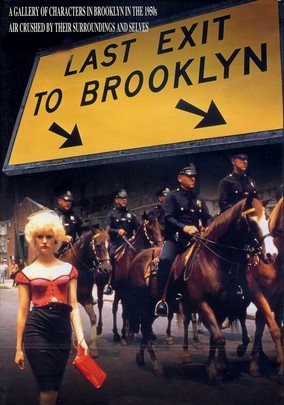
Last Exit to Brooklyn-1989

Last Exit to Brooklyn-1989

Director Uli Edel

Starring Stephen Lang, Jennifer Jason Leigh

Top 250 Films #176

Scott’s Review #152

70141619

Reviewed August 13, 2014

Grade: A-

Last Exit to Brooklyn (1989) is a slice-of-life film set in lower-class Brooklyn, NY, in the early 1950s.

It tells the story of a group of struggling neighborhood people- sex workers, union members, drag queens, etc., whose lives intersect. Also in the neighborhood is a military base where soldiers come and go on their way to war-torn Korea.

The central characters, though there are several with small yet interesting stories, are Harry, played by Stephen Lang, a sexually conflicted union worker with a wife and newborn child.

He is in love with a selfish drag queen, and Marilyn Monroe lookalike, Tralala, played superbly by Jennifer Jason Leigh, a prostitute whose best days are behind her, and who will do anything for attention.

The sets and cinematography in the film are very well done- the feeling of despair and hopelessness is accomplished by the dowdy streets, homes, and bars that the cast frequents.

Some of the characters are sympathetic- the aforementioned plus Tralala’s love interest, the Diner boy madly in love with Tralala, and the virginal seeming (but not really) Donna, portrayed by a young Rikki Lake.

Other characters are abhorrent in their violence and hatred.

Last Exit to Brooklyn is quite a dark film and sometimes tough to watch, but it captures a dreary time and atmosphere. The Brooklyn set is excellent in its dreariness.

Jennifer Jason Leigh is the standout as the tough-talking, boozy prostitute who is losing her luster, and the final scene of the film is truly a heartbreaker.

The topics of union, strike, bisexuality, gangs, and drag queens are covered, and unique characters and conflict/loneliness are presented.

This film is an overlooked gem from 1989.

The Wolves of Willoughby Chase-1989

The Wolves of Willoughby Chase-1989

Director Stuart Olme

Starring Stephanie Beacham

Scott’s Review #1,418

Reviewed January 20, 2024

Grade: B+

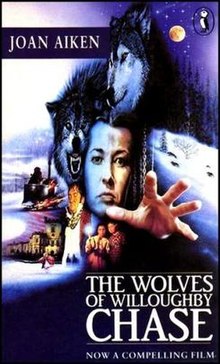
The Wolves of Willoughby Chase (1989) is a British dark fantasy film directed by Stuart Orme in his theatrical directorial debut. Most notably, as a rock video director, I am unsure if Orme ever directed another film.

The film is based on the 1962 novel of the same name by Joan Aiken, which was popular with children during the 1960s and beyond.

Similar to the book, the film is set in an alternate history version of nineteenth-century England where wolves roam the countryside. The animals prance through the wintry landscapes, causing fear among humans who spot them.

The experience is playful and escapist, with similarities to both Oliver! (1968) and The Witches (1990). Especially regarding the former, some of the action takes place in a bleak workhouse where adults mistreat children.

Predictably and satisfying, the evil adults get their comeuppance while the nice children and warm adults live happily ever after. This is a main part of the fun of watching the perilous situations.

The plot centers around two young girls. Bonnie (Emily Hudson) is the daughter of Lord and Lady Willoughby, who live at the grand yet cozy country estate named Willoughby Chase. Lady Willoughby (Eleanor David) is ill, and the couple plans to recuperate, basking in the warm sun along the Mediterranean.

In urban London, Bonnie’s cousin, Sylvia (Aleks Darowska), is leaving her impoverished Aunt Jane (Lord Willoughby’s cousin) to keep Bonnie company while her parents are away.

While on the train, she meets a mysterious man, Mr. Grimshaw (Mel Smith), whom they decide to bring back to Willoughby Chase after falling unconscious when wolves attack the train.

Meanwhile, Bonnie and Sylvia’s cousin, Letitia (Stephanie Beacham), is their new governess. She is evil and determined to get rid of the children so she can inherit the money and the estate.

Billed as a children’s film, as Oliver! Some of the sequences may be too much for younger kids. The ferocious wolves may be frightening, while a scene in which one of the girls is locked in a chest might cause nightmares.

There is a presumed drowning, and another character catches on fire.

For adults, particularly those who enjoyed the book as youngsters, the dangerous situations are light fare and merely make Bonnie and Sylvia more heroic and justified in escaping the adults’ clutches.

The art direction and set designs are also a big part of the fun. Numerous scenes of winter and snow-covered roads and pathways are what make The Wolves of Willoughby Chase a perfect watch for a frigid January evening.

I’m not sure if the film would feel as atmospheric in July or August.

The estate where much of the action takes place has a warm and cozy feel. It made me want to curl up by a raging fire with a good book.

There’s an undertone of class distinction when the servants are all dismissed to save money, and I questioned why Sylvia and her aunt didn’t simply live on the estate. The poor living amongst the rich is a perfect setup for more meaningful storylines, but the intent is more for The Wolves of Willoughby Chase to be fun.

Beacham is delightful while slightly over-the-top playing a fiendish character. Best known for appearing on television’s ‘Dynasty,’ the actress has also appeared in British horror films.

I assumed she planned to kill the parents and the girls, but what about the aunt?

It doesn’t matter much because her plan is foiled and the girls are reunited with their loved ones.

The Wolves of Willoughby Chase (1989) contains a nice musical score that enhances the adventures. The film is a bit too scary for kids, but perfect for young adults and older adults.

The Rainbow-1989

The Rainbow-1989

Director Ken Russell

Starring Sammi Davis, Paul McGann, Amanda Donohoe

Scott’s Review #1,409

Reviewed November 5, 2023

Grade: A-

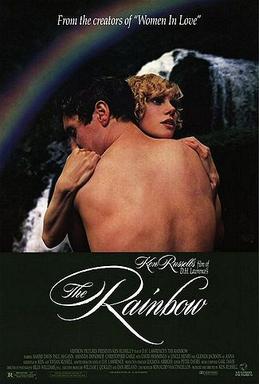
Continuing my exploration of more obscure films by the British director comes The Rainbow, a 1989 picture adapted from a 1915 D.H. Lawrence novel.

Russell fans will know that he also adapted 1970s Women in Love from Lawrence, so there is a tie-in between films.

Even though The Rainbow was made nearly two decades after Women in Love, it’s a prequel. The antics of the Brangwen sisters are explored as they grow up in rural England, specifically one sister’s burgeoning sexuality and desires.

One could view The Rainbow as a feminist film that primarily centers on the eldest sister.

Born to a rich landowner, played by Christopher Gable, in the final days of the Victorian era (the late 1800s), Ursula (Sammi Davis) blossoms into a beautiful young woman full of imagination and promise.

She is quite free-spirited and begins to feel trapped by her surroundings. Still, her life changes when she has an erotic experience with Winifred (Amanda Donohoe), an adventurous and bisexual teacher.

From that point on, Ursula puts all of her passion and creativity into the pursuit of sexual fulfillment. She prefers men and develops a relationship with the dashing Anton (Paul McGann).

But she is constantly frustrated and continues to suffer from anguish and under-fulfillment as her development years go by.

Davis is delightful and mesmerizing as the lead character. Her flowing blonde locks, which she eventually cuts, give her a wholesome schoolteacher persona. But she is peppered with sassiness and experimentation, which Davis flawlessly executes.

Donohoe, who starred in another Russell film, the bizarre The Lair of the White Worm (1988), smolders with sophistication and sensuality. Winifred easily takes Ursula under her wing and teaches her the pleasures of sex.

Eventually marrying Ursula’s wealthy Uncle, Henry, she doesn’t sink into dull matrimony but remains a mentor and a source of temptation for Ursula.

McGann, as Anton, brings a boyish yet masculine quality to the film and succeeds as Ursula’s main love interest. Becoming a soldier, he smolders most during his plentiful nude scenes running around forests and up mountains with Ursula in tow.

These scenes are the zestiest as Russell plugs his all-too-familiar bizarre sequences of lust and bare flesh into the film.

There are many nude scenes to salivate over, turning the prim and proper Victorian upper-crust characters into horny, animalistic creatures.

The dynamics between Ursula, Anton, and Winifred are my favorite because it’s not played as a traditional love triangle with one pair to root for. It’s more sexual and interesting than that.

Not everything in The Rainbow works, however.

Even though I’m very familiar with Women in Love, the connection to that film is tough to capture. Gudrun (the other sister) is the main focus in Women in Love but has only a small role in The Rainbow.

To make matters more confusing, Ursula (in The Rainbow) is more similar to the character of Gudrun (in Women in Love).

Also, Glenda Jackson (who plays Gudrun in Women in Love) is cast as the mother in The Rainbow. The role is unspectacular, especially compared to the brilliant portrayal Jackson did in Women in Love.

She doesn’t have much to play except being their mother.

I finally decided to stop thinking about Women in Love and enjoy The Rainbow on its own merits.

Admittedly, the final sequence does satisfy, as Ursula forges ahead toward a new life, bringing us back to the start of Women in Love.

Reminiscent of E.M. Forster’s adaptations like A Room with a View (1985), Maurice (1987), or Howards End (1992), the quaint English cottages, landscapes, and villages are wonderful and capture a specific time capsule.

The Rainbow (1989) transported me to another time and offered a character study meshed in sexuality, coming of age, and feminist power.

The Return of the Musketeers-1989

The Return of the Musketeers-1989

Director Richard Lester

Starring Michael York, Oliver Reed

Scott’s Review #1,401

Reviewed September 24, 2023

Grade: B

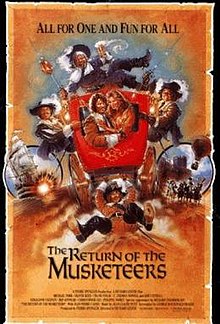
The Return of the Musketeers (1989) is the third Musketeers film directed by Richard Lester, following 1973’s The Three Musketeers and 1974’s The Four Musketeers.

George MacDonald Fraser wrote each screenplay.

This is key to mention because a strong continuity helps make the film fun and charming.

The results of the same person directing and writing resonate on screen in several ways. The characters feel truthful, and their motivations are clear.

A rich sense of the characters’ history is apparent, making the film a pleasing adventure for fans of the franchise.

After ambitious Oliver Cromwell (Alan Howard) overthrows the king, Cardinal Mazarin (Philippe Noiret) enlists a down-and-out D’Artagnan (Michael York) to rally the Musketeers against him.

Porthos (Frank Finlay) accepts the mission at once, but Athos (Oliver Reed) and Aramis (Richard Chamberlain) hesitate at first. Eventually, the three reunite, but they are soon torn apart by infighting and a situation from their past.

They get a chance at redemption when they are sent to England to save the life of King Charles I (Bill Paterson).

There is some slapstick play to endure, making The Return of the Musketeers feel juvenile at times when characters are bopped over the head or otherwise trip and fall in silly form.

For this type of adventure film, the plot is too complicated and veers in different directions a shade too often. I wondered more than once if I was in France or England.

This makes the minor characters difficult to keep track of, and Christopher Lee’s character of Comte de Rochefort once again has little to do.

The costumes and the French setting are a major victory, and the history lessons provided, especially the British and French kings and queens, are more than fulfilling.

We delved into our history books to determine which King Louis reigned when and who was aligned with the film (it’s Louis XIV during the 1600s).

The point of the film, made 15 years after the second film, is to please fans, and the result is a huge success.

I’m a sort of fan with my hubby being a big fan, and we both enjoyed the resurfacing of familiar characters.

It feels like old-home week. The reunion of the musketeers feels like witnessing a family reunion. As D’Artagnan, Porthos, Athos, and Aramis embraced each other, we felt their warmth.

Since the characters played by Raquel Welch and Faye Dunaway (Milady) were dead, a creative idea was to introduce her daughter, Justine, played by Kim Cattrall, into the story. Athos also has a son named Raoul, played by C. Thomas Howell.

This provides a further nod to history and introduces compelling lead characters who have a connection to familiar characters.

It is also an example of good writing and storytelling. Despite the characters being new to the audience, we already care about them because of their ties to other beloved characters.

To make the film more sentimental, a sad incident occurred during filming. Actor Roy Kinnear, who plays lovable Planchet, died following an on-camera accident in which he fell off a horse.

His role was completed using a stand-in, filmed from the rear, with lines dubbed in by a voice artist.

The film is dedicated to him.

Reuniting most of the original cast years later makes The Return of the Musketeers (1989) a warm experience.

Beautiful costumes, locales, and history raise the film above expectations, considering it’s a third installment.

National Lampoon’s Christmas Vacation-1989

National Lampoon’s Christmas Vacation-1989

Director Jeremiah S. Chechik

Starring Chevy Chase, Beverly D’Angelo

Scott’s Review #1,248

Reviewed April 23, 2022

Grade: A-

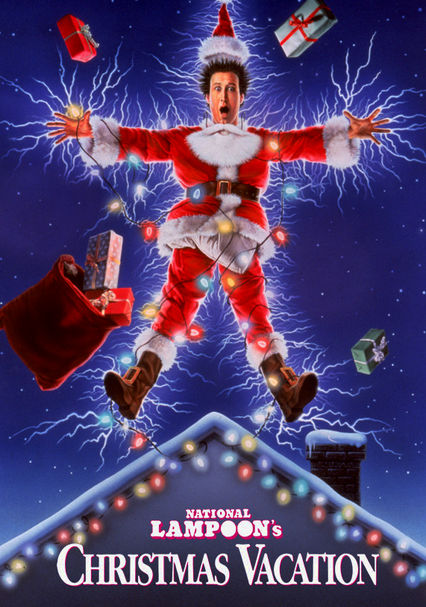
Made several years after the first in the National Lampoon’s Vacation series (1983-2015), the inevitable production of National Lampoon’s Christmas Vacation (1989) is my personal favorite of the bunch and the most laugh-out-loud.

Silly personified, but the jokes work, and the enjoyment carries throughout the entire running time.

In retrospect, you knew they were going to do it. What better fodder for the bumbling Griswold family than to have them reunite with extended family on such a seasonal holiday?

The gags and awkward situations are ripe for the picking, as situation after setup is done exceptionally well and with grand humor.

The silliness works, and the film is a recommended watch with the family gathered around the holidays.

Viewers can either relate directly to the film or inevitably know families that resemble the incompetent yet lovable Griswolds.

As the holidays approach, Clark Griswold (Chevy Chase) is determined to have a perfect family Christmas. He motivates his wife, Ellen (Beverly D’Angelo), and their children to ensure everything is in order, including the tree and house decorations.

Naturally, things quickly go awry in the greatest of humor.

His hick cousin, Eddie (Randy Quaid), and his family show up unplanned and start living in their camper on the Griswold property.

Even worse, Clark’s employers renege on the holiday bonus he needs, causing a great deal of stress for the family patriarch.

For starters, the film has a cool holiday vibe. The setting is wisely the Midwest United States, somewhere outside of Chicago, Illinois. Snow is to be found everywhere, and Christmas decorations and lights are lit all over the place throughout the film.

This creates a suburban, homey atmosphere that is warm and friendly.

Most viewers can snuggle up by a warm fireplace with delicious hot cocoa and enjoy the film. The environment is one of the finest achievements in National Lampoon’s Christmas Vacation.

A classic moment and the film’s funniest scene occurs when Clark excitedly decorates the inside and outside of the house to the nth degree and blows the town’s electric circuit as a result, leading to uproar among his neighbors.

Proud Clark’s ego is suddenly deflated, and the man must rise above it all to somehow enjoy his family Christmas.

Watching the film decades after its release is still great fun as a nostalgia offering. The tacky Griswold Ford LTD station wagon with paneled siding is garish and unsightly (then and now), and anyone growing up in the 1980s can easily recall suburban families piling into this gas-guzzling car.

Not every aspect works perfectly in National Lampoon’s Christmas Vacation, like the unappealing yuppie neighbors Todd and Margo (played by Nicholas Guest and Julia Louis-Dreyfus) or Eddie and his redneck family.

These roles are a bit too over-the-top and secondary inclusions to be the major win the film is.

The real wins from the supporting cast are Clark’s immediate family. His parents and Ellen’s parents are perfectly cast and provide excellent comic timing and seasoned wit.

Special notice goes to John Randolph, Diane Ladd, and Doris Roberts.

And who won’t fall in love with Clark’s senile Aunt Bethany, played with hilarity by Mae Questel (the voice of animated Betty Boop and Olive Oyl)?

Predictably, and well-intentioned, all the Griswold problems quickly fade away when Clark receives his annual Christmas bonus after all, and all characters have a lovely send-off while singing ‘The Star-Spangled Banner’ just in the odd way that the Griswolds would do.

National Lampoon’s Christmas Vacation (1989) used to be a traditional Christmas viewing for me, but it has shamefully fallen out of favor over the years.

It might be time to dust off this forever gem that provides laugh after laugh, fun, and togetherness for the whole family.

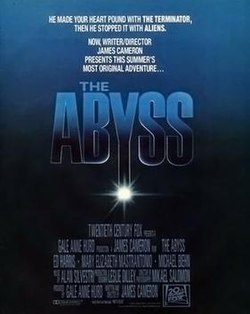
The Abyss-1989

The Abyss-1989

Director James Cameron

Starring Ed Harris, Mary Elizabeth Mastrantonio

Scott’s Review #1,210

Reviewed December 19, 2021

Grade: B+

Well before he created Titanic (1997) and Avatar (2009) and became a household name, director James Cameron made the gorgeous, special effects-laden film The Abyss (1989).

The film followed hits like Terminator (1984) and Aliens (1986).

These films undoubtedly allowed him to make a film that he wanted to make with the necessary freedoms.

The Abyss is completely visual, and the interesting cast of characters, with potential for development, is never allowed to shine through, instead feeling stale.

They are usurped by the constant flow of underwater, lush, worldly spectacles that utterly encompass the film.

Even when the central characters get a moment to dig deeper into their backstories, Cameron never goes for the emotional jugular, instead encouraging viewers to focus on the extraterrestrial and science-fiction elements rather than on his characters.

That’s the type of director Cameron is, and I recommend watching The Abyss on the big screen, or the biggest screen possible.

I did not recognize the sheer bombast that a cinema watching would render.

I missed out.

The film, and specifically Cameron, must be heralded for the vast loveliness of the art direction, visual effects, and cinematography.

Forget the convoluted plot entirely and sit back and enjoy the spectacle.

Ed Harris and Mary Elizabeth Mastrantonio portray Bud and Dr. Lindsey Brigman, formerly married petroleum engineers who still have some issues to work out.

When an American submarine sinks in the Caribbean, a US search and recovery team works with an oil platform crew, racing against Soviet vessels to recover the boat.

Deep in the ocean, they encounter something unexpected, and the American team is determined to find out what it is. Is it the Russians or a deadly and intelligent extraterrestrial force?

The story is overly complicated and riddled with stereotypical plot points.

As the team becomes submerged in their submarine, they encounter the usual troubles: a hurricane, a rogue team leader, a flooded rig, and freezing temperatures.

Harris and Mastrantonio have pretty good chemistry here, but we never fully grasp their marital problems or why there is a distance between them. Thrown together on this mission, they predictably face peril and come close to losing each other.

When they embrace in the final scene, it is a wrapped up as a tight bow sort of ending that underwhelms.

But, man, the visuals are amazing. When the team drops at the alien city in the deepest trenches of the ocean floor, the beautiful underwater camera shots take center stage.

The technical consistency is simply breathtaking and becomes the focal point of the film.

I daresay The Abyss (1989) features the greatest underwater sequences ever seen on film to date, but somehow, decades later, the film feels forgotten or overshadowed by Cameron’s other works.

Perhaps the dated Cold War plotline and the traditional romance have not served the film well in the long run.

Oscar Nominations: 1 win-Best Art Direction, Best Cinematography, Best Visual Effects (won), Best Sound

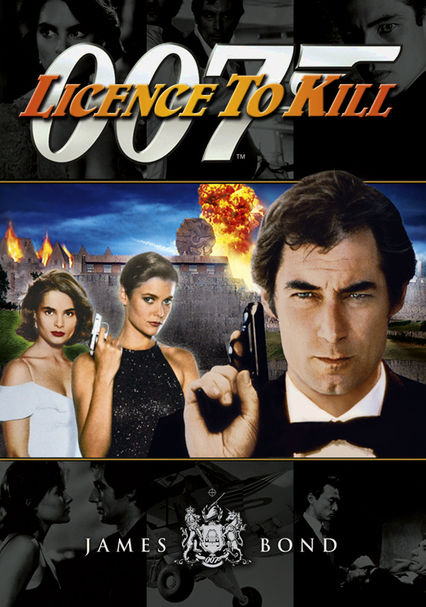
Licence to Kill-1989

Licence to Kill-1989

Director John Glen

Starring Timothy Dalton, Carey Lowell

Scott’s Review #1,196

Reviewed November 14, 2021

Grade: B

Of the two turns 007 that Timothy Dalton gave us, Licence to Kill (1989) ranks as the weakest, with The Living Daylights (1987) being superior. But that doesn’t mean the film has no good qualities.

It’s an okay film, and director John Glen, now returning for his fifth James Bond film, seems a little out of gas. Many of the stunts and sequences are very familiar territory, and the dialogue is far from crackling or exciting.

The James Bond film franchise would go on a six-year hiatus after Licence to Kill, returning refreshed in 1995. Perhaps it needed to.

Dalton does his best, but his heart doesn’t quite seem in it, and the serious tone of the film gets even darker than The Living Daylights.

I don’t think this is a bad thing, and I love how the franchise regular, Felix Leiter (David Hedison), gets more of a storyline. But the wit and charm are lacking.

Events begin in sunny Key West at the impending nuptials of former CIA agent and Bond friend, Leiter. Pursuing one of the international drug cartel’s most brutal and powerful leaders, Franz Sanchez (Robert Davi), events quickly escalate.

After a double-cross, poor Felix is fed to the sharks. While he survives the attack, his wife is murdered. Bond goes rogue and seeks personal vengeance.

What separates Licence to Kill from other Bond entries is the limited locales. Though exquisite, they occur only in North America. The Florida Keys, the Bahamas, and Mexico are used in fine form, especially the latter.

The gorgeous coastline feels European, and I surmised that it was shot and set in Spain when, in fact, it was Mexico.

Also enjoyable is the Latin flair, with lots of cultural influences throughout. Davi is as powerful and dangerous as the Latin drug lord, and he exudes violence and treachery. He is gleeful when a nemesis falls victim to his pet shark and loses a limb or two before succumbing to death.

A great kill is when dastardly Milton Krest (Anthony Zerbe) topples into a giant microwave oven and explodes into bloody bits. His death is deserved and satisfying.

To build on this, the inevitable death of Sanchez himself is a crowd-cheering moment. Before he explodes into a giant ball of flames, Bond is certain to let the villain know that his death is courtesy of Leiter.

This is an exciting and fulfilling moment.

The Bond girls are not at their finest in Licence to Kill. Carey Lowell plays Pam Bouvier, an ex-Army pilot and DEA informant. While sometimes portrayed as a tough-minded and brazen female character, she is also written as simpering and pining over Bond.

She can also be silly and foolhardy, like when she carelessly plays with dangerous gadgets that Q creates. I would expect greater intelligence and wherewithal given her credentials.

Secondary Bond girl Lupe Lamora (Talisa Soto), Sanchez’s girlfriend, lacks depth. Beautiful, she is quite wooden in the acting department and suddenly falls in love with Bond, insisting on her powerful feelings for the man she barely knows.

It’s a bit far-fetched even for Bond standards, but she is nice to look at.

So there’s that.

Licence to Kill (1989) is usually either lost in the shuffle or derided outright, and that is unfair. It’s not one of the greats, but it’s not garbage either.

It feels a bit tired of its time. Truth be told, it’s grown on me since I first saw it, and even the title song performed by Gladys Knight has enamored me over the years.

Friday the 13th Part VIII: Jason Takes Manhattan-1989

Friday the 13th Part VIII: Jason Takes Manhattan-1989

Director Rob Hedden

Starring Jensen Daggett, Scott Reeves

Scott’s Review #1,163

Reviewed July 21, 2021

Grade: D+

After eight installments in only nine years of the iconic horror Friday the 13th series, fans by this time know what they are in store for.

The title of Friday the 13th Part VIII: Jason Takes Manhattan (1989), and its accompanying cover art, offer a glimmer of originality and intrigue.

If this were 1989, I would be excited about the prospects of what this film could deliver.

Hell, the city of New York was dour and dirty in the late 1980s, filled with grit, grime, and seediness. What a perfect setup for our crazed killer, Jason, to mix and mingle with the dregs of society.

I conjured up images of Jason chasing frightened teenagers through graffiti-laced subways and X-rated peep show theaters in the Times Square district.

We get a few location shots of Times Square, but not much more.

Unfortunately for fans, only the final thirty minutes or so of the film are set in the Big Apple, and for eagle-eyed viewers, even less is filmed there.

Years later, director Rob Hedden would blame Paramount Studios for severely limiting the budget allowed for on-location filming.

The result is that Friday the 13th Part VIII: Jason Takes Manhattan feels like a sham.

Okay, the film is a terrible, cheesy, poorly acted, jaggedly paced film, but on a late Saturday night, it provides some fun and comfort, along with the right mood and spirits.

A few years following the events of Friday the 13th Part VII: The New Blood (1988), multiple mass murderer Jason Voorhees (Kane Hodder) is resurrected from the bottom of Crystal Lake after an underwater electrical fire.

After he kills a passing boat’s occupants, he stows away on a cruise ship filled with a high-school graduating class excitedly bound for New York City.

Strict Biology teacher Charles McCulloch (Peter Mark Richman) is on board with his niece, Rennie (Jensen Daggett), who has visions of Jason drowning as a child.

They temporarily escape his bloody rampage, but when Rennie and Charles reach Manhattan, Jason is hot in pursuit.

The ten million other Manhattanites are uninteresting, and Jason must kill Rennie and his cohorts.

There is an unnecessary side story about Uncle Charles pushing Rennie into Camp Crystal Lake in a sink-or-swim moment, when she first saw glimpses of Jason.

This has nothing to do with the main story, nor is it needed.

The rest of the film is exactly as one might suspect, with very few surprises. The character development, limited in slasher films like this, is extremely pitiful and uneven.

One female character is a rocker chick who clutches her electric guitar and plays it nonstop, practically during her death scene.

Other unintentionally laughable characters include a young black man who is an aspiring boxer and attempts to spar with Jason on a building’s rooftop. This proves to be a big mistake when Jason takes one punch at him and decapitates him.

The popular blonde prom queen/mean girl, Tamara (Sharlene Martin), decides to throw Rennie overboard after she catches Tamara doing drugs.

Murdering a fellow student is a better option than being caught.

Finally, the deckhand played by Alex Diakund is a carbon copy of the Crazy Ralph character from Friday the 13th (1980) and Friday the 13th: Part II (1981), even uttering the famous “You’re all doomed” line.

The stereotypes are rampant.

However, unusual for the slasher genre in 1989, diversity is evident, with African-American, Hispanic, and Asian characters. While all are supporting characters and know their purpose is to be bludgeoned, the inclusiveness is at least a slight win.

Other positives are the familiar Camp Crystal Lake setting not being completely scrapped, as the title might indicate. There is something nice and familiar with Jason: a lake, darkness, and murder.

Rob Hedden’s idea to take much of the action to an unfamiliar setting, like a metropolis, is a good one; a city is the opposite of a lake, but the studio screwed the director over royally with its limitations.

Still, a wonderful shot of Times Square can easily transport a viewer watching the film in the present back to 1989 and, if only for a minute, let them experience what life was like.

That’s worth a small something.
A Nightmare on Elm Street 5: The Dream Child-1989

A Nightmare on Elm Street 5: The Dream Child-1989

Director Stephen Hopkins

Starring Lisa Wilcox, Robert Englund

Scott’s Review #1,032

Reviewed June 12, 2020

Grade: C+

When one compares A Nightmare on Elm Street 5: The Dream Child (1989) to the first A Nightmare on Elm Street (1984), made merely five years earlier, the latter is shockingly bad, but, rated on its own merits, it is okay, with both creative and silly moments.

The franchise feels exhausted at this point; a long rest is recommended, as too many cheesy, doltish moments make this installment more of a comic failure, with hardly any scary or sinister moments.

A watered-down and forgettable entry in a series once blooming with potential.

Sadly, it would only be two years before another Nightmare was released.

With a mother theme complete, nearly all the parents and children involved in Freddy Krueger’s original storyline dead and buried, a dream sequence double-shot contained within parts 3 and 4, the logical next idea is to utilize a child story.

This is not a bad idea, given that Freddy was accused of child molestation, but the intention to produce a spawn of Freddy is less than marvelous.

The Child’s Play franchise (1988-2019) took this cue with Seed of Chucky in 2004.

Once again, a year has passed since the events of the previous entry, as Alice (Lisa Wilcox) and Dan (Danny Hassel) cheerily date and enjoy their lives together as they graduate from high school.

They are accompanied by friends Greta, Yvonne, and Mark.

When Alice has a strange dream about a nun, a mental hospital, and an attack by patients, Dan stresses that she controls her dreams.

As the dreams persist, she begins to have nightmares of Freddy and a strange baby. When Alice and Dan learn they are pregnant, things become violent when Dan and the others are systematically killed off in their dreams while Alice is deemed “crazy”.

A pleasant note is that the film at least offers a slight measure of consistency and continuity as we are reintroduced to Alice and Dan, familiar characters from Part 4.

The film wisely keeps the same actors to avoid the jarring disruption that occurred in Part 4, when a startling recast of its main character from Part 3 was made.

Johnson and Jordan are not the greatest actors, nor is the supporting cast, but great acting is a nicety, not a necessity, in slasher films.

The visuals are also entertaining, which has consistently been good throughout each chapter. Some animated sequences emerge, particularly within the dream sequences.

The kills and attacks are also well crafted, as when Freddy terrorizes a comic book artist, and when one victim, Greta, eats herself alive. There is more humor to the kills than in other installments.

Greta’s death is almost a revenge against her controlling mother, who is weight-conscious. When Greta chokes to death (in real life), she drops dead in front of her mother and their dinner guests.

The scene is macabre black humor.

Otherwise, the film is very familiar territory. The baby topic culminates in a wacky sequence that fails to work and is implausible even for a horror film.

In dreams, Freddy is feeding his victims to the baby (strangely, named Jacob- wouldn’t Freddy Jr. have been cleverer?) as nourishment to make him be like Freddy. In the real world, Dan’s (now dead) parents demand the baby from Alice when it is born.

This is a silly television afternoon special moment. The story concludes with Alice going to sleep to fight Freddy and save her son, which she naturally does.

At the risk of beating a dead horse, 1989 was a paltry year in cinema, specifically in the slasher genre.

Quite successful during the late 1970s and the early 1980s, it became oversaturated and riddled with carbon copies.

A Nightmare on Elm Street 5: The Dream Child (1989) is a forgettable film that offers little to distinguish it from other chapters. In its defense, how could it be the fifth release in six years?

A feeble attempt by the studio to capitalize financially on a name brand that has run out of steam.

Do the Right Thing-1989

Do the Right Thing-1989

Director Spike Lee

Starring Spike Lee

Scott’s Review #746

Reviewed April 21, 2018

Grade: A

Do the Right Thing is one of the few great films to come out of 1989, not remembered as a fantastic year in cinema when most mainstream films were as glossy as tin foil- and barren of quality substance.

Here we have a small, independent gem that sparked discussions about current race relations in the United States and became a monumental, influential film.

Filmmaker (and star) Spike Lee carves a controversial story of racial tensions in a Brooklyn neighborhood on a hot summer day.

Beginning rather light and comedic, then turning violent and dark, the action is set in a largely black neighborhood, Bedford-Stuyvesant, Brooklyn, where twenty-five-year-old Mookie (Spike Lee) works delivering pizzas at an Italian pizzeria owned by Sal (Danny Aiello).

With a toddler at home and a nagging girlfriend, Tina (Rosie Perez) always in his face, Mookie is unmotivated yet still a decent guy and loyal friend.

Sal has two sons who work at the pizza place- Pino (John Turturro), who is angry and racist, and nice guy Vito, who is a friend of Mookie’s.

When conflicts erupt over whether Sal’s restaurant should celebrate black celebrities and white celebrities on a wall in the dining room, tensions reach their breaking point as the intense heatwave makes matters much worse.

What makes Do the Right Thing a marvel is both the film’s overall tone and the atmosphere Spike Lee conveys, who does an incredible job of writing, producing, and starring in it.

The elements having little to do with the actual story immediately impress with big, bright colors in comic-book style, screaming at the big screen, eliciting both a warm, inviting feeling and an angry, contemptuous vibe.

The loud rap and hip-hop beats are instrumental in conveying a specific feeling and emotion in the film.

Made independently and on a small budget, the film feels raw and intense from the get-go.

Brooklyn and New York City, in particular, are the perfect settings, as Sal and his family are white folks living in a predominantly black neighborhood, so, in turn, the minorities in the story are the ones in the minority.

Additionally, the viewer sees the friendly neighborhood and feels a sense of belonging regardless of race- the humorous drunk, the kindly, grandmotherly type people-watching from her stoop, and the boombox music kid all form a sense of community and togetherness.

This point is tremendously important to the film’s overall plot.

The relationship between Mookie and Sal and his sons is very important and the centerpiece of the entire film, which I found quite interesting as a character study.

Open-minded, Sal is a decent man and fine with the diversity in his neighborhood- yet still true to his Italian roots. Aiello does a fantastic job of portraying this complex, conflicted character.

His two sons could not be more different from each other- Vito, who is a close friend of Mookie’s, is sympathetic and sweet, with nary a racist bone in his body.

Pino, on the other hand, is angry and resentful of the black community taking over what he feels is his territory.

Finally, while lazy, Mookie is also a sympathetic character, as he is conflicted when the tension reaches its boiling point.

These diverse characters make the film so dynamic.

Revered director Spike Lee carves out a story and brings it to the big screen, telling an important topic that is as vital in modern times as it was when Do the Right Thing was released in 1989.

The film is intelligent and timely without being condescending to either black or white races, nor preachy- instead of telling a poignant story that is angry and sometimes painful to watch, but more importantly, is empathetic and real.

Oscar Nominations: Best Supporting Actor-Danny Aiello, Best Screenplay Written Directly for the Screen

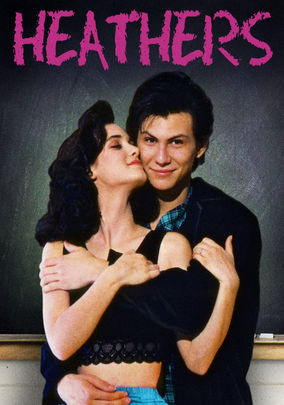
Heathers-1989

Heathers-1989

Director Michael Lehman

Starring Winona Ryder, Christian Slater

Scott’s Review #207

580335

Reviewed December 25, 2014

Grade: B

My gut tells me that Heathers was quite controversial and influential upon release in 1989 and has sustained a cult following that continues to this day, 2014.

Having seen the film only once in 2014, I found it good, but it now suffers from a slightly dated look and feel. Still, it is a brave and unique expression of creativity.

It is a film that sends the message that the popular kids are bad and that the meek shall inherit the earth.

The uncool kids will rise.

To summarize the plot, Heathers is told from the perspective of high school student Veronica Sawyer, played by a young Winona Ryder. She is a second-tier popular girl- she is lieutenant to the generals, if you will.

The school is run by three popular girls named Heather. As popular as they are, they are also despised and feared by the other students, but carry great influence.

They enjoy playing cruel jokes on other students and ridiculing anyone beneath them.

A rebellious male student, J.D., played by Christian Slater, befriends Veronica, and they hatch a plan to destroy the popular clique, including another pair of popular jocks.

Shannon Doherty plays the second-in-command, Heather.

The tone of Heather’s is surreal and dream-like. For example, in the opening scene, all three Heathers- along with Veronica- are on a perfectly manicured lawn in the suburbs playing croquet.

The hierarchy is established when Veronica is buried up to her neck and becomes the target of the croquet balls, making her, without question, the lowest of the four girls.

Whether or not this is a dream or real is unclear.

The film is well-written and edgy. It reminds me, at times, of The Ice Storm (1997) and American Beauty (1999), which Heathers preceded and are, in my opinion, superior.

Heathers is a teen angst film and quite dark at times- the various deaths are committed viciously (drain cleaner poisoning, concocting a setup for the jocks to appear to be having a love affair with each other, and then passionately shooting each other), but with sly wit and humor.

Veronica is, at heart, a good girl, albeit misguided and heavily influenced by J.D., but her intentions of having a fair, just school society are noble. The character is likable.

All the parents are hilariously portrayed as buffoons and have no idea of the darkness that exists in their kids’ lives- Veronica’s parents in particular.

Fearing that Veronica has committed or soon will attempt suicide, they fret that it is their fault stemming from childhood negligence; however, their concern has more to do with themselves than with Veronica’s well-being.

Small gripes about the film are the 1980s-style outfits and hairstyles, which, since they were made in the 1980s, are not a particular fault of the film, though it does contain a slightly dated feel while watching in the present.

Also, Christian Slater mimicking Jack Nicholson’s voice is odd- was this a decision by the film or by the actor himself? Either way, the imitation is both distracting and confusing. What is the point?

The ending of the film is a happy and satisfying conclusion- however, different from the dark tone of the rest of the movie- rumor has it that the studio had some influence in toning down the original ending.

1989 was not a stellar year for film, so Heathers deserves major props for thinking outside the box and doing something dark and creative.

Brave, inventive, and unique, Heathers is a cult classic worth a look.

Independent Spirit Award Nominees: 1 win-Best Female Lead-Winona Ryder, Best Screenplay, Best First Feature (won)