Category Archives: Christopher Gable

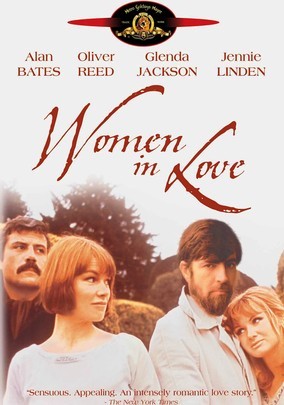
Women in Love-1969

Women in Love-1969

UPDATED REVIEW

Director Ken Russell

Starring Glenda Jackson, Oliver Reed, Alan Bates

Top 250 Films #54

Scott’s Review #766
Reviewed June 2, 2018

Grade: A

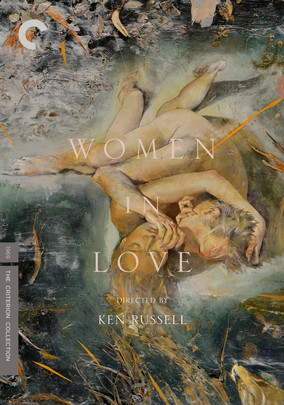
Women in Love (1969) is a British romantic drama film that stands out as truly one of a kind. The film is quite cerebral and requires a bit of thought, which will undoubtedly lead to good conversation with film connoisseurs everywhere after a viewing.

The four central characters are complex and flawed, and they dramatically intersect in each other’s lives, making the film a “thinking man’s” feast.

The film is adapted from a popular D.H. Lawrence novel of the same name.

In 1920, set in the Midlands section of central England, sisters Ursula (Jennie Linden) and Gudrun (Glenda Jackson) attend the wedding of an acquaintance, Laura Crich. The Crich family is enormously wealthy and owns a large share of the mining town.

During the ceremony, Gudrun and Ursula fantasize about Gerald Crich (Oliver Platt) and Rupert Birkin (Alan Bates), respectively. When the foursome cross paths again at Rupert’s pretentious girlfriend’s party, attraction and conflict arise.

The film is described as “character-driven,” but it does not begin to do it justice. Each of the four principal characters is richly written with intelligence and gusto. All of them are either flawed or insecure in some way, while the fact that Gerald and Rupert share a sexual attraction for each other is another nuance explored throughout the film.

Rupert is confident and outspoken about his bisexuality- extremely rare for a 1969 film. In this way, Women in Love is ahead of its time.

The significant themes in Women in Love are commitment and love, and how each character handles them, sometimes embracing them and sometimes running away from them.

Gudrun and Gerald are in love with each other, as are Rupert and Ursula, but only one couple reaches any bliss. The characters possess a bevy of emotions, making their happiness almost impossible, and they feel doomed to failure from the onset.

This is an example of Larry Kramer’s tremendous writing and of bringing the characters to the big screen in a memorable way.

Jackson’s Gudrun and Bates’s Rupert are my favorite characters because they seem to have a bit more depth and feel like standouts. Gudrun appears to have love-hate feelings toward Gerald and is often downright cruel to him.

As they vacation in the Swiss Alps, Gudrun purposely and inexplicably flirts with a gay artist, leaving Gerald extremely jealous, which results in tragedy.

Counter-balancing Gudrun’s anger, Rupert showers in fun and zest for life, happily bisexual and thinking nothing of it, enjoying his sexually charged affections for both men and women.

The supporting characters, specifically snobbish Hermione and mentally unstable Christianna Crich, are examples of perfect casting. Eleanor Bron plays Hermione as mocking and teetering on the edge of unhinged. As she psychologically bullies poor Ursula, even though it’s clear Rupert prefers the more innocent woman, Hermione becomes frightened.

Actress Catherine Willmer takes Christianna to a new level of creepy. Already appearing psychotic, when her daughter tragically drowns, the woman goes over the edge, unleashing vicious dogs on any visitors to her estate.

Both actresses give unforgettable performances.

Women in Love contains a scene that may very well be the most homo-erotic scene in film history. As Rupert and Gerald decide to partake in a Japanese-style wrestling match one evening, they strip completely naked and grapple in front of a roaring fire.

In this lengthy sequence, both front and rear nudity are provided, leaving nothing to the imagination. When Rupert suggests they swear eternal love for each other, Gerald cannot commit to the emotional union.

One wonders if this outstanding scene influenced 2007’s Eastern Promises.

1969’s Women in Love is a fantastic film with terrific acting all around. Taking romantic drama to an entirely different level and setting a new standard for cinematic complexity, the work of director Ken Russell is peppered with nuance, making it rich with great storytelling and character development.

The fact that one couple ends in bliss and the other in tragedy is sheer excellence.

Oscar Nominations: 1 win-Best Director-Ken Russell, Best Actress-Glenda Jackson (won), Best Screenplay Based on Material from Another Medium, Best Cinematography
The Rainbow-1989

The Rainbow-1989

Director Ken Russell

Starring Sammi Davis, Paul McGann, Amanda Donohoe

Scott’s Review #1,409

Reviewed November 5, 2023

Grade: A-

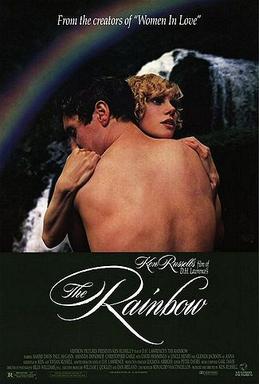
Continuing my exploration of more obscure films by the British director comes The Rainbow, a 1989 picture adapted from a 1915 D.H. Lawrence novel.

Russell fans will know that he also adapted 1970s Women in Love from Lawrence so there is a tie-in between films.

Even though The Rainbow was made nearly two decades after Women in Love, it’s a prequel. The antics of the Brangwen sisters are explored as they grow up in rural England specifically one sister’s burgeoning sexuality and desires.

One could take The Rainbow as a feminist film that centers mainly on the eldest sister.

Born to a rich landowner, played by Christopher Gable, in the final days of the Victorian era (the late 1800s), Ursula (Sammi Davis) blossoms into a beautiful young woman full of imagination and promise.

She is quite free-spirited and begins to feel trapped by her surroundings. Still, her life changes when she has an erotic experience with Winifred (Amanda Donohoe), an adventurous and bisexual teacher.

From that point on, Ursula puts all of her passion and creativity into the pursuit of sexual fulfillment. She prefers men and develops a relationship with the dashing Anton (Paul McGann).

But she is constantly frustrated and continues to suffer from anguish and under-fulfillment as her development years go by.

Davis is delightful and mesmerizing as the lead character. Her flowing blonde locks which she eventually cuts give her a wholesome schoolteacher persona. But she is peppered with sassiness and experimentation which Davis flawlessly executes.

Donohoe, who starred in another Russell film, the bizarre The Lair of the White Worm (1988) smolders with sophistication and sensuality. Winifred easily takes Ursula under her wing and teaches her the pleasures of sex.

Eventually marrying Ursula’s wealthy Uncle Henry she doesn’t decline into dull matrimony but remains a mentor and source of temptation to Ursula.

McGann, as Anton brings a boyish yet masculine flavor to the film and succeeds as the main love interest for Ursula. Becoming a soldier, he smolders most during his plentiful nude scenes running around forests and up mountains with Ursula in tow.

These scenes are the zestiest as Russell plugs his all-too-familiar bizarre sequences of lust and bare flesh into the film.

There are many nude scenes to salivate over turning the prim and proper Victorian upper-crust characters into horny animalistic creatures.

The dynamics between Ursula, Anton, and Winifred are my favorite because it’s not played as a traditional love triangle with one pair to root for. It’s more sexual and interesting than that.

Not everything in The Rainbow works, however.

Even though I’m very familiar with Women in Love the connection to that film is tough to capture. Gudrun (the other sister) is the main focus in Women in Love but only has a small role in The Rainbow. To make matters more confusing, Ursula (in The Rainbow) is more similar to the character of Gudrun (in Women in Love).

Also, Glenda Jackson (who plays Gudrun in Women in Love) is cast as the mother in The Rainbow. The role is unspectacular especially compared to the brilliant portrayal Jackson did in Women in Love.

She doesn’t have much to play except being their mother.

I finally decided to stop thinking about Women in Love and enjoy The Rainbow on its own merits.

Admittedly, the final sequence does satisfy as Ursula forges ahead to a new life which brings us back to the start of Women in Love.

Reminiscent of E.M. Forster’s adaptations like A Room with a View (1985), Maurice (1987), or Howards End (1992), the quaint English cottages, landscapes, and villages are wonderful and capture a specific time capsule.

The Rainbow (1989) transported me to another time and offered a character study meshed in sexuality, coming of age, and feminist power.

The Boy Friend-1971

The Boy Friend-1971

Director Ken Russell

Starring Twiggy, Christopher Gable

Scott’s Review #1,407

Reviewed October 27, 2023

Grade: B+

With each Ken Russell film, I expect something wacky, and I sit back for a schizophrenic roller coaster ride.

His finest efforts, such as Women in Love (1970), The Devils (1971), and Tommy (1975), offer bombast and weirdness in their own way.

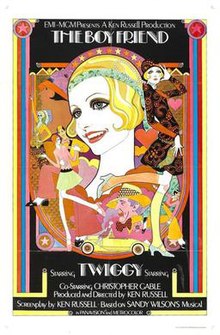
The British director decided to take on The Boy Friend (1971), a reworking of a 1953 traditional musical of the same name by Sandy Wilson, and turn it upside down on its ass. Those expecting a conventional affair with cheery sing-along numbers in perfect symmetry will be disappointed.

The messy project has its ups and downs and meanders off course on more than one occasion. With jagged storytelling and dragging sequences, it makes up for ground with sizzling visuals and costumes. It offers the audience a glimpse of theatrical drama and shenanigans both onstage and offstage.

On its own merits and given that the director is Russell, it gets a marginal thumbs-up, but it is nowhere near as fantastic as his other works.

The plot is a bit confusing, divided into three levels. Level one tells the main story: in the 1920s, in the south of England, a struggling theatrical troupe is performing a musical about romantic intrigues at a finishing school for young women in the south of France.

The cast awkwardly strives to impress a visiting, famous movie director, hoping for fame and fortune. They giggle, improvise, and scheme to get noticed, risking upstaging the other cast members.

Next, there is the musical itself. Four of the girls at the school are very forward and have boyfriends, but Polly, played by 1960s supermodel Twiggy, is shy and has no one to take her to the carnival masked ball that night.

Tony (Christopher Gable), a messenger boy from a dress shop, brings her a costume, and they fall in love.

Finally, the film features extensive fantasy sequences in which the characters’ dreams and hopes are enacted through music and dance, without dialogue.

Glenda Jackson, who won an Oscar for Russell’s Women in Love, returns in an uncredited appearance as the theatre star whom Polly must fill in for when she breaks her leg.

The crux of the film is the romance between Polly and Tony. While there is some chemistry between the duo, they never fully take off as the centerpiece.

The cleverness lies in the reveal of the twist on stage, cementing the pair’s connection as characters in the play.

Nonetheless, there are too many other things going on to care about the lovebirds for very long.

The musical numbers got my attention, especially towards the end of the film. My personal favorite, ‘It’s Nicer in Nice’, kicks off with high-caliber energy and shout-outs to other cities compared to Nice, France. It’s a fun regional experience with great culture and an upbeat rhythm.

The chirpy ‘It’s Never Too Late to Fall in Love’ follows soon after, offering a gleeful ending.

The fantasy sequences waste the story’s potential and offer no plot direction, yet are fun to watch anyway. Dripping with colors and razzle-dazzle, the chaotic events are dreamlike and foot-stomping.

Twiggy, with little to no prior film experience, is quite impressive in the lead role. Her voice is strong, and her acting skills are more than adequate. What might have been a disaster is not, thanks to her talents.

Although other Ken Russell films are tighter and more linear, The Boy Friend (1971) is worth watching, especially for his die-hard fans.

Oscar Nominations: Best Music, Adaptation, and Original Song Score

Women in Love-1969

Women in Love-1969

Director Ken Russell

Starring Glenda Jackson, Jennie Linden

Scott’s Review #553

Reviewed December 20, 2016

Grade: A

Women in Love is a shamefully, by and large, forgotten gem- except for the obscure cinema lover- made in 1969.

The film is a British art film and is way ahead of its time. Despite the title, it is anything but a romantic comedy- quite dark in content. The film is adapted from a D.H. Lawrence novel of the same name.

The story is of two sisters, Gudrun and Ursula, living in a small mining town. They gather for a friend’s wedding, and each becomes enamored of a member of the wedding party.

Later, at a swanky dinner party, the girls meet the men. The film tells of the sisters’ relationships with each of the men (played by Alan Bates and Oliver Reed) and of the men’s relationship with each other.

All of the relationships are very complex and filled with tender emotion, and some are pretty violent.

Women in Love is one of the first films to feature extensive nudity, but not in a gratuitous way.

The film explores themes of love, hatred, and the trials and tribulations of the English upper class. The film is a love of mine because it is character-driven, told from each character’s perspective, and is quite an intense experience.

Glenda Jackson won the 1970 Best Actress Oscar- deservedly so.

Oscar Nominations: 1 win-Best Director-Ken Russell, Best Actress-Glenda Jackson (won), Best Screenplay Based on Material from Another Medium, Best Cinematography
The Lair of the White Worm-1988

The Lair of the White Worm-1988

Director Ken Russell

Starring Amanda Donohoe, Hugh Grant

Scott’s Review #15

60029656

Reviewed June 17, 2014

Grade: C+

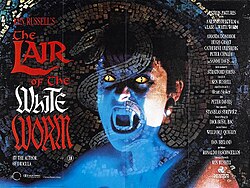
The Lair of the White Worm (1988) is a very strange film.

Set in Scotland, it tells the tale of a giant snake skeleton found in the ground that leads to a series of strange events.

A wealthy Lady, brilliantly played by Amanda Donohue, begins a sinister plot to sacrifice the townspeople.

The film is campy and way over the top, though Donohue is delicious and seems to have fun with the role of a slithering, sexy, bisexual creature.

The gloomy ambiance is fantastic, mixed in with many psychedelic sequences that entertain.

It’s a somewhat fun, late-night B-movie, to be sure, but the plot did not seem to make much sense to me, especially in the final act.

Lair of the White Worm (1988) is a trippy experience to say the very least. I may need to see it again.