Category Archives: Richard Chamberlain

The Towering Inferno-1974

The Towering Inferno-1974

Director John Guillermin

Starring Paul Newman, Steve McQueen, Faye Dunaway

Top 250 Films #41

Scott’s Review #194

1059232

Reviewed November 15, 2014

Grade: A

The Towering Inferno (1974) epitomizes the disaster film craze heaped on audiences throughout the 1970s (Airport, Airport ‘75 and ‘77, The Poseidon Adventure (1972), and Earthquake (1974), to name a few).

I am (guilt-free) a huge fan of this 1970s movie genre, though some certainly look down on it; I am not one of them and feel The Towering Inferno is one of the greatest.

The film is enormous, with a strong sense of adventure and danger.

The grand film tells of the trials and tribulations of an enormous cast of characters trapped inside a skyscraper aflame – led by Paul Newman and Steve McQueen (fun fact: the two actors reportedly despised each other).

An incredible skyscraper is erected in San Francisco, with 138 floors; it is professed to be the tallest building in the world and is incredibly state-of-the-art. At the ribbon-cutting ceremony, an elaborate party is held atop the building overlooking the gorgeous Pacific Ocean.

Due to faulty electrical wiring, the building catches fire, and the cast of characters faces one challenge after another to escape the grips of death.

The stellar cast features William Holden, Faye Dunaway, Fred Astaire, Robert Wagner, Jennifer Jones, and O.J. Simpson, in addition to Newman and McQueen.

The film is quite a soap opera style- numerous characters are introduced, many having affairs with each other or suffering some conflict.

Wagner, having a torrid office romance with his secretary, played by then up-and-coming star Susan Flannery, is deliciously sexy, and I yearned to know more about both characters.

Holden’s son-in-law is responsible for the faulty electrical system, yet he blames his father-in-law for cutting budgets.

Another subplot involves Astaire’s character attempting to swindle Jones’s character, only to fall in love with her. The plots are so melodramatic that, given the period of the film, it has a definite primetime television soap opera style to it- think Dallas or Dynasty in a state of peril.

I enjoyed the enormous cast and trying to guess who will be killed off next, and in what elaborate way the film will burn them to death is a joy to watch- several victims fall or jump to their deaths, which eerily (and sadly) bring back morbid images of jumpers from the World Trade towers on 9/11.

The beginning of the film shows a dedication to firefighters everywhere, and the film has a definite moral and heroic quality to the firefighters sent to rescue the people in the building. They are portrayed as heroes and are intended not to be forgotten amid all the drama encompassing the story. This is admirable.

The special effects are elaborate and quite impressive- the glass elevator rescue scene is amazing! The beautiful set designs are a treat to watch, as each lobby, apartment, or lounge in the skyscraper is exquisitely designed in the height of 1970s style.

Every sofa or carpet featured is plush, colorful, and sophisticated. The skyscraper, made of glass, is an amazing element of the film, and the aerial views of the building, especially while ablaze, are impressive, to say the least- remember, 1974 was long before CGI. I am assuming small replicas of the building were used, but what an achievement from a visual perspective.

The effects certainly champion the syrupy story elements.

My only small gripe with The Towering Inferno is, assuming it is 138 stories high, the action taking place at the top of the tower- the rooftop, as well as the party scenes on the top floor- do not feel that high. The scenic outlook overlooking the water and some land feels about 25 stories high, not 138.

Some find The Towering Inferno (1974) to be nothing more than schmaltzy drama- I say schmaltz was never done better.

Enjoy this feast of a big film.

Oscar Nominations: 3 wins-Best Picture, Best Supporting Actor-Fred Astaire, Best Original Dramatic Score, Best Song-“We May Never Love Like This Again” (won), Best Sound, Best Art Direction, Best Cinematography (won), Best Film Editing (won)
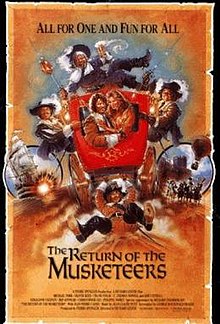
The Return of the Musketeers-1989

The Return of the Musketeers-1989

Director George Lester

Starring Michael York, Oliver Reed, Kim Cattrall

Scott’s Review #1,401

Reviewed September 24, 2023

Grade: B

The Return of the Musketeers (1989) is the third Musketeers film directed by Richard Lester, following 1973’s The Three Musketeers and 1974’s The Four Musketeers.

George MacDonald Fraser wrote each screenplay.

This is key to mention because a strong continuity flow helps the film be fun and charming. The results of the same person directing and writing resonate on screen in several ways. The characters feel truthful and their motivations are clear.

A rich sense of the history of the characters is apparent making the film a pleasing adventure for fans of the franchise.

After ambitious Oliver Cromwell (Alan Howard) overthrows the king, Cardinal Mazarin (Philippe Noiret) enlists a down-and-out D’Artagnan (Michael York) to rally the Musketeers against him.

Porthos (Frank Finlay) accepts the mission at once, but Athos (Oliver Reed) and Aramis (Richard Chamberlain) hesitate at first. Eventually, the three reunite, but they are soon torn apart by infighting and a situation from their past.

They get a chance at redemption when they are sent to England to save the life of King Charles I (Bill Paterson).

There is some slapstick play to endure making The Return of the Musketeers feel juvenile at times when characters are bopped over the head or otherwise trip and fall in silly form.

For this type of adventure film, the plot is too complicated and veers in different directions a shade too often. I wondered more than once if I was in France or England.

This makes the minor characters difficult to keep track of and Christopher Lee’s character of Comte de Rochefort once again has little to do.

The costumes and the French setting are a major victory and the history lessons provided especially the British and French kings and queens are more than fulfilling. We delved into our history books to determine which King Louis reigned when and who was aligned with the film (it’s Louis the XIV during the 1600s).

The point of the film made fifteen years after the second film is to please fans and the result is a swimming success. I’m a sort of fan with my hubby being a big fan and we both enjoyed the resurfacing of familiar characters.

It feels like old-home week. The reunion of the musketeers feels like witnessing a family reunion. As D’Artagnan, Porthos, Athos, and Aramis embraced each other we felt the warmth along with them.

Since the characters played by Raquel Welch and Faye Dunaway (Milady) were dead a creative idea was to introduce her daughter to the story, Justine played by Kim Cattrall. Athos also has a son named Raoul, played by C. Thomas Howell.

This provides a further nod to history and introduces compelling lead characters who have a connection to familiar characters.

It is also an example of good writing and storytelling. Despite the characters being new to the audience we already care about them based on their tie to other beloved characters.

Making the film more sentimental, a sad occurrence happened while filming. Actor Roy Kinnear who plays lovable Planchet died following an on-camera accident in which he fell off a horse.

His role was completed by using a stand-in, filmed from the rear, and dubbed-in lines from a voice artist.

The film is dedicated to him.

Reuniting most of the original cast years later makes The Return of the Musketeers (1989) a warm experience. Beautiful costumes locales and history raise the film above expectations considering it’s a third installment.

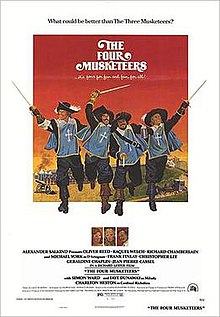
The Four Musketeers-1974

The Four Musketeers-1974

Director Richard Lester

Starring Oliver Reed, Michael York, Faye Dunaway

Scott’s Review #1,379

Reviewed July 17, 2023

Grade: B

The Four Musketeers (1974) is a sequel to the film The Three Musketeers, made a mere year earlier. It takes the second half of the famous novel by French author Alexandre Dumas, with the original film covering the first half.

A recommendation is to watch the sequel directly after the original, so there is less struggle to figure out what is going on. I did not do that, so connecting the plot points was a struggle.

A further negative is the omission of English subtitles, making it difficult to hear or understand the events of the film. British accents are tough.

King Louis XIII’s (Jean-Pierre Cassel) four swashbuckling heroes engage in chivalrous and daring adventures when Cardinal Richelieu (Charlton Heston) and his evil accomplice, Milady de Winter (Faye Dunaway), kidnap the queen’s dressmaker, Constance (Raquel Welch).

The heroes are D’Artagnan (Michael York), Athos (Oliver Reed), Porthos (Frank Finlay), and Aramis (Richard Chamberlain).

It’s a British swashbuckler film, so the adventures are prevalent and the physical comedy is fast and furious. It’s like a sitcom at times, with over-the-top and outlandish fight sequences and one-liners.

The frequent low-cut tops on the female characters are intended to channel the male viewer into a thirteen-year-old boy.

The film gets darker than I anticipated in the final act, which is to its credit, with two deaths. This surprised me in a good way because so much of The Four Musketeers is light-hearted.

The death by the beheading of a major character is well done. The heroes watch an executioner perform his duties to the fiendish character from across a lake. The decapitation is not shown directly, but it’s conveyed through a tremendously effective silhouette from a distance.

The costumes and attention to detail from a historic perspective are superior elements of the film. One can imagine being in the French countryside during the Anglo-French War in the 1600s. The bright sets and lighting create a colorful, picturesque style.

The cast is made up of several A-list Hollywood stars of the time, and each adequately does their share to light up the screen. My favorites are Dunaway as the villainess and Reed as a ‘good guy’, a refreshing change for the actor who usually appears as the heavy.

Reed and Dunaways share some scenes, mostly in flashbacks, that made me want to see more of their romance, but this is not to be. Athos was unaware that Milady de Winter was a criminal who left a permanent branding mark.

Still, what little I got featured tremendous chemistry between the pair, and I would have liked to have seen more.

Where the film loses me a bit is with the silliness, which follows the same formula that made The Three Musketeers a success. Feeling redundant were the endless sword fight scenes and tongue-in-cheek winking.

The film tries hard to be a comedy but also includes darker moments, leaving it feeling unbalanced.

Some actors get short shrift.

Christopher Lee as Count De Rouchfort is a secondary villain and has little to do except prance around in a wig, uniform, and eye patch. His character is no Dracula and does not feel dangerous.

The Four Musketeers (1974) is good entertainment, thanks to a solidly professional cast. Hardly a masterpiece, it’s a bang ’em up comedy adventure with a few moments of death and destruction.