Category Archives: Cathleen Nesbitt

Julia-1977

Julia-1977

Director Fred Zinnemann

Starring Jane Fonda, Vanessa Redgrave, Jason Robards

Scott’s Review #1,283
Reviewed July 31, 2022

Grade: A

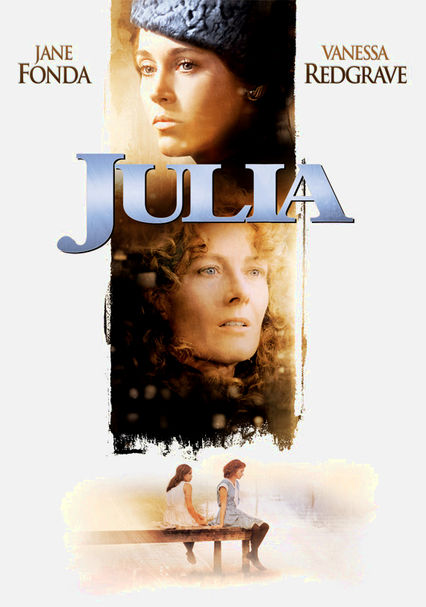
Jane Fonda leads the charge in a powerful, and gorgeously shot, drama named Julia (1977) centering around pre-World War II and the impending Holocaust.

The drama is based on the writing of Lillian Hellman, a famous playwright, which depicts the relationship between two close friends and its unexpected consequences when one desperately needs help from the other.

When Lillian (Fonda), a renowned playwright, reunites in Russia with her childhood friend Julia (Vanessa Redgrave), the writer is asked to smuggle funds into Germany to aid the anti-Nazi movement. In the mix is Lillian’s mentor, Dashiell Hammett (Jason Robards), who is unaware of her dangerous assignment.

I immediately relish the film mainly because the message is extremely female-empowering and a dynamic friendship between two women is examined. This does not happen enough, successfully, in films even to this day.

Given the World War II theme, one would naturally assume the film would center around men, not women, and plenty of female spies and the like, are featured.

Added to the mix is the astounding cinematography of Germany, Poland, and Russia. In truth, the film was shot in England and France for security and restrictive reasons but it could have fooled me since the countries look authentic and believable.

Julie looks polished and that’s hardly a gripe. The production design and costumes are perfectly shot and colored to perfection. It’s not a dowdy or drab film and it depicts little amount of violence or torture choosing to focus on relationships and intrigue.

The suspenseful train sequence is brilliant in every way, sprinkling in Hitchcokian bits along with enough nail-biting to make the long scene a key takeaway. Lillian must keep secret her intentions as she traverses toward Russia and each train scene whether it’s the peril of being checked while crossing the border, or eating in the dining car, is captured with perfection.

A slight suspension of disbelief is the casting of the beautiful Fonda as the plain-looking playwright Lillian Hellman. In some scenes, she is made up to look haggard, tired, and homely but the trick never works for a minute.

It’s even giggle-worthy and recommended to sit back and watch Fonda give a splendid performance forgetting altogether that she is portraying the writer.

In other movies, it might have only been about Fonda from an acting perspective but in Julia, the spoils go round and round. At the very least Redgrave, Robards, and Maximilian Schell, who plays a pivotal character named Johann, must be mentioned. Each brings professionalism and believability to their characters.

But quieter parts by a woman passenger and a girl passenger are my favorites. They go from cheery to serious, speaking in a sort of code, not stating they are helping Lillian, but obviously, they are using facial expressions to reveal true alliances.

A delightful point to make is that Julia is Meryl Streep’s first film role, albeit in a tiny part.

Speaking of Redgrave, when she won the Best Supporting Actress Academy Award she made an infamous speech that marks a great controversy.

In her acceptance speech, she thanked Hollywood for having “refused to be intimidated by the threats of a small bunch of Zionist hoodlums whose behavior is an insult to the stature of Jews all over the world and to their great and heroic record of struggle against fascism and oppression”.

This was preceded by members of the Jewish Defense League picketing the ceremony and followed by some boos and retorts to her comments.

But back to the film, Julia does not end in a happily ever after way. A major character is killed and a baby is lost forever. But, that’s part of the truth about creating a film that harkens back to a day when non-conformity led to death.

Julia (1977) is a vital film that still holds up tremendously well and in a world still filled with chaos and oppression, it’s a great reminder of the power of cinema.

Oscar Nominations: 3 wins-Best Picture, Best Director-Fred Zinnemann, Best Actress-Jane Fonda, Best Supporting Actor-Jason Robards (won), Maximilian Schell, Best Supporting Actress-Vanessa Redgrave (won), Best Screenplay-Based on Material from Another Medium (won), Best Cinematography, Best Costume Design, Best Film Editing, Best Original Score
French Connection II-1975

French Connection II-1975

Director John Frankenheimer

Starring Gene Hackman, Fernando Rey

Scott’s Review #1,148

Reviewed June 2, 2021

Grade: B

The French Connection, the winner of the coveted Best Picture Academy Award for 1971 releases, is a brilliant film that holds up well as a cream-of-the-crop cop film.

An action film winning an Oscar is as rare as a horror film winning one. It’s rare.

The decision to make a sequel is debatable, but French Connection II (1975) stands as a decent action crime thriller, but hardly on par with the original.

Is anyone surprised?

Sequels rarely usurp their predecessors, especially when The French Connection is such a superior genre film. In a way, Part II didn’t have much of a chance measured up against Part I.

Films like The Godfather (1972) only come around once in a lifetime.

Unfortunately, William Friedkin did not return to the fold to direct, replaced by John Frankenheimer, best known for the nail-biting The Manchurian Candidate (1962).

Thankfully, Gene Hackman did return. He helps the film from an acting perspective and gives his all in a tough role. His partner, played by Roy Scheider, does not appear and is not mentioned.

Picking up a couple of years after the first one ended, Detective “Popeye” Doyle (Hackman) is still hot on the heels of cagey and sophisticated drug trafficker Charnier (Fernando Rey).

Doyle hops a flight to lovely Marseilles, France. Away from his familiar New York City territory, he struggles to assimilate himself in a strange city and conquer the drug ring to bring Charnier down.

Doyle is accosted and spends time as a dreary heroin addict in rough confines before being tossed away and forced to recover cold turkey style. He becomes even more determined to bring the bad guys to justice- dead or alive.

As a stand-alone action film, French Connection II is not a bad experience. It is certainly better than the still-to-come 1980s doldrums, like the Die Hard and Lethal Weapon cop/buddy films, that marginalized the genre into cookie-cutter popcorn fare.

The equally compelling French landscape replaces the gripping New York City. Gorgeous locales like the French Riviera and the Mediterranean Sea are featured, but Marseilles is not Paris. There exists a seediness and dirtiness that helps the film a bit.

Hackman acts his ass off, especially as a drug addict. I shudder to think of a weaker actor trying to pull off this acting extravaganza. From scenes featuring his withdrawals to his drug cravings, it is exciting to watch and showcase Hackman’s wonderful acting chops.

But the intent is to produce a good action film after all, and that effort is mediocre. French Connection II is not as compelling as The French Connection, and despite some decent chase scenes and a cool finale where Doyle gets his satisfaction, there is little else but by-the-numbers activity.

The final fifteen minutes are the best part of the film.

Remember the frightening car chasing a subway sequence? Or the delicious cat-and-mouse subway sequence between Doyle and Charnier?

Brilliant scenes like this do not exist.

A few clichés are bothersome. Predictably, Doyle stands out like a sore thumb in France, and his hot-headedness emerges quickly, offending or pissing off the French authorities. He is not the most likable character, and I frequently found myself rooting for the bad guys!

I don’t think I was supposed to.

Other implausibilities occur, like the boneheaded decision to send Doyle to Marseilles, to begin with. Was he the only detective, including the French authorities, capable of catching Charnier?

What was the point of the old-lady heroin addict stealing Doyle’s watch?

A shadow of The French Connection, the dull titled French Connection II (1975) is a weaker effort but still respectable compared to other genre films.

This is mostly due to the French landscape and Gene Hackman’s return.

Family Plot-1976

Family Plot-1976

Director Alfred Hitchcock

Starring Bruce Dern, Karen Black

Scott’s Review #99

Reviewed July 9, 2014

Grade: B

Family Plot is sadly Alfred Hitchcock’s final film, made in 1976.

It is certainly not one of his greats, but not bad either, and a fitting way for a viewer to conclude his career.

The film is a jewel caper and has a vastly different feel from many of his other, earlier films. It has a slick quality to it and is reminiscent of a 1970s television movie, which is not a knock.

It simply feels more television-like than film, which could be because it stars notable television stars, William Devane and Katherine Helman.

It also features some big film stars of the time- Karen Black, Bruce Dern, and Barbara Harris.

The film is a departure from other Hitchcock films in that it is a macabre comedy. It is a tongue-in-cheek story of a fake psychic (Harris) and her boyfriend (Dern) who become involved in a search for a missing heir, a jewel heist, and a murder.

All of the characters intersect as the film moves along, and it contains some nice Hitchcock elements- the speeding car with no brakes down a hilly road is pure Hitchcock.

The film, for me, has a slightly melancholy feel, as it is, sadly, Hitchcock’s final farewell.