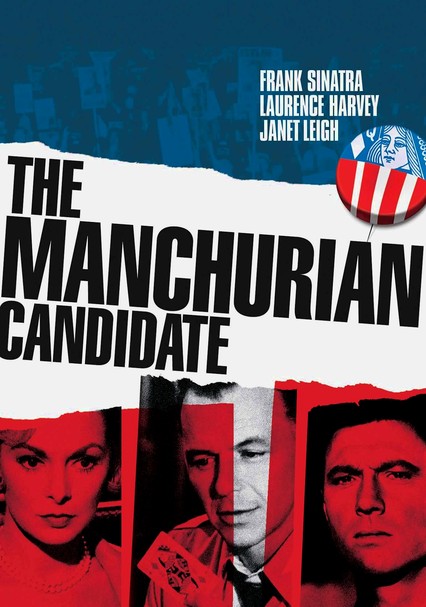
The Manchurian Candidate-1962
Director John Frankenheimer
Starring Frank Sinatra, Laurence Harvey, Janet Leigh
Top 250 Films #195
Scott’s Review #852
Reviewed January 3, 2019
Grade: A
The Manchurian Candidate (1962) is an enthralling film that perfectly captures the political landscape of its time and remains relevant to present-day politics.
Taut, mysterious, and filled with great twists and turns, the film flows smoothly and culminates in a shocking crescendo.
With compelling performances by all and a brilliant musical score, the film fires on all cylinders and can be watched and enjoyed repeatedly.
Events begin in 1952 during the bloody Korean War. A United States platoon consisting of several men is accosted by the Soviets and sent to communist China for experimentation.
Three days later, the men return as if nothing had happened, and Sergeant Raymond Shaw (Laurence Harvey) is hailed a hero and awarded the Medal of Honor for saving their lives.
When the war ended, the men returned to the United States to resume their everyday lives.
Years later, Captain Bennett Marco (Frank Sinatra) suffers from recurring nightmares in which Shaw murders two missing soldiers in front of a panel in a bizarre brainwashing demonstration.
When another soldier in the platoon has the same nightmares, Army Intelligence begins an investigation.
Further complicating the plot is Raymond’s ambitious mother, Eleanor Iselin (Angela Lansbury), and her attempt to use any means necessary to guide her husband, Senator Iselin (James Gregory), to further power.
The Manchurian Candidate is a film that requires attention to appreciate and understand.
The plot is highly complex, but that is a testament to the film’s composition and hardly a complaint. The viewer must stay on course to appreciate the intricate details.
Director John Frankenheimer is fantastic at adding unique dramatic effects and imaginative filmmaking.
A prime example is the brainwashing sequence, as dialogue is interspersed between what the soldiers think is happening (a peaceful grandmotherly horticulture demonstration) and reality (a dastardly experiment involving murder and programming).
Despite Sinatra being billed as the lead in the film, the most treasured props go to Lansbury as Eleanor and Harvey as Shaw. Raymond is the most developed character, with several sides.
He is primarily a loner who appears cold and harsh because he is programmed to assassinate.
A sequence involving the love of his life, Jocelyn (Leslie Parrish), and a romantic summer they share is beautiful and innocent, contrasting with the dismal and manufactured “new Raymond.”
Lansbury has never been cast in a more challenging role. Eleanor is determined to stop at nothing to ensure her husband reaches the presidency, and she connives and cheats her way to the top.
Still, the part is written this way to avoid making her a one-note character despite her ways.
In an eerie scene close to the finale, she vows payback for what has been done to Raymond and then plants an incestuous kiss on his lips. An odd and disturbing moment, the scene also, in her mind, justifies the lengths she has gone to get what she wants.
The musical score is lovely and contradicts the dour backstabbing and espionage throughout. Romantic and sweet melodies abound, and classic hymns like The Twelve Days of Christmas and The Star-Spangled Banner are included in the film.
As a result, The Manchurian Candidate’s score feels multi-faceted, patriotic, and artistic with enchanting results.
The Manchurian Candidate (1962) is a stellar film, blending thrills, deceit, politics, and creative filmmaking into a bold classic. The final sequence is jaw-dropping in its finality and brutality.
Remade in 2004 with a great cast but a poor script; avoid that one at all costs and enjoy the power and lasting effects of the original.
Oscar Nominations: Best Supporting Actress-Angela Lansbury, Best Film Editing
Golden Globe Nominations: 1 win- Best Director-Motion Picture-John Frankenheimer, Best Performance by an Actress in a Supporting Role in any Motion Picture-Angela Lansbury (won)