Category Archives: William Devane

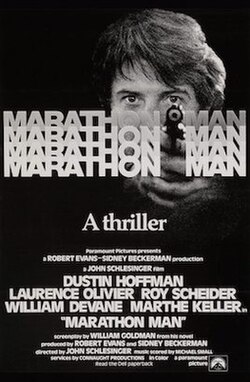
Marathon Man-1976

Marathon Man-1976

Director John Schlesinger

Starring Dustin Hoffman, Laurence Olivier, Roy Scheider

Scott’s Review #1,359
Reviewed April 29, 2023

Grade: A-

Writer William Goldman was involved in two politically charged, taut thrillers released in 1976 that can easily be watched back-to-back.

Fast-paced, rapidly edited, action-packed offerings are on the menu.

The Academy Award-winning All the President’s Men (1976) and Marathon Man (1976) are highly recommended, as they are in the same vein.

They are part of why I love 1970s cinema so much. Freedom and rich character development, combined with a sole vision, are admirable traits.

John Schlesinger, famous for Midnight Cowboy (1969) and other films, directs.

Both films are written by Goldman, and each stars actor Dustin Hoffman, so the similarities are endless. And yet, each has its own identity.

In Marathon Man, Thomas “Babe” Levy (Hoffman) is a Columbia graduate student and long-distance runner, residing in New York City. His older brother, Doc (Roy Scheider), is a government agent chasing down a Nazi war criminal named Szell (Laurence Olivier).

Babe does not know Doc’s career until a tragic event draws him into a plot involving stolen gems and sadistic madmen. Even his girlfriend, Elsa (Marthe Keller), becomes a suspect as everything Babe believes is suddenly turned upside down.

At over two hours, there is not a slow moment in the film.

We meet Babe as he runs through New York City, so the audience learns that his obsession with running may be linked to his need to escape something.

This proves to be true when we learn the brother’s father committed suicide after being investigated during the Joseph McCarthy era, when civilians were suspected and accused of being communists.

So, the backstory made me sympathize with Babe and Doc and fleshed them out as characters. Hoffman and Scheider are superb and show the nuances in the brothers’ personalities. Doc is sophisticated, and Babe is common, though highly intelligent.

The musical score, created by Michael Small, must be mentioned. Oftentimes in film, the score serves as more or less ‘background music’ and can go unnoticed. This is not the case in Marathon Man, and I noticed several times the music-enhancing sequences, especially when peril was involved.

I was pleased to learn that the iconic Laurence Olivier plays the villain, Szell, in the film. He is believable as a vicious German Nazi who specializes in a unique brand of dental work.

First blonde and then bald, the physical nature of the role is showcased. He also calmly performs torturous tactics using dental tools.

Marathon Man is made up of a series of scenes that will either enthrall, make the audience squirm, or, in some cases, both.

Speaking of dental work, any viewer who has a phobia or dislike of going to the dentist may want to fast-forward past the sequence in which Babe is forced to endure some stylized poking and prodding. Szell and his henchmen are convinced that Babe knows more than he is letting on and are determined to make him reveal all.

Early on, a terrifying scene centering on road rage in Manhattan is as good as it gets and reveals the gist of the plot. Nazis, anti-semitism, and a fiery gasoline truck encompass a speedy and argumentative car chase scene.

The sequence is heart-racing, nail-biting, and revealing.

Others flesh out the film like a quiet lunch at a lovely French restaurant. Doc takes Babe and Elsa out where they dine on lavish courses of creamy, sophisticated cuisine and wine. The richness of the food and culture enhances the earlier scenes set in Paris.

The final thirty minutes of Marathon Man are the best part. A series of shootouts in the suburban rural farmland and foot chases in downtown Manhattan culminate in a showdown between Babe and Szell near a water tank in Central Park.

A strong appeal for viewers is experiencing scene after scene in New York City, as many exteriors were shot there.

The plot of Marathon Man (1976) is sometimes too complicated, and not all events add up satisfactorily. The who’s who and realism are a tough sell, but it hardly matters. The film entertains and is a high-energy thrill ride, and that is more than enough for me.

Oscar Nominations: Best Supporting Actor-Laurence Olivier
The Dark Knight Rises-2012

The Dark Knight Rises-2012

Director Christopher Nolan

Starring Christian Bale, Tom Hardy

Scott’s Review #431

70213514

Reviewed June 23, 2016

Grade: C+

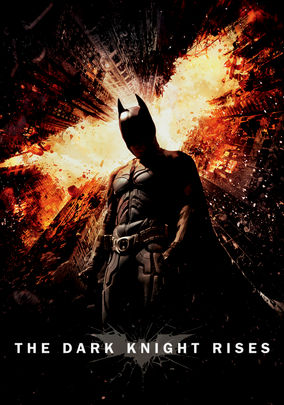
The Dark Knight Rises (2012) is a sequel to the exceptional The Dark Knight from 2008 and, unfortunately,  is a complete letdown, especially compared to that film.

Perhaps my expectations were too lofty- it is a sequel after all, and sequels, typically disappoint.

To be fair, the film looks great and has a fast-paced, modern feel- slick and action-packed. A summer popcorn film.

The story, though, is uninteresting- the villains are not compelling, which is a major miss in a film like this where the villains are crucial.

Tom Hardy as Bane is miscast. Anne Hathaway’s Catwoman is underdeveloped and one-dimensional. We never really know much about what makes these characters tick.

I did enjoy the twist at the end involving Marion Cotillard, which impressed me and I did not see coming throughout the story.

I might have rated The Dark Knight Rises even lower than a C+ had it not been for the group of top-notch actors appearing in the film.

Having loved the most recent Batman film, I expected more and received less.

Interstellar-2014

Interstellar-2014

Director Christopher Nolan

Starring Matthew McConaughey, Jessica Chastain

Scott’s Review #277

70305903

Reviewed September 25, 2015

Grade: B-

Interstellar (2014) is an interesting film to review.

Science-fiction/futuristic epic with a run time of nearly three hours and is complex and intricate. It is the latest offering by director Christopher Nolan.

I cannot say I loved the film, however, I did appreciate and marvel at the visual and technical aspects of it, which completely usurps the convoluted plot, made difficult to follow due to changing worlds and galaxies.

The film reminds me of Inception (2010) with an obvious homage to 2001: A Space Odyssey (1968), the former directed by Nolan, but not quite as compelling from a story point of view as Inception was.

The complexities of different entities, worlds, and layers of worlds are featured and admittedly, mind-blowing, which is the weak part of the film.

Making the film arguably too intelligent, it loses the audience’s attention.

By too intelligent, I mean too complex. As I review the film, I see two halves-the story side and the visual side. In Interstellar, both are essential components and one fails and one marvels.

The story goes something like this. Matthew McConaughey plays Cooper, a widowed, former space expert stuck in a small town in the mid-west, where he begrudgingly runs a farm, living out an unsatisfying existence.

The Earth’s food and crops are slowly running out and the planet is dying. His two children, daughter Murphy and son Tom face a bleak world.

One day, a dust pattern with coordinates leads Cooper and Murphy to a secret NASA team intent on finding other worlds and attempting to save Earth. The team is led by Dr. Brand, a college professor, and science wizard, played by Michael Caine.

Cooper, naturally, is chosen to lead the venture, which could take him away from his family for years. He accepts much to Murphy’s chagrin. Once in outer space- assisted by Amelia Brand (Dr. Brand’s daughter), the team embarks on an endless mission leading them to different planets and one strange encounter with a rebel astronaut (played wastefully by Matt Damon).

Years later (on earth anyway) Murphy and Tom (now grown and played by Jessica Chastain and Casey Affleck) assume their father Cooper is dead.

Critically, the story is way too much to comprehend. I let go of the story instead of focusing on the visual spectacle I was treated to.

The plot eventually meanders off track as the team traverses through a space wormhole created by an alien intelligence and travels fifty years without aging. Life has gone on over planet Earth. Some characters age, others do not.

To summarize, the story is convoluted and impossible to follow.

Speaking of the story side of Interstellar, the writing contains an irritating wholesomeness, especially in the early stages- pre-outer space.

McConaughey was given this tough, machismo side to him that screams of Hollywood traditionalism- almost like “I am a man- I save the family”. Haven’t we seen this too many times in film?

I also found the relationship between Cooper and his young daughter Murphy incredibly saccharine and screamed of Hollywood schmaltz.

McConaughey was given and succeeded in delivering, one great crying scene.

The visual aspect of Interstellar is a spectacle and much, much better than the story, especially during the final third of the film. The sheer grandeur is astounding. When the crew lands on Miller’s planet, an ocean world, a great tidal wave topples their space ship killing one of the team.

The massive look of the tidal wave is monumental in size and ferocity. Later, when the crew lands on an icy planet, the immense coldness and shape of the planet work perfectly and one feels like they are in outer space.

How inventive and creative is the scene where Cooper attempts to contact a character through a bookshelf. The scene is set up like a maze with different periods, colors, and shapes, seemingly blending is very impressive and artistic.

Visually speaking, Interstellar has some similarities to the 1968 epic 2001: A Space Odyssey. Grandiose, artistic, experimental, and epic along with the obvious space theme allow the two films to be compared.

However, where 2001: A Space Odyssey was about life and contains a clear and powerful message, I did not find the same with Interstellar. Instead, I did not find a message, only a confusing story, mixed with spectacular visuals.

Oscar Nominations: 1 win-Best Original Score, Best Sound Editing, Best Sound Mixing, Best Production Design, Best Visual Effects (won)

Family Plot-1976

Family Plot-1976

Director Alfred Hitchcock

Starring Bruce Dern, Karen Black

Scott’s Review #99

Reviewed July 9, 2014

Grade: B

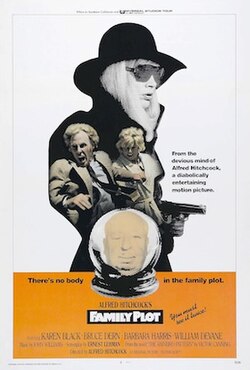
Family Plot is sadly Alfred Hitchcock’s final film, made in 1976.

It is certainly not one of his greats, but not bad either, and a fitting way for a viewer to conclude his career.

The film is a jewel caper and has a vastly different feel from many of his other, earlier films. It has a slick quality to it and is reminiscent of a 1970s television movie, which is not a knock.

It simply feels more television-like than film, which could be because it stars notable television stars, William Devane and Katherine Helman.

It also features some big film stars of the time- Karen Black, Bruce Dern, and Barbara Harris.

The film is a departure from other Hitchcock films in that it is a macabre comedy. It is a tongue-in-cheek story of a fake psychic (Harris) and her boyfriend (Dern) who become involved in a search for a missing heir, a jewel heist, and a murder.

All of the characters intersect as the film moves along, and it contains some nice Hitchcock elements- the speeding car with no brakes down a hilly road is pure Hitchcock.

The film, for me, has a slightly melancholy feel, as it is, sadly, Hitchcock’s final farewell.